Ornament and Crime; Raumplan
After the publication of Memar 128, with the subject of "Adolf Loos and the Art of Architecture...," this is the second issue devoted to this great architect-artist. While we were preparing Memar 128, we unfortunately could not find a reliable translation of his essays in English. Access to the book Ornament and Crime, translated by Adolf Loos — translated into English by Stewart White, who is a respected translator from German — particularly in view of the afterword by Joseph Masheck, one of the most distinguished critics and analysts of Loos and his era, who in his brilliant afterword refers to Loos's essays and has evidently reviewed the English translation, gave us greater confidence in rendering this selection of Loos's essays. It is obvious that no criticism or analysis can substitute for the works and writings of great artists and architects; the best critic in principle "analyzes," whereas great architects and artists — like poets — are people of "synthesis." Memar 128 was largely about his works and his role in architecture and art, but in this issue, by translating and publishing seven of Adolf Loos's own essays, the reader is brought into direct contact with his ideas. Loos is known for two things: first, the controversial essay "Ornament and Crime"; second, his architectural vision known as the Raumplan (spatial plan), which is less well known and has attracted less attention, though it may be one of his most important contributions to architecture.
Ornament and Crime · Compared with the other great architects of the first generation of modern architecture, schools and architectural circles pay relatively little attention to Adolf Loos, and attention to Loos tends to focus on the essay "Ornament and Crime," which has been approached in an extremely superficial manner — perhaps due to Loos's remarks about non-European indigenous peoples and Austrian peasants, which have not been politically correct in recent decades. Nevertheless, in a curious way the title of the essay remains lodged in the student's subconscious (especially in Iran, where it has become known under the headline "Ornament is Crime"), and in professional life, whenever one wishes to combine a pattern, form, or color with a structure or cladding, the student's enthusiasm for the necessity of such an action is unconsciously suppressed, as though one were about to commit a "crime."
Raumplan (Spatial Plan) · His architectural vision, known as the Raumplan, has likewise been overshadowed by the controversies over ornament. On this matter too, what Loos himself says is most eloquent: "My architecture is conceived not in plans but in spaces (volumes). I do not design floor plans, facades, and sections. I design spaces. For me, there is no such thing as a ground floor, a first floor, and so on... There are only continuous and sequential spaces, rooms, antechambers, terraces, and so on. Floors merge and spaces connect with one another. Every space demands a different height: the dining room is certainly higher than the pantry, therefore the ceilings are at different levels. The connection of these spaces is such that the rise and fall (the difference in level) is not only imperceptible but also useful; in this [approach] I see something that is a great mystery to others, whereas for me it is entirely natural and self-evident." And: "But the artist, the architect, first senses the effect he wishes to create and then with the mind's eye sees the spaces he wishes to bring into being. The effect he wants to produce on the beholder — whether terror, whether dread, as in a prison; fear of God, as in a church; reverence for the power of the state, as in a government building; piety, as in a funerary monument; comfort, as in a residence; conviviality, as in a tavern — the cause of this effect is matter and form." What is said here from Loos regarding architecture, or the "secret" he speaks of, is not specific to Loos or modern architecture; it was something that great architects and artists had in mind from the beginning of history — that through their architecture they wish to produce a certain effect upon the human being. Loos places little emphasis on beauty per se and concentrates more on the emotional-sensory effects of architecture. The "secret" poses an unanswered question that still accompanies the human being: what combination of effects makes something "beautiful" is yet another unsolved "mystery."
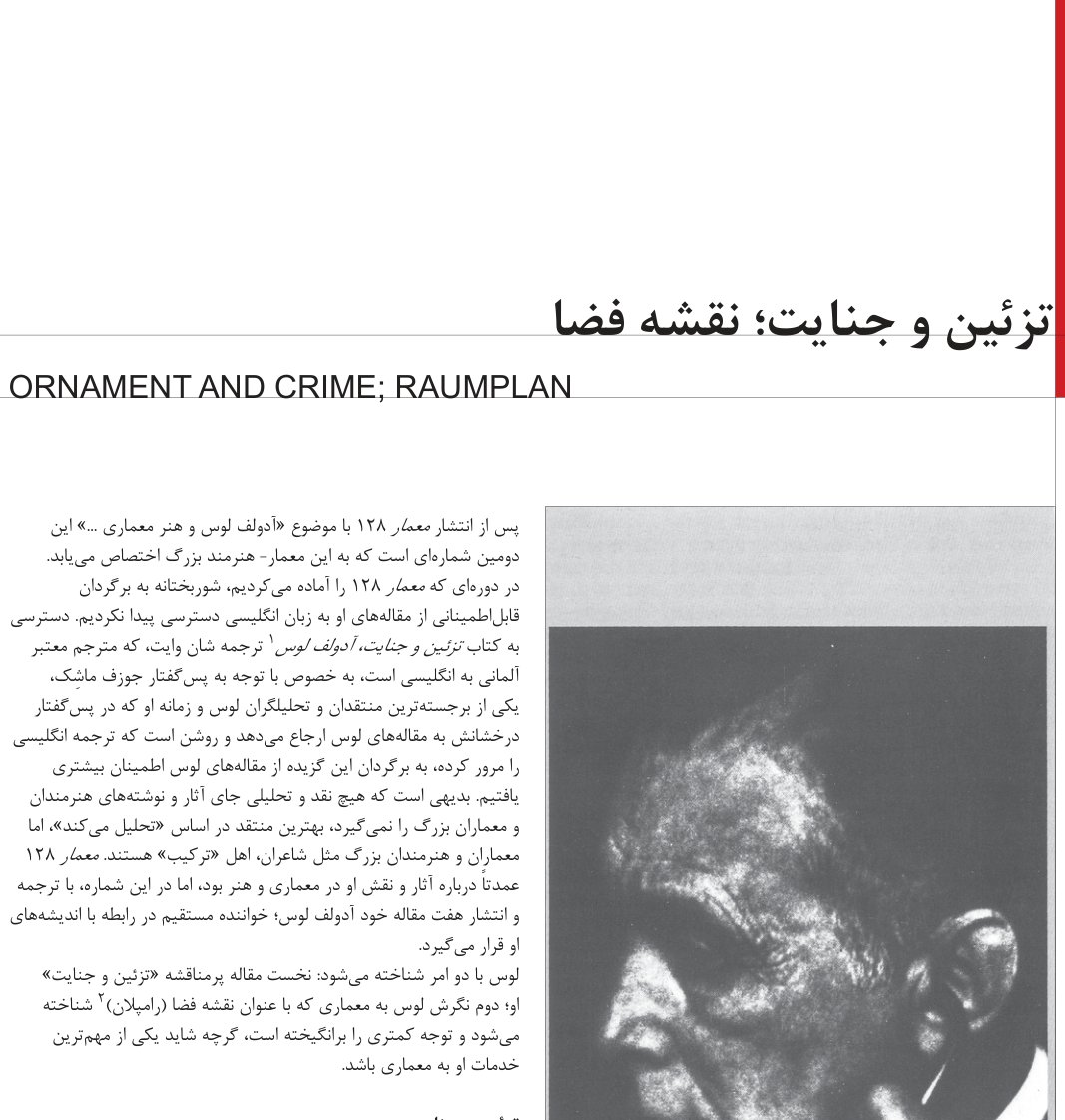
Adolf Loos (1870–1933)
Editor's Note · Editor's Note
American Bar, Vienna, Austria, 1908
For further reading, refer to Memar 128. — Some of Adolf Loos's most influential works
Horner House, Vienna, 1913 · Müller House, Vienna, 1928 · Moller House, Prague, 1930
Loos House, Vienna, 1909–1911 · Scheu House, Vienna, 1912
Notes: 2 — Raum, in German, means both "space" and "room"; culture and above all language influence the work of the architect and artist. How language in general (here, the double-meaning word raum) affects the work of the architect could be the subject of an interesting study. White
3 — Politically correct. 4 — Adolf Loos's Raumplan seems to have been influential in Iranian architecture during the 1320s and 1330s [solar]; apparently it was referred to in that period as the "broken cross-section." It is obvious that reducing the Raumplan to a "broken cross-section" was the result of an incomplete understanding of Loos's thought. 5 — These sentences are from an untitled text by Adolf Loos dated approximately 1930; this text appeared first in Glück's monograph on Adolf Loos and subsequently in the collected works of Loos: Adolf Loos, Sämtliche Schriften, Glück. 6 — Taken from the essay "The Principle of Cladding," 1898, which appears in this same issue.