O sky, you are mine and you are not the sky, unless my small wings cleave your breast... (Juan Ramón Jiménez)
Where is the Tehran that we love? Where in this sprawling, boundless city are the inherent natural and historical values of Tehran hidden? Perhaps the whole pain lies in the fact that fewer and fewer people truly know Tehran and hold it dear. Many young architects do not even know where Shams ol-Emareh is! When my old friend — Soheila Beski — said: "You who complain so much, come and organize an issue of Memar about Tehran and its values," I felt that the time had come to take the criticisms seriously and formulate them, to also appreciate the good and clear initiatives, and to persist in this endeavor until the entire cultural community of Tehran — architects and artists, officials, builders, and associations interested in quality of life in the city of Tehran — gradually becomes involved in this movement. Of course, we have recently witnessed signs of such movements in the press and other specialized publications, and special issues devoted to Tehran occasionally attract attention. In this issue, I wanted to address or at least reference all the natural and historical values of Tehran — from the Alborz mountain range and the seven valleys (Darband, Darakeh, and others) as the valuable ecological axes of our city, the valuable villages of the northern districts, as well as the historical sites and buildings of the city — from the city of Rey to the Reza Shah-era factories along the Fadaiyan-e Eslam axis. We also intended to dedicate pages to the literature and poetry related to Tehran. However, due to lack of space, we were compelled to limit the material to Naseri Tehran — that is, old Tehran and the approaches and examples of dealing with it in the domains of urbanism and architecture. And now to the main point. Perhaps it is best to say the last word first: "If it does not matter to us that all the historical fabrics of central Tehran are leveled to the ground and no trace of the old city remains — a city that has been prosperous since the time of Shah Tahmasp and has functioned as the country's capital for two hundred years — or does not remain, then we had better come to a consensus sooner. Let us declare the issue and stop spending so much time, money, and sensitivity on this matter" [article by Eskandar Mokhtari]. There are great capitals in the world — such as Cairo — that have not been successful in preserving the authentic character of their city, but they did not have the material and moral capacity for this task, and we do! So if it matters to us, we had better exercise greater care in our path and method. Of course, the first step is knowledge. I, who thought that after years of professional work on this city I knew its ins and outs well, realized while talking and gathering material from friends and acquaintances during the autumn and winter of 2011 how little I knew about my city. Today's Tehran, despite its population of several million, is a "provincial" and even "rural" metropolis [article by Mohammad Beheshti] whose civic culture and architectural heritage are rapidly disappearing. Moreover, Tehran as
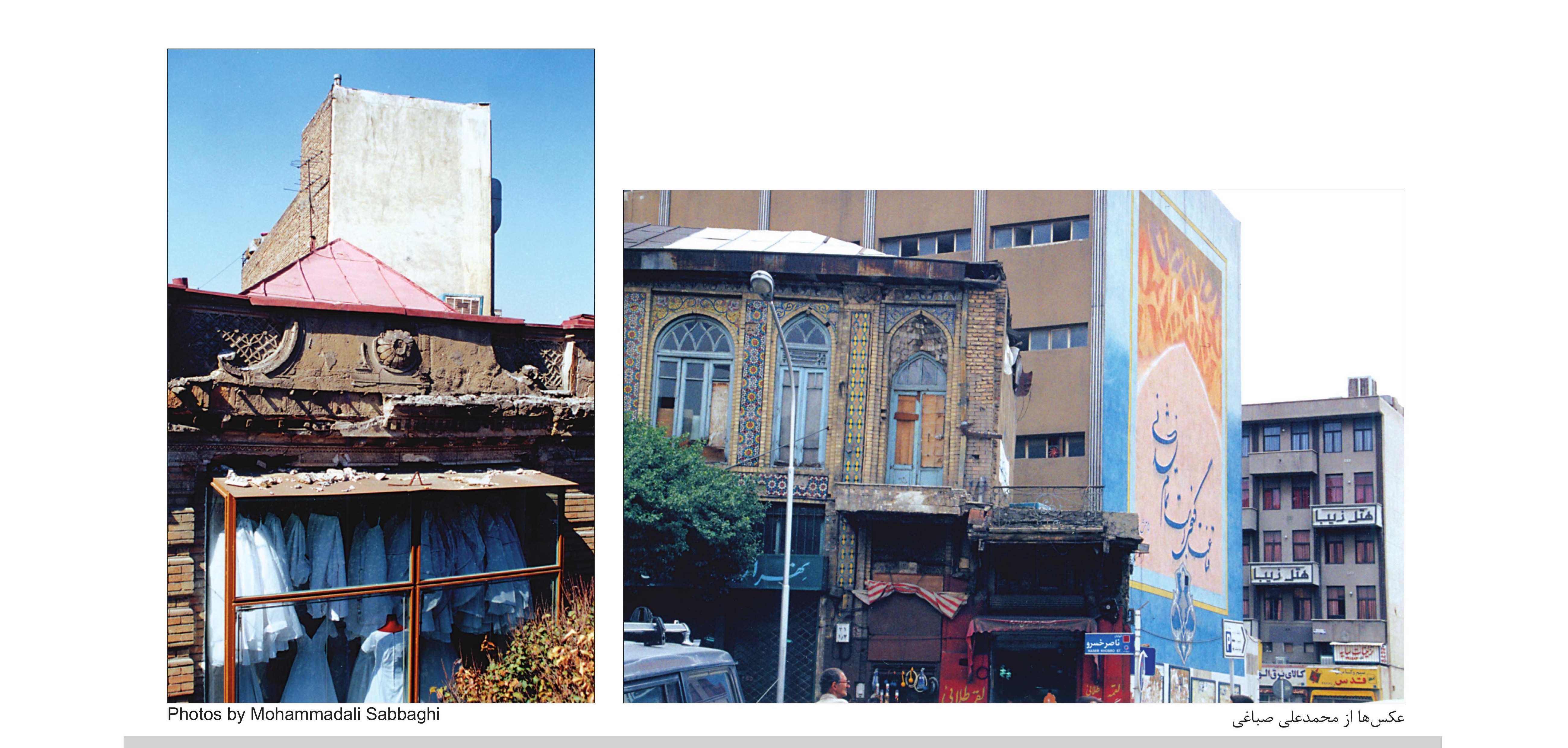
an interconnected spatial ensemble does not function, although relative consolidation based on its original authenticity would be possible. So if we do not know Tehran precisely and are not aware of its characteristics and problems, we will never be able, as interested architects and urban planners, to intervene effectively in its transformation. The second step is raising awareness, persistence, and action. Today, the funds that Tehran's municipality obtains from selling density bonuses — at the cost of creating problems for some neighborhoods and at the city's expense — are spent generously and sometimes squandered. The municipality has still not realized that the more roads, highways, and streets it opens and widens, the worse the traffic problem becomes, and the more inappropriate density it sells — as it has sold to date in the valuable foothill villages and other northern Tehran neighborhoods — the more tangled this confusion will become. Construction, even in sensitive areas of our historic city, is mostly carried out by those who on the whole care nothing about the composition of the city and the beauty of its landscape. These people, for whatever reason, do not know the city of Tehran, read little, are not up to date in terms of science and art, work through connections in giving and receiving projects, and since they have a monopoly over the work, compliance with standards in their output is not controlled or supervised. Proper steering mechanisms have not yet been properly formed in the government and the municipality. Let us not even speak of the rapid changes in high-responsibility and sensitive positions, which cause the thread of management to become sluggish and fragmented. Numerous plans are prepared but never properly brought to fruition. This chaotic and regressive course of urban development — in which severe disregard for the city as a whole and the public interests of citizens, and shortsighted movement to serve the interests of the privileged and tasteless investors, torments every observer — has had and will have no result other than severe unsustainability! The contradictory movements currently underway in the city are noteworthy. On one hand, the authentic and beautiful old buildings belonging to the Qajar and first Pahlavi periods [article by Dr. Eskandar Mokhtari] are being demolished one by one, and on the other hand, a kind of stamped-out architecture and pseudo-traditionalism using gratuitous arches and brick and tile decorations is being promoted, which resembles set decoration more than architecture [interview with Engineer Khoshfekri]. Is this not the result of ignorance of values? Perhaps the time has come for Tehran's municipality to cast half a glance at the quality of work being done in the city.
"Old Tehran" still has no institutional existence! In a metropolis as vast as our city, there is always talk of Tehran's bazaar, but the name of District 12, as the living and beautiful center of the city of Tehran, does not form a particular image in the mind of Tehran's citizens, because for years the spirit of centrality has departed from it and has constantly moved toward the more northern reaches of the city, to the point where the next step is the summit of Tochal, which fortunately still does not have a completed vehicular road. Conversely, right in the heart of the city, in the grounds of Bagh-e Melli, which for years was a bustling space with foot traffic, and even had a water channel and fountain, after it was restored and the University of Art also came there to promise vitality, iron railings blocked even pedestrian passage, and today the entirety of this beautiful and expensively finished space is desolate. For us, "revitalization" is an unfamiliar word, and the improvement and rehabilitation of Tehran's authentic and old fabrics such as Oudlajan and Sangalaj are also foreign ideas for which plans have been prepared, but there is no hope for their realization [article by Fariborz Jabbarnia on Sangalaj]. Furthermore, a series of measures only acquire meaning alongside one another and with a comprehensive outlook — measures that take shape around a common ground and mindset: the restoration of buildings, bazaarcheh, timcheh, bazaar rows, the revitalization of old houses and neighborhoods for new uses, alongside the possibility of walking in the city, and the return of certain activities and residences and the launching of high-level tourism in suitable locations in the city center, will acquire meaning. Tehran's municipality recognizes these needs, but an "Office of Old Tehran" or a "Historic Tehran Municipality" or something similar has not yet been established in Tehran. No one even speaks of historic Tehran at all. Instead, each month a conference is held about the issues of the city of Tehran, which incidentally relates to authentic old Tehran. The municipality's Beautification Organization, through the efforts of interested and active friends, welcomes discussions such as the conceptual evolution of the urban landscape, pedestrian-way construction throughout the city, arts, design, and urban furniture, but practical actions in this direction are slow and uncoordinated. Of course, the sidewalk-construction movement in Tehran that began a few years ago should be appreciated here! But in general, Tehran's urban landscape, despite costly construction, grows uglier by the day, and the architectural committees of districts — as guardians and controllers of authorized construction in the city — are not active east of the Kan River and do not supervise, because the municipality's economic issues overshadow everything. The main problem is perhaps Tehran's municipality not seeking the government's help for implementing foundational projects such as the "Tehran Metro" and other vital and important projects such as the "Revitalization of Tehran's Historic Center." It should be noted that these two projects are in fact two sides of the same coin! Without iron therapy, the city will not become "pedestrian"!
Double standards. In the zoning regulations approved in the new detailed plan — that is, the regulations that determine the amount of authorized construction in every part of the city of Tehran — for "activity zones, service functions at urban and supra-urban scale," which mostly have commercial-administrative functions and are situated alongside the city's main and arterial streets, buildings of nine stories and sometimes towers of twelve stories and more have been declared permissible. Given the land prices in these expensive strips, the presence of real and public services — for instance, public educational and medical services — in this functional category will become more faint by the day, and already even some government agencies have begun selling their well-located lands. In effect, this regulation means that along all of Tehran's main streets, private and public investors and builders will be able to build tall commercial and administrative buildings in the future. Wonderful indeed! And God willing, this will also bestow character and identity upon many of our city's streets, especially in the newly built and modern areas. But when the discussion turns to issuing these permits for the main streets of Tehran's city center, whose physical form is established and whose existing street-front buildings are two to four stories, the story becomes contradictory, and quite simply, after these new commercial-administrative centers are built, the sometimes historic and valuable old buildings on these streets — which constitute Tehran's identity documents — will inevitably be demolished and rebuilt. On the other hand, although Tehran's municipality has affectionately purchased and restored several old houses and uses them, at present the only governmental and public body that is legally "responsible" for the protection of valuable buildings is
the Cultural Heritage and Tourism Organization, which practically no longer has even an effective presence in the city of Tehran — since it has been relocated to Shiraz — let alone possessing government budget for saving old and heritage houses and buildings. This organization has been condemned multiple times in the past year by the Administrative Court of Justice to acquiesce in the removal of registered houses from the Cultural Heritage Organization's list of registered monuments. We hope, of course, that this trend ends here and that a remedy and rule is sought for it. Meanwhile, experts from District 12's municipality reassure us that special regulations have been devised for old Tehran that have not yet been approved, but have in any case become established in the urban planning deputy of this district over the past year or two, and it is clear to them that, for example, on Ferdowsi Street, tall towers are not to be built along the entire street front. But the evidence testifies to other tendencies, which are also interesting: for instance, we have new proposals for high-rise construction, not on the main street fronts, but inside the blocks and in the rear layers behind the main fronts on Lalezar and Jomhouri streets, which, after the experience of the pointed-peaked towers of northern Tehran, could become another novel experience unique to the city of Tehran. What is certain is that every beautiful building gives identity to the city. But who determines the criteria for beauty and harmony? Today's large and powerful capitalists and speculators of Tehran consider these technical efforts in the domain of urban legislation futile. Just take a look at the twin facades of the Aladdin buildings at Jomhouri-Hafez intersection, which are planned to be replicated in chain form throughout Greater Tehran! Perhaps Tehran is the most expensive city in the world. Capital in this city is young and unstudied. It seeks a place and activity that yields quick returns and is safe, where accumulation happens greatly and rapidly. It does not matter whether the building's safety against earthquakes and fire is sound, whether energy is consumed optimally, whether the building has a long lifespan, whether it is compatible with the environment, or how its maintenance and upkeep during operation is managed. Today all investors favor large commercial buildings, and for the time being, out of indifference, land in our city's neglected center is cheaper than anywhere else. They openly mobilize everything and everyone for building their own projects: they remove historic buildings from the Cultural Heritage registration list, build as many stories as they wish wherever they please in the city, and occupy one hundred percent of the lot area. Thus, wherever there is a sign and memory of historic Tehran, it is rapidly heading toward obliteration and destruction [article by Shahrzad Mahdavi]. But it should be recalled that the responsibility for these actions lies not with these builders, but with the professional community and city officials who do not properly play their role in determining and guiding construction. Recently, a large number of journalists, cultural heritage enthusiasts, and lovers of old Tehran have written a letter to Mr. Ghalibaf, Tehran's mayor, and have asked him about the events unfolding in historic Tehran, and have warned him that the demolition of houses such as the registered monument "Ettehadieh House" — the setting of the television series "My Uncle Napoleon" — will uncontrollably trigger a flood of historic building demolitions, and they have rebuked him for the municipality's encouraging role — albeit indirect — in such demolitions. In reality, this is a cultural and multifaceted issue. Fundamentally, it is the owners of historic houses who step forward and voluntarily sell the houses, because they no longer have any interest in preserving them, nor are they able to resolve inheritance issues, nor do the law and the municipality offer the heirs a new avenue for generating income while preserving the building. Dr. Hojat, the president of ICOMOS Iran, says the Cultural Heritage Organization and the Administrative Court of Justice must have legal tools in their budgets for satisfying the owners of historic houses, such that either historic buildings are purchased, or their owners are somehow satisfied. On the ICOMOS website, he refers to Tehran's municipality
as seemingly standing behind the door of the Administrative Court of Justice, ready to immediately place the construction permit in the hands of the complaining owner and earn revenue by selling density bonuses. But how long will such unsustainable revenues cover the costs of our city?
The authority of the profession, the resolve of the municipality, or both? In response to my expression of concern, Iraj Kalantari — a grand figure of the architectural professional community — says: "Our standing has declined and we no longer hold authority over the professional community." He, who in his architecture has always sought an authentic and vernacular stamp, complains that the consultants' community has lost the power of selection, listing, and sanctions, and referring to the dissolution of the Management Organization, the entry of new consultants, and the young architects who graduate each year from the country's 430 architecture schools and flood the job market, he says: "These people know no tariffs, laws, or regulations." Consequently, everyone is free to place anything anywhere in the city, next to anything else, and so to speak, engage in "creation" and "innovation." The result is: ghormeh sabzi pizza!
Making up for past neglect. In the past, urban planners would draw a line around the problematic historic fabrics when preparing the comprehensive plan, to be addressed at "another opportunity," and in effect regarded the old fabric as a black hole. Perhaps at that time they lacked the patience, budget, and time to address it. But today, after years of neglect, the time has come, and since we Iranians are among the last in the world in this regard, our task is also easier! Because it suffices to observe others and learn! Nevertheless, now that the entire peripheral zones of our cities have come under construction and it is the turn to attend to and organize the historic centers of cities, we see that in the domain of urbanism we practically lack the appropriate urban planning and architectural tools for confronting the financial, legal, social, economic, and other problems in the field of improving and renovating historic fabrics. Who should write these tools — which include special urban planning regulations for construction and various legal provisions for encouraging the owners of valuable buildings to preserve and restore their buildings and houses — other than the experts of this very field? (Of course, with the help of economists, lawyers, and others.) And who should stand firm and insist that a solution be found for each of these impasses? If our specialists confuse their technical and professional burden of responsibility with the heavy financial burden of responsibility borne by the municipality for the city's daily administration, this zeal beyond one's station will result in nothing but negligence and carelessness that obscures the problem itself.
We have only ourselves to blame! The behavior of our professional community toward historic Tehran has been as follows: 412 historic buildings have been registered for Tehran on the Cultural Heritage Organization's list over the years. The Heritage Organization had identified approximately 5,000 historic buildings (mostly private houses) several years ago for registration, but these buildings have mostly been demolished in recent years, and of them probably around 1,000 buildings still remain, awaiting historic registration with the Heritage Organization. A series of buildings were also identified by the consultants of regional detailed plans themselves during the 2000s, in the course of preparing detailed plans, which primarily possess valuable architectural elements. In any case, the manner of registering these buildings on maps, as well as the quantity and quality of the information declared, varies across districts and is
inconsistent. A small number of these buildings have been restored to date by the Heritage Organization and the government, the municipality, and the private sector [articles by Faramarz Parsi, Sohrab Soroushiani, Mehrdad Bahmani, and others], some of which are introduced and critiqued in this issue of Memar. Of course, plans from an urban design perspective and in the field of urban public spaces have also been prepared for all of Naseri Tehran and for each of its important streets individually, but virtually all are ignored, and new plans for the same streets and squares are commissioned, whose superiority over the previous ones is by no means established [article "Lalezar" by Maryam Mirzaei]. Consequently, we face a kind of chaos which, before being a sign of disorder among the involved experts, is a sign of the entire urban planning system's disregard for the issue of historic fabrics, and is in its own way extremely dangerous. Because although the demolition of a single residential building may not by itself harm the entire old fabric, if all old buildings are gradually demolished over the next five years under the pretext of being dilapidated and privately owned and so on, then by the time we come to our senses it will be too late and regret will be of no use... .
Effective city council resolutions. For more than two years, the groundwork for the municipality's activity around the resolution on "determining economic policies, attracting private sector participation in the preservation and revitalization of historic sites," adopted by Tehran's City Council, has been slowly taking shape. This resolution, which has a precedent under the title of the resolution on "how Tehran's municipality should participate in organizing the city of Tehran's historical, religious, and cultural fabric" (April 2005), has obligated the municipality to organize the city's historic fabric and preserve and revitalize existing historic spaces. But the story is still not serious.
What can be done? If Tehran's municipality puts resolve and will into this path, the practical process of gentrification must begin with the current residents and owners who will slowly become involved in the process of rehabilitation and improvement in the historic fabrics of Oudlajan and Sangalaj. On the demolished lands within these fabrics, we also hope that gradually valuable and high-quality new buildings, harmonious with the character of the fabric, will be built. But it is clear that with the revaluation of these central areas of Tehran, many of the current residents and tenants may gradually sell their homes or leave the area, and the class composition of residents will naturally change — as has happened in many similar cases around the world. It is obvious that being in a "central location," in a city with suffocating traffic, and gentrifying fabrics where "pedestrian life" can once again be delightful, adds to values; moreover, transforming the central areas of the city, where activity and employment are concentrated, into accessible and well-equipped environments (metro and complete services) can become so attractive that in the city center, particularly in Tehran, it creates momentum toward attracting affluent classes and special groups (for instance, bazaar merchants, students, or artists) for work and residence. If we accept this idea, the issue of attracting investment and the necessity of planning for the resettlement of middle-to-upper-income classes in Tehran's central areas can easily be raised and gain traction! And this will be the beginning of the renewed prosperity of old Tehran.
* Yalda Traneh is an architect and urban planner, a graduate of architecture and urbanism from Turin and Paris, who has been involved in urban plans for Iranian cities for 30 years and has worked on urban plans for the city of Tehran since 2004. Her activity throughout all these years has also included writing articles and criticism about urban events.