"Since treasure lies hidden in the world, grieve not / Regard no ruin as devoid of treasure" — Rumi
The Guest
Imagine a celebration or gathering in the small home of a family in Isfahan. A modest yet dignified house with a courtyard open to the sky, where a small family spends their time in joy and tranquility, and will warmly welcome travelers who, upon entering the home, are called "guests." Everything is arranged with care, and everyone is at work for the guests' arrival. For our Isfahani family, the guest holds a position of great honor — called the beloved of God — and is expected to spend a few short days with us, to participate in a gathering held in celebration of their presence, and to carry away a pleasant memory. The guests of this house are like temporary members of our family. Members who, together and not merely alongside one another, are shared creators of the experience of "being." Our Isfahani family considers "hospitality" a noble virtue, for they find their own happiness in the happiness of others.
The House
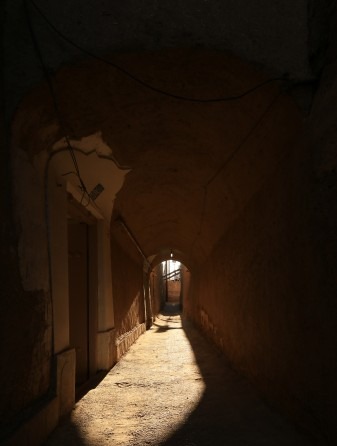
When we first encountered it, little more than a dejected ruin remained of the house. The house stood in a historic neighborhood, in the middle of a narrow alley too tight for cars to pass. It was astonishing how this alley had survived the unbridled ravages of our time. The door of the house lay beneath a sabat, with a window above watching over the alley. The Qaeli family — a father and two sons — had purchased this ruin at a negligible price on the suggestion of a benevolent friend, hoping that one day, through demolition and reconstruction, it would both provide an investment for the children's future and serve as a place to host guests who came from other cities and stayed for a few days. But thanks to the alley and neighbors who had not yet squandered their historical assets, demolition and reconstruction would not only yield no profit but would also forfeit even this meager area due to street-widening setbacks and the thousand-and-one tales of the municipality and fire department.
The house belonged to a later period but possessed valuable spatial qualities and features. Although it lacked the elaborate ornament of the city's elite residences, this very simplicity and restraint provided a delightful calm and silence. It was clear to us that the indifference of ages had hidden the house's vibrant face behind a mask of old age, and it needed a thorough cleansing. The house's appearance told us it belonged to the lower ranks of society, though it was unclear what had befallen it over the years. Our house had opened its eyes to existence in a different atmosphere — days when families still lived gathered around one another and porticos and shah-neshins hosted them — yet apparently in our house there was no shah to warrant a shah-neshin.
The Guesthouse
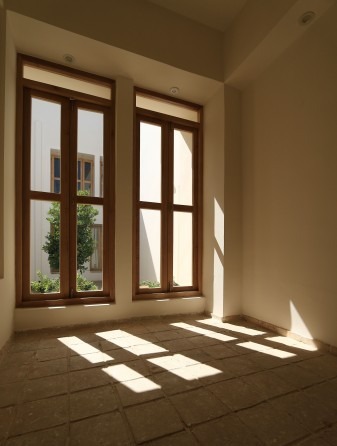
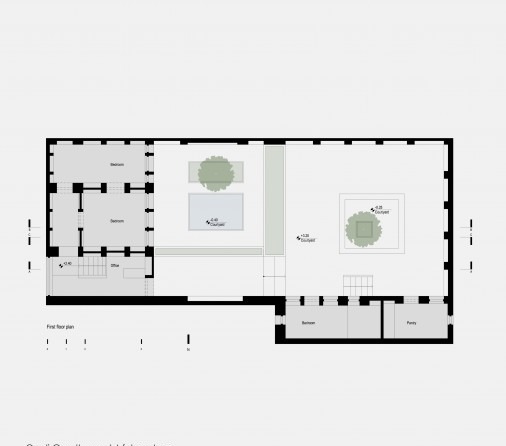
The house consisted of two east-west sections separated by a central courtyard. Two stories in the western section and one story in the eastern section. The four rooms of the house were stacked in the taller section, accessible after the courtyard through a corridor and a straight staircase to the upper floor. A notable feature of the rooms was a wall with a door at their center, allowing both rooms to merge into a single, more spacious space when the doors were opened. In Iranian architectural tradition, large rooms — the so-called five-door rooms — could be subdivided into smaller three-door and two-door rooms, and vice versa.
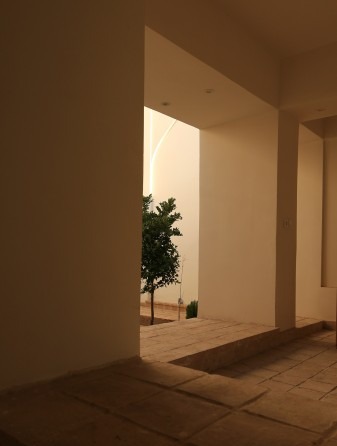
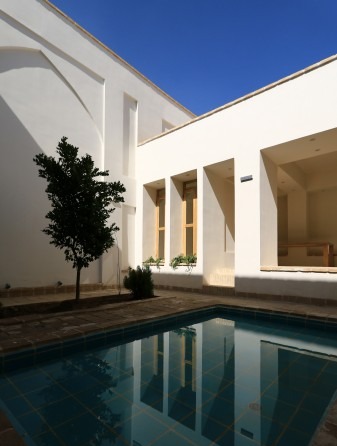
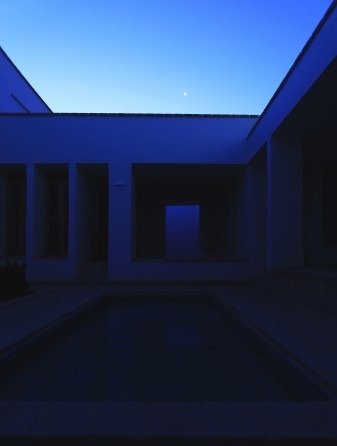
In the eastern section, the impact of previous occupants' interventions was strikingly different. During the 1980s, the eastern portion of the building had undergone renovation, the results of which seemed to mock the section facing it ungraciously. We conceived that by relocating the kitchen and pulling it away from the roof opening, the collapsed ceiling would become a gift — making it possible to transform it into a small courtyard beside the kitchen. Now we had a space between two courtyards that was the ideal place for guests to gather, much like the old porticos.
The eastern section, once again shedding its skin, had a flat and uniform roof that evoked dreams of sleeping on the cool roof on summer nights and gazing at the stars. The solution was to establish a connection between the two sections of the house, such that by creating a bridge on the second floor as a continuation of the staircase, the roof would become a space with character and could function as yet another courtyard. By dedicating one of these rooms to a small kitchen and service area, "we could host guests on the roof with refreshments and views of the sky."
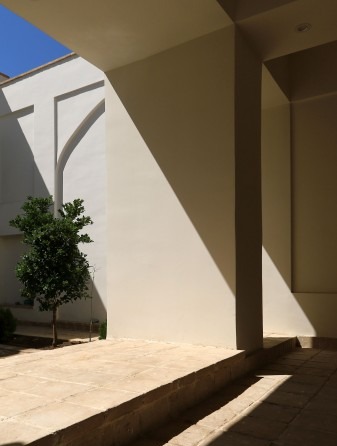
Gradually, our house was becoming ready to receive guests. The vestibule had become a catalyst for curiosity, and beyond it, the courtyards adorned with the green of trees and a water basin, the rooms providing solitude, and the portico transformed into a place of encounter and fellowship. The all-white walls softened boundaries and made the house feel far more spacious than it was. The scent of damp earth rising from the brick floors in the afternoons plunged one into the depths of millennia, and the two arches of the courtyard walls were a magnificent memento of the bitter and sweet days that had passed over our house. Our old house now wore a flush of youthful vitality on its face, smiling inwardly in silence, its eyes fixed on the door in anticipation.