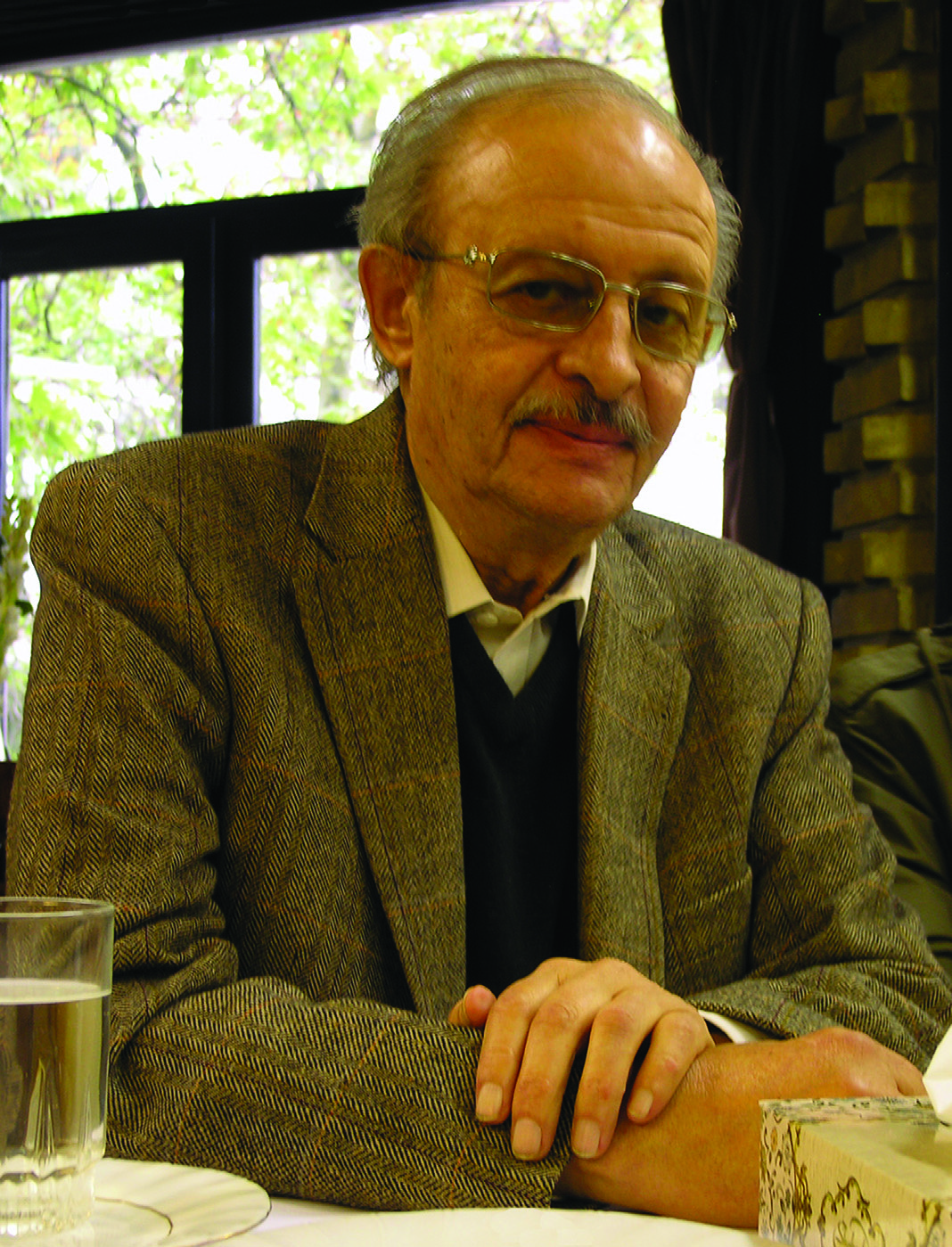
In the search to understand an architect who departed from among us years ago, beyond finding related documents and records, there is no recourse but to listen to his old friends and colleagues. Friends who lived and grew alongside him for a long period are invaluable sources for knowing him. One of the prominent figures who served as a mirror of Yousef Shariatzadeh's professional life — who was present at his side for years and later himself played a pivotal role as a solid foundation in the country's architecture — is Mohsen Mirheidar. Despite a prolonged illness in the final decade of his prolific life, he retained the vigor and magnetism of earlier times and recounted lesser-known aspects of Shariatzadeh and the experience of working with him. This text is a portion of the interview sessions conducted by Arash Tabibzadeh with Mohsen Mirheidar in 1394 [2015], in which he speaks of his old friend and colleague, Yousef Shariatzadeh.
How did your collaboration with engineer Shariatzadeh begin?
After I entered the Faculty of Fine Arts [in 1335 / 1956] and completed the first year and submitted a number of architecture studio projects, I had reached a point where it was time to work. The theoretical courses at the faculty had also become fewer, and consequently our time had become freer. Our professors mostly came to the atelier in the afternoons. Seyhoun would arrive at five and conduct critiques until eight in the evening. During the day, time was mostly wasted and spent on worthless matters. I decided to do something that would serve a dual purpose: to have some income and, if possible, to do something serious. It was better to go to an office where they understood architecture, where they practiced architecture properly, so that I could learn it correctly. Architecture is a craft, and to learn this craft you read some theory and must also do some practical work. If you proceed with theory alone without practicing, you will gain nothing.
A partner or colleague of Monaqqah — loosely speaking, not officially registered — was Shariatzadeh. He is among the rare figures of our architecture. That is, a person who is unique, or if there are others like him, there are perhaps one, two, or at most three who, firstly, learned architecture gradually and became architects — meaning they started from small works and advanced to very large ones — and, on the other hand, studied and researched every subject thoroughly.
I was alongside him and learned and pursued this same approach. Imagine — I started from drawing a fireplace or a bookshelf or designing such things, and progressed to other designs. The designs were real, meant to be built. The question of aesthetics aside, the issue was function — how the design works and how it would be constructed. Most of our time was spent on these discussions, not on grander talk. Because at that time there were no larger projects, and no one had the patience for idle talk. As we moved forward, the projects gradually grew larger. What distinguished Shariatzadeh from others was that he constantly studied and researched every new project that came along — he would read everything from beginning to end and kept the findings in mind during the design process. For example, he would study that if the project were a hospital, what are the characteristics of an operating room? What is the space like? How should it be positioned? What is a sterile environment like? And so on with other important matters...
For instance, when the Rivoli Cinema project was referred to us, I well remember that Shariatzadeh constantly studied sources on cinema acoustics — how to calculate the acoustics of the space and with what characteristics and what materials one could address the acoustic requirements of a cinema. Back then, unlike today, acoustic tiles and such things were neither plentiful nor readily available. Although even now acoustic tiles have technical shortcomings and do not perform optimally, back then there was simply no usable product. We wanted to design a cinema hall with no echo. What were we to do? The only way was research. Something that others paid little attention to. In the end, they would simply go to some doctor to define the project's acoustics.
From the second year at the faculty, my routine was to go to the office. Sometimes, when Seyhoun came to the faculty, I would rush back for the critique session. At other times I would go to the faculty just for amusement. This is how we grew up together.
What was your design method and collaboration like?
That aspect of the work — the studies, research, problem-solving, and design — was carried out by Shariatzadeh, and I, on this side, would put the ideas into practice. That is, the plans would be drawn, we would prepare the details, and the construction specifications would be readied. Throughout this work, we would constantly consult one another: What should be done? Or what should not be done? What is the best solution? Where is the problem? How much will the work and execution cost? We would discuss all manner of architectural challenges. The craft of architecture cannot take shape without observing these fine points. It is not like electrical engineering, where a person goes to a technical faculty, learns a set of formulas and calculations, places a few light sources, and if good lighting is not achieved, supplements it with floor lamps and lampshades, while making sure that from a technical standpoint the wiring and connections are correct. For this reason, an electrical engineer can arrive at a design very quickly, since the design has already been done by someone else — he simply runs the wires, installs the outlets, and provides the lighting. The same is true in mechanical installations and structural engineering. Until you, the architect, produce a design, the structural engineer cannot provide anything unless it is a repetitive scheme.
In these matters, Shariatzadeh was extremely proficient because of his extensive studies. For example, the columns of the National Library are Shariatzadeh's design, upon which the structural engineers later placed the reinforcement. This was not the work of Sano Company. Sano was to handle the structural engineering, but had no role in the building's design. To the extent that one day, after the completion of the structural framework of this building, the late Ghalibafian came with two or three colleagues to visit, and they were astonished by our work and had been unaware of it. The library's columns and that mushroom-cap form at the top in fact follow the mushroom ceiling concept — a span of 8 meters and 10 centimeters transforms to a span of 5 meters and 40 centimeters. Therefore, a considerable amount of reinforcement is saved, and in terms of external form, for a space like a library, it can be very significant.
In another instance, consider the roof of the assembly halls for the machines at the Tabriz Tractor Manufacturing project. A double-sloped, skylit roof was designed so that light came from the ceiling while it was also sloped, and rainwater collected inside the columns, with pipes emerging from within the columns. This roof design was an innovative scheme among warehouse-type roof designs. These were all the product of Shariatzadeh's study, persistence, and knowledge. He would search, he would study and discover, and we too would work on them and push the work forward.
Shariatzadeh was never among the so-called followers of fashion. Those who chased trends did their own thing, and Shariatzadeh did his — he had no pretension of being praised for his work. After the passage of years, it has now become somewhat clear what Shariatzadeh's role in the architecture of this country has been, and who was working properly and who was not. But truly, reaching Shariatzadeh's level is extremely difficult. It requires constant dedication to acquainting oneself with technical and architectural matters. I remember that in his leisure time, instead of reading detective novels and other diversions, he would study books related to work — subjects like lighting, mechanical installations, acoustics, furniture design — he would examine all of these to understand the logic behind them, and he would incorporate them into his designs. This trajectory began with the smallest tasks at Monaqqah's office and culminated with the largest, which was the National Library.
What was engineer Monaqqah's involvement in the work?
Engineer Monaqqah was involved in the projects related to the Ministry of Labor and the Social Security hospitals, and later also in auxiliary architectural activities, professional associations, and consulting engineering — all in service of our being among the best first-grade consulting engineers. We had reached such a standing that at one point, in the evaluation of consulting engineers by the Plan and Budget Organization, with about seventy to eighty employees, we were among the best. This was while, for instance, Farmanfarmaian's office had 300 employees. The limited volume of our work and our precision had caused the company to shine among projects. Everyone believed that the work referred to us would be brought to completion in our office and its problems would be solved — not that we would simply produce another project with the same old functional shortcomings. When the Central Bank banknote printing works was being considered, and Taghi Tavakoli, the head of Tabriz Machine Building, was on the selection committee for the consulting engineer, everyone had said that Bonyad Consulting could handle it, even though other good consultants were also in the running. This project was extremely complex work — both from a security standpoint and an industrial one, as well as administrative and other aspects. Combining all these considerations was a fairly difficult task. Ultimately this project was also executed well and received the approval of the printing equipment specialists.
Tell us about Pirraz. What happened that after the Revolution, Bonyad became Pirraz?
The Kerman University campus project essentially became a turning point in our office's work, both in terms of how we worked, the manner of executing projects, and the proper approaches required for architecture projects. It was a project that began with programming, thorough preliminary studies, and phase-two and execution-phase studies, and fortunately the client was fully cooperative with us on this project and we carried out the work by mutual agreement. From the time we started the Kerman University project [around 1351 / 1972] until 1357 [1978], fairly large commissions were referred to the company — projects with various functions. We had previously worked on hospital programming, as well as industrial projects and educational ones, and the specializations of the office were gradually expanding.
In 1357 [1978], after the Revolution, the provisional government appointed supervisors for various companies. I believe for about 600 consulting engineering firms, they installed government-appointed supervisors. Some of these companies had been confiscated, though some had not. At that time, engineer [Ezzatollah] Sahabi, head of the Plan and Budget Organization, was acquainted with us. So we went to see him. He received us and explained that in these circumstances there was no alternative to appointing government supervisors. Otherwise the prosecutor's office would intervene, and consequently all these firms would face closure and dissolution. He said that they had, in fact, placed a director and supervisor who was also a cousin of Mr. Banisadr, and told us to cooperate and that the problems would gradually be resolved and we could continue working. Of course, this process was carried out with great humiliation, and until 1360 [1981], we naturally looked into every possible avenue to determine what would happen.
The government-appointed director did not have too many pretensions — until Banisadr was also removed, and then he too was taken away, and one or two unsuitable directors were appointed who, as it were, were there to "plow through." This was the period when we were managing important projects like the banknote printing works and Labbafinejad Hospital. Since we had appealed to everyone to resolve these problems, including [Mohammad-Taghi] Banki, the head of the Plan Organization, he had stated that due to the problems your company has had, a supervisor has been assigned, and the best solution would be for you to establish a new company and work within the new system and prove yourselves.
A meeting was held with Mr. Shariatzadeh, and we concluded that if we did not cooperate, our absence would be attributed to non-compliance, so it would be better to heed this advice and form a new company. This was the very company that came to be called Pirraz, and it began its operations in 1362 [1983]. During this interval, our sole supporter was the late [Alireza] Afzalipour, who had founded Kerman University. In the following months we prepared plans for the Kerman Medical Faculty for him. In the master plan for the Kerman University campus, all the sciences were together under the Ministry of Science. Later, during a certain period in those years, with the separation of the medical faculty from the other science departments, the university was effectively split in two. Consequently, the buildings we had designed for the medical faculty were on this same Shahid Bahonar campus site. After this separation, it was decided that the medical faculty section would receive a separate budget and that the faculty would be built on a detached parcel of land. This plan was the late Afzalipour's, built with a concrete structure, whereas the structures of the other buildings are steel.
During this time, one of the first projects referred to us was the teaching hospital for Kerman University. That is, Kerman University needed a teaching hospital in order to establish a medical faculty. The ministry approached Afzalipour, and he undertook to cover the design costs, while the ministry would handle the construction costs. For the first time, Pirraz carried out the hospital programming itself. Before the Revolution, under Dr. Sheikholeslam[zadeh], the Minister of Health, hospital programming had been done by Americans, and this was the first time we did the hospital programming ourselves, and the result was highly satisfactory. This project, with a limited footprint, met all the program's requirements. Previously, in the programming of teaching hospitals, the estimate per bed was 135 square meters, 120 square meters, or 100 square meters of built area, whereas in our program for the hospital, it was approximately 75 square meters per bed. When this plan emerged, a commission of 19 was formed — comprising specialist doctors and others — who reviewed and approved the drawings.
After the Revolution, starting with the Kerman teaching hospital and then designing other projects, we began working. With Shariatzadeh, we reached the conclusion that since we had no connections, were nobody's favorite, were not into wheeling and dealing, and were under no circumstances willing to share undefined profits with anyone — with the low fees, no client understands what good work entails and what effort goes into it. All work is the same to them — small and large, good and bad, it is all one quality. Therefore, the only solution would be to increase the speed of project execution and thereby distinguish ourselves. From the very beginning, we resolved to not cut corners on the studies and research, to devote time to them, and to increase the speed of work. In reality, after the Revolution, this had become the main thrust of our work. This was seen in many instances, the result of which was our company being selected in 1376 [1997] by the Ministry of Housing and Urban Development to undertake the Summit Conference project — without any correspondence or the usual formal procedures. In this manner, we completed the project within six months, and through this approach, we were able to earn a good standing among our peer firms.
How did the National Library project come to Pirraz?
From the very beginning, efforts were made so that the technical aspects of our work would be of desirable quality, and the results were very good for the clients. Following that, one day the Ministry contacted us and invited us to discuss a project. A meeting was held with the deputy at the Ministry of Housing and Urban Development, and as it happened, Mr. Shariatzadeh was unable to speak due to dental surgery. In the meeting, it was stated that there was a project called the National Library, and they intended to entrust it to us. This was a cause of surprise for us. It apparently became clear that in meetings held prior to this with experts, it had been stated that the execution of such a project could only be handled by our company.
Without any prior background in such a subject, we began gathering information and the programming was initiated. Under conditions where no site had yet been selected for this project, we began the studies, while on the other side meetings with the client were also being held for site selection. These proceedings continued until 1370 [1991]. After two to three years, it was finally announced that in the Shahestan-e Pahlavi, or the same Abbas Abad hills, a parcel of land had been allocated for this purpose, and the site specifications were communicated to us. At that time, ATEK Consulting Engineers was working on the Abbas Abad hills master plan. Later, during one or two trips, Shariatzadeh visited libraries in various countries such as Germany and the Netherlands, and then we entered the design phase and the preliminary design was completed. During this period, there were colleagues — including Mirmiran, Sheikh Zeinoddin, and ATEK Consulting — who proposed that a national-level competition be held to select the library design, even though the preliminary design had been done by us. Given that we had made many visits to the Ministry of Housing and Urban Development, and engineer Tafazzoli was the head of the executing organization, we were informed one day that the client had decided to hold a competition for the selection of the National Library design. I recall that in the meetings, only engineer Joudat acknowledged that, given his acquaintance with these gentlemen, they know their work. It might not be to our taste, but their work is good, and whatever Shariatzadeh says is acceptable. He was the only one who said this.
The competition was held, and the first-place winner was Pirraz, with no second or third place. A first place, then fourth, fifth, and sixth. In any case, the fruit of that Kerman University work was that we reached a position where the greatest cultural project of the country was entrusted to us, which was immensely valuable. The speed I mentioned also manifested in the Summit Conference. It was extraordinarily important for the nation and the government of Iran that this summit succeed, and in the end, despite all the complaints and criticisms — they said the roof leaked and so forth — abroad they wrote that the Iranians executed and commissioned 50,000 square meters of building within six months.



