



Rem Koolhaas was born in 1944 in Rotterdam. He studied architecture at the Architectural Association, London, and began his work with journalism and writing subject matters on cinema. He travelled to America in his youth and soon became famous with his book Delirious New York, printed in 1978, which sold about 28,000 copies. In this book he proceeded with the attractive aspects of New York City, which was lacking town planning and architecture. Koolhaas announced his instinctive discouragement from the intensively planned and inflexible cities of Holland, especially Rotterdam. He thinks that the culture of congestion and overcrowding, modern technology and the quality resulting from the gripping magnitude of the civic phenomena are the cause of a value which is under no circumstances less than an idealistic town planning and academic architecture.
About 20 years later with the book Small, Medium, Large, Extra Large he shows that the real idea of modernism is in contradiction with modern city planning, and that to resolve today's problems — with due attention to the fact (which he calls New Realism) — one must revive the real soul of modernism. In fact modern town planning could not reflect the essence of modernism, because of its connection with 19th-century utopism and the tendency toward the unity of Renaissance forms, and faced failure for this reason. Perhaps for form's sake the advance guards of the figurative field were able to picture the soul of modernism better than the modernist architects. In the field of architecture the modernists in the first half of the century also could not rid themselves completely of the restrictions of 19th-century typology.
The soul of modernism, more than “the unified entirety”, deals with ragged and shattered facts which apparently do not conform to a single uniformity formula. In place of an aesthetics attached to meditation, an aesthetics worthy of perception through movement is considered — and the movement Koolhaas speaks about is different from what Le Corbusier, Gropius and Rietveld used to discuss. In the first modern architecture, the effects of architecture are perceived from the circulation outside and inside the building and not from the observation of the façade (which is motionless in connection with optical perception). Today, though the electronic media and public transport have changed the method and the speed of discovery and perception of architecture, even the time factor known as the 4th dimension of architecture is not able to solve the problem of planning. We are facing different temporalities, which an architect is not able to control. Just as time is broken, so also the physical reality of our cities has been shattered. In this period of many beliefs, a designer — by releasing a unifying idea and “strong form” (which according to Koolhaas is moved only by the self-censorship of today's architect), and making use of a collection of ideas lacking a unifying system — can create a work which belongs to the present and is capable of solving the basic problems of our time.
There is a new Platonic and idealistic thought hidden behind the ripped outer appearance and realistic writings of Koolhaas — a thought that lays the foundation of a utopia by theorising reality, the elements of which are a reflection of the truth. Reality this time has become so pure that it has emerged in the form of a list of basic and structural ideas. Attention to structure in Koolhaas's view is fully evident from the way his book is set up. If a book is supposed to explain a truth, that explanation cannot be obtained only through explaining the meanings; the structure of the book and its organisation crystallise Koolhaas's ideas regarding the reality of today's architecture and town planning, and the methods which give shape to a realist architecture. The book consists of chapters organised only on the basis of quantity — that is, the size of the work — and this itself is an indication of the importance of “the quality of the quantity” in today's metropolises. The subject matters are inserted among the pictures in the form of a directory of useful points, but without any traditional and virtual relation. Koolhaas's object is that the book can be read from anywhere and in any manner the reader wishes, without going to the first page. This is the literary crystallisation of the shattered temporality of today's world and the non-existence of structural connection between metropolitan realities.
In another place he speaks about the system of the formation of big-city building agglomerations. In these agglomerations, because of vast dimensions, the direct relation between outer and inner form, and functional transparency, is lost, and these items are transformed into different subjects of design. Attention is drawn to the same subject matter in the new urban plan of Euralille, the master plan of which is prepared by Koolhaas. If there is no practical possibility of exhibiting the complete building at a single glance and establishing a connection between inner and outward portions of the building, where is the urge that the design of the building should follow an entire uniform geometrical pattern? In the large scale also, in comparison with big cities, we see that they are broken to pieces by road networks, the metro and other infrastructures. Facts show that these structures have a precedence over any town planning, and place architecture under their influence. In Euralille, the traffic network, which is one of the causes of the existence of this new city, has come out as an independent structure, in such a way that the architectures accidentally collate with it. The debate on a kind of accident preplanned and deliberate is one of the main principles of Koolhaas.
In the smaller scale, as Koolhaas refers to in another place, new technology — especially the elevator — has caused the different floors of a building to obtain independent and unrelated existence. The stairs are transformed into a secondary element, and perpendicular unity has no meaning. In the Paris Library project we see that Koolhaas has utilised this specialty and has placed floors on top of one another in the form of independent and different phenomena. In this project, the debate on the placing of independent structures on top of each other has found crystallisation in a very specific form: the horizontal floors for general operations of the library, like the other floors of a traditional building, are placed on top of one another; and a second structure — consisting of huge volumes, as if dug inside this systematic and set network — is added to the floors. These are the assembly and exhibition halls and the special spaces of the library. In this project a contrast between surface and volume, between set and organic, and between private and common, can be seen.
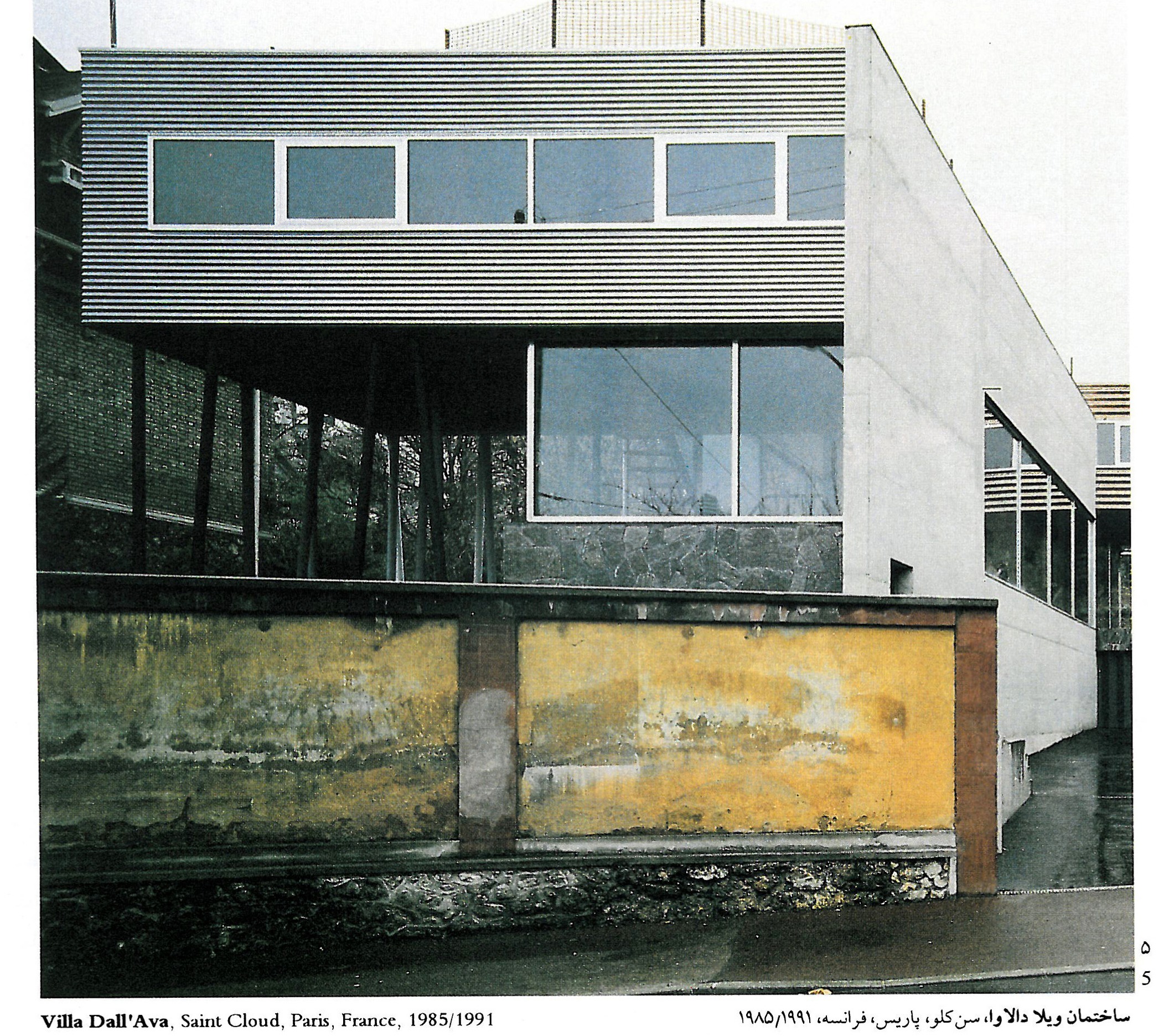
As we see, in Koolhaas's works contrast and lack of connection has only a figurative dimension. In reality, there is complete coherence between his works in the theoretic dimension. As is evident from the comparison of the National Library of France in Paris and Euralille, there is no difference between small and extra-large scale from the point of view of methodology and understanding, and the everlasting contrast between different scales has disappeared even in details of the building — as in the façade and the windows of Villa Dall'Ava, where non-existence of connection and the proximity of opposites can be seen: the composed elements of this building are placed side by side without a single unifying order, and even the window of the main façade is apparently left half finished.
Unity is the crystallisation of calm, totality, meditation and predetermination, while Koolhaas is looking after the incomplete, movement, partial and unrelated perception, and an untimely aesthetic. The movement factor is a main characteristic of Koolhaas's work, and takes a share of the main ideas of most of his projects. In the Lille project there is no space of civic calm, like a square. In the Kunsthal of Rotterdam, in the two libraries of Jussieu University in France, and in the Centre of Art and Technology in Karlsruhe, ramps — which transform the floors into continuous surfaces — appear as one of the main spatial elements of the building.
In each project Koolhaas tries to encounter a main and structural planning problem, and it is for this reason that his works more or less remain closer to scientific discoveries than to innovations. The problem of the companionship of independent phenomena — such that the work is not a synthesis of the subjects raised but only a collection of independent and different programmes — is nicely seen in the Congrexpo project in Lille, where the concert hall, the convention halls and the exhibition hall are, like three totally independent sections, assembled next to one another. In the Parc de la Villette urban-design project (which was not executed) independent structures, from the spatial point of view, stand on top of each other, but each has its own design and function; the relation among them looks like a calculated accident. “Layer design” — which also means the expressive (not merely instrumental) use of computer-design programs such as CAD — simulates structural complexities and the co-existence of elements belonging to different projects and different times of the real city. The Villette scheme consists of four different layers. The first is of cross-wise strips that cover the entire surface of the park; in each of these east–west strips one of the open-space functions is placed (thematic park, playground, special plantations, etc.). The second is a collection of dot-like elements (in comparison with the vast surface of the park) — kiosks, cafés, picnic grounds — set on a regular grid. The third is devoted to circulation: a linear north–south boulevard and a curving promenade that links the common spaces. The fourth arranges the existing and newly established buildings.
What is distinct: Koolhaas, in spite of the wholly abstract formal language and the theoretic contents of his works, seeks a kind of planning that is “possible” for today's world. In pursuit of this aim he plays a kind of cultural idol-breaker. He sets aside all the settled standards of “beautiful design”; his argument is not confined to solutions, and he also subjects the main principles, such as composition, to criticism. His disrespect goes beyond the level of general ideas and theoretic arguments and reaches the practical and operational problems of building. The economy of building is one of Koolhaas's important themes: for him economy is not saving but “realising the maximum programme with the minimum capital.” In any case, he also pays attention to saving, so that the reduction of executive costs does not become a parasite in the design process; he investigates the capabilities of the aesthetics of poor materials. The Educatorium of the University of Utrecht (25,000 m², built for about US$ 12 million) raises a cost that is entirely possible even for third-world countries: a total cost per square metre of about 230,000 tomans — not far from Iranian costs, and about one third of the cost of similar buildings in Europe.
Today expensive, high-quality buildings like the Miyagi Prefectural Library by Hiroshi Hara are built at a cost of about 2,600,000 tomans per m². In the Netherlands itself the Central Library of the Technical University of Delft and the New Luxor Theatre are built at a cost of roughly 1,400,000 tomans per m². The administrative building Villa VPRO, work of MVRDV office in Hilversum, at 10,500 m² was built at 735,000 tomans per m². In France the BDM student residence at Le Creusot (5,000 m²) cost 667,000 tomans per m².
This problem of price — which I have tried to show through many examples — is very important for today's world, and especially for countries like Iran. Koolhaas's experience shows that the quality of architecture is not solely tied to elite and expensive works, and that with a bearable cost important, authored buildings can be brought into existence. On the other hand, the theoretic and methodological realism of Koolhaas, and his glance on the extra-large cities, is in strong conformity with the situation of extra-large cities such as Tehran, and his modus operandi here seems wholly practical and suitable — especially since some of the problems he discusses, such as the large urban agglomerations, have specific counterparts in our own history. The features described, or the principles used by him — lack of connection between outside and inside, the superiority of the internal space, the importance of routes, the companionship of disconnected sections, and the superimposition of a network of more or less repeated elements over a network of special, unique elements — apparently correspond completely with the Iranian traditional bazaar.
From the dictionary Small, Medium, Large, Extra-Large (Monacelli Press, New York, 1994)
Future 1. We saw the future and confidently recognised it. I saw people moving about in it in one direction or another, without knowing it — because they still thought in the past, with the examples of the past. But the only thing you had to do was to know you were in the future — and that is what puts you there. The secrets had moved aside, but a fresh astonishment was beginning.
Future 2. Intelligent space will not only open a one-way route into the world of the open stage, but will also lay special effects on your table. The future is here — only (still) in equal measure.
Future 3. But the future does not come of its own accord; only if we do our work well will it provide a good foundation for the future. Over all these years I have learned more and more that architecture is not a play of forms. I have understood the close relation between architecture and civilisation. I have learned that architecture must arise from the sustaining and forward-moving forces of civilisation, and that architecture can, at its best, be the expression of the innermost structure of its own age.
In Search of a New Modernism — Rem Koolhaas in conversation with Bart Lootsma
(Domus 800, January 1998 — Persian translation by Leila Ghadimzadeh)
The relation between the profession of architecture and the issues of our time needs to be defined anew. The role of architectural forms in the making of the whole city must be looked at realistically. A new relation between architecture and civilisation will be developed only in the light of an examination of the phenomena of reality.
Rem Koolhaas has never been a utopian. In a conversation with students (Lebreich, Sanford Kwinter, Houston, New York, 1994) he describes his works as “in step with the force of modernisation and the unavoidable transformations that follow from that project — now 300 years old”, and continues: “What is important for me is to join those forces and to find an expression for them — without utopian purism.” In one of his first writings on architecture, while still a student at the AA in London, he defined the city as “a tarmac-covered surface with a few dense, inflamed points”, and closed with the provoking remark: “As you see, there is no problem.”
— Bart Lootsma: In your view, what are the greatest problems of our time, and what role should an architect or designer play in relation to them?
— Rem Koolhaas: I find it extremely interesting that the question of the relation between the architectural profession and the problems of our time is once more being raised. I think twenty-five or thirty years have passed since the last time it was. Paradoxically, I think one of the problems of our time is that it never speaks about its own problems. I think one of the problems of our age is that, with the entry into a market economy, architects can no longer claim that the issues they deal with are anything more than an immediate answer to an immediate need. Therefore, though it is extremely difficult, I very much welcome the chance to speak about the relations between the architectural profession and the problems of the time. The difficulty is that we have entirely lost the habit of asking such questions, and — with the thought that we already know everything about it — we have calmly gone on to display all kinds of happy leaps in architecture and left people in a moral vacuum.
More important than all the problems of our time is the old question of the movement of population from the countryside to the city, which was there before — in the 1960s. The result is ever-increasing urbanisation, or better, the conditions that define “the urban condition”. Those conditions yield different results in different places. One of the issues of our time is to urbanise fast enough to settle that flood of population — and also to discover what happens when we build cities at that pace. I think in Africa the problem of our time is wholly different, and again in America wholly different problems exist. One of the odd features of globalisation is that it connects everything and at the same time makes differences sharply visible.
In Europe, for example, one of the problems of our time is the complete absence of executive firmness to define the many capacities that exist. At every level there is a kind of disarray, which means that we are probably creating gigantic problems — both as architects and as planners. Take the Netherlands: in all architectural discussion the idea of Holland is of a low-rise holiday park. I think that way of thinking will bring disaster in the long run (if not already). It is strange that there is no fiery young Dutchman to say: “We should aim at a denser city, at higher building density.”
One of America's problems, in my view, is that everyone knows things have to be done, but no one agrees that they should be done in their own back yard. Everyone in Los Angeles knows it is good to have an underground transport system; but when a station is planned within a kilometre of their house, they protest and step back. There is an absolute separation between a common understanding of the situation and the private sphere. These are, in principle, things that are not directly reflected in architecture but they largely define the context in which architecture is built. What draws my attention is how right up to the end of the 1960s architects took part in a public, benevolent discourse about architecture, and how that discourse has now stopped. Why has the architect as “the well-wisher” — the one who used to warn — completely disappeared from the stage?
— B. L.: Have you not had any role in this process yourself? You have always been interested in a particular subject, and unbelievably sceptical of the utopian ideas or idealistic scenarios that architects were expected to realise. That is, you have always adopted a very cautious manner toward the architect as solver of great problems.
— R. K.: Perhaps. I do not mean that one should always think one was right, or that one cannot change one's mind sometimes, or that the times were not right and now may be more right, or that the things around us have not changed. But I have always been amazed by criticisms which generally take our interest in realism as synonymous with an uncritical attitude — because I think we have been unbelievably critical, and on both fronts: on the way architects work, and on the way the system works. Our realism was fed by two things: on one side, the architect's way of working, in a way that would restore his credit to him; and on the other, the need to find the credit attached to the real working of the system, which is no longer taken seriously and for which no price is paid.
— B. L.: Do you wish to go on preventing the raising of these moral questions, or would you rather find a new moral or political way of dealing with them?
— R. K.: I am fundamentally not a moralist. It is increasingly important to me and to us to work in two different fields at once: on one side, the production of architecture; on the other, a critical distance from it, which takes the form of research. You know we have been working in China. We move about in the markets, just as everyone does, and next year we will be going to Africa.
— B. L.: You have been engaged in work in China and Singapore. Your lectures raise situations that are often bewildering for a Western audience — for instance, on questions of democracy, or the pace of construction there. When your audience comments, you often answer that in the foreseeable future similar situations will arise in the West too.
— R. K.: Forms of them will arise in any case.
— B. L.: Do you think that is good? Can we still wage a fight against these tendencies? Can architects propose forms of resistance?
— R. K.: I think there are many good things in this field. Fascinating things like the appearance of a city out of a scratch, and the fact which proves one can build authentic cities which have no history and have come out of nothing, but are very dense and built with a relatively average architecture. If you compare Shenzhen with Almere, you ask yourself: how can it be that a place on which so much architectural force and so much money is spent still has so little urbanity?
— B. L.: Has the growth of intelligent space also influenced the public space and collective sense in cities?
— R. K.: I think the collective sense is implicitly tied to intelligent space; it is not a direct consequence. In my view the consequence is a kind of double complexity, with a double richness of the possibility of choice. Apart from that, I do not think much has changed. These consequences have been there a long time, beginning with the invention of the telephone. Cities have long existed that are not based on personal contact. The “generic city” is related to this. The Pearl River Delta is a perfect example of what happens there, because all the events are the result of “intelligent space” — and I also think it is a visual counterpart of intelligent space.
— B. L.: You said at the start of the interview that certain topics such as ecology were last raised in the 1970s. But in that period you had a very definite position — you were not one to go along with the hippy current or the green lobby. Can you say something about that? Were you then somewhat in doubt about these questions, or did you arrive in the end at the same questions but by another path?
— R. K.: I think the second is more correct. Because if I understand anything today, it is because I was much closer to currents from which I felt a great distance at the time. I also think my journalistic past has always, in some way, concealed a deeper commitment to these matters.
— B. L.: Can you give one or two examples?
— R. K.: I will confine my answer to the hippy current or Flower Power: the ideal of a kind of architecture fading away, or an architecture extremely cautious — not dark, but mild. That fading is present in our work today too. You might also say that belief in ongoing critique was an important ground of our scepticism — because, with all its mildness, it ultimately took architecture as its target. I think there are, and have been, all kinds of deep and unconscious bonds.
— B. L.: Apart from the problem of population growth, what other major problems exist at present?
— R. K.: I think all the other problems are related to that. One of the aspects of our work that has received less attention is that it has always been cheap; this has an ideological side. It does not at all mean that we only make cheap things, but I think the research into how one can realise the most programme for the least money is very interesting. A building like the Grand Palais of Lille — built on a budget also possible in Calcutta — is an interesting project, because it has proved that one can set aside all the glitter used to seduce people, and, merely on the basis of a genuine commitment, bring about the best condition in specific circumstances. In my view, one of the results of the fact that architecture is no longer counted among the great issues of the time is that architecture is losing its credit — in the sense that the credit of architecture ends with its transfer to the side of object-hood. As a result, a wholly sentimental face of architecture has been given tragic, exaggerated attention.
— B. L.: I am surprised you have not raised the issue of the environment among the problems of our time.
— R. K.: That too goes back to urbanism. In fact, in my view, the discussion of the environment is essentially symbolic. We have long been interested in linking architecture and engineering. I do not think the environmental issue will be resolved any time soon — certainly not within ten years — but by itself it will play a role in all the other issues. It is also related to the minimum use of resources. In fact there are two kinds of minimum use: a “Calcutta-style” minimum and a detail-filled, even fastidious, minimum. I feel closer to the Calcutta kind, and that is why I see the environmental issue as a kind of “overemphasis.”
— B. L.: But will this not affect the organisation of architecture and urban design?
— R. K.: This is one of the interesting findings of the research we did in China. One of the results was that a Chinese architect can design an apartment skyscraper in four days. That is: they sit behind their Macintosh in the kitchen, and in four days you have all the drawings of a skyscraper. This is repeated very many times, and without the organisation of “intelligent space” it would be impossible — not that it itself takes an intelligent form. One of the most interesting features of the present, in my view, is that the things that most owe their existence to the computer have the least visual relation to it.
— B. L.: Would you today be willing to set aside certain standards, or bring in regulations, that could solve some of the problems we have spoken about — or ensure that the situation in 2028 will be more hopeful? What could such standards be?
— R. K.: I think I do not have the courage for such a thing — that is, for setting aside standards. But even now we are already working with standards that will play the same role in the long term. I think, for example, that all the work done in Lille is part of a frame that will in the end have wide consequences. I think our interest in infrastructures is also related to this: a kind of desire to take a conscious part in works that do not necessarily make things easier, but are in some way future-making. But the main criterion that is of interest to me — and which I think will have an effective consequence — is “research.” The research in Harvard, where I now teach, is so wide that one can certainly imagine it will have some effect, and surely particular things will be discovered with consequences. The exciting side of my work at Harvard is that I can each year choose a different subject — for example, one year I can choose modernism, or do research on modernism, the new modernism.