Historical Architecture

The Revival of Hammams

Partager
The Revival of Hammams

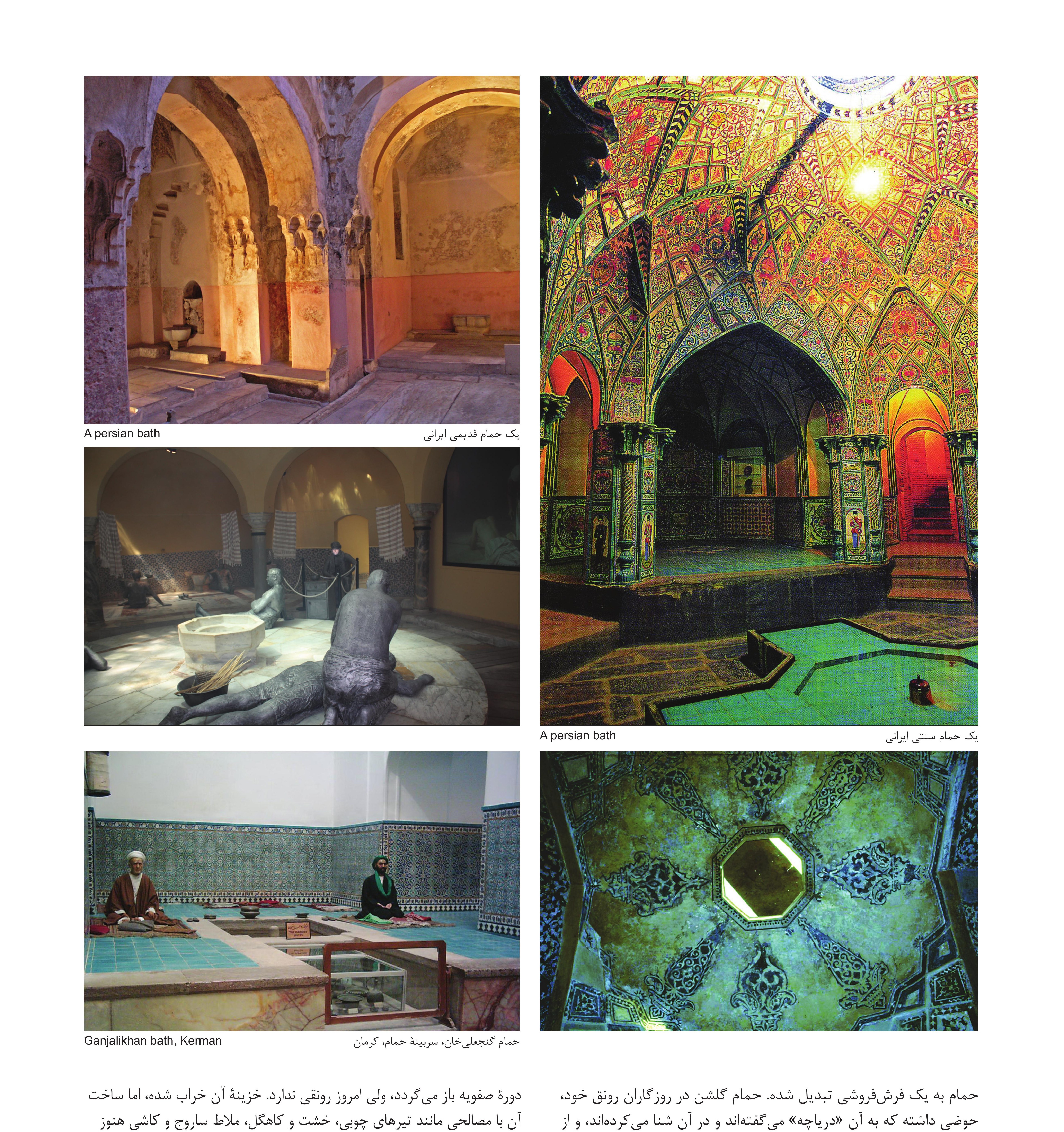
According to E'temad al-Saltaneh, the Mehran qanat dates back a thousand years, which attests to the durability of qanats through historical periods and their good maintenance. During the Qajar era, this qanat was diverted toward the Ark: "After the construction of the Sepahsalar garden and mansion, three dangs of this qanat's water were endowed to the Sepahsalar garden" (Qanats of Tehran, 1966, issue 75), which still passes beneath it and reaches the Golshan Bathhouse opposite the Seyyed Esmail shrine, then continues toward Sirus intersection and the Amin al-Soltan bazaar. Unfortunately, this qanat is today filled with urban sewage. The author, during the Golshan Bathhouse restoration project, saw the qanat that passes beneath the bathhouse. At times they would block the qanat with a wooden panel so that the bathhouse pool behind it would fill with water, and Qajar princes would bathe in it during the month of Ramadan. The village of Mehran was situated between the villages of Mobarakabad and Zarrabkhaneh, north of Qasr-e Qajar, of which no trace remains today except the neighborhood names. Therefore, northern Tehran has been of interest since ancient times, but after Tehran's establishment as a city, and especially from the Qajar period onward, new settlements were built around Tehran for farming, vegetable growing, and summer crops to supply the city's needs. The mountain-slope villages, irrigated by Tehran's seven rivers, were covered with orchards and fruit trees. Hojjat Balaghi, in his book Tehran, North, Appendices writes: "The town of Rostamabad, upper and lower, lies four kilometers southeast of Imamzadeh Saleh and three kilometers east of Qolhak. Its population is four hundred. The town is on the mountain slope, in the cool highlands, and its water comes from two qanat lines and in spring from the Darabad river, and its products are grain and fruits." (Rostamabad was one of the settlements formed during the Qajar period.) The pleasant climate of Tehran's northern highlands and the existence of seven river valleys—the main factor behind the good air and the temperature difference between this area and Tehran—enticed Qajar kings, following their custom of seasonal migration between summer and winter quarters, to seek refuge from Tehran's unbearable summer heat in the mountain foothills. As Tehran expanded, the Qajar palaces also grew more distant from the city. A number of these garden-palaces were built during the reign of Fath-Ali Shah, such as the Lalezar garden and Qasr-e Qajar, which was later converted into Qasr Prison. Of its buildings, only an octagonal pavilion in the center of the garden and a few trees from its original 50-hectare grounds remain. Mohammad Shah also built a palace called Mohammadiyeh in Shemiran, in the Mahmoudiyeh neighborhood (later renamed after the palace), situated on the western edge of Vali-ye Asr Street—of that garden nothing remains today. Mozaffar al-Din Shah also built a palace in Darabad, part of which is now the Masih Daneshvari Hospital. But Naser al-Din Shah, owing to the length of his reign, the country's relative security, and his pleasure-seeking nature, founded or appropriated numerous palaces and gardens around Tehran. From Eshratabad Palace, which was near the fortification, to Saltanatabad on the eastern edge of today's Ekhtiarieh neighborhood, Doshan Tappeh, the Firoozeh and Yaqut palaces (Sorkh Hesar) to the east, and Niavaran Palace to the northeast, and dozens of other gardens and mansions—all are his legacy. E'temad al-Saltaneh notes in his diaries: "Since Naser al-Din Shah was born under a tent, he could not live under the ceiling of a room in the city and always took to the open country." Qajar courtiers and princes, following his example, also built many gardens in Tehran and its surroundings, especially toward Shemiran. These gardens were often built near the roads that served as routes to the Qajar kings' palaces. The Saba garden was one such garden, belonging to Fath-Ali Khan, the Saba Malek al-Sho'ara. The only small building remained from the Negarestan Royal Garden, today imprisoned between governmental buildings. Qasr-e Qajar Palace, Tehran. Map of Tehran, beginning of the Qajar period, early 18th century.

It belonged to Fath-Ali Shah and was later purchased by Haj Kazem Malek Tojjar (the father of Haj Hossein Agha Malek) and until recently was counted among the properties of his heirs. This garden was situated on the western side of the old Shemiran road (Shariati Street), above the present Se-Rah-e Malek, and in recent years the remaining trees of this garden were also felled and extensive construction took place. Count de Gobineau, the French ambassador to Iran during the Qajar era, writes: "The nobility, aristocrats, and merchants purchased land outside the city at cheap prices and created avenues and gardens and built small and large mansions, so that one could say the lands of Tehran have absolutely no owner." This constitutes the second factor in Tehran's expansion. One of the great landowners of Naser al-Din Shah's era, Mostofi al-Mamalek, established many settlements in Tehran and around the city, including Behjatabad and Yusefabad, which in the northeast of Naseri Tehran spanned hundreds of hectares. A major portion of the lands of the village of Vanak also belonged to him. He built a road through his gardens and farms from upper Amirabad to Yusefabad, lined with trees and flowers (see the map of Amirabad Street). Among other gardens, the Jalalieh garden belonged to Jalal al-Dowleh, son of Zell al-Soltan, and was situated beside the western edge of Mostofi's properties. During the first Pahlavi period, parts of this garden from Fatemi Street to Enqelab were converted into the Carpet Museum, Laleh Hotel, Laleh Park, and the University of Tehran. Amirabad Street (Kargar) passed along the western edge of this garden and extended from Bagh-e Shah to Bagh-e Amirabad. Dr. Feuvrier, Naser al-Din Shah's physician, writes in his book Three Years at the Court of Iran: "The road to Sahebqaranieh is at the Shemiran gate, and Eshratabad, Qasr-e Qajar, the Mint, the Gunpowder Factory, and the great Saltanatabad garden are all on the right side of the road." Hojjat Balaghi also states in his History of Tehran: "In 1278 AH, the Saltanatabad road was macadamized under the supervision of Ali-Qoli Mirza E'temad al-Saltaneh and Mirza Saeed Khan Ansari, the Foreign Minister, by Monsieur Caskerkhann, the Austrian engineer, and that road became known as Shemiran Avenue." He also says: "The village of Jamaran is two kilometers east of Imamzadeh Saleh, beside the macadamized road from Tajrish to Niavaran." From the accounts of Balaghi and Feuvrier, one can conclude that Naser al-Din Shah connected the distance between the capital and his palace gardens in Shemiran with macadamized roads, thereby also smoothing the way for the development and linkage of Tehran with the villages along the route toward Shemiran. More gardens and settlements continued to form along and around these roads, and therefore the third factor in Tehran's northward expansion can be attributed to the existence of these roads. On a map dating to 1286 AH, corresponding to the middle of Naser al-Din Shah's reign, natural features, gardens, agricultural lands, and Naseri-era constructions are shown. The connection between Tehran and Shemiran, indicated by mule tracks (dirt roads) marked with dashes and dots, is also visible. This map shows that parts of Shariati Street and Vali-ye Asr Street pass through the corridor of these same roads. On this map, some gardens that had been built by that time are identified. Over time, many gardens took shape in the northern part of the city, extending as far as the historic village of Imamzadeh Qasem. E'temad al-Saltaneh introduced the important gardens of this area in his diaries. In his entry for Friday, 7 Dhu al-Hijjah 1307 AH, he writes: "Today the Shah is a guest at the Malek garden, which is in Imamzadeh Qasem." In his entry for Monday, 14 Rajab 1292 AH, he says: "Today the Shah, with the harem, is a guest at the Nosrat al-Dowleh garden, which he has in Imamzadeh Qasem... Three hours past midday, the Shah departed toward Imamzadeh Qasem, passing below Jamaran... In the evening upon return, the Shah bestowed upon me the Dervish garden, which is between Imamzadeh Qasem and Niavaran, that I might cultivate it." Among other important gardens of the Naseri era, the Farmanieh garden belonged to Abdolhossein Mirza Farmanfarma and was sold by his heirs to the Italian Embassy for 100,000 tomans. This garden still stands on the southern side of Farmanieh Street as the residence of the Italian Ambassador, and its old mansion has been beautifully restored and preserved. It is regrettable that the only remaining gardens of old Tehran are the embassy gardens, and that Iranians themselves placed no importance on preserving these gardens and mansions—and still do not. The Ajoudanieh garden is another garden from the Naseri period. Hojjat Balaghi states in his History of Tehran: "Ajoudanieh was developed by Agha Reza Khan Eqbal al-Saltaneh, the Minister of Artillery." Of this garden, too, only the name survives. E'temad al-Saltaneh writes in Al-Ma'ather va al-Athar: "And Kamranieh, in the Shemiran district, situated north of the city of Tehran at the foot of the famous Alborz mountain, is the summer palace of His Highness Kamran Mirza, the Amir Kabir and Minister of War... In this great estate, the landscaping and flower arrangements in the European style astonish the beholders." Another royal palace was the Aqdasyeh garden. Hojjat Balaghi says in his History of Tehran: "The Aqdasyeh garden is east of Sahebqaranieh and is among the buildings of Naser al-Din Shah Qajar. Its former name was Hesar-e Molla, and the said Shah named it Aqdasyeh after Aqdas al-Dowleh, one of his wives." These examples represent but a small portion of Qajar-era gardens, of which only a handful remain. With the formation of Vali-ye Asr Street during the reign of Reza Shah, Tehran's expansion toward Shemiran intensified, but along the edges of Vali-ye Asr Street, apart from Ferdows Garden and Mahmoudiyeh Garden which date from the Qajar period, the customary Qajar-era gardens were not built, for several reasons: first, a large part of Mostofi al-Mamalek's properties lay between Amirabad Street and the village of Vanak (east of and uphill from Vali-ye Asr Street), and no one could build there. Second, the condition of Vali-ye Asr Street, with its considerable unevenness, did not allow for farming and gardening. Additionally, the flood-prone nature of certain points along it compounded the problem, causing little attention to be paid to construction along this route during the Qajar period. To clarify this, it suffices to look at the current condition of Vali-ye Asr Street from Se-Rah-e Abbasabad to approximately Vanak Square. The western side of Vali-ye Asr Street has a significant elevation difference from its eastern side, such that connection with the western side along this stretch is necessarily made through numerous staircases—particularly around Sa'ei Park, which sits in a depression relative to Vali-ye Asr Street and was historically flood-prone. This situation, combined with the fact that Vali-ye Asr Street was initially intended for rapid and convenient connection between the Marble Palace and Sa'dabad, meant that less construction took place around Vali-ye Asr Street. When the city's expansion accelerated and the edges of Vali-ye Asr Street also took shape following new lifestyles and modern architectural methods, villa-style houses with courtyards gradually replaced the large garden-pavilions of the Qajar era. The social transformations of that period also influenced urban planning and architecture, and the transition from tradition to modernism reached its peak during this era. Among other things, residential buildings shifted from a closed and introverted form—created largely for reasons of security and belief (the andaruni and biruni houses that had minimal connection with the outside)—to an extroverted form with a relationship to the surrounding space, one of the effects of this enormous transformation in the history of Iranian architecture and urban planning. The courtyard, as a piece of nature in the form of small gardens surrounding a pool and fountain, has played an enduring role in residential architecture. Thus, one- and two-story villa buildings with diverse designs, styles, and new materials became a redefinition of transformed and modern Iranian architecture. Therefore, the fourth factor in Tehran's expansion—and among the most important—was the population increase, especially from the second Pahlavi period, which caused Tehran's rapid growth particularly toward the northern highlands. Eduard Polak says: "No house in Tehran can be found without a courtyard, and no courtyard is without a garden and trees." The extensive formation of residential buildings in this manner meant that every Tehran family had a small courtyard with gardens full of flowers and trees, and residents' connection with nature and clean air was provided through this. Tehran grew and developed in this fashion, and even now, in corners of the present-day metropolis, traces of these houses can still be seen. For example, along the entire length of Niavaran Street, parts of Vali-ye Asr Street and Shariati Street—especially in the northern sections—and other parts of the city, these houses line both sides of the streets with tree-filled courtyards, some of which are remnants of Tehran's former gardens. While beautifying the urban landscape, they play an important role in tempering the air. Tehran needs cleanliness and vitality more than ever, and before it is too late, a solution must be devised to preserve this way of life, before the prevailing trend of apartment and tower construction destroys even this small remainder—in which case Tehran will increasingly become nothing but channels for automobile traffic. What remains of Tehran's historical gardens is precious, and city administrators must strive more than ever to identify, revive, and protect them for the sake of giving identity and improving the quality of urban spaces. Sources: E'temad al-Saltaneh, Mohammad Hassan Khan. Al-Ma'ather va al-Athar, ed. Iraj Afshar, Asatir, 1984. E'temad al-Saltaneh, Mohammad Hassan Khan. Ruznameh-ye Khaterat, ed. Iraj Afshar, Amir Kabir, 1977. Polak, Jakob Eduard. Travelogue, trans. Keykavous Jahandari, Kharazmi, 1989. Khansari, Mehdi; Moghtader, Mohammad Reza; Yavari, Minoush. The Persian Garden: Echoes of Paradise, trans. Aran Consulting Engineers, Cultural Heritage Organization, 2004. Della Valle, Pietro. Travelogue, trans. Shoja al-Din Shafa, Book Translation and Publishing Institute, 1969. Feuvrier. Three Years at the Court of Iran, ed. Abbas Eqbal Ashtiani, Elmi, 1984. Kariman, Hossein. Qasran, National Monuments Society, 1977. Kariman, Hossein. Tehran Past and Present, Shahid Beheshti University, 2nd edition, 1992. Clavijo. Travelogue, trans. Masoud Rajab Nia, Book Translation and Publishing Institute, 1958. Gobineau, Count de. Three Years in Iran, trans. Zabihollah Mansouri, Koushesh Newspaper Publications, undated. Mo'tamedi, Mohsen. Historical Geography of Tehran, University Publishing Center, Tehran, 1st edition, year 81. Najafi, Naser. Tehran of the Naseri Era, Attar, 1984. Hedayat, Mehdi Qoli Khan. Khaterat va Khatarat, Zavvar, 1984. Footnotes: 1- Jakob Eduard Polak 2- Ruy Gonzalez de Clavijo 3- Pietro Della Valle 4- Joseph Arthur de Gobineau 5- Feuvrier. *Mehdi Me'marzadeh holds a master's degree in historical buildings and fabrics and is a cultural heritage specialist for Tehran Province. He has supervised Cultural Heritage restoration projects, and his cultural articles and research have been published in the Great Islamic Encyclopedia and heritage journals.

Commentaires

Aucun commentaire. Soyez le premier à partager vos réflexions.