The following piece was sent to Memar by Gholamhossein Memarian. A reply by Kamran Afshar Naderi — a member of the magazine's editorial board and author of the article under critique — follows.
Dear Editor of Memar,
Thank you for the good work your magazine has done in introducing part of Iran's contemporary architecture to readers who care about Iranian architecture. Criticism of works, arguments and opinions is without doubt one of the tasks of such a magazine, and in that spirit I offer the remarks that follow on the article “The Influence of Iranian Building Sciences on Medieval European Architecture.”
My own acquaintance with the subject goes back to my studies in Italy. My thesis, La Struttura Statica nell'Architettura Islamica dell'Iran, was presented in 1986 to the Faculty of Architecture of the University of Genoa and approved for publication by the examining board. It was issued in Persian in 1988 by Jihad Daneshgahi under the title Niyaresh-e Sazeh-haye Taaqi dar Me'mari-ye Eslami-ye Iran. The book is the first to lay out the development of various types of vaulted structures — especially domes — and it is also the first study to present a large part of the computational methods of Ghiyath al-Din Jamshid al-Kashani to a Western readership. A further English paper on domes has been submitted to Muqarnas, and a paper on al-Kashani, co-written with Professor Anwar Islam of the University of Manchester, is in preparation.
The article in Memar 04 argues a hypothesis about the influence of traditional Iranian architecture on Western architecture. The paper's brevity leaves many questions unanswered, and raises fresh ones of its own.
To understand the method proposed, I tried it on several Iranian buildings, some of which the author probably also included among his 39 test cases. I chose examples from three historical periods — Seljuk, Timurid and Safavid: the Friday Mosque of Ardestan and the Davazdah Imam of Yazd (Seljuk); the Gur-i Amir in Samarkand, the tomb of Qazi Zada Rumi in Samarkand, and the 72 Martyrs (Shah) Mosque in Mashhad (Timurid); the Shaykh Lotfollah Mosque and the Imam Mosque of Isfahan (Safavid).
The result is as follows. Neither of the two Seljuk mosques yields a pier thickness by this method; it is not easy to say which part of the domed chamber the pier thickness refers to, since the two domes are of quite different construction — one continuous double-shell, the other single-shell. Similar difficulties arose with the three Timurid domes, and again with the two Safavid ones. The following issues seem to prevent the computation from reaching sufficient precision.
Observations
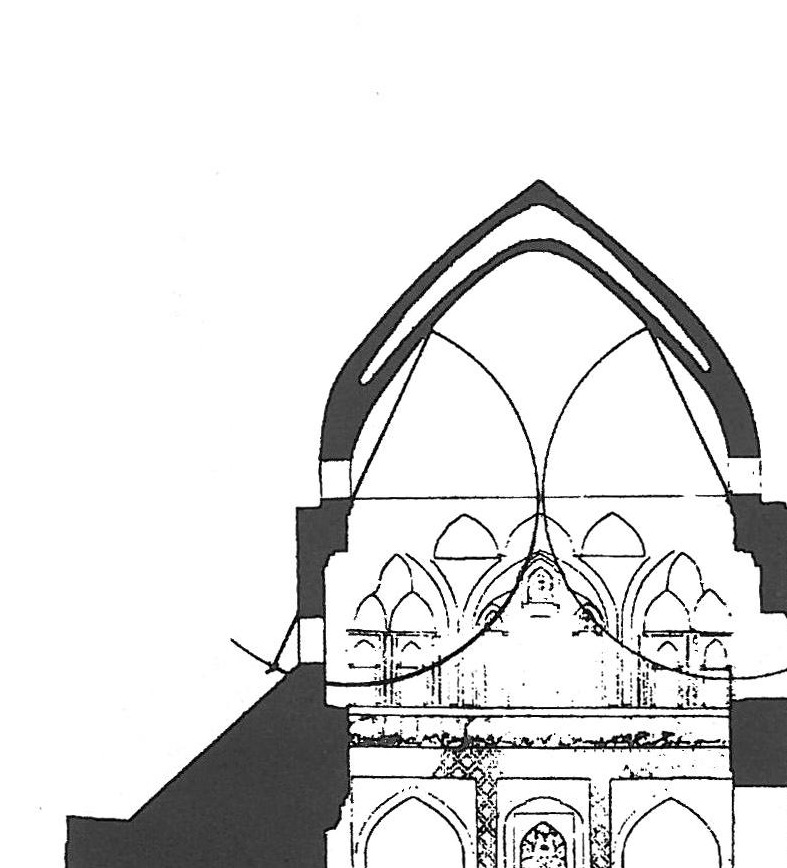
Urmia Jameh Mosque, dome section (Seljuk)
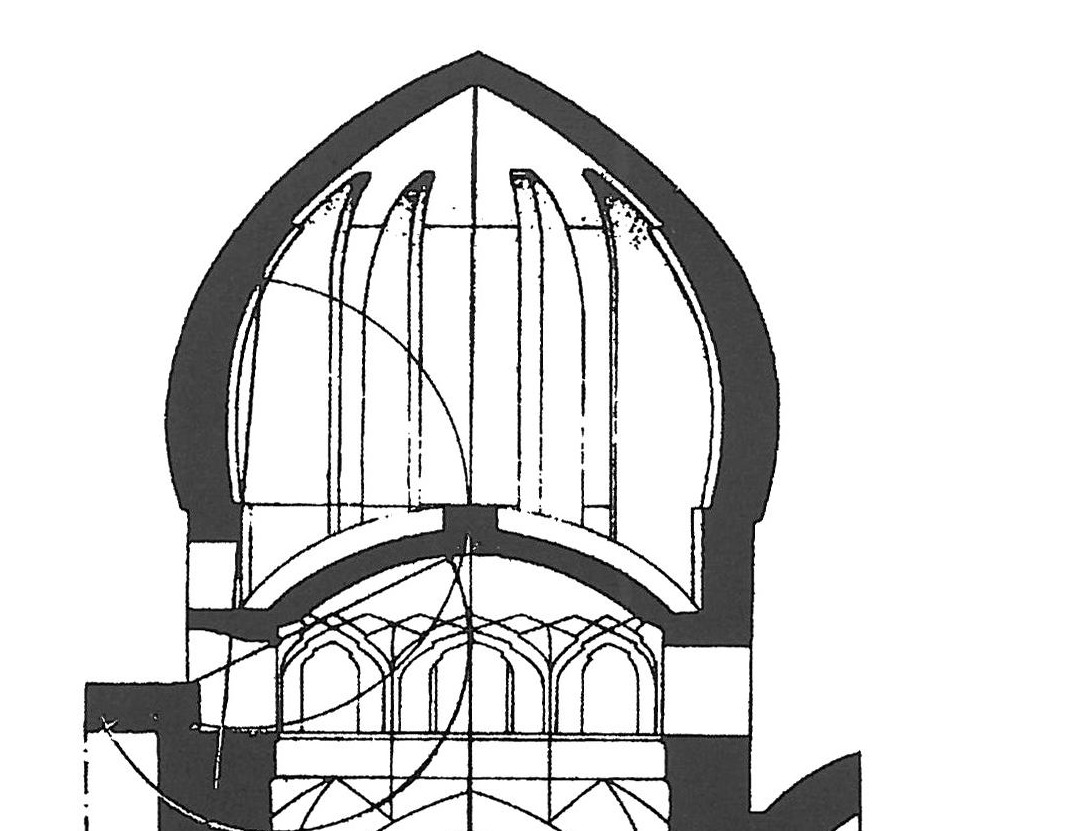
1. Where to place the centre of the semicircle. In testing the six domes, my most serious question was where to locate that centre. In Iranian dome practice the hardest part is finding the starting point of the curve at the paakaar (springing). What Pirniya calls paaraasti sometimes places the centre at the top of the small arches that transform an octagon into a sixteen-sided figure — a pointed squinch, as proposed for the Isfahan Friday Mosque's dome — and sometimes at the springing of the upper dome (as in the section of the Yazd Friday Mosque). Is the centre of the circle above the inscription band at the beginning of the dome's curve, as in the Aqa Bozorg Mosque-Madrasa or the Friday Mosques of Varamin and Barsian, or is it below the inscription, as in the Friday Mosque of Urmia? On what basis did the author choose his semicircle centre, and by what evidence can it be shown that the dome's curve begins in one of those three positions rather than another?
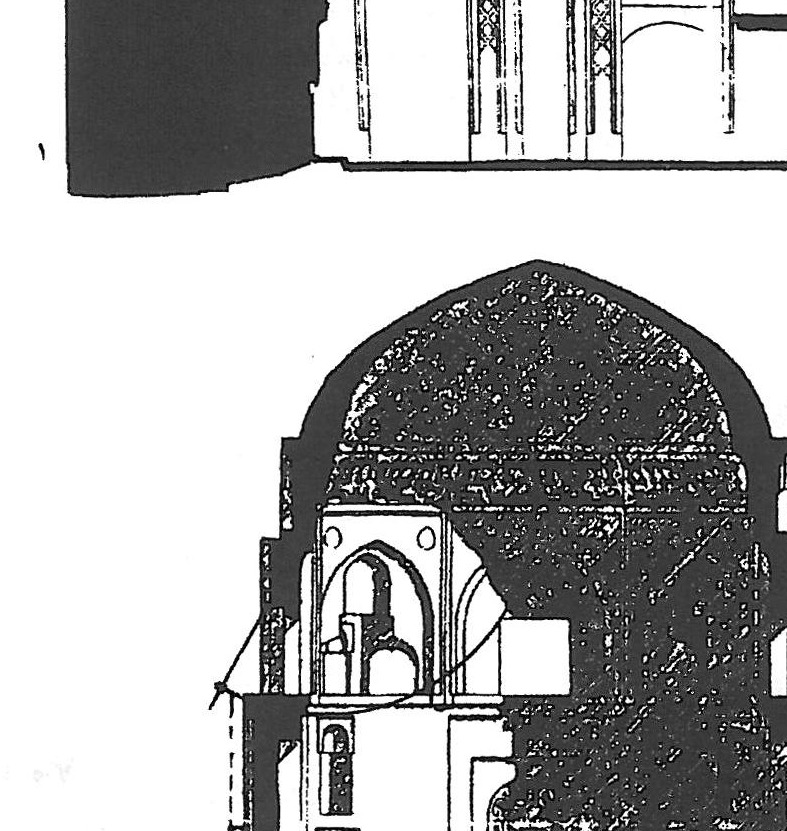
Davazdah Emamzadeh, dome section (Seljuk)
2. The principle of opposing forces. An architect partly resolves stability problems by the way he places the adjoining spaces around the domed chamber. Thrust is much less troublesome where a vault is bounded by iwans, prayer halls and other spaces than where its back is open. In the Friday Mosque of Ardestan, for example, a large later buttress was built on the qibla side of the dome chamber, while the other sides were left as they stood; in the Friday Mosque of Yazd, similarly, the qibla pier is thicker than the rest. Of the nine buildings in Afshar Naderi's paper, five are surrounded by adjoining spaces and four are more kushk-like (free-standing). A sounder test would take each dome at two faces at the same time — one where adjoining spaces exist, one where they do not.
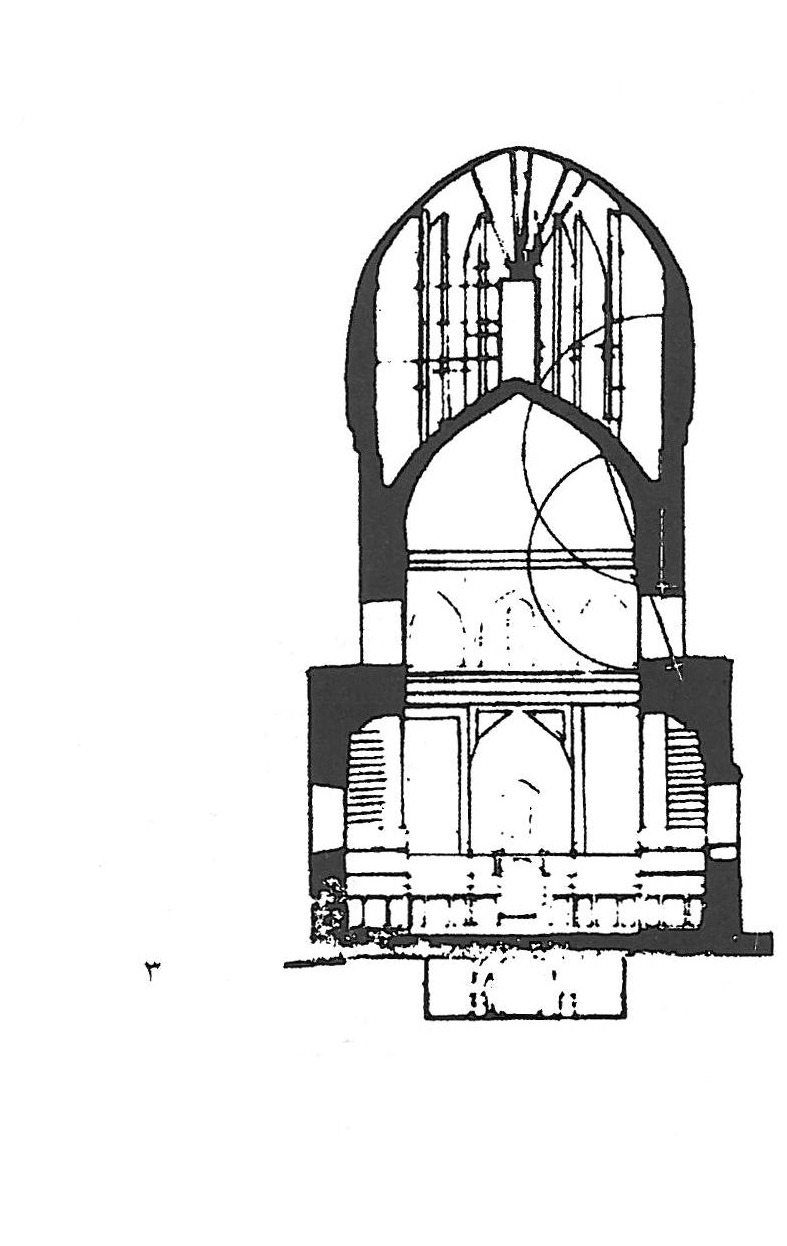
Gur-e Amir, Samarkand, dome section (Timurid)
3. From where should the pier thickness be measured? In six of the nine buildings the paper measures the pier thickness at the boshn (the drum), and in three (the Friday Mosques of Varamin and Barsian and the Friday Mosque of Saveh) at the chepireh (the zone of transition from square to octagon to hexadecagon). Stability problems concentrate at the springing; there the whole weight from above produces the maximum thrust that can break an arch or a dome. This is precisely where Western architecture suffered most, so that Brunelleschi and Michelangelo designed various buttresses to resolve the thrust at Santa Maria del Fiore and St Peter's. The Iranian masters' achievement was to calculate this zone so that an appropriate pier could be designed, with pier thickness derived from it — historically below a ratio of 1:16 to the dome's span, a figure reached through long experience. For the results to be sound, the paper should give, for each of its nine domes, a single precise point for the centre of the semicircle and a single precise point for the dome's thickness, rather than measuring the thickness from the lowest part of the domed chamber to the springing.
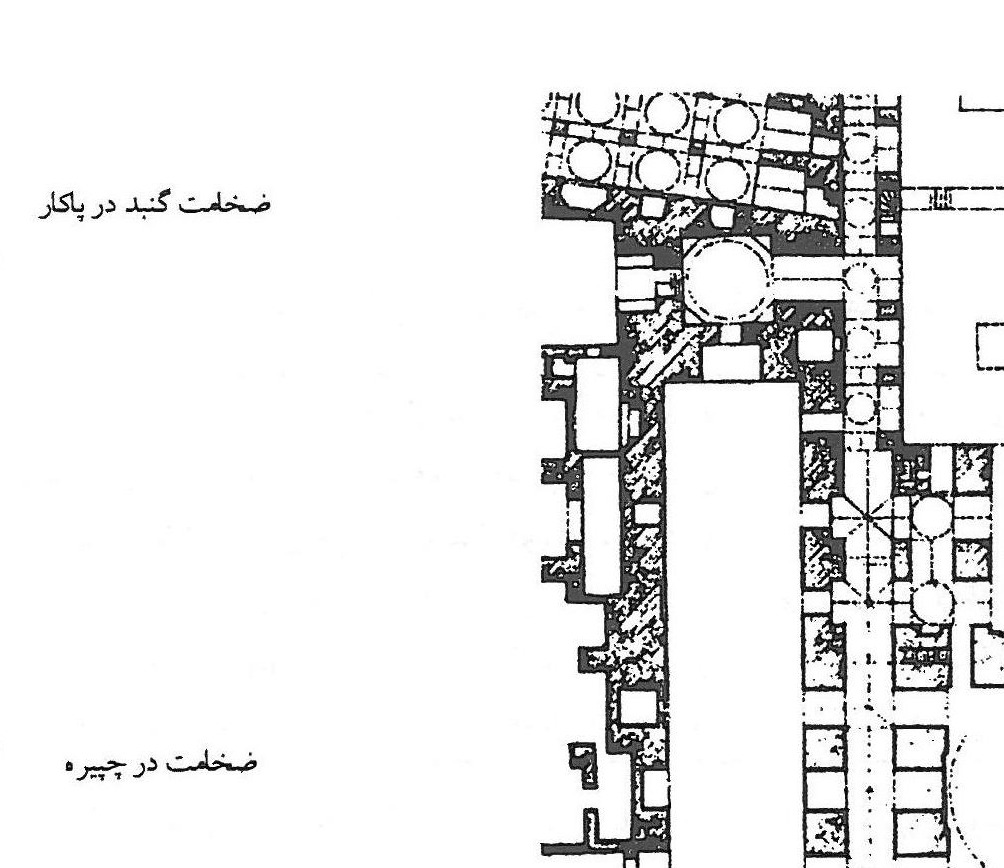
Where to measure the dome thickness: at the springing (pakar) and the squinch (chapireh)
4. The drawing method and the structural variety of Iranian domes. Iranian architects have been building domes for some 2,000 years. Before the Seljuk period a great variety of single-shell, ribbed and discontinuous two-shell domes had already been built. How was the right pier thickness found for pre-Seljuk domes such as the tomb of Shah Ismail the Samanid in Bukhara, the tomb of Arsalan Jazib in Sang-Bast, or the Sasanian and Parthian domes? Were those experiences abandoned in the Seljuk period in favour of a new method? And beyond this, every Iranian dome has its own structural behaviour; can a single drawing method answer several quite different static behaviours? The dome of the Friday Mosque of Saveh (a free-standing discontinuous type, rok) and that of the Aqa Bozorg Mosque-Madrasa (a slender discontinuous type, naar) are of the same family; yet the paper draws a single semicircle for the first and two semicircles for the second, and the reason is not clear.
Mashhad, Haftad-o-Do Tan Mosque, dome section (Timurid)
5. Accuracy of the plans and sources. Of the nine plans in the article, at least two (Urmia and Semnan Friday Mosques) are from Pope and one (Sultan Sanjar's tomb) from Hoag; all three are quite schematic and differ from those held by the Cultural Heritage Organization. There are captioning and textual errors that can be corrected as follows: (a) the figure on p. 79, bottom-left, is the Aqa Bozorg Mosque-Madrasa, not the Moshtaqieh Dome of Kerman; (b) the figure on p. 80, middle, is the Friday Mosque of Saveh, not the tomb of Shah Abdolazim — a dome of the early Safavid period.
Notes:
1. Gh. Memarian, La Struttura Statica nell'Architettura Islamica dell'Iran, tesi di laurea, Genova, Facoltà di Architettura, 1986. 2. See Mohammad-Karim Pirniya, “Gonbad dar me'mari-ye Iran” (Domes in Iranian Architecture), Athar, no. 20, 1991, p. 143. 3. Ibid., p. 144. 4. Ribs — nervatura. 5. The two plans from Pope and Hoag can be found in Barresi-ye Sazeh-haye Taaqi, Tehran, Jihad Daneshgahi, 1988, pp. 149-151. For a more accurate plan of the Semnan Friday Mosque see Athar 24, p. 78. 6. Ibid., p. 139.
Kamran Afshar Naderi's reply
Mr Memarian's remarks raise two principal points. First, that the rule I set out does not hold for all Iranian domes. There is no argument about that; I cannot imagine that any rule in architecture holds without exception across all buildings from all periods. What one can claim is that a rule holds for a particular group of buildings — the exception, indeed, confirms the existence of the rule. Second, that the rule I proposed deserves closer study and that the reference points of the measurements should be established with much greater precision. On this, too, I grant the point to him.
I should add that Mr Memarian and I were classmates at university. We both wrote our theses on the history of building science in Iran at the Institute of Building Science under the same supervisor, Professor Benvenuto. Professor Benvenuto, one of the best-known figures in the field today — and the same man who approved Mr Memarian's thesis — discussed the results of my research in his most recent book, An Introduction to the History of Structural Mechanics. Given the importance of the question, and my respect for Mr Memarian's interest, learning and command of the material, I would ask him — as a colleague and fellow student — together with other scholars, to take this debate forward and publish more precise results.