Contemporary Architecture

Sayeh Residential Building, Tehran

Ali Haghighi, Mohammad Mahdi Zamani·Photos: Deed Studio, Ali Haghighi·Memar 142 — 23rd Memar Award
Sayeh Residential Building, Tehran

Location: Zafaraniyeh, Asef Street, Hosseini Street, Razi Alley, Tehran

Client: Mr. Shakeri

Design Team: Ali Haghighi, Mohammad Mahdi Zamani, Hadi Ahmadi, Samar Asghari, Neda Feyzmand, Majid Izadyar

Construction: Mahdi Mohammadi, Mohammad Mahdi Khoshnood

Supervision: Hadi Ahmadi, Mohammad Mahdi Zamani

Electrical: Mohammad Khavaninzadeh · Mechanical: Hosseinali Rahmani

Graphic Design: Mohammad Mahdi Zamani, Samar Asghari, Matin Hatam

Photography: Deed Studio, Ali Haghighi

Total Built Area: 3,500 m² · Site Area: 607 m²

Studio: Ali Haghighi Architects

Score: 8/15

◆ ◆ ◆
A Structure Inherited

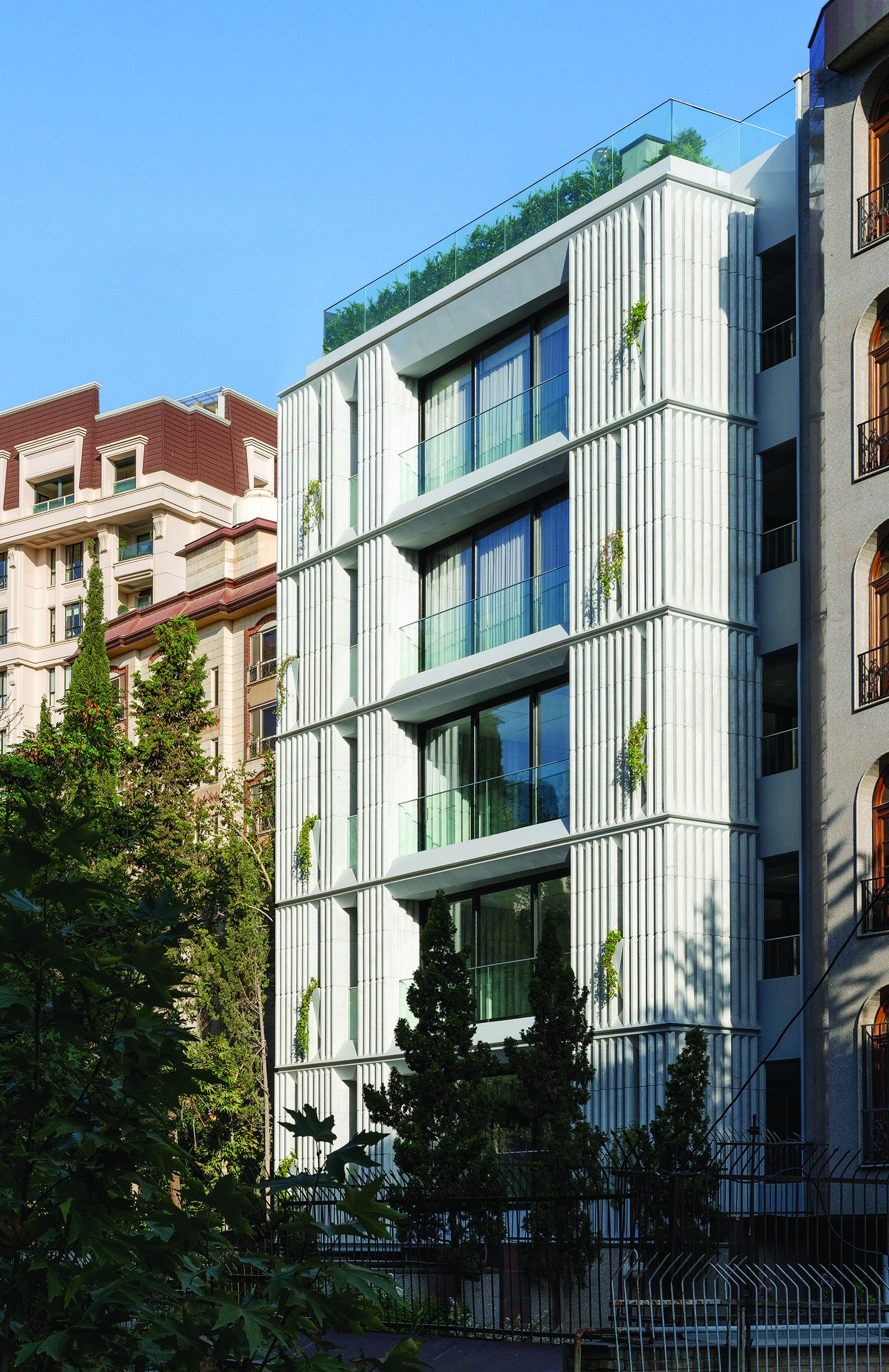
The project was referred to our office at a stage when its structure had already been built based on an ostensibly classical design. The client's wish at that time — influenced by a different current, the so-called "modern" — was to revisit the design of the plans and the facade. The already-constructed structure imposed certain constraints upon us, including the existing column placement, the relatively low floor heights, and a 45-degree chamfer on the facade.
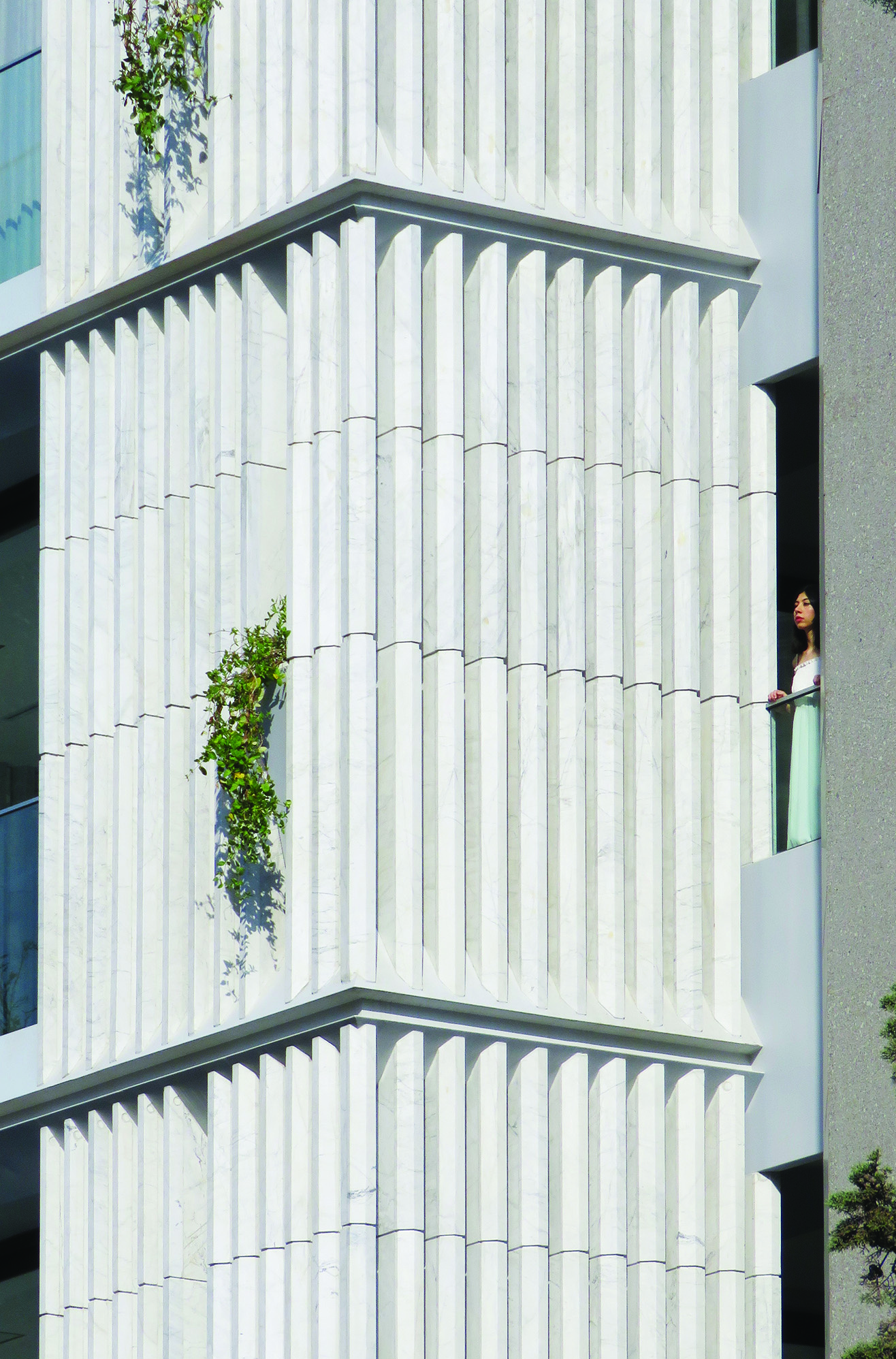
Close-up of the white carved stone louvers on the Sayeh Building facade, with trailing greenery emerging between the vertical fins and a resident visible through an opening
Stone louvers in close-up — carved and polished bars with trapezoidal cross-sections create a rhythm of light and shadow

Simultaneously with revising the plans and achieving the desired spatial order, the central idea was to design a facade that, beyond conveying an overall sense of simplicity — in a context where excess of color, material, and superfluous detail has disfigured the urban landscape — would, by returning to the principles of aesthetics, including proportion, scale, rhythm, and the balance of vertical and horizontal lines, arrive at a perception of a static whole that nonetheless possesses dynamic details.
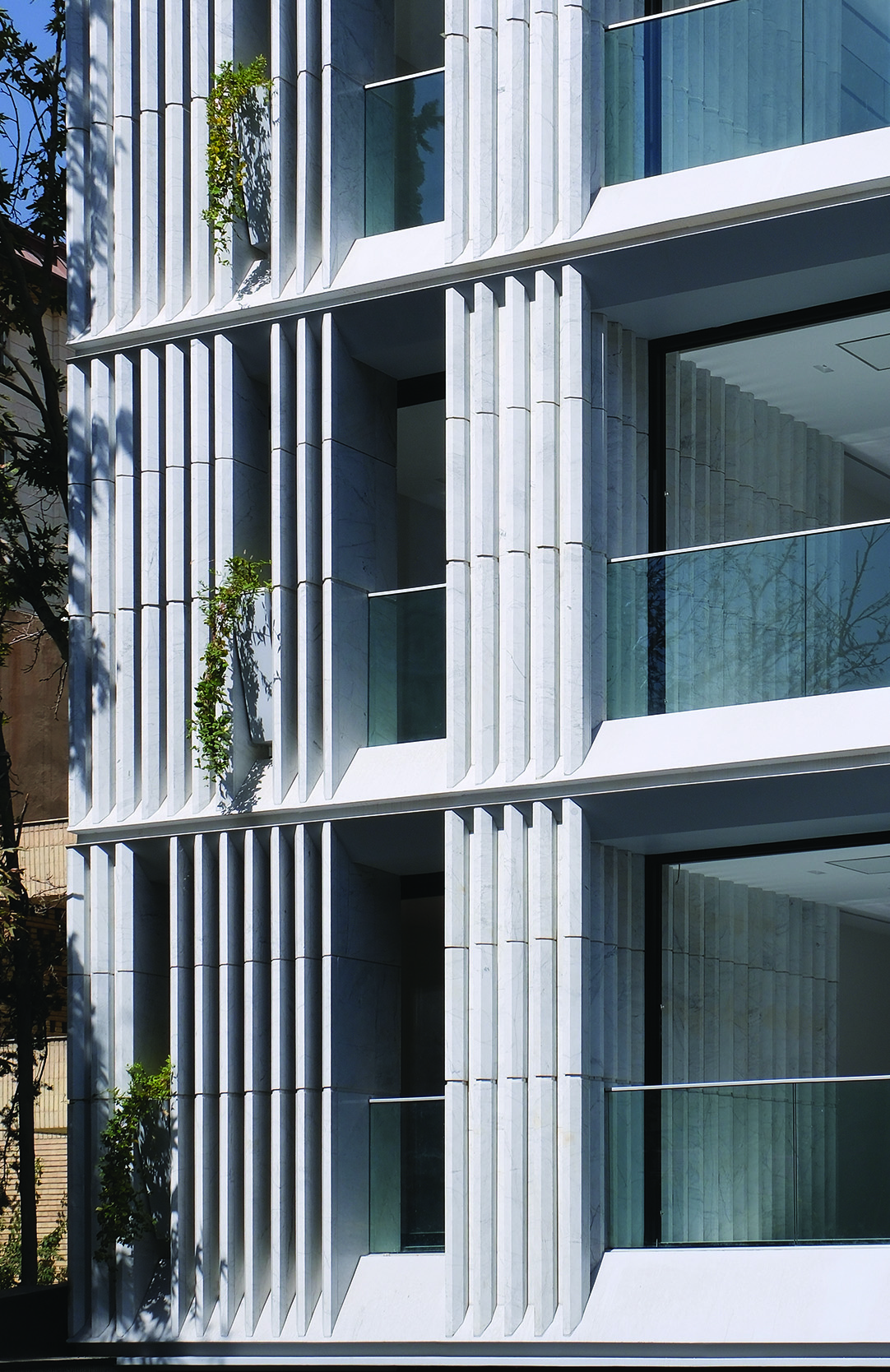
Detail of the stone fins and glass windows on the Sayeh Building facade, showing greenery growing between the vertical louvers
Vertical stone fins frame glazed openings, with plants taking root in the intervals
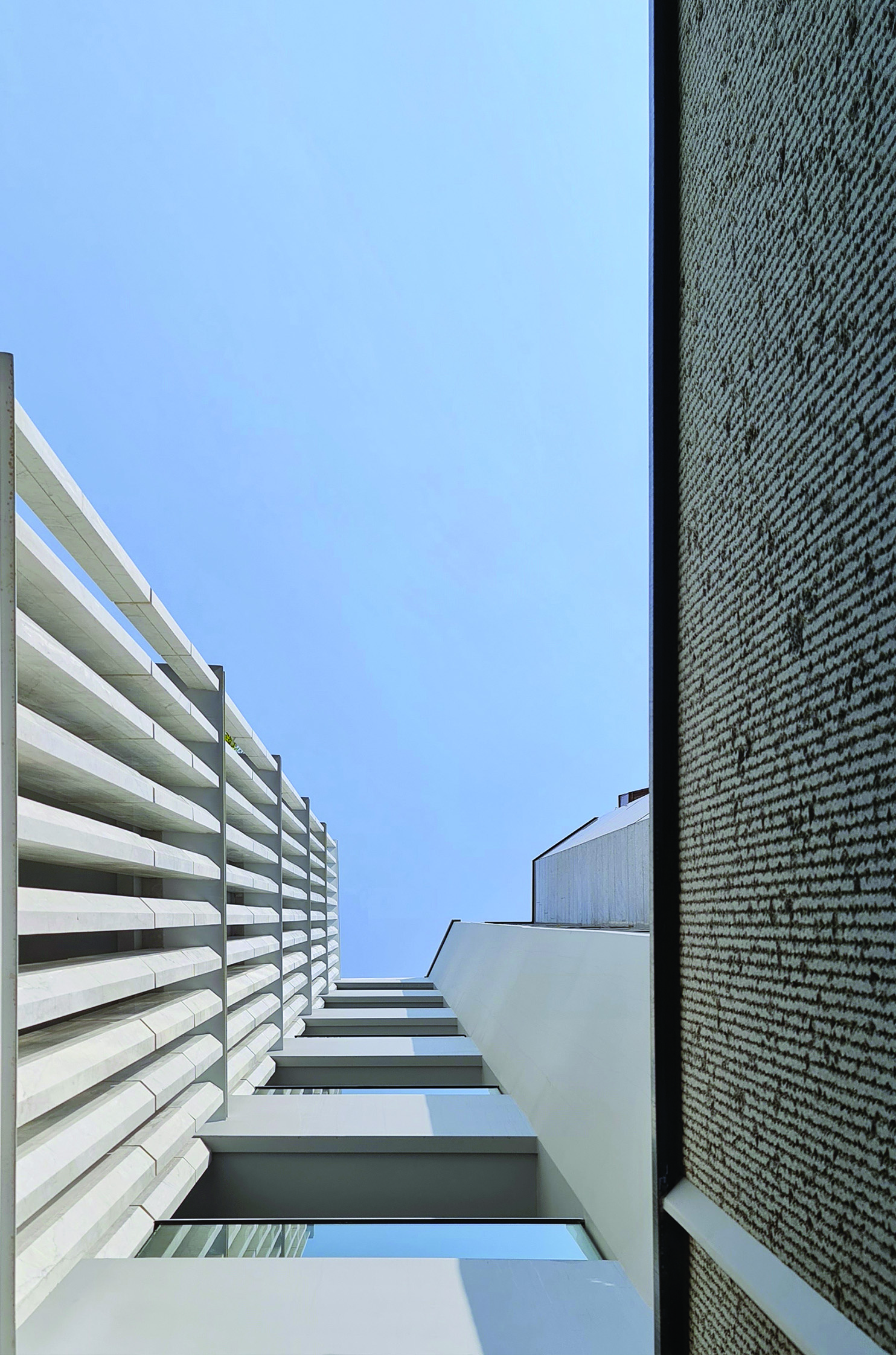
Looking upward between the Sayeh Building and its neighbor, the vertical stone louvers receding into the sky against a brick wall
Looking upward — the louvers recede into the sky, their horizontal rhythm punctuating the ascent
◆ ◆ ◆
Stone Beyond the Facade

The residents of this building feel the stone beyond the facade, within their living spaces. The carved and polished stone bars, which pass through the facade skin as vertical louvers with a trapezoidal cross-section and enter the principal interior spaces, not only partially enclose the more private areas — the guest room and the terrace — but also bring reflected natural light into the interior at different hours of the day.
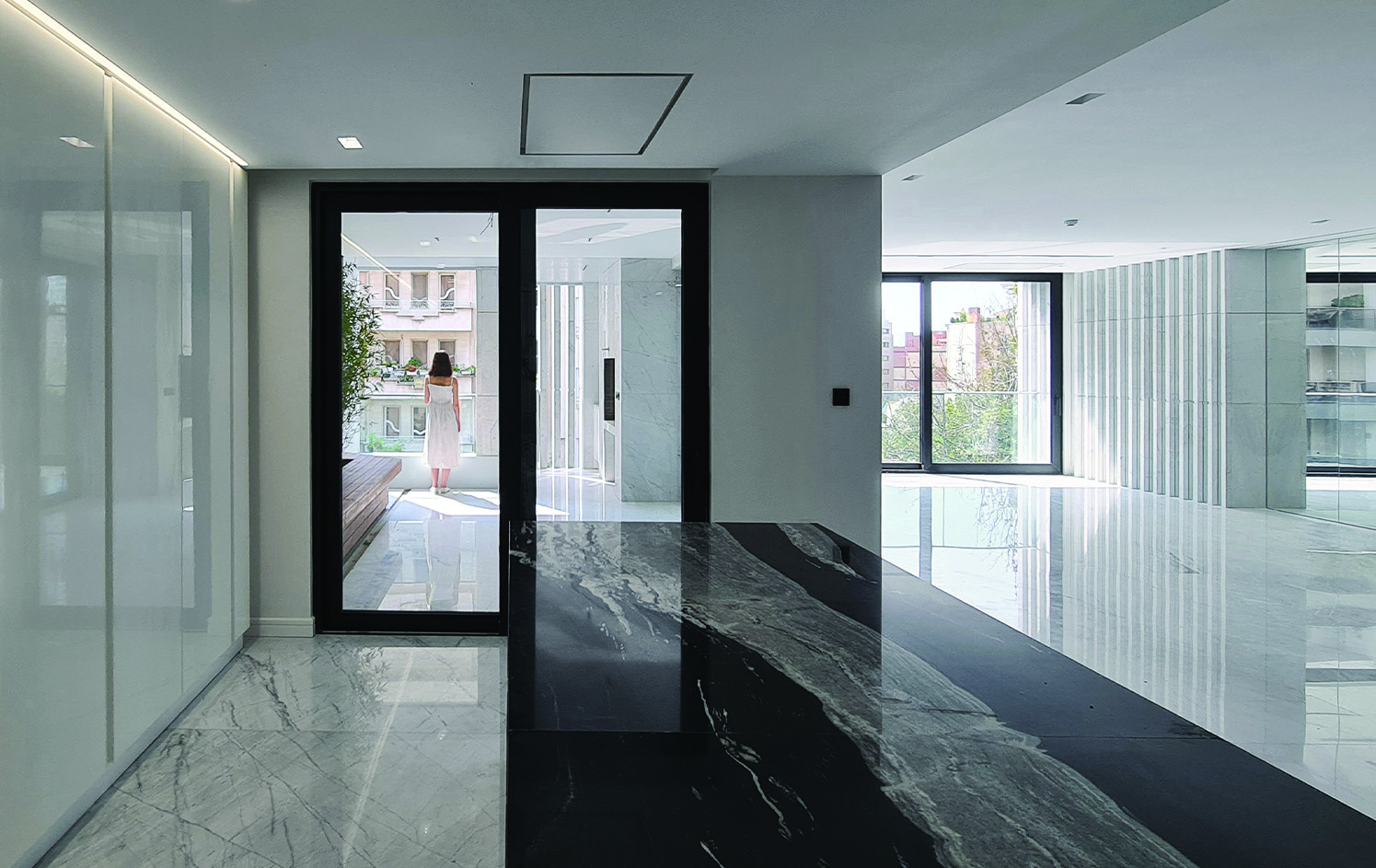
Interior of a Sayeh Building apartment showing a spacious living area with black and white marble flooring, glass doors opening onto a terrace where a woman stands, and stone louvers visible through the window
The living space — black and white marble floors, glass doors to the terrace, stone louvers filtering the city beyond

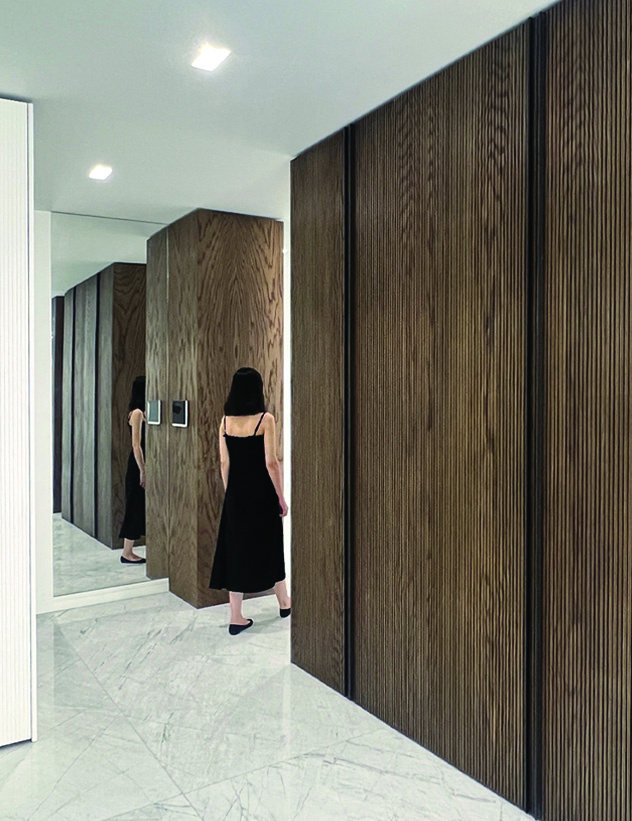
The varying cut angles of the stone bars in the facade skin's arrangement create different shadows and half-shadows at different times of day, and their white, polished surfaces also play a role in reflecting direct sunlight inward. Furthermore, the details of the stone bars — extending into the interior and combining with vertical mirrors — create a harmonious interplay of light, shadow, and reflection that, in addition to lending depth to the facade, fosters a dreamlike and poetic perception of the interior space.
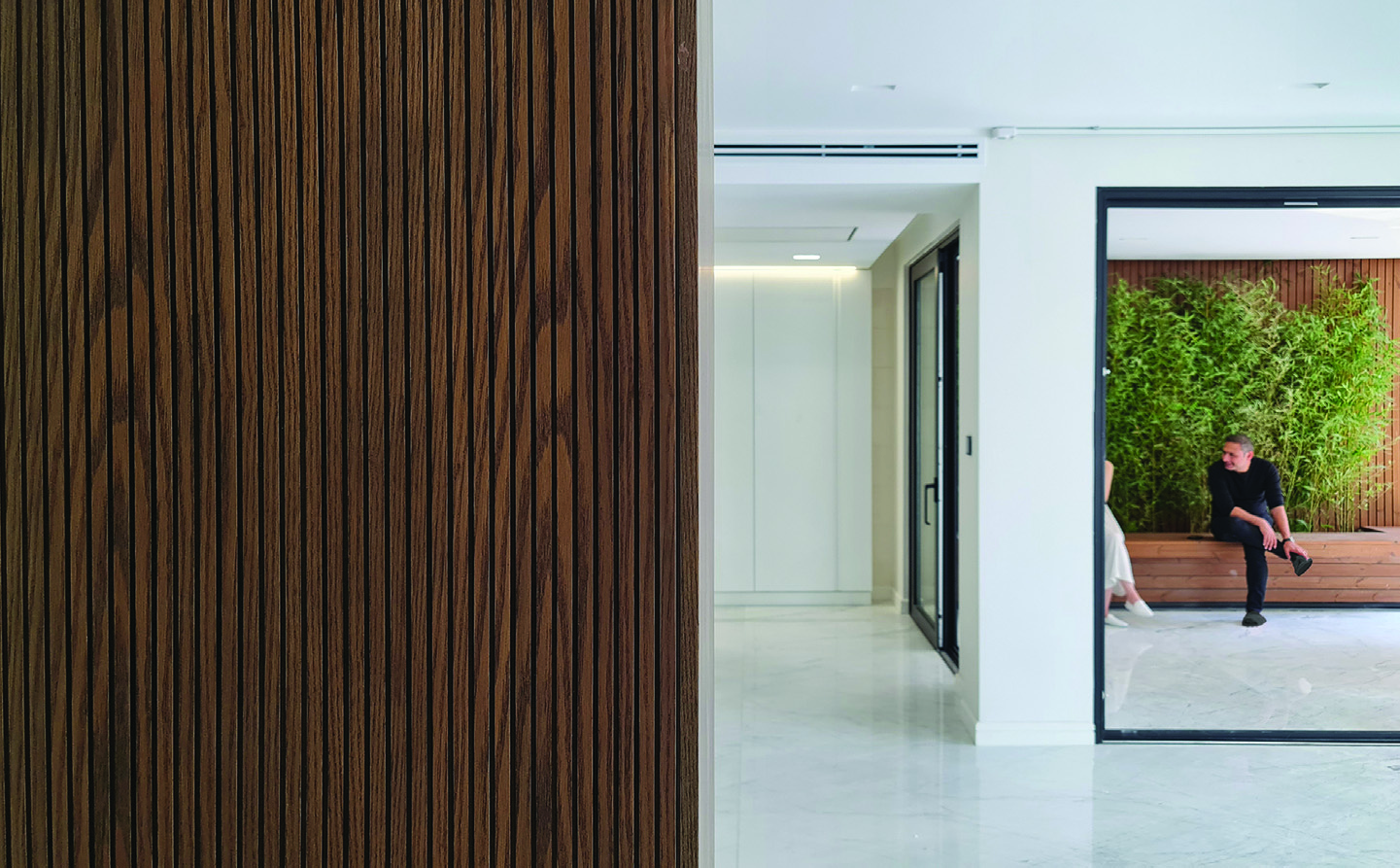
Interior view past a dark wood-paneled wall toward a glass door opening onto a green courtyard, where a man sits among bamboo plants
Wood paneling gives way to a lush interior courtyard — a pocket of green within the building
A woman walks through an apartment corridor lined with dark wood panels and full-height mirrors on a marble floor
The corridor — wood panels and mirrors create depth and a sense of quiet passage
◆ ◆ ◆
Interiors & Common Spaces
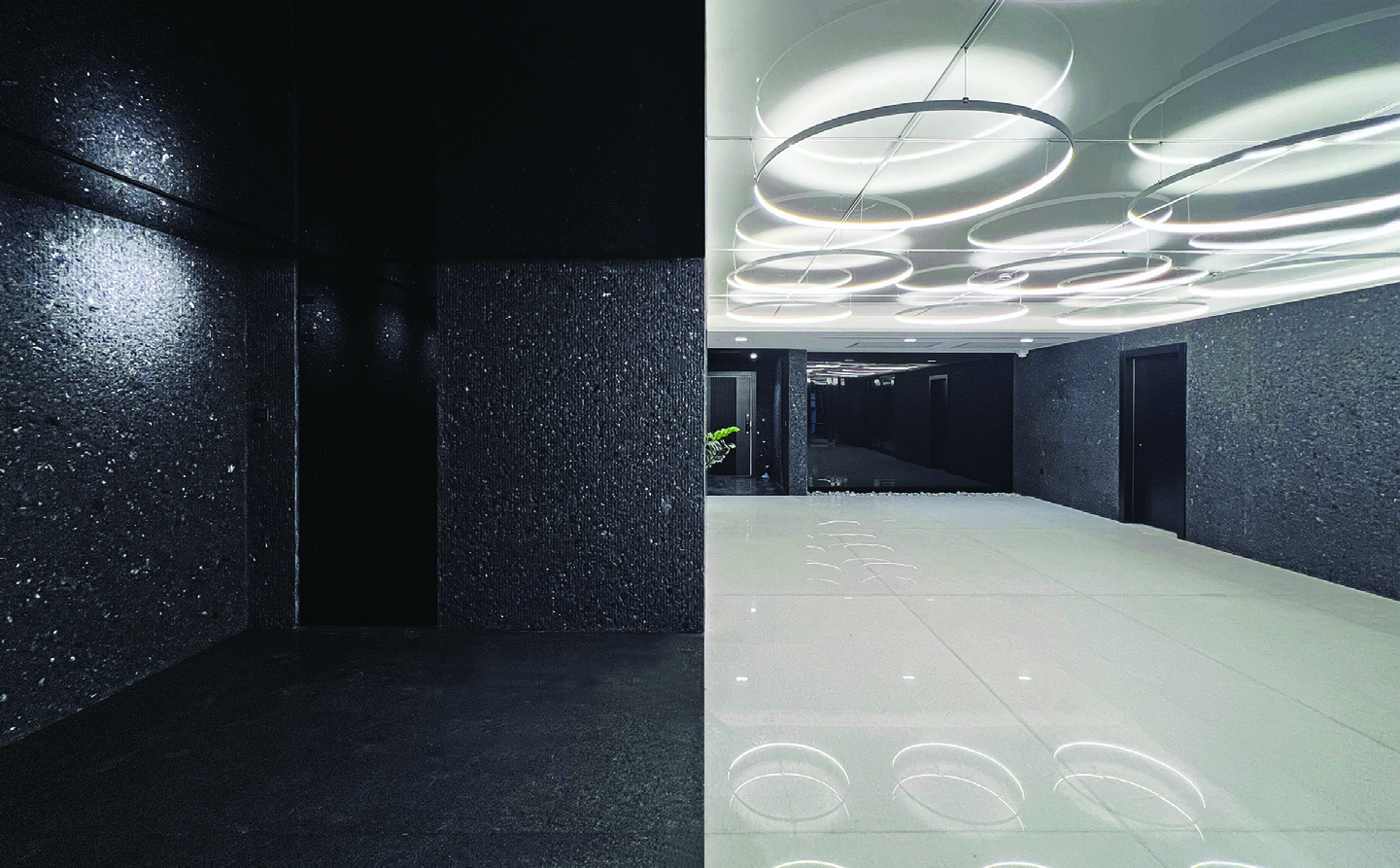
The building lobby split between dark terrazzo walls with dramatic lighting on the left and a bright white reception area with circular ring pendant lights on the right
The lobby — a contrast of dark terrazzo and luminous white surfaces beneath concentric ring lights
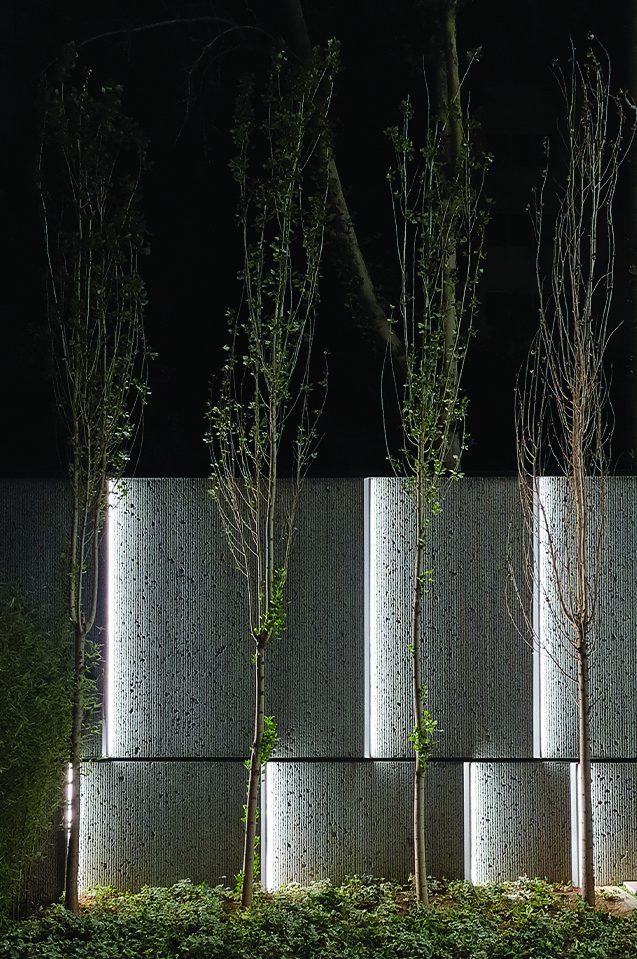
Night view of the building's garden wall with uplighting illuminating young trees against textured stone panels and low ground cover
The garden wall at night — young trees uplighted against textured stone panels
◆ ◆ ◆
Plans & Diagrams
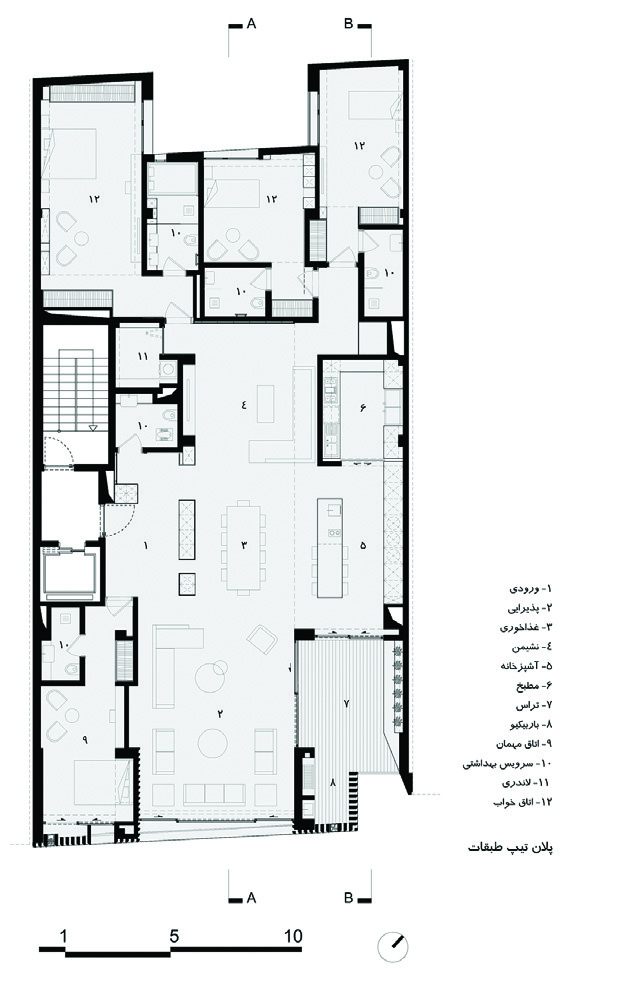
Typical floor plan of the Sayeh Residential Building showing the layout of rooms, terraces, kitchen, and living areas with Farsi labels
Typical floor plan — 1. Entrance, 2. Reception, 3. Dining, 4. Sitting room, 5. Kitchen, 6. Study, 7. Terrace, 8. Barbecue, 9. Guest room, 10. Bathroom, 11. Laundry, 12. Bedroom
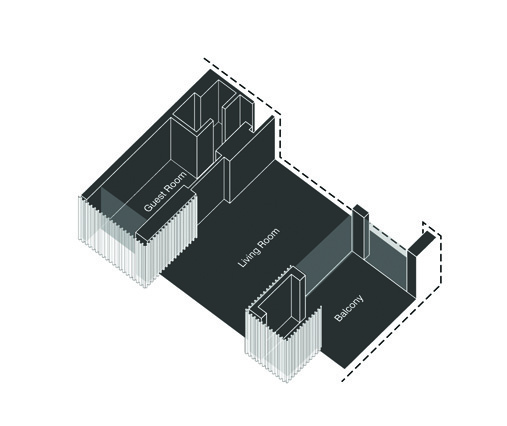
Axonometric diagram showing the spatial arrangement of a typical unit with guest room, living room, and balcony labeled
Axonometric view of a typical unit — the stone louvers extend from the facade into the guest room and living room
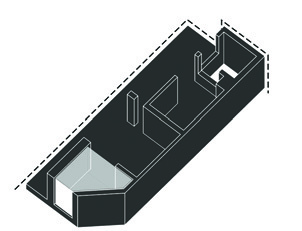
Axonometric diagram of a smaller unit configuration
Small unit
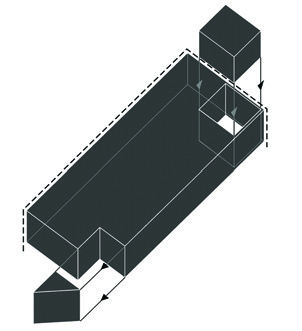
Axonometric massing study showing the building volume with two projecting elements
Massing study
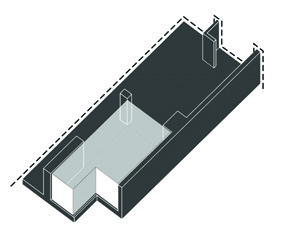
Axonometric diagram of a unit variation with different spatial arrangement
Unit variation
Memar Magazine
Iranian Bimonthly on Architecture and Urban Design · Issue 142 · December 2023 – January 2024

Related in Architecture Database