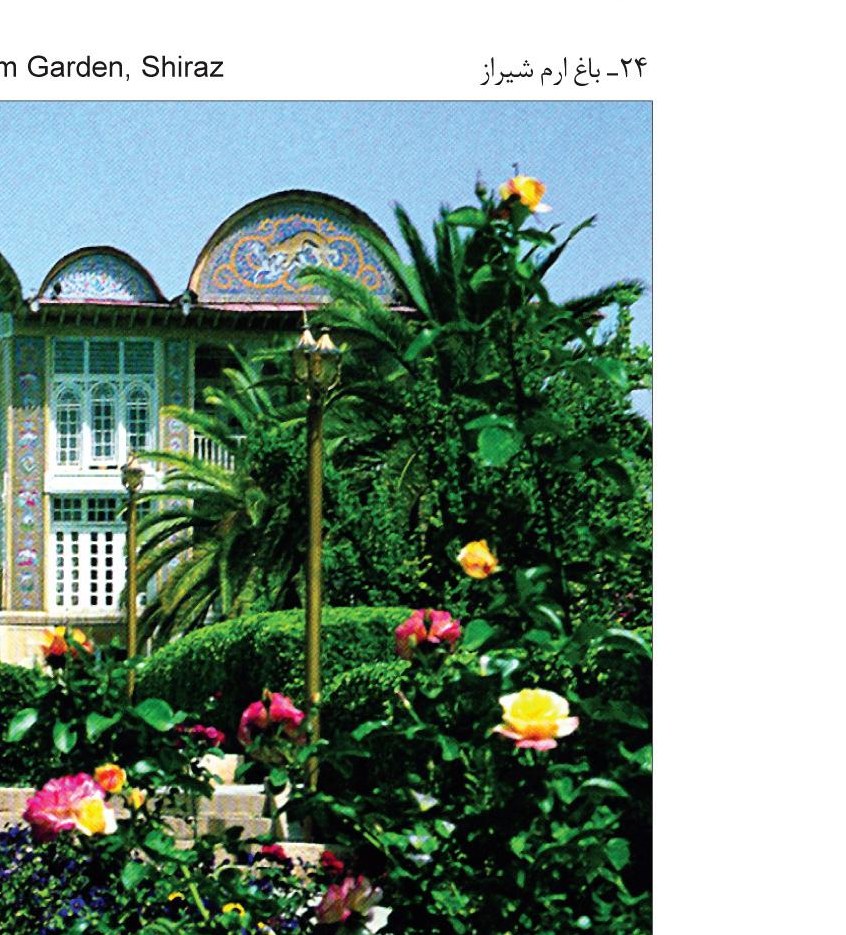
Throughout history, the most beautiful activity of humankind was the making of gardens. When we realize that the Iranians, from some six or seven thousand years ago, worked so long upon wild flowers and plants until they were at last able to turn them into today's beautifully coloured, fragrant flowers, their reasons are entirely understandable, for by this means people obtained food. Yet one may say that the aesthetic dimension, too, drove people to order and enclose nature. Some historians hold that women pressed men to give up hunting and take up agriculture and animal husbandry; I think women also had a part in cultivating flowers and plants and in creating the garden.
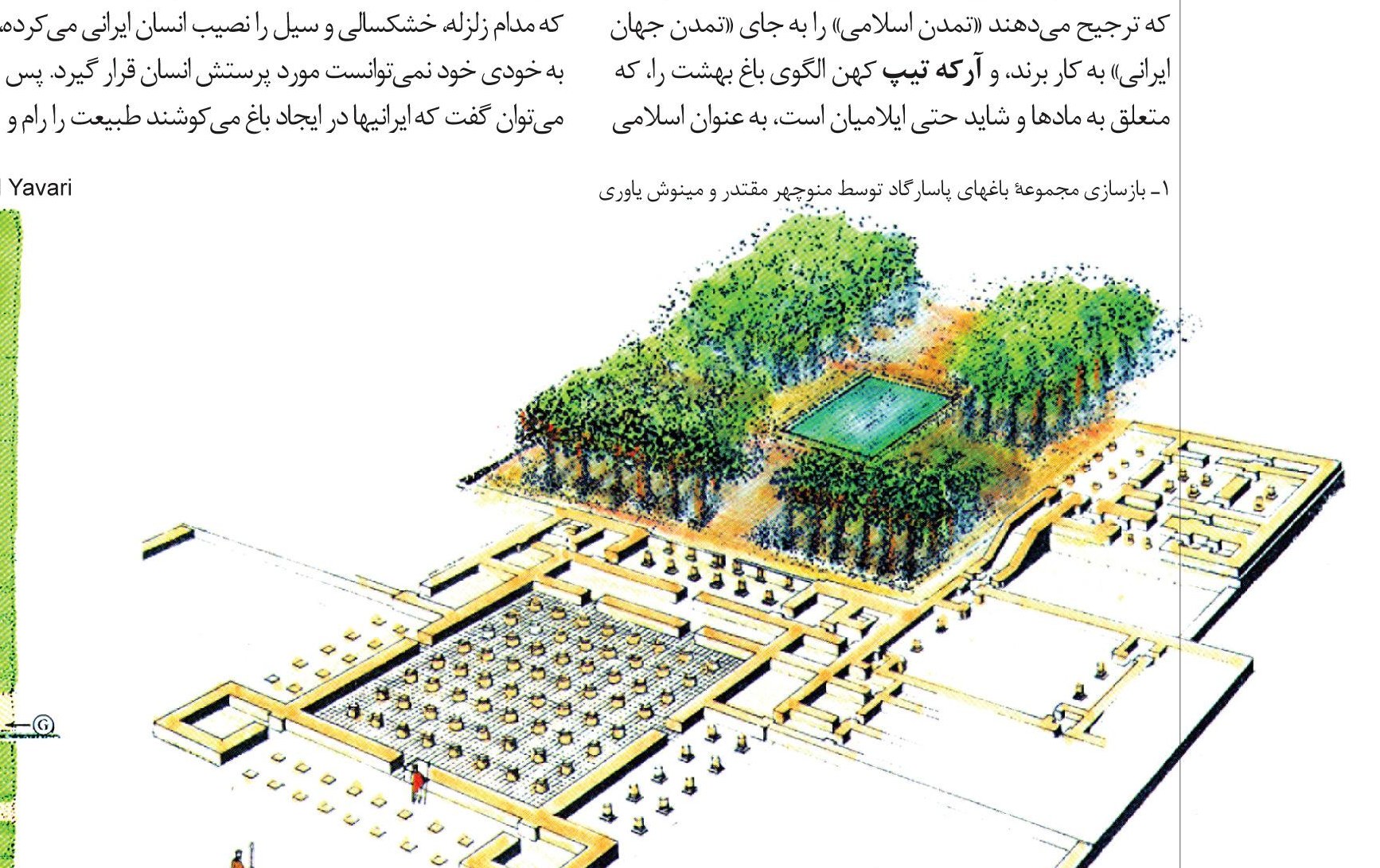
The chaharbagh (fourfold garden) designs were made in the Achaemenid era. The term “Islamic garden” arises from the laziness of Western researchers who prefer to use “Islamic civilization” in place of “Iranian civilization,” whereas the ancient archetype of the Paradise garden belongs to the Medes and perhaps even the Elamites. According to Henry Corbin, the archetype of the Paradise garden has always existed in the collective unconscious of the Iranian people. Another astonishing point in the history of garden-making is that there are only two types of garden design in the world: the Persian garden and the Japanese garden, and all other garden designs stem from these two. The Spanish, Indian, Italian, French, and North African gardens follow the Persian design, and the Chinese, English, American, and other natural gardens follow the Japanese. These two express ideas and feelings that, above all, bring joy and pleasure to the human being and, in a way, create a balance between human and nature.
The interaction of the Japanese mind with nature stems from the beliefs of Shinto and Zen Buddhism. In Zen, painting a mountain is considered a kind of worship and is called “sansui.” The mountain — the most important element of the Japanese garden — is manifested as a definite number of rocks; and one may say that, unlike the Iranians, the Japanese are the servants and worshippers of nature. These two cultures, then, have two entirely different visions of the world and of nature, and these two visions are manifested, in a way, in the making of the garden.
In the culture of the Iranians, the garden is paradise on earth. A wall is drawn all around it to keep the clamorous world outside away from the ordered world within and to allow it no penetration. According to Zoroastrian beliefs, the garden must have seven layers of wall so that demons cannot enter. In the view of some researchers, the border edges of the Persian carpet are in fact an expression of those very walls around the garden. Making water flow to the four sides of the garden divides it into four parts, and the streams originate from it. From 4,500 years ago until now, the symbol of the Sumerian civilization — two rivers crossing each other at right angles and dividing the world into four parts — has remained in force in the various religions of the world. Professor Ernst Herzfeld was the first archaeologist to discover and interpret the “four-part” motifs in the ruins of the city of Samarra. This chaharbagh pattern became so important that it also appeared in the design of Persian carpets; and despite the diversity of Iran's climate and weather — from the verdant shore of the Caspian Sea to Khuzestan and to the mountainous regions — everywhere this same pattern and this same geometric structure bring the garden into being.
In Japan too, despite the small extent of this land, there is much climatic diversity; geographically Japan has a sub-polar region and shares common aspects with the land of Iran. Japanese gardens have a unique beauty that comes from the combination of several elements: one is the beauty arising from the combination of plant, sand, water, and rock; another is the beauty of the natural scenery of Japan, which is completely transformed with the change of season; and, of course, conceptual and symbolic beauty. The rocks of the Japanese garden are called “yobitsu,” meaning “the boundary of paradise” or “the seat of paradise.” The dense gathering of trees, too, is called “hedono,” meaning “density.” In the Japanese garden, nature is imitated, and the garden strives to connect itself to nature.
In Iranian mythology, the spring, the well, or the mountain peak — all of them manifestations of water — are considered sacred, mysterious places. The source of the water is sometimes 70 kilometres from the garden and is in fact the symbolic beginning of the garden. In the heart of the desert, the Persian garden makes the fullest use of this water to build an “introverted, dense unit” and to separate itself from nature — unlike the Japanese garden, which connects itself to nature. The first Japanese gardens appeared in the mountainous region of “Yamato,” now called “Asuka,” in the sixth century. In the sixth and seventh centuries, Shinto thought gave way to Buddhism, and thereafter Buddhism's influence became evident in garden design. In the year 794, the capital was moved from Nara to Kyoto, into a very beautiful and poetic natural setting in which several rivers meet.
In the eleventh century, in the late Heian dynasty, an anonymous nobleman set down the rules of garden-making in the book “Sakuteiki.” Almost five centuries later in Iran, the treatise “Ershad al-Zera'a” was written, in which Abu Nasr Heravi set out the rules for designing and building the ideal garden. In the Sakuteiki, the principles of garden design are stated thus: first, the existing ground and water should be taken into account; then the beautiful natural places engraved in memory and mind should be recalled; and then the final site of the garden should be chosen. The golden age of Japanese garden design was the “Muromachi” period, which lasted from 1332 to 1568. In this period, master craftsmen called “sen-zui-riku-jin” (meaning “people of mountain, brook, and river”) were very active and created, at that time, the new style of dry garden, “karesansui.” These gardens were influenced by the “shoin” architectural style and by Chinese painting, and their aim was to display the world within a limited space and to attain the ideal space for the practice of meditation.
The structure of the Japanese garden rests on a diagram used from the fifteenth century until now, such that a natural landscape is created by means of definite elements. This diagram has 16 elements, all set around the “central rock” or “guardian.” Here it is no longer symmetrical squares that balance the space, but rather various elements that create an asymmetrical balance. The presence of all 16 of these elements is not always necessary, and one can use them in various ways and in differing numbers; these elements are much like the characters of a play: the central guardian rock, the small hill (the guest rock), the surrounding mountain, the sand beach, the main mountain, the distant mountain, the middle mountain, the mountain peak, the central island, the sacred rock, the owner's island, the guest island, the pond outlet, the mouth of the waterfall, the pond or lake (which is the heart of the garden), and the wide shore lines.
The structure of the Persian garden rests on these pillars: the two main water axes and their intersection with the other channels, which creates the four principal kart (beds); the planting of great trees along the main axes (especially cypress, pine, and plane); the planting of colourful, fragrant flowers without any particular order along the edges of the axes, with an emphasis on the rose, which draws the nightingale [to the garden]; and a fortress-like wall enclosing the garden all around, with one to four entrances in the four directions. In the Persian garden, the aim is to build an ordered paradise amid a world full of turmoil and disorder; but in the Japanese garden, the chief aim is to create a world [reduced from nature].
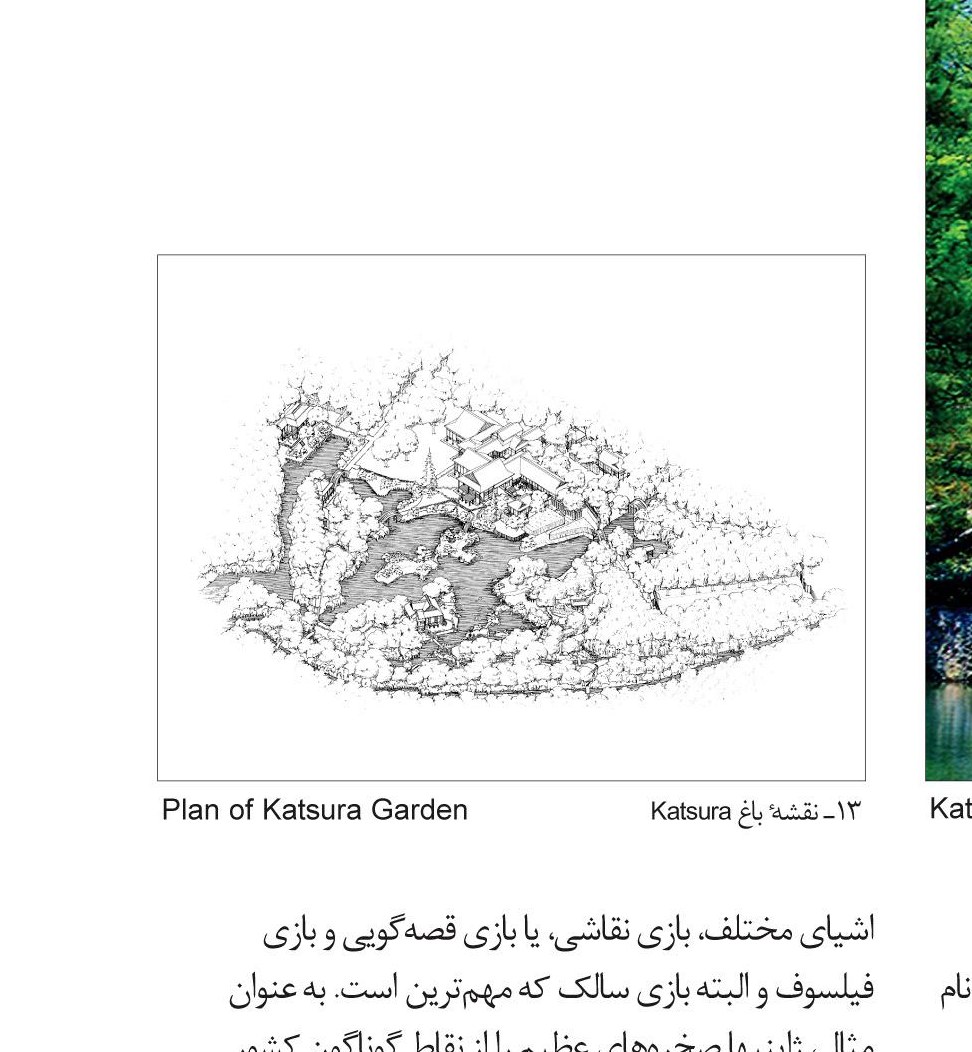
In the Japanese garden there is the term “borrowing from nature” (shakkei), in which the edges of the garden are connected to the surrounding nature; the best example of this is in the Katsura garden, whose end terminates in the forest. This is one of the most important features of the Japanese garden: the Japanese garden can be very small, yet from within it appears to be a fragment of the vast world outside and to have spread on every side toward the world around it. It may be that poets and mystics, by their presence in the Persian garden, gave it a spiritual and sacred dimension, but the essence of the Persian garden is founded on the seeking of pleasure; the princely gardens of Shiraz are for rest and delight. These two gardens — the two primal archetypes of humankind for paradise — spring from two fundamental attitudes toward the world and toward nature.