The small, ancient town of Natanz is located on the eastern edge of the Zagros Mountains, between the cities of Kashan and Isfahan. In the past, due to its location along a strategic and commercial route to the south of Iran, this town was considered an important and prominent urban hub for a considerable period of time. Nowadays, Natanz has lost its historic status as it sits far away from the main north-south arteries, and the effect is clearly visible in the decline of its population and physical development.
Natanz enjoys a relatively moderate climate with cool summers and cold winters. During the Safavid era, Shah Abbas I built two palaces on either side of Natanz and chose this town as a summer residence, with its surroundings serving as a royal hunting ground.
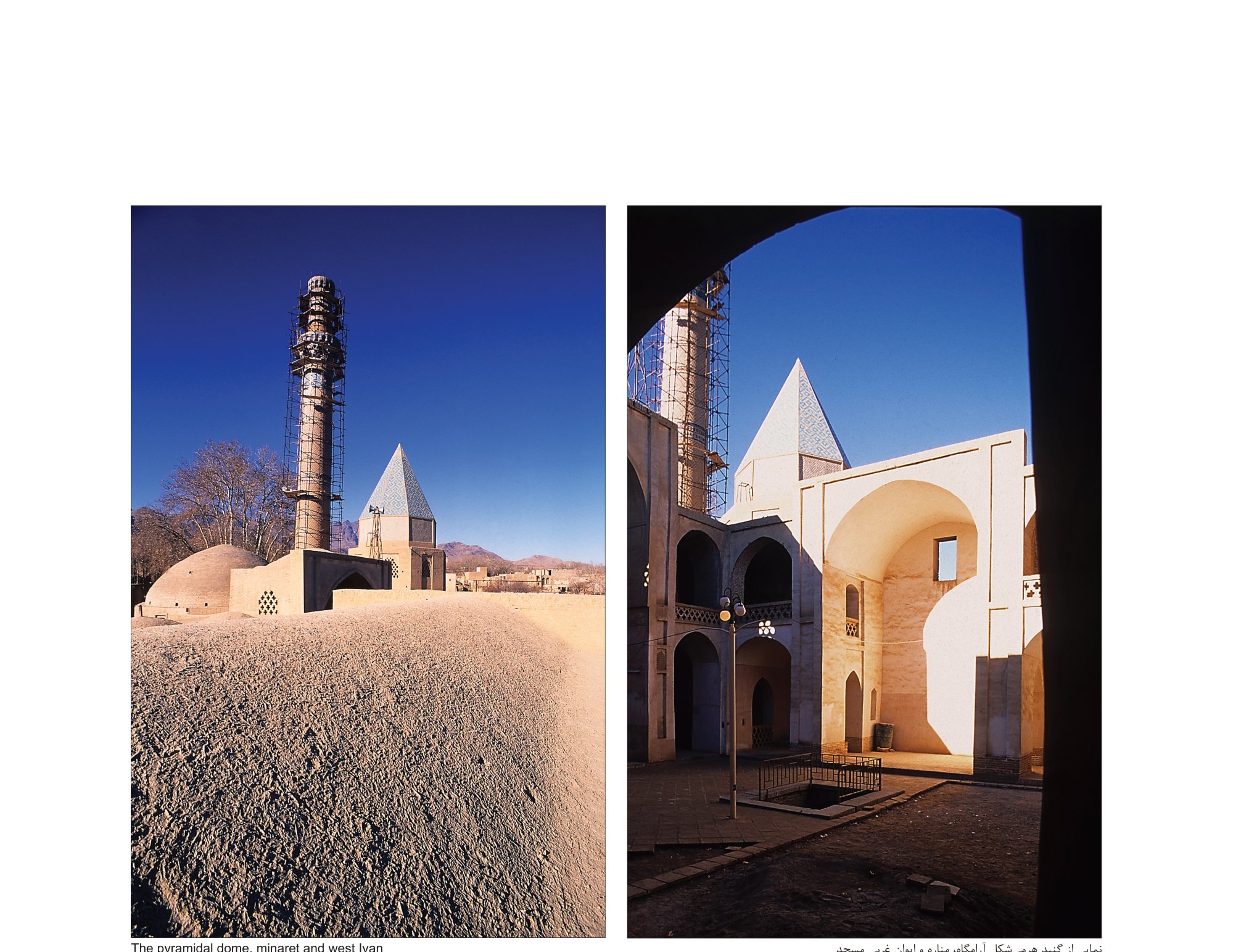
The Sheikh Abdolsamad Complex is a remarkably rare composition of valuable historic buildings, resulting from the juxtaposition and special interplay of several worship and mausoleum spaces. Despite its simplicity and modest scale, the complex possesses an extraordinary elegance and beauty. It comprises various spaces including an octagonal domed shabestan, the mosque building, the main tomb of Sheikh Noureddin Abdolsamad, as well as a portal, khanqah, and a tall minaret.
With the exception of the domed shabestan, which dates from the Deylamid period, the remaining sections belong to the Ilkhanid Mongol era and were constructed between 704 and 725 AH according to available documentation. Although various parts of this precious complex have been destroyed over time due to different events, the remaining structure still possesses extraordinary architectural and artistic values.
Sheikh Noureddin Abdolsamad ibn Ali Isfahani Natanzi was one of the great Sufi sheikhs, and Sheikh Kamaleddin Abdolrazzaq Kashi wore the kherqeh after him. Sheikh Noureddin lived in Natanz in the seventh century AH and maintained a khanqah in this area, and evidence suggests he held a special status among the Sufis of his time.
The current mosque of the complex consists of an octagonal domed shabestan overlooking the courtyard and four main iwans, a prayer hall, and corridors connecting the sides of the courtyard. The materials used are a combination of brick, lime, and plaster coating. The Friday Mosque has three different gateways and entrances.
The tomb of Sheikh Noureddin Abdolsamad stands adjacent to the mosque in a square-shaped space, the epitome of simplicity. The pyramidal dome of the mausoleum, visible from afar, is undoubtedly the most important architectural attraction in the urban fabric of Natanz.



