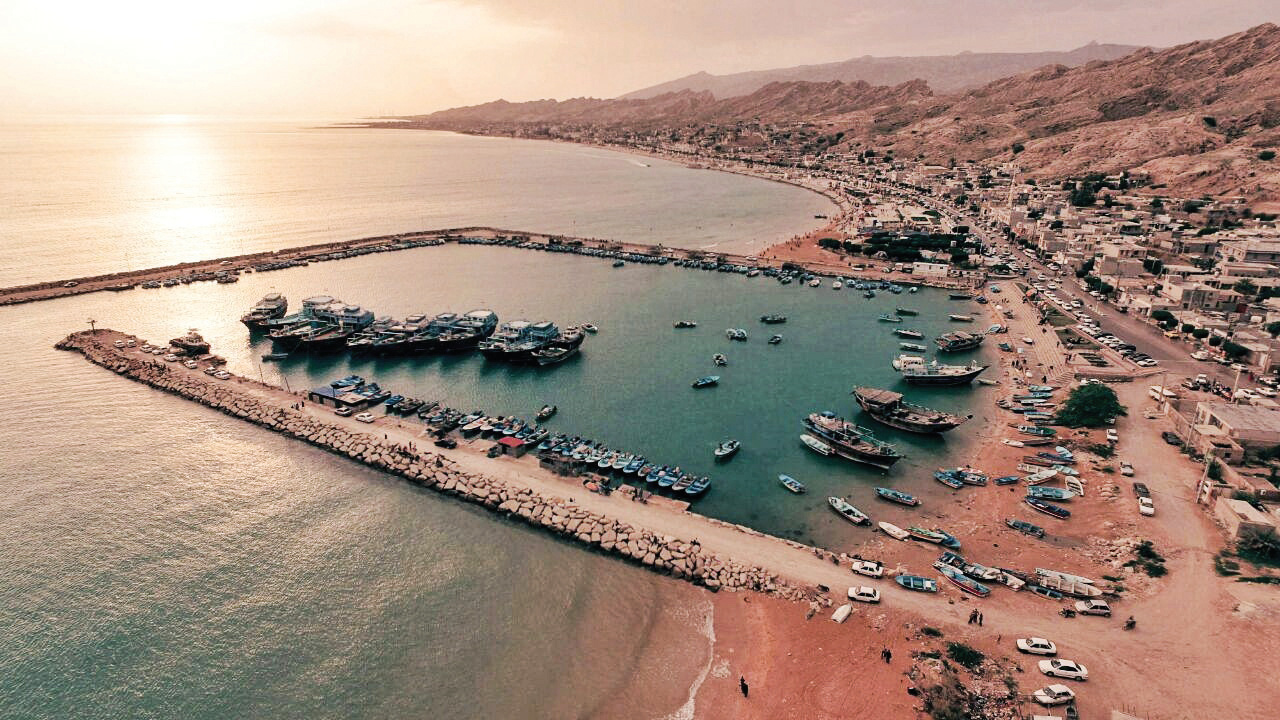
The port of Siraf was one of Iran's most prosperous and magnificent harbors from the late Sasanian era onward. The famous sailors and merchants who came from this city engaged in maritime trade from ancient times with Muscat, Oman, Yemen, Zanzibar, and even China. Ya'qubi, one of the historians of that era, wrote: "China is a vast land, and whoever wishes to go to China by sea must cross seven seas, each with its own color, scent, fish, and wind, different from the next." He then added: "The first sea is the Persian Sea, and one must board a ship at Siraf and..."
The prosperity of this ancient port continued until the devastating earthquake of 977 CE, which destroyed Siraf and submerged a considerable part of it beneath the sea, after which it never regained its former glory. Throughout all these centuries, the principal occupations of the people of Siraf were seafaring, trade, and fishing.
The name Siraf derives from the word shilu, which in Sasanian Pahlavi means "valley" + "water" — i.e., "water valley." This word evolved from shilav to shilaf and then Shiraf — a coin discovered by the English archaeologist Dr. Whitehouse — and subsequently to Siraf.
In the texts of ancient geographers, the harsh climate of Siraf is noted. Drinking water was supplied from the relatively elevated region of Jam, a temperate area compared to the port itself. The problem of water scarcity led to remarkable arrangements for collecting water, including deep wells and stone collection basins.
From antiquity, structures such as the Gor Dakhmeh (rock-cut ossuaries), the fire temple, and a stone-paved road survive in Siraf, and from the medieval centuries, structures such as the Nassouri Castle remain. The tall buildings of Siraf, which sometimes reached five stories, were destroyed in the devastating earthquake.


Among the most remarkable relics of Siraf's civilization are the deep wells extraordinarily excavated in the Lir Valley and on the heights. Their number is approximately 170, dug in two types: wells completely carved in rock with stone rings at the mouth for holding a pulley (1.1 meters in diameter), and wells dug on sandy surfaces with walls of sand and gravel. All display precise engineering, with depths ranging from four to approximately one hundred meters. Many contain fresh, drinkable water.

Cubic depressions carved into the mountainside for water storage number more than seven thousand basins. The basins are rectangular, some with overflow channels connecting to other basins. Beautiful stairways between them allowed access while keeping the purified water uncontaminated. This advanced technology enabled Siraf to thrive as an international port. The collected water gradually seeped into the earth, filling underground aquifers — the type of rock in Siraf's mountains enabled maximum groundwater infiltration with minimum evaporation.


The Nassouri Castle is situated atop a hill in a strategic position. Built in 1808 by Sheikh Jabbar II, the castle's rectangular plan is oriented north-south, perpendicular to the coastline, commanding a view of all areas of the port. Built on two floors, its southeastern section features a four-story Shah-neshin tower for enjoying the seascape. The castle has two separate sections: the biruni (exterior) with the south courtyard, and the andaruni (interior) with the north courtyard.

On the western side stands a windcatcher — the largest in Bushehr province and a feature unique to this castle among Siraf buildings. Next to it is a watchtower. The castle served as both a center for administering city affairs and a residence for the local sheikh. Its main decorations include wood carvings and plaster decorations, the latter being the most important architectural elements, featuring quasi-muqarnas plasterwork and Shahnameh relief scenes in the reception hall.


The castle was purchased from the Nassouri family by the Cultural Heritage Organization in 1999, registered as a national heritage site under number 3515, and is currently being restored as an accommodation and reception center under the Pardisan project.
1. Such stone basins have been built in other locations along the Zagros, including Shushtar, though in far fewer numbers. In ancient cultures, water — alongside earth, wind, and fire — had a sacred dimension beyond practical utility. In South Asia, the ritual of bathing in sacred rivers continues to this day. One can imagine that the ancient inhabitants of Siraf, by building these basins, created a kind of artificial sacred river in which they purified not only the body but also the spirit. — The Editor



