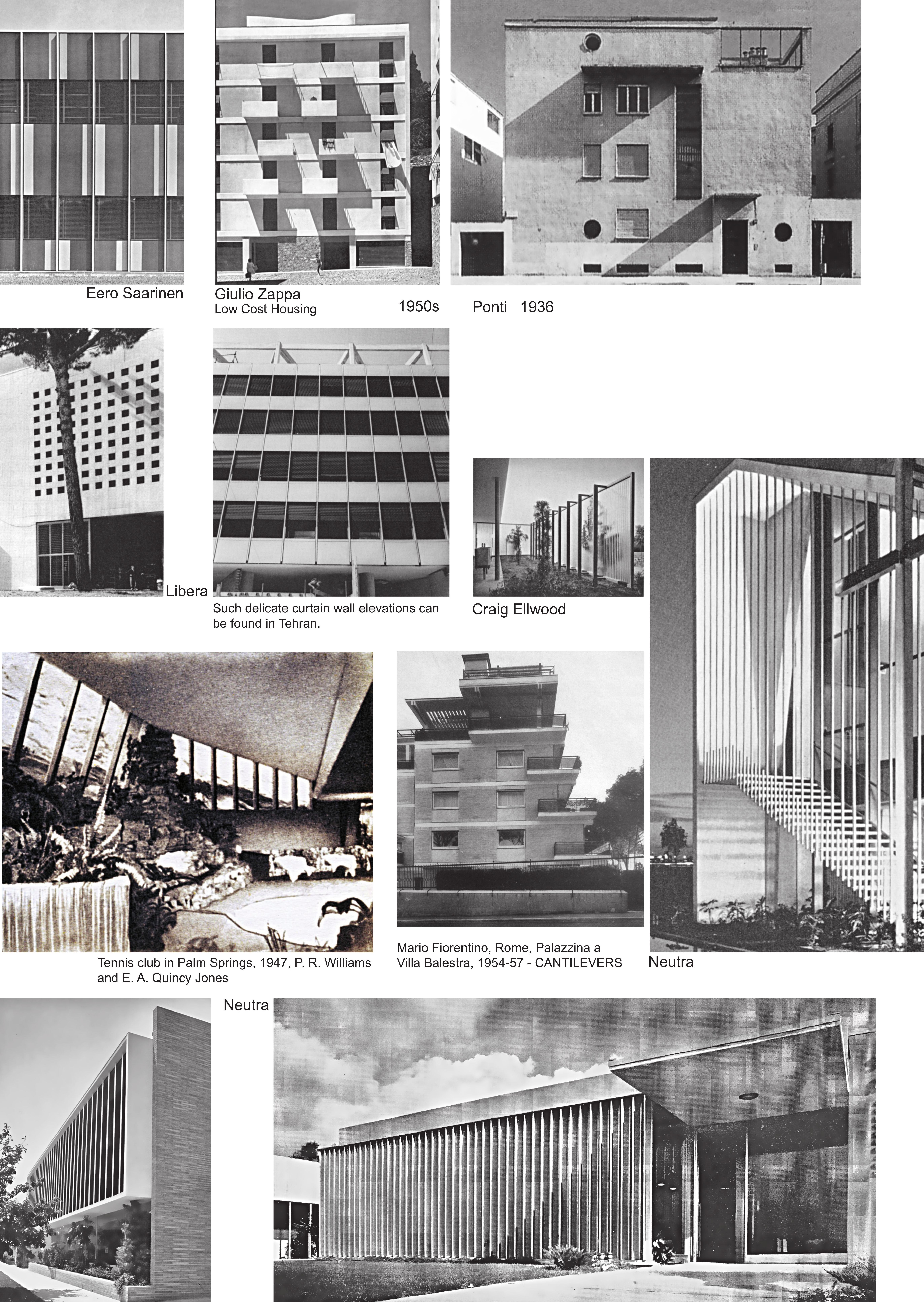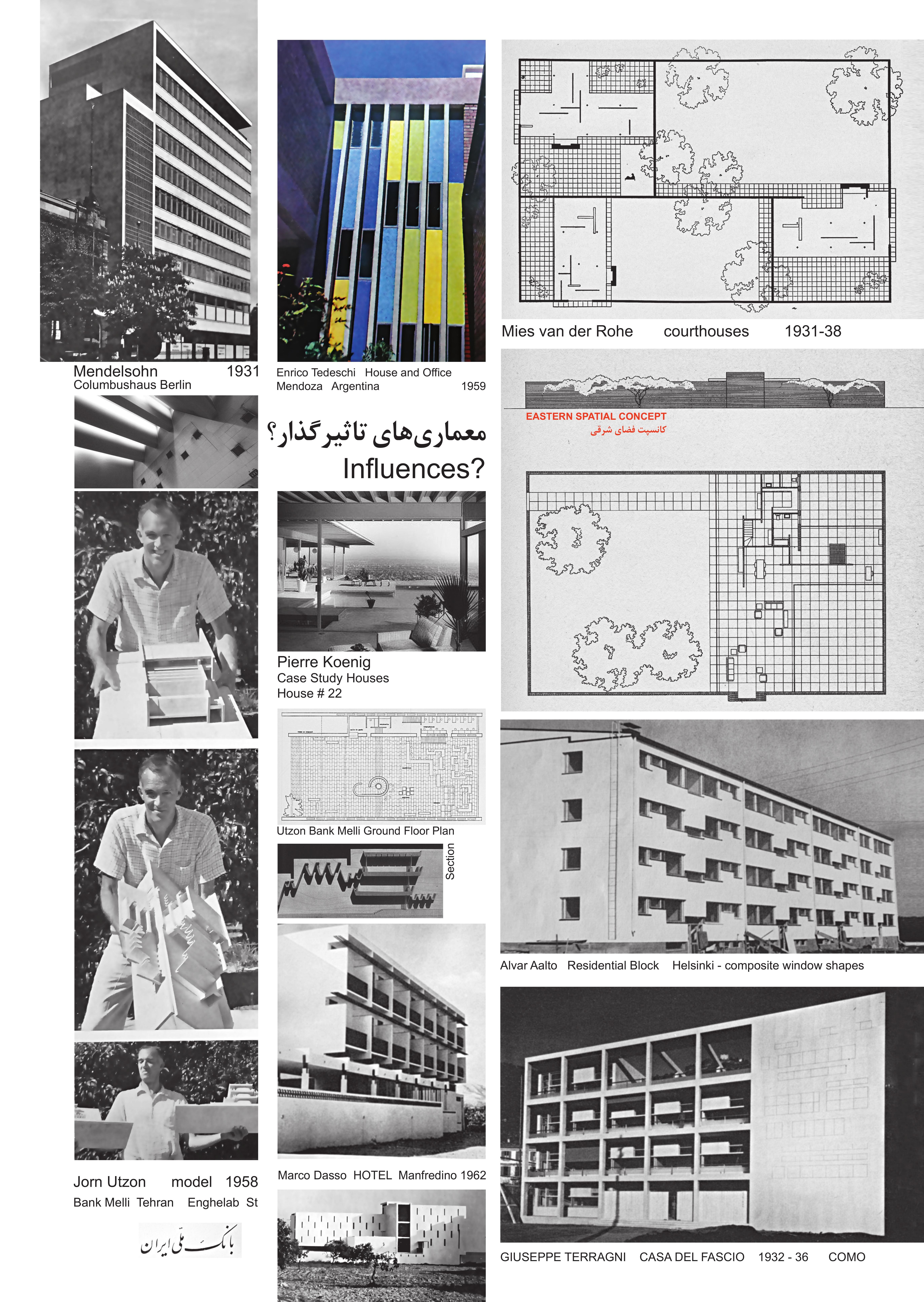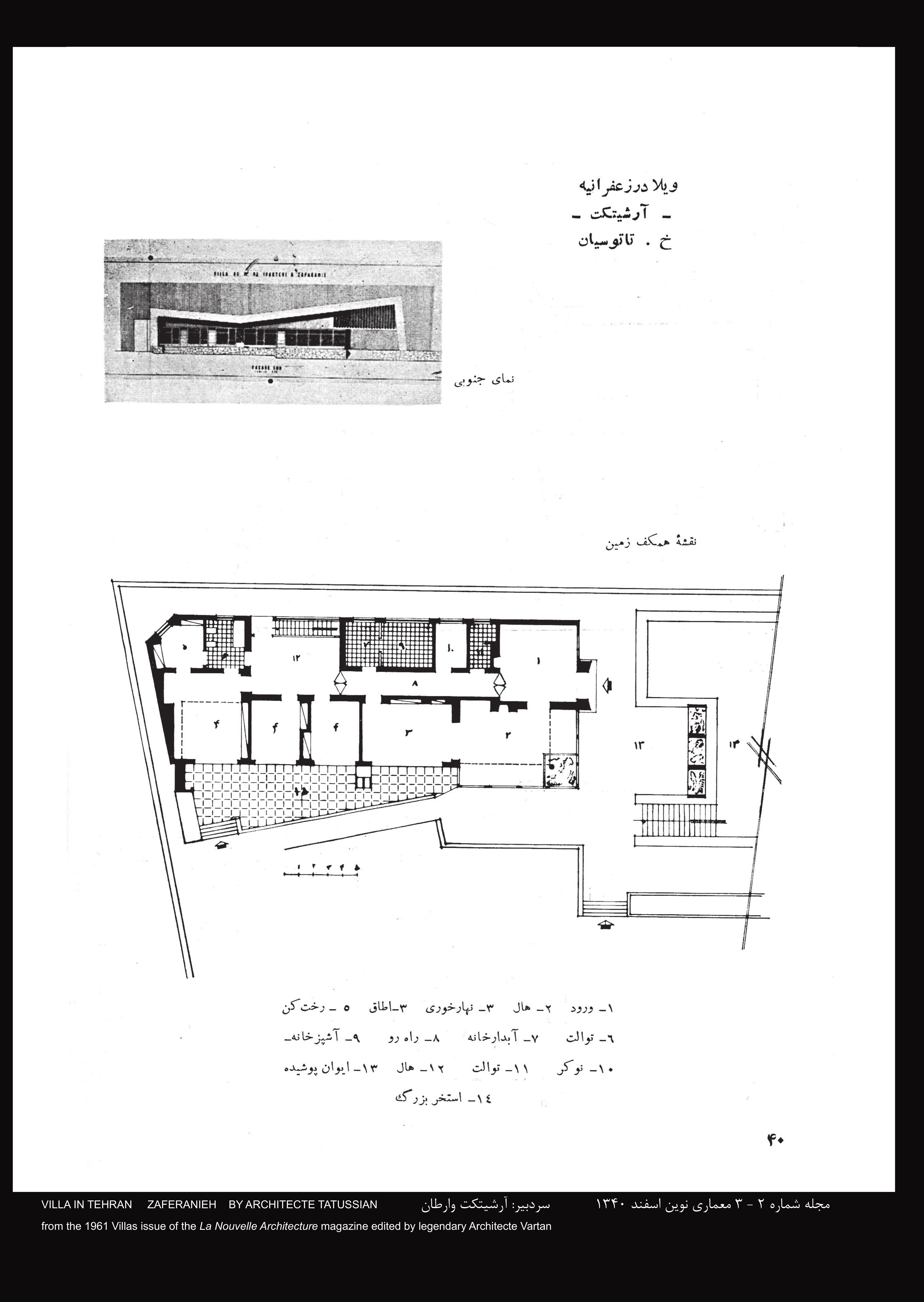
Mehr Azar Soheil. Alas for Tehran's Modern Architectural Heritage. History builds the city. Over the centuries, different generations of society have added new layers and themes to this symphonic poem that is the city of today. The defense of cultural heritage and the living identity embedded in the built and natural environments of nations has been the founding principle of UNESCO. The architecture and urban planning that took shape from the early twentieth century, based on new social orders, technology, and new forms of life, existed within an international and global framework. This transformation gave rise to an international movement that emphasized functional efficiency and new spatial concepts, rooted in evolving technical innovations that enabled experimentation and invention in new forms. At the same time, at its best, modern architecture can address the aspirations and needs of society by emphasizing the specificity of place. Modern architecture is a fundamental part of our shared heritage, recognized by international organizations such as UNESCO and the European Union, as well as professional bodies like ICOMOS (the International Council on Monuments and Sites). The International Working Party for Documentation and Conservation of Buildings, Sites and Neighbourhoods of the Modern Movement (DoCoMoMo) has begun identifying and cataloguing this type of architecture in various countries, and has added a large number of outstanding examples of modern architecture and urban ensembles from Africa, the Americas, Asia, and Europe to the UNESCO World Heritage List. The people of Tehran can be proud of the valuable work of their city's builders, not only in the past but also in the twentieth century, when, by embracing the ideas of the international movement, they were able to apply these principles while taking into account local needs and cultural frameworks. Buildings from the 1950s to 1970s constitute a significant part of Tehran's architecture, yet with deep sorrow, we witness the loss and destruction of this heritage, which has become an essential part of the city's history. It is important that this heritage not be defined solely in terms of its architectural form, but that the broad ecological, social, anthropological, economic, and cultural framework that constitutes its entirety also be taken into account. Although the heritage of modernism differs in many respects from earlier periods, it is part of a continuum and an essential phase of the city's overall history. The authorities are obligated to enforce the country's existing laws for the protection of heritage, buildings, and sites associated with modernism. Safeguarding this heritage also requires a focus on raising public awareness. The first step is to stop the demolition! Footnote: 1- DoCoMoMo. ICCROM. * Mehr Azar Soheil, graduate of architecture from the University of Tehran, with specialization and a doctoral degree in conservation from the University of Rome La Sapienza. Member of the ICOMOS Scientific Committee on Training, and Theory and Philosophy, and the scientific council of ARCo, the Association for the Recovery of the Built Environment.
Opposite Massoudieh Garden — Ekbatan. Reciprocal Formal Function. EKBATAN STREET - Off BAHARESTAN SQUARE, Opposite the Qajar MASSOUDIEH garden and mansions. Reciprocity
Niels-Christian Fritsche. The Flat Roofs of Modernism Among the Flat Roofs of Tehran. An architect traveling from Central Europe to Tehran surely already knows the city built on the slopes of the Alborz. He would expect a striking array of architectural forms — a thorough geopolitical mix of Asian, North African, and Western motifs. But upon arriving in Tehran, the city seems to reflect a simple contemporary urban fabric, another victim of traffic and commercial imperatives. Soon after, he must revise his assumptions, for Tehran is a quintessential modernist city. The lanes and streets are brimming with Bauhaus-style buildings. Let us pause for a moment: flat roofs are naturally suited to a semi-arid climate, so they are hardly unexpected. But what to make of the striking abundance of discreet details of modern architecture? In Tehran, there are not only varieties of windows with slender frames and decorative mullions, playful door designs and handles, beautiful facades with articulations, grooves, and thoughtful details, and three-dimensional, projecting balconies that work perfectly with the fundamentally rectangular building
volumes, but in a surprising — or perhaps entirely natural — way, these characteristics are intertwined with vernacular elements. Did the curvy Persian script, seen in rectangular shop signs and traffic signs, contribute to the shaping of Tehran's modern architecture as a distinctive combination of curves and straight lines? The city suddenly evokes and rivals quintessential modernist experiments like the Baba Housing Estate in Prague, bringing to mind Hans Scharoun's organic modernism. Parallels to Japan's metabolism movement are visible: flat yet sculptural architecture that achieves a rare balance in urbanism — architecture without fanfare that fits into every lane and street, while possessing uniquely detailed features. This individuality stands out even more against the clones of the International Style, which promised simplicity and the elimination of ornament. The key question is whether this substance can be viewed separately from its other associations. The matter of the built-from-scratch city dates back to the 1920s, when the rulers wanted to reinvent the city. Today, modern architecture seems to have gone out of fashion — a phenomenon by no means unique to Tehran — at least in part because it has not been well maintained over the years. Deterioration always diminishes the appreciation of architecture, as architectural quality cannot compensate for poor building conditions. But beyond this, modern architecture in Tehran is further endangered because it represents a past that is disregarded. There is a three-pronged threat: after 50 to 80 years, the lifespan of many buildings comes to an end. Modern architecture, with its horizontal surfaces and risky waterproofing, usually comes with a set of serious structural problems. The third part is this: modern architecture belongs to the optimism of the twentieth century, before the Club of Rome's 1972 publication on "The Limits to Growth" and the 1973 oil crisis. In Germany, the remnants of 1920s modern architecture — those buildings that survived World War II — have taken on landmark status. They are regarded as an essential part of the diverse cultural heritage of the twentieth century. I hope that a similar critical appreciation will be established in Tehran and other Iranian cities as well. Footnotes: 1- Registered for conservation in 1993. 2- Hans Scharoun. * Niels-Christian Fritsche, graduate of Dresden University of Technology, Germany. He worked at the DTA office in Chicago from 1995 to 2000. He is currently an architect, illustrator, and professor of presentation methods at Dresden University of Technology.
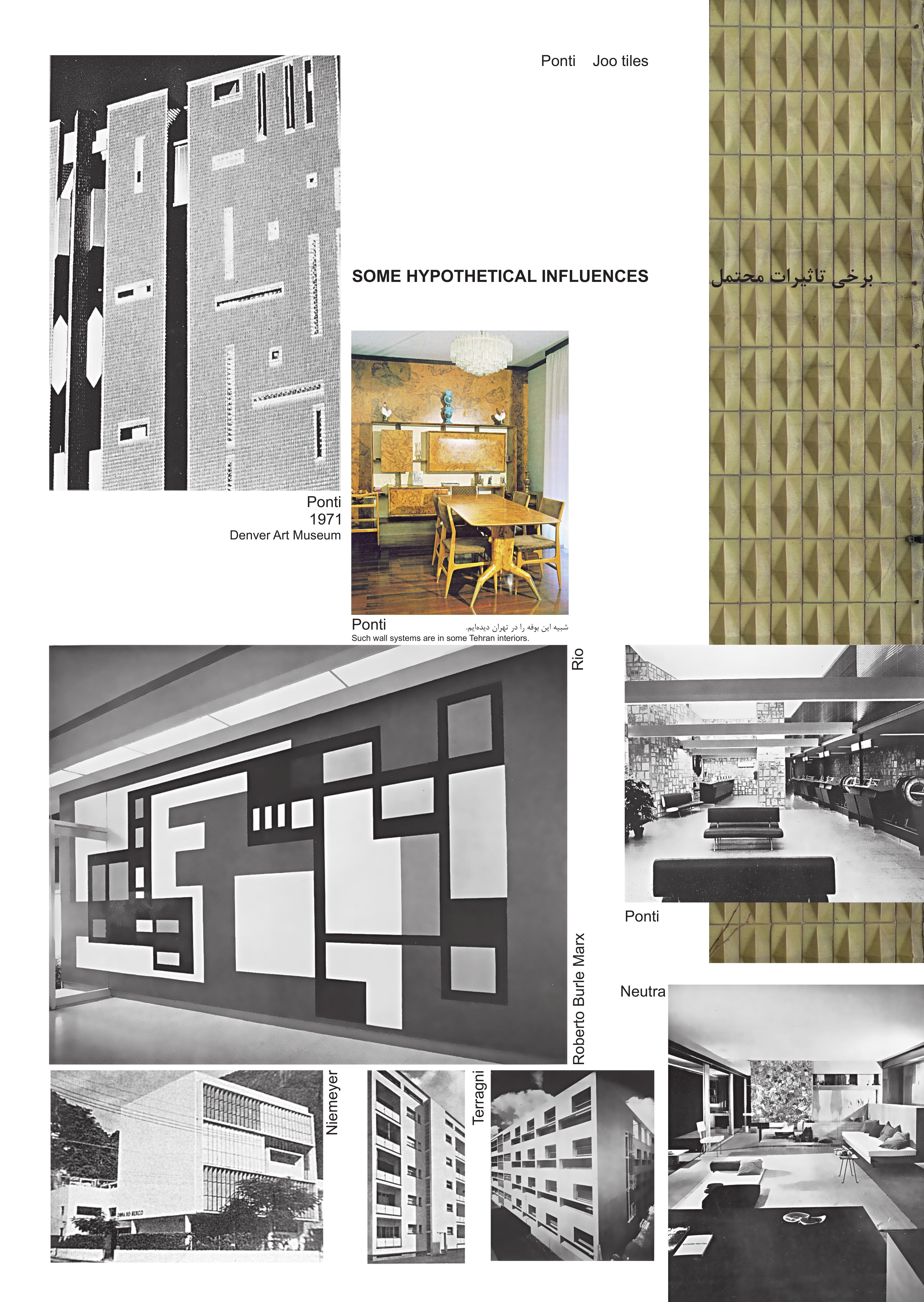
Some Hypothetical Influences. Ponti. Joo tiles. Ponti. Rio. Roberto Burle Marx. Terragni. Niemeyer. Ponti. Neutra. Ponti. 1971 Denver Art Museum. Such wall systems are found in some Tehran interiors. SOME HYPOTHETICAL INFLUENCES. We have seen buffets similar to this one in Tehran.