Tabiat Walking Bridge, Tehran
Location: Abbas Abad Lands, between Taleghani Park and the Water & Fire Park, Tehran
Client & User: Tehran Municipality
Principal architect: Leila Araghian
Architectural detail design: Homa Soleimani, Mina Nikoukalam
Construction supervision: Nader Naghipour, Payam Golfeshan, Adel Mohammadi, Shahram Shadfar, Masoud Momeni
Structural high supervision: Kourosh Shirani
Mechanical: Aram Shahriari
Structure: Maffeis Engineering Spa
Structural design team: Massimo Maffeis, Marco Grigoletto, Loris Frison
Contractor: Shahid Rajaee Co.
Columns steel construction: Mashinsazi Arak Co.
Floors, ramps and body steel construction: Azarteif Sepahan Co.
Length: ~270 m Spans (E→W): 68, 94, 68, 39 m Deck width: 6–13 m
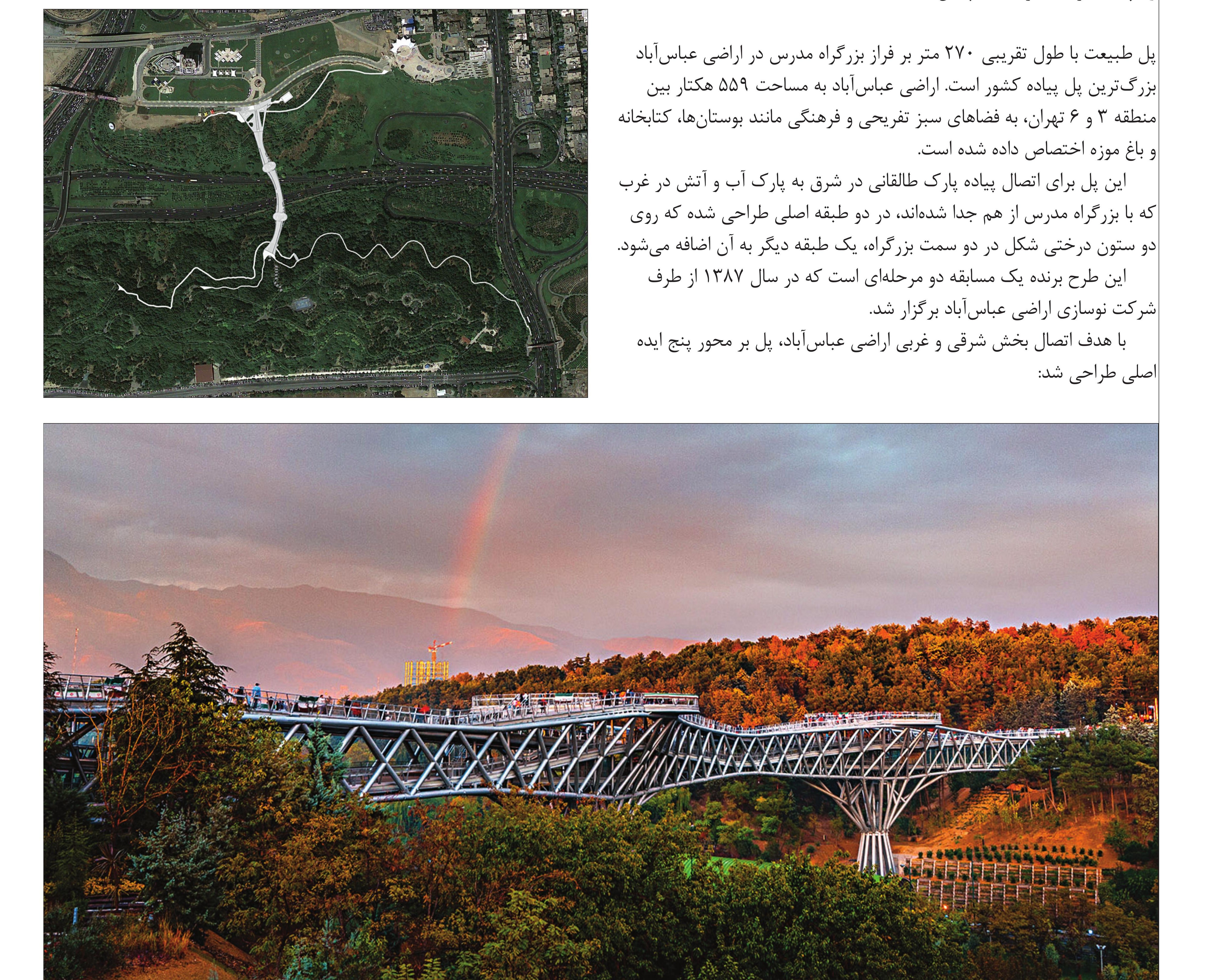
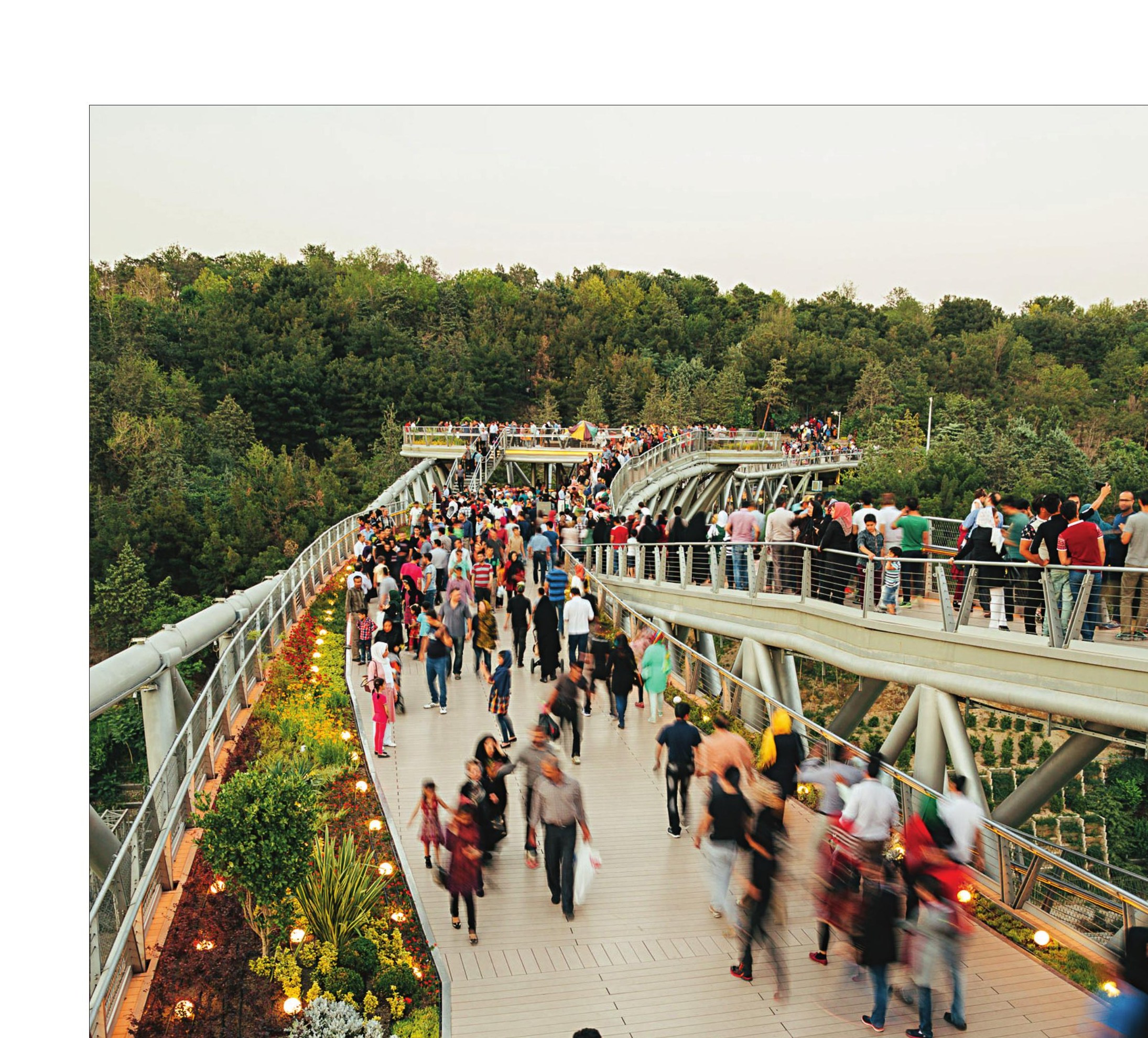
Tabiat (Nature) Bridge — approximately 270 metres long — crosses Modarres Highway in the Abbas Abad Lands and is the largest pedestrian bridge in Iran. The 559-hectare Abbas Abad Lands, lying between Tehran's Districts 3 and 6, are dedicated to recreational and cultural green spaces such as parks, libraries and the Museum Garden.
The bridge was conceived to link Taleghani Park on the east with the Water & Fire Park on the west — the two parks separated by Modarres Highway. It is organised on two main decks, with a third level rising above the two tree-shaped columns on either side of the highway. The design won a two-stage competition held by the Abbas Abad Lands Renovation Company in 1387 (2008).
With the aim of connecting the eastern and western parts of the Abbas Abad Lands, the bridge was developed around five principal ideas:
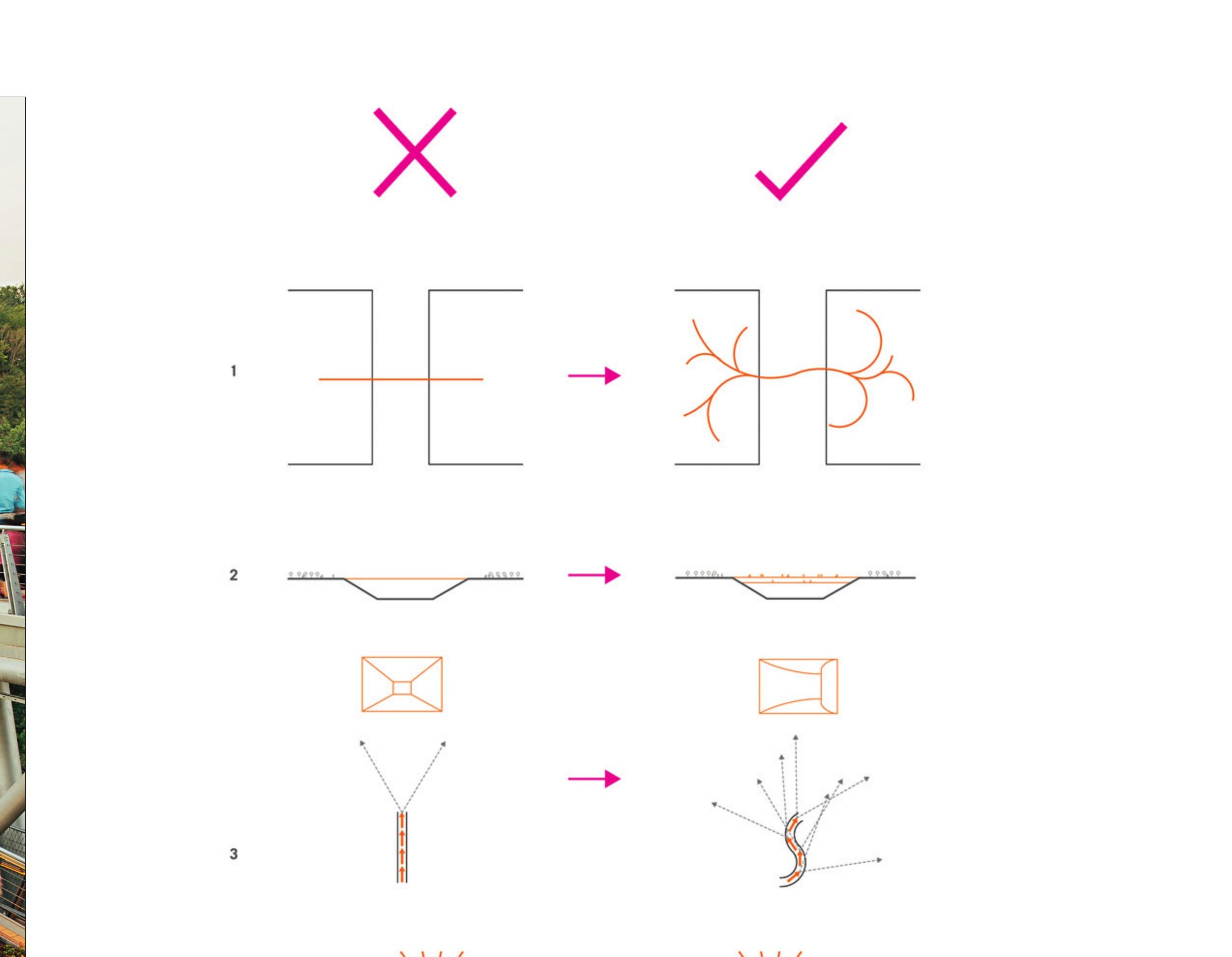
1. Contrary to the conventional reading of a bridge as a corridor for getting from one point to another, and despite the master plan calling for a single connection between the parks, one of the chief ideas was that a bridge need not link two points like a line segment. It can branch on each side, joining several points on one side to several points on the other.
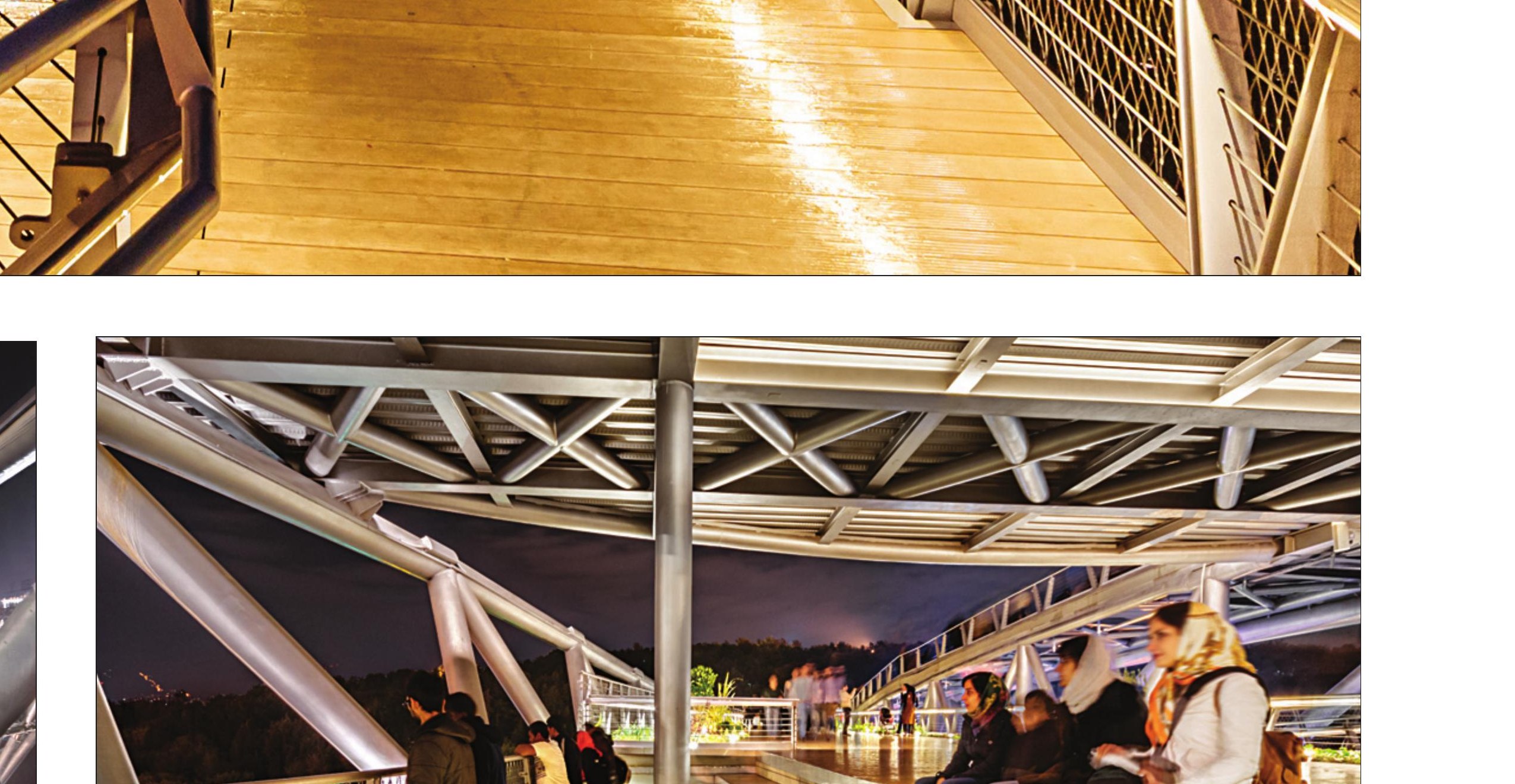
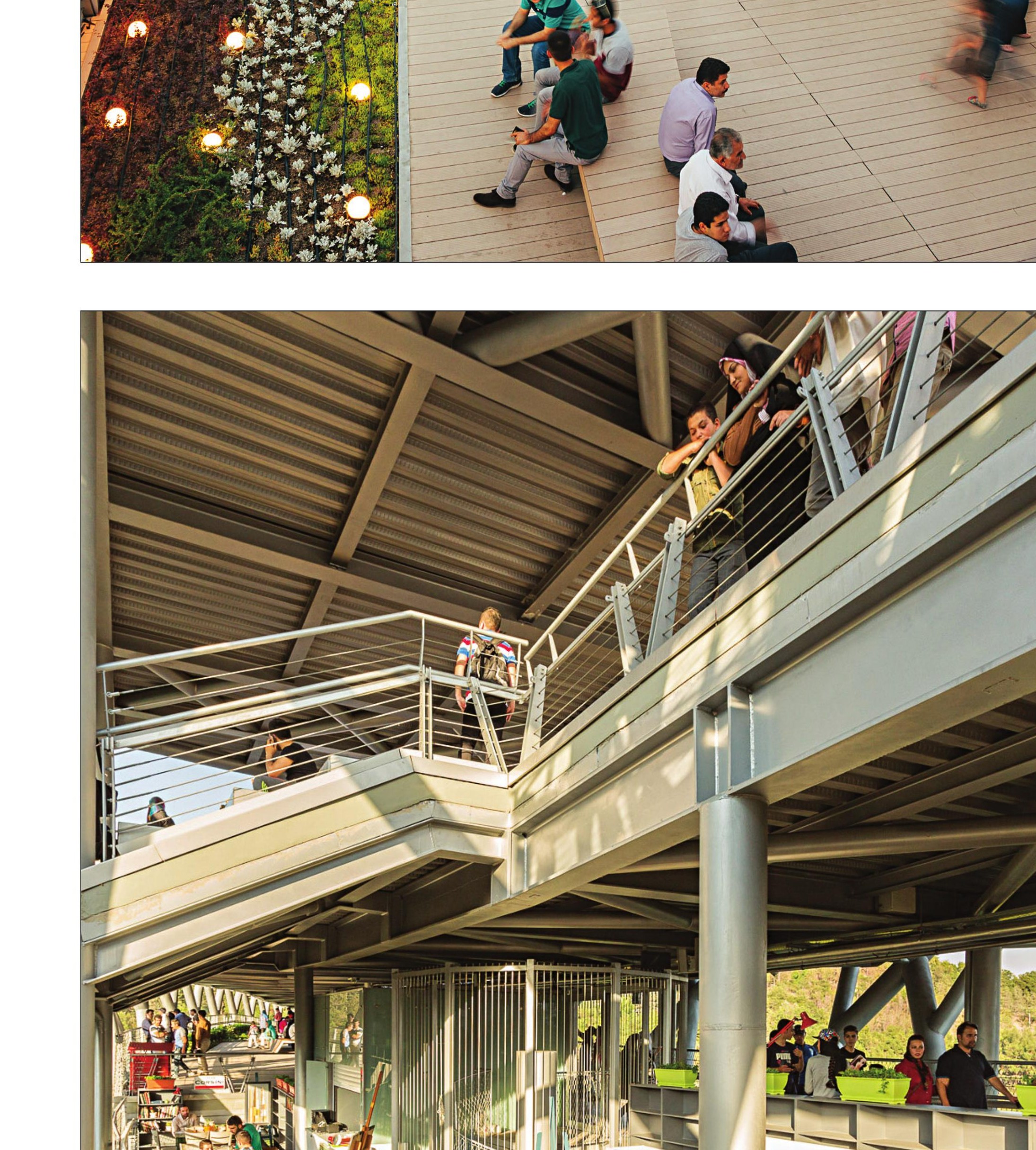
2. Contrary to the conventional reading of a bridge as a corridor for moving from A to B, this bridge was conceived from the start as a place for staying. Through green areas, seating and recreational programmes — a restaurant, a café — both parks continue onto the bridge, dissolve into one another, and create reason enough to remain.
3. A bridge or any path designed on a straight line creates a one-point perspective and only suggests "going," since the whole path is visible from end to end. Because this bridge was to be space and a place for staying, it had to be shaped not as a straight line but as a non-linear route — or a composition of several routes.
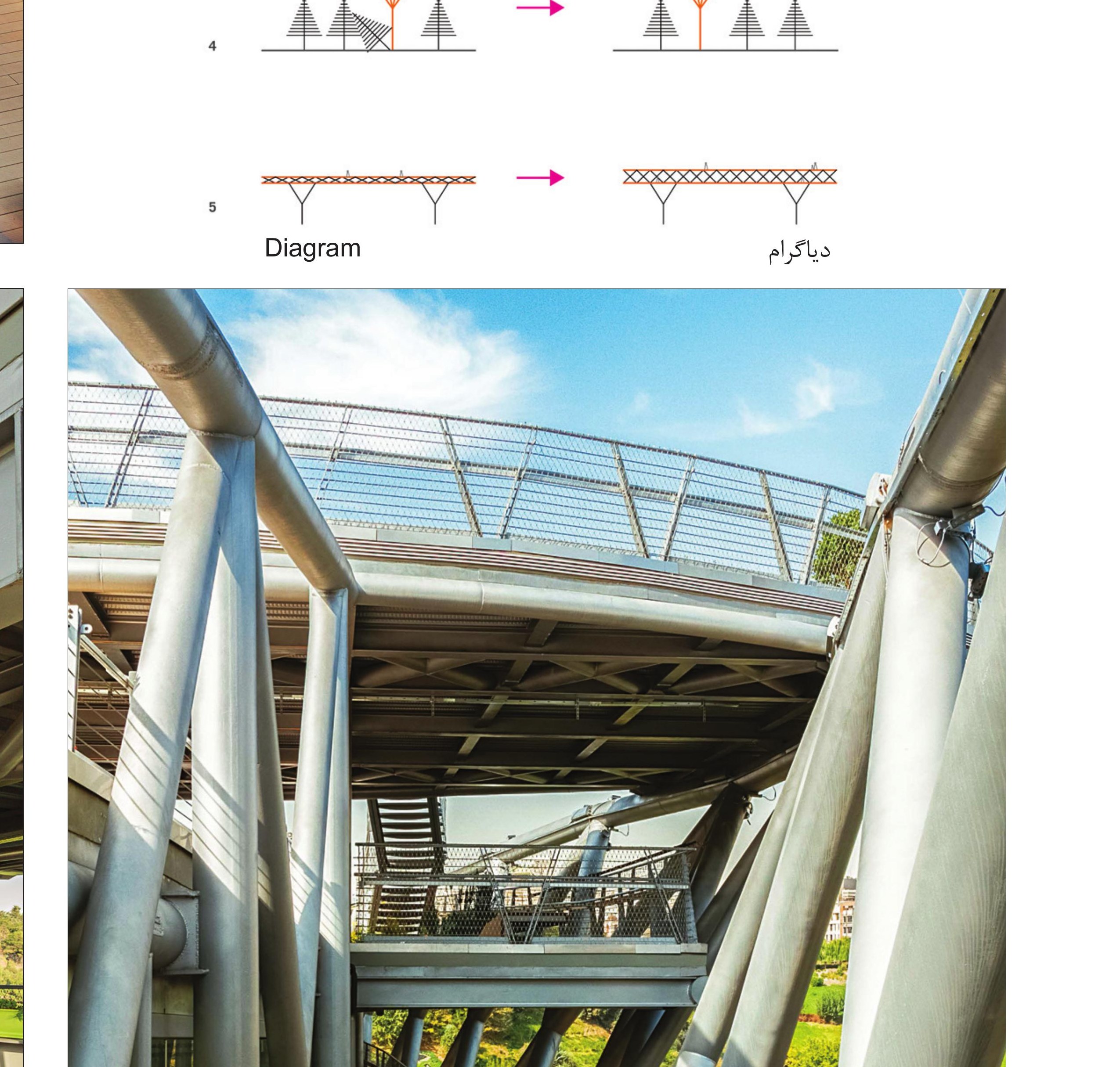
4. Since both sides of the bridge — especially on the Taleghani Park side — have many trees, the attempt was to place the columns and the bridge end-points where there were fewer trees. The number of columns and their ground anchorage was reduced to a minimum so that intervention in nature would be kept as small as possible.
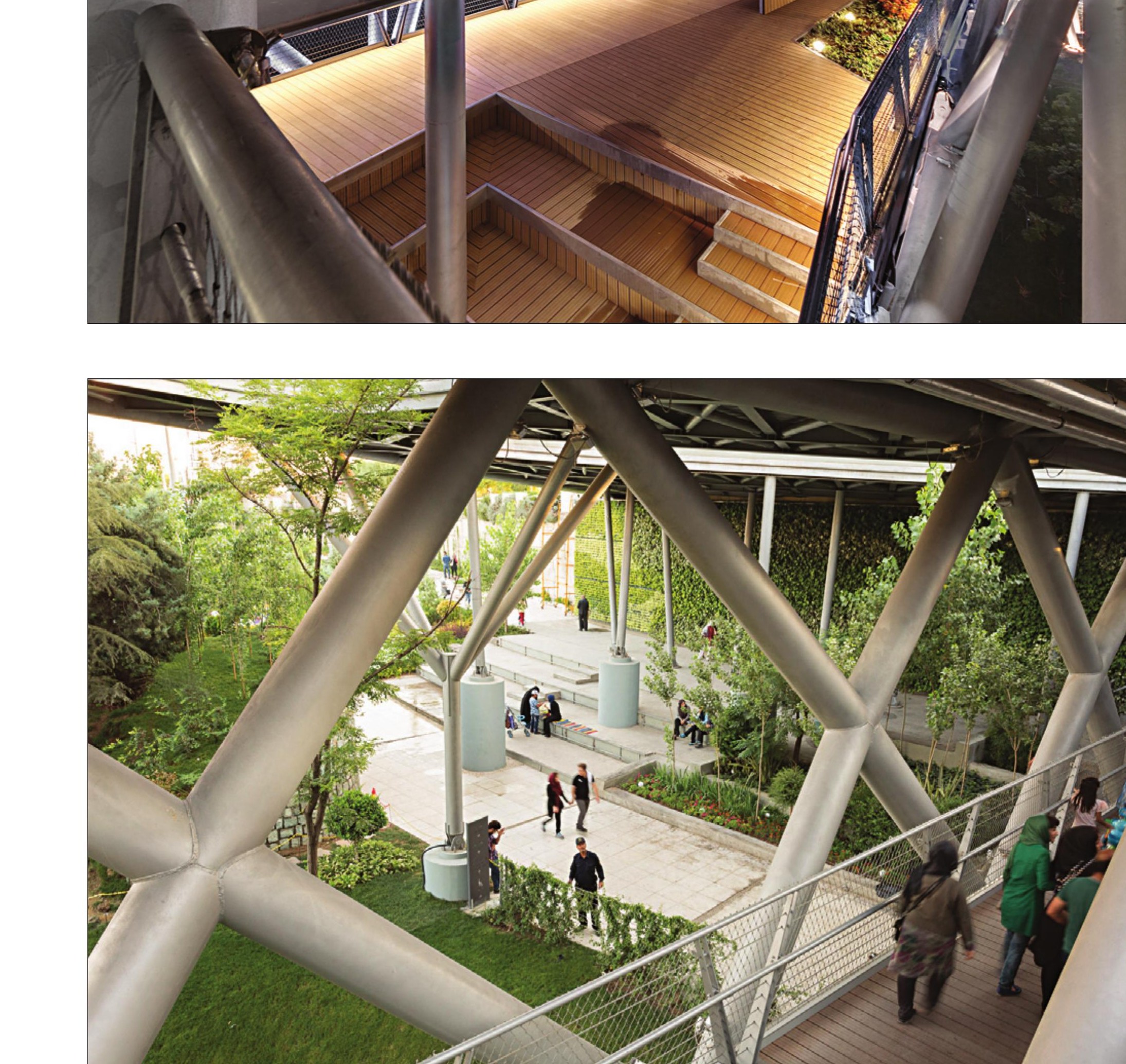
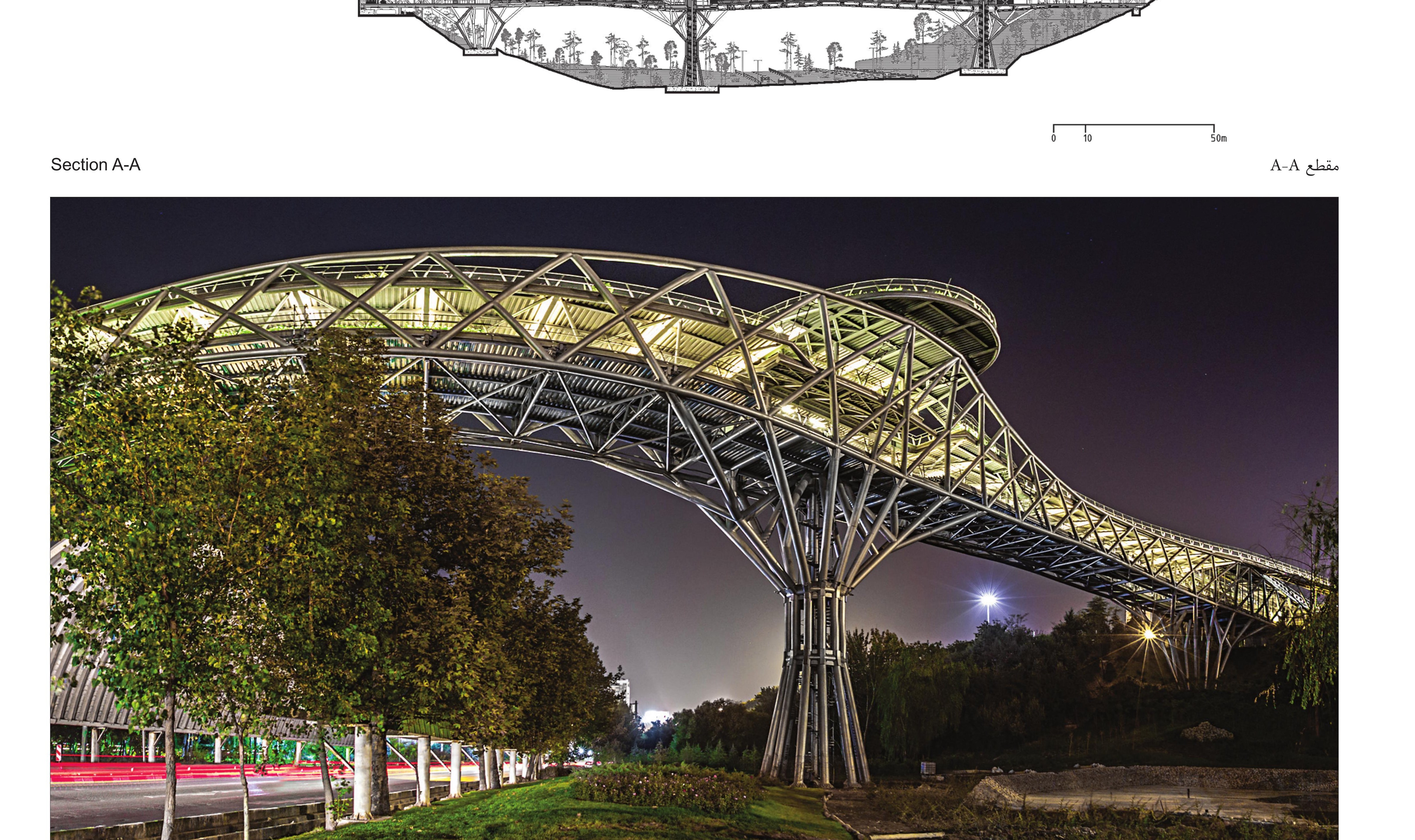
5. In this bridge, structure and architecture are not separated. Given that large spans require great depth for load-bearing and stability, the depth of structure was set so that it could create usable architectural space. This view of structure led to the bridge being conceived from the outset as a three-dimensional steel truss with a dynamic form, on two continuous levels, resting on three tree-like columns.
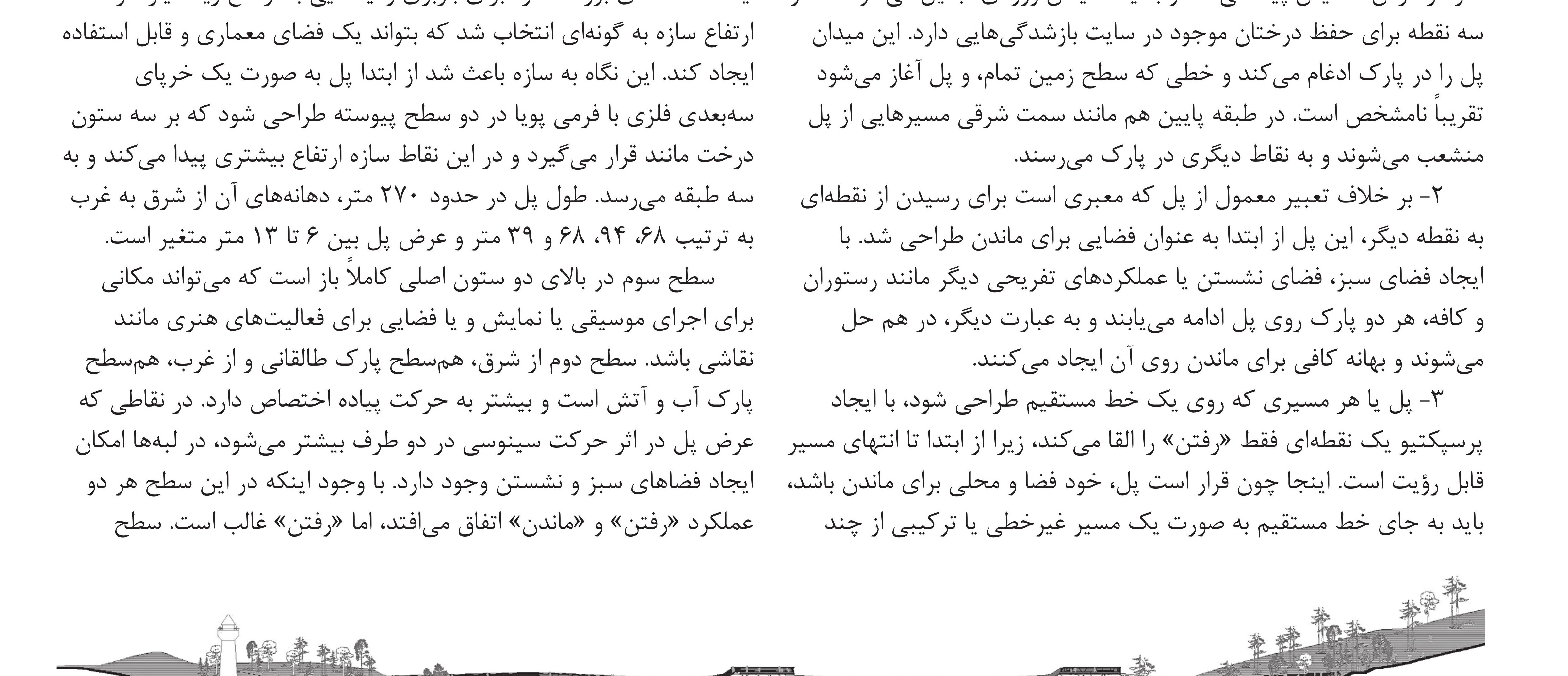
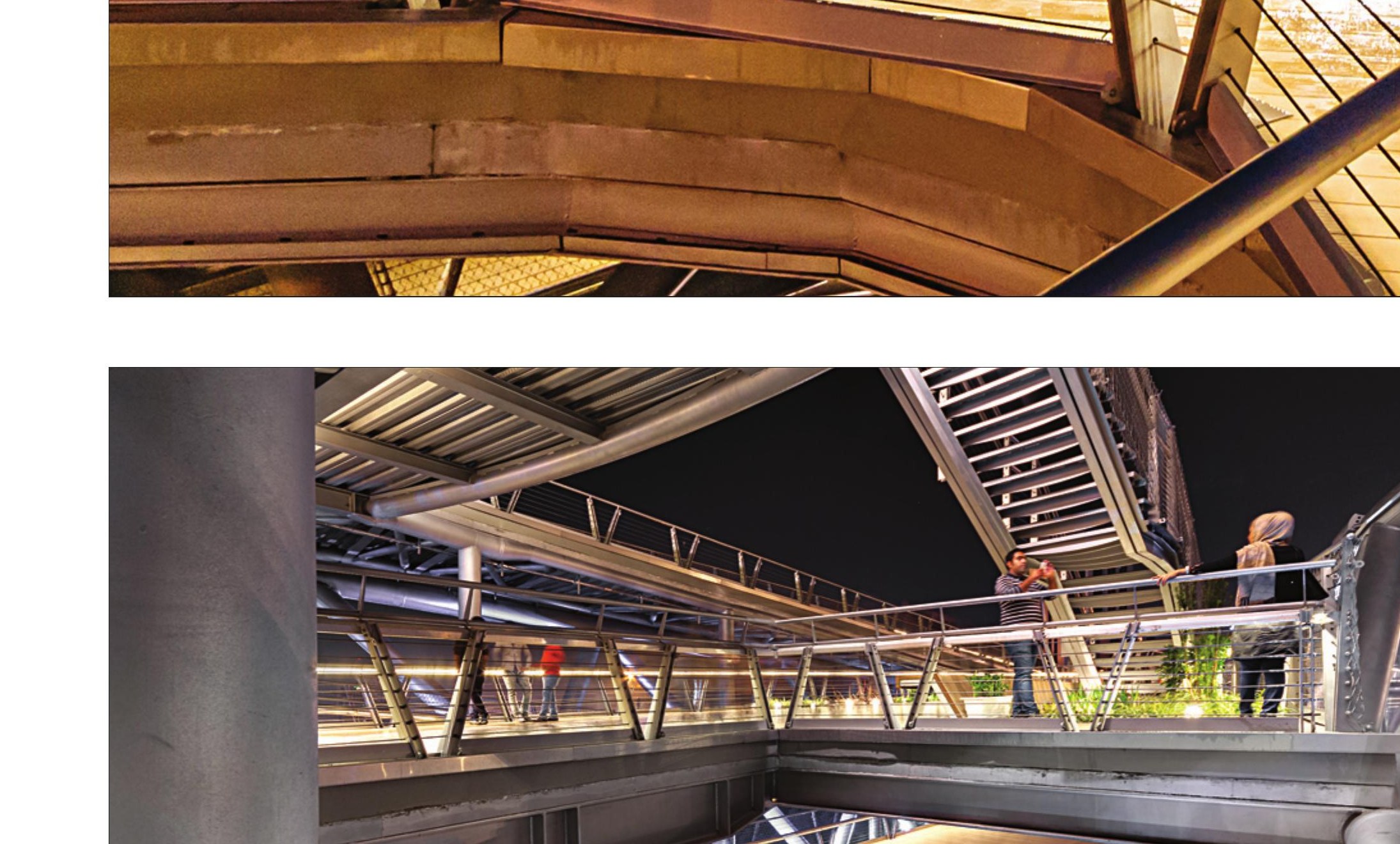
The bridge is about 270 m long, with spans of 68, 94, 68 and 39 m from east to west, and a deck width varying between 6 and 13 m. The third level above the two main columns is fully open and can serve as a venue for music, performance or artistic activity such as painting.
The structural design — developed in parallel and iteratively with the architecture — minimised the diameter of the tubes; the overall geometry of the bridge, the slope of the decks, the structural elements of the floors and the diameter and geometry of the columns were also optimised. The trusses are built from steel tubes about 50 cm in diameter, welded on site.
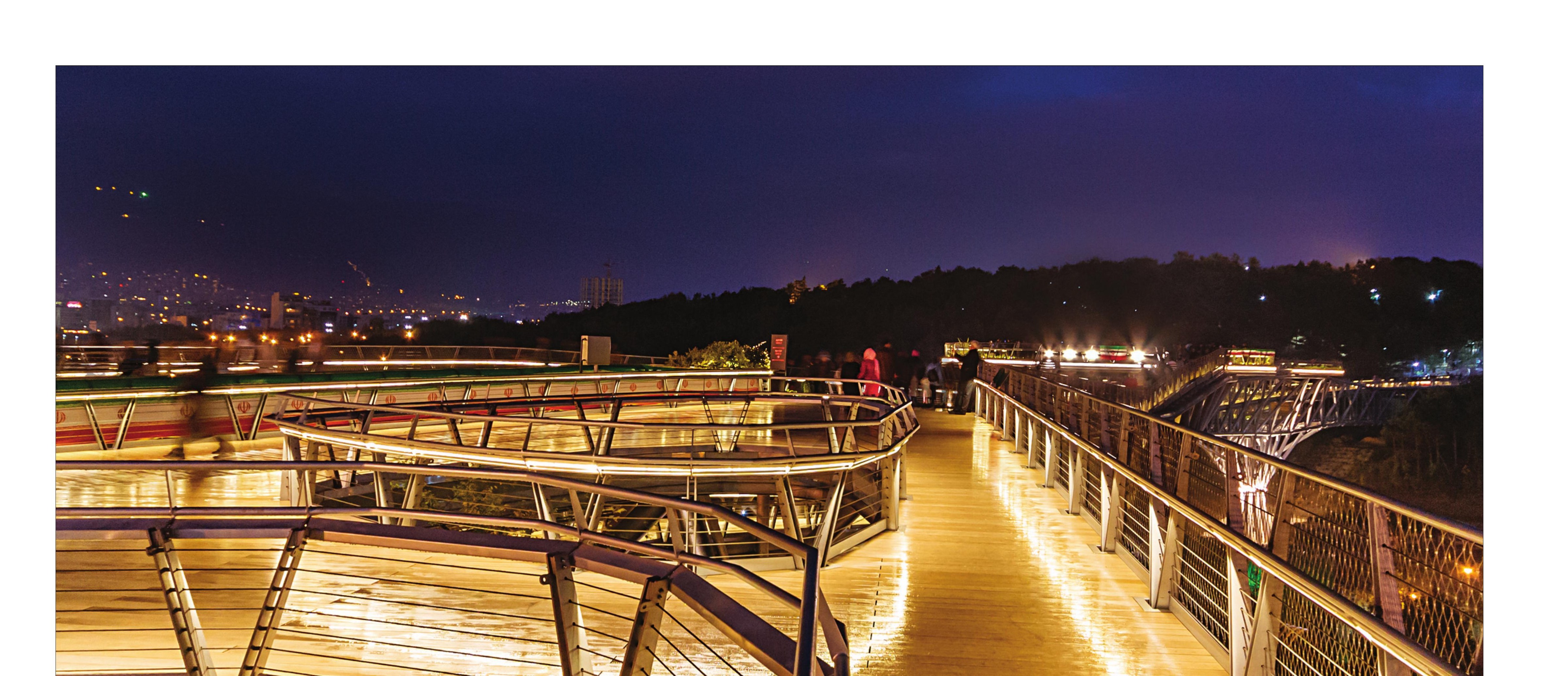
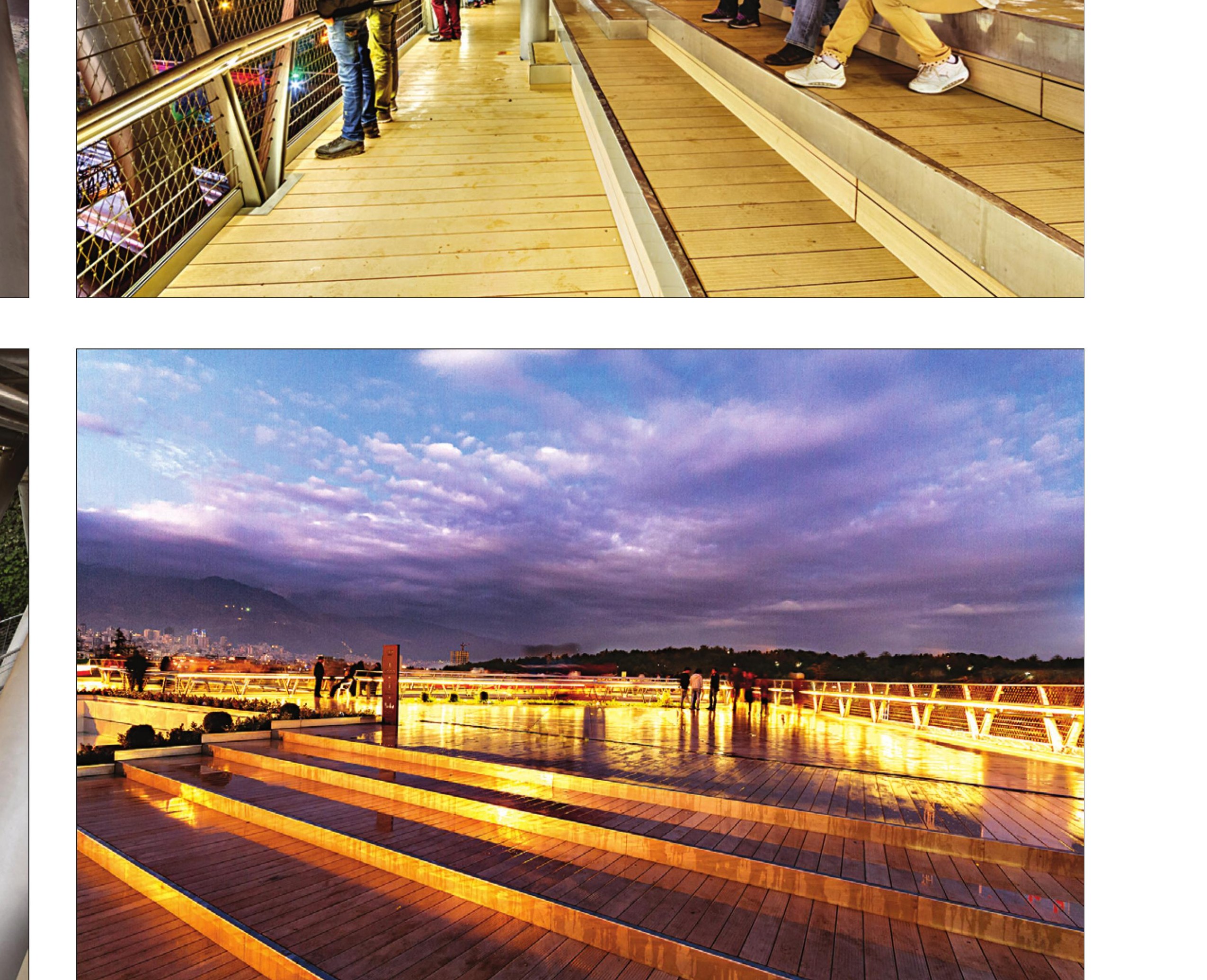
The bridge lets visitors who have parked on the east or the west walk to a wider range of destinations. In the past year, since opening, the bridge has been embraced by citizens and visitors and has itself become an urban destination. Bridges are usually about structure more than architecture; this one was designed from the outset with an architectural attitude.