If, on your way back from Dowlab, you choose not to pass through the centre of the city but to take the boulevards of Narmak, Majidiyeh, Tehran-No and Tehran-Pars instead, you will see at the start of the road a signboard that reads "Qasr-e Firouzeh" ("Turquoise Palace"). The word "palace" suits it only loosely. Across the wide tract of east Tehran, filled with apartment blocks, government offices and complexes of the army, the air force and the institutions of the Revolution, Qasr-e Firouzeh is the second name of a district. If you follow the signs — which will certainly take you to the destination they claim — you will soon reach a two-way street, which a little further along becomes a one-way street, and then abruptly shortens.
And somewhere in this wide district, behind walls and guards, there is a building from which the area has taken its name. I have a photograph of that palace, probably taken in the first decade of the twentieth century. In the foreground stand a number of Iranian dignitaries with their retainers, and a European lady in a Victorian hat and dress who looks strange in the place. One of the men is peering at something with a pair of binoculars. Qasr-e Firouzeh had been built as a hunting retreat for Mozaffar al-Din Shah, who came to the throne at forty-four, signed the Constitutional Decree at fifty-four, and died a year later, in 1907 CE (1286 Shamsi). Qasr-e Firouzeh is one of the buildings that remain from his time.
Farrokh Khadem had given me this photograph one day over tea. It was at one of our countless meetings in the studio and darkroom that still bore his father's name, in a narrow street behind the Iran-Air building. I had spent many afternoons in that workshop, and very often, while waiting for Farrokh Khadem to arrive, had taken pleasure in looking around the rooms filled with the working implements of three generations of photographers.
I still remember a photograph of an elderly bespectacled man with a smile in his lightless eyes. I remember photographs of a certain street that I could never quite place. But above all I remember the photographs of Ali Khadem — Ali Khadem in formal suit beside the giant guards of a European palace, Ali Khadem on an elephant, and Ali Khadem aged by all those press trips. I also remember a newspaper clipping announcing the young Farrokh Khadem's first photography prize.
In a corner stood a battered suitcase with old Swiss-Air labels and the names of hotels in Bombay and Vienna. The verse written on the wall was from Hafez: "We have not read the tale of Alexander and Darius / Ask of us nothing but the story of love and fidelity."
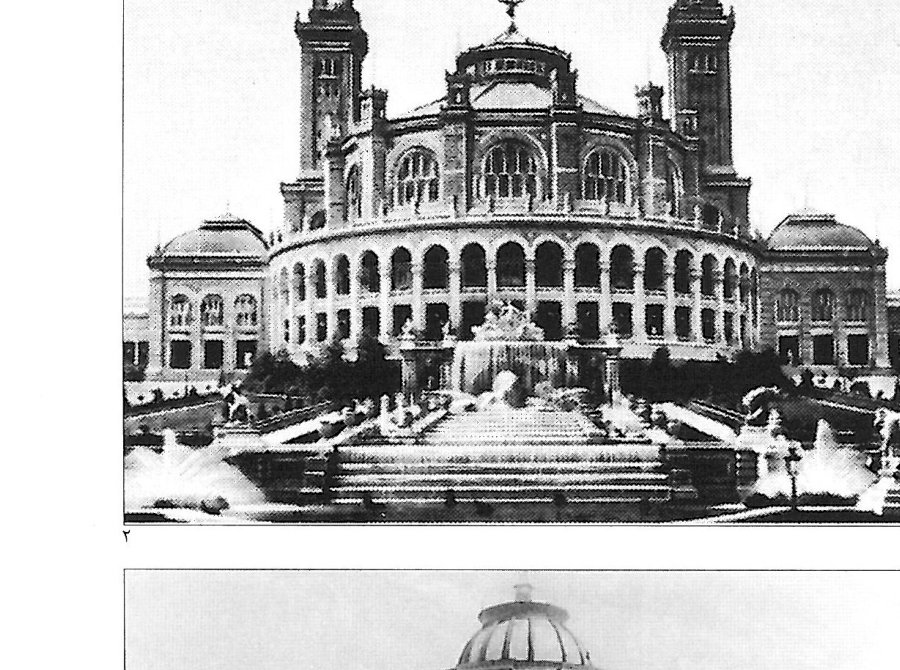
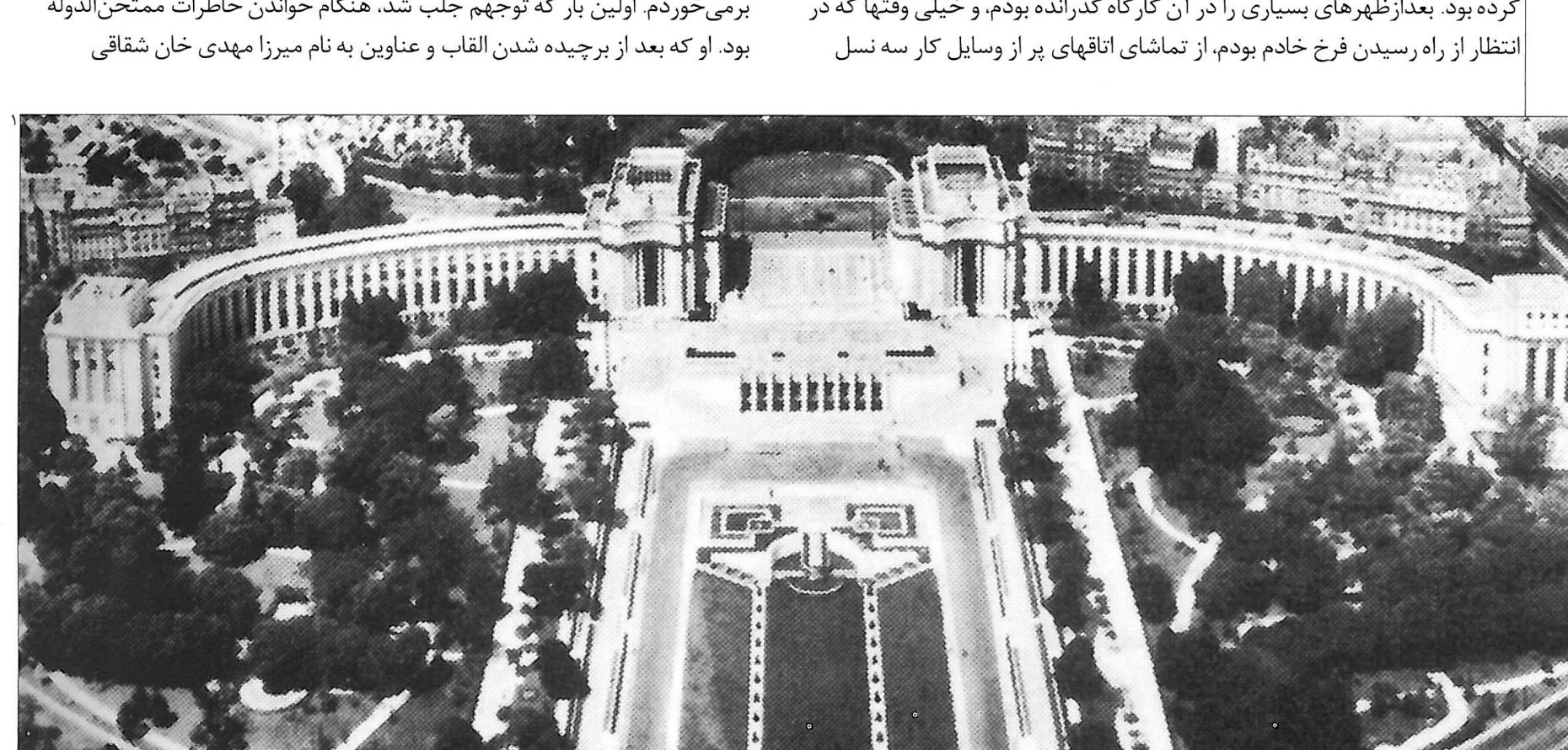
On that particular day, Farrokh Khadem showed me a photograph of Qasr-e Firouzeh and said various writers believed it had been built with an eye to the Trocadéro Palace — and asked whether I knew that European palace that had been the Qajar shahs' inspiration. When I admitted I did not, he asked me to gather what information I could. I filed the photograph there and then with the projects we hoped to make — the modern architecture of the stations of the country's railways, and portraits of Qajar courtesans (one of them painted by a window, her fire rising like an angel with wing and cloud) — and thought of it no more.
And later, as I read through vague and muddled biographies or leafed through cracked, dust-covered leather-bound books, I would come across references to Qasr-e Firouzeh. The first time my attention was caught was when I was reading the memoirs of Mamtahan al-Dowleh. He, who after the abolition of titles was known as Mirza Mehdi Khan Shaqaqi, carries the doubtful reputation of being the first European-trained Iranian architect — though it must be added that he spent most of his working life writing letters and translating for the Ministry of Foreign Affairs.
He studied in France in the time of Napoleon III and claimed to have taken responsibility for parts of the design of Qasr-e Firouzeh — though he gives no hint of his source of inspiration. In his memoirs he tells us that, on a summer day at Doshan Tapeh, he presented the building's overall scheme to Naser al-Din Shah on site. He adds that the building was not built until twenty years later, and that he himself never received a reward for the design. All of this is perfectly possible.
Elsewhere he also offers a rather plausible account of why the building — without any apparent resemblance — came to be called Qasr-e Firouzeh ("the Turquoise Palace"): on that summer day at Doshan Tapeh, Moayyer al-Mamalek made a gift to the shah of a number of very pure turquoise stones. Naser al-Din took the gift as a good omen and decided that the palace should be named after these stones. Unhappily for Mirza Mehdi Khan Shaqaqi, the stones were not so lucky: in the course of defending his designs he provoked the shah's displeasure, and brought a sudden end to his hopes of a career as an architect.
Whatever the account, Qasr-e Firouzeh — with its portico, its double stairway and its façade set against the hunting hills of eastern Tehran — is one of the few buildings that mark a turning point between Iran's traditional architecture and its European translation. Mozaffar al-Din Shah's eye on the palaces of Paris, and the long letters Mamtahan al-Dowleh used to write to the Ministry of Foreign Affairs, all come together to leave a memory in that signboard, "Qasr-e Firouzeh," that we see beside the Narmak boulevards.