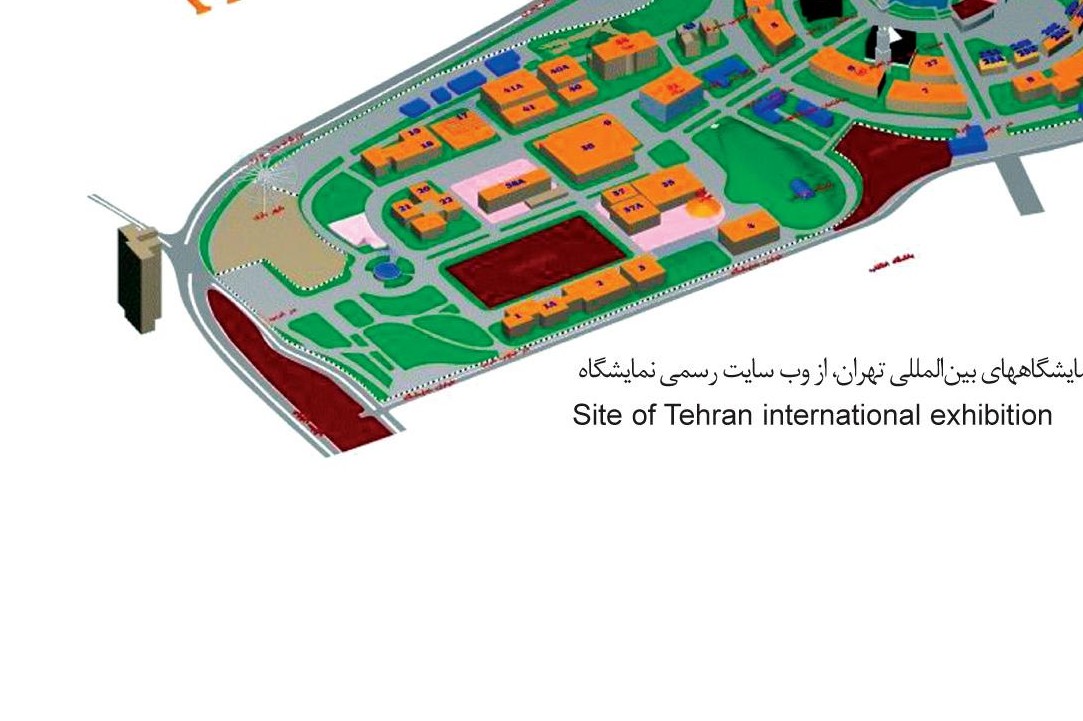
In 1348 (1969) the first exhibition was held at the site of the international fairground in the northern district of Tehran. Four years later, the first Tehran international exhibition — which was in fact an EXPO¹-style fair — was held with the aim of familiarizing the public with science, technique, and technology, and had no commercial character. The organization of the fairground site was carried out largely in those same years: part of the exhibition halls, the central water feature and the stands around it, the laying out of streets, the local accesses, and the northern car park — which was in fact the fair’s main car park — and the highway overpass, which also carried vehicles and connected the car park north of the highway to the fairground to its south.
Over the past twenty-five years, various facilities have been added to the site, and the number of specialized, commercial, and international exhibitions has grown ever larger; the number of visitors to some exhibition events has exceeded one hundred thousand a day. The consequences of this growth have shown themselves as regional problems around the fairground. In these last twenty-five years, no effective action has been taken — in terms of urban facilities and amenities for the optimal use of the site and for improving the quality of the capital’s residents’ access to it — except for the removal of the fair’s northern car park and its handing over to the summit-conference site, and the assignment of a vacant plot on the north-west side of the fairground as the main car park.
The former car park (the northern car park) had been chosen so that vehicles entered and left it from a side street that lay at a relatively acceptable distance from the heavy-traffic junction of the Chamran highway and Oveis Street, and it thus worked very well in gathering vehicles before the junction. Pedestrian access to the fair’s main gate from the car park was likewise provided by an overpass that separated them entirely from the highway traffic. The location of the current car park is such that its only entry and exit lie just past the junction on the Seoul highway, and the only pedestrian route to the fairground is to cross the width of the Seoul boulevard or highway. After ten years, no facilities whatever have been built in this car park.
As for road-building, within a two-kilometre radius of the fairground only the Parkway junction bridge at the Vali-Asr Street intersection and the access road to the Niyayesh highway from the Seoul highway have been built in recent years. For exhibitions with many visitors, the only task the urban transport system performs is to allocate a small number of buses and minibuses to carry visitors to the fair and return them to the main squares — alongside which the efficient system of private shared taxis should not be overlooked.
The economic standing of the exhibitions held at this site within the country’s macro-economy is not the subject of this piece; but what has not so far been addressed is the effect of holding exhibitions at the present location upon the economy of the city. The failure to clarify this relationship is itself the source of much of the discontent that, after twenty-five years, has given rise to a difference of opinion between Tehran’s city management and the body responsible for the complex — the permanent site of Tehran’s exhibitions, namely the Ministry of Commerce — and has raised the debate over relocating the fairground. Holding close to thirty different exhibitions a year at this place, and the failure to create facilities to reduce the negative effects of this space on the district, have created numerous problems for the residents of the fairground’s neighbourhood.
What Should Be Done?
Many cities have such sites. In 1994 the Bureau International des Expositions² chose the city of Hanover³ in the German state of Lower Saxony⁴ as the venue for the Expo 2000⁵ exhibition. At first, local citizens and the Green Party⁶ opposed this choice, out of concern over pollution and the consequences of the fair’s heavy traffic, the rise in the cost of housing and living in the city, and other problems bound up with urban matters. The motto of Expo 2000 was “Man, Nature, and Technology,” and the anxiety of Hanover’s citizens — which was not without foundation — stood in contradiction to the fair’s motto and aim.
To concentrate and better direct all the economic, political, and development activities connected with Expo 2000, a company named “Expo” was founded. The state government looked favourably on holding the fair, believing that it could be a spur to the economic vitality of the city and the state, could create new jobs, and could reduce unemployment. The fair’s considerable profitability for the local economy on a global scale, and the prestige it would bring the state, were among the other advantages of Expo 2000. Yet all this support could not prevent the Green Party from calling for a referendum on holding Expo 2000 in Hanover. In the referendum, 51.5 per cent of the people were in favour of holding Expo 2000, and in the end the federal government, at the insistence of Chancellor Kohl⁷, agreed to hold the fair in Hanover. Once the Expo was confirmed, extensive programmes in various fields were prepared to win the public’s support.
The fairground lies at the junction of Kronsberg⁸ and Karlsruher⁹ streets. Public opposition to widening the routes leading to the Expo site — including increasing the width of the transit highway (Berlin–Hanover–Ruhr¹⁰) to three lanes in each direction — led the Expo company to put forward a plan to reduce the car parks of the areas around the fairground by 50 per cent. This plan was meant to restrict the access of private vehicles to the area around the fair. It was estimated that about 60 per cent of the fair’s three hundred thousand daily visitors would arrive by private car, each car carrying on average two occupants; providing car parking for such a number of vehicles was practically impossible.
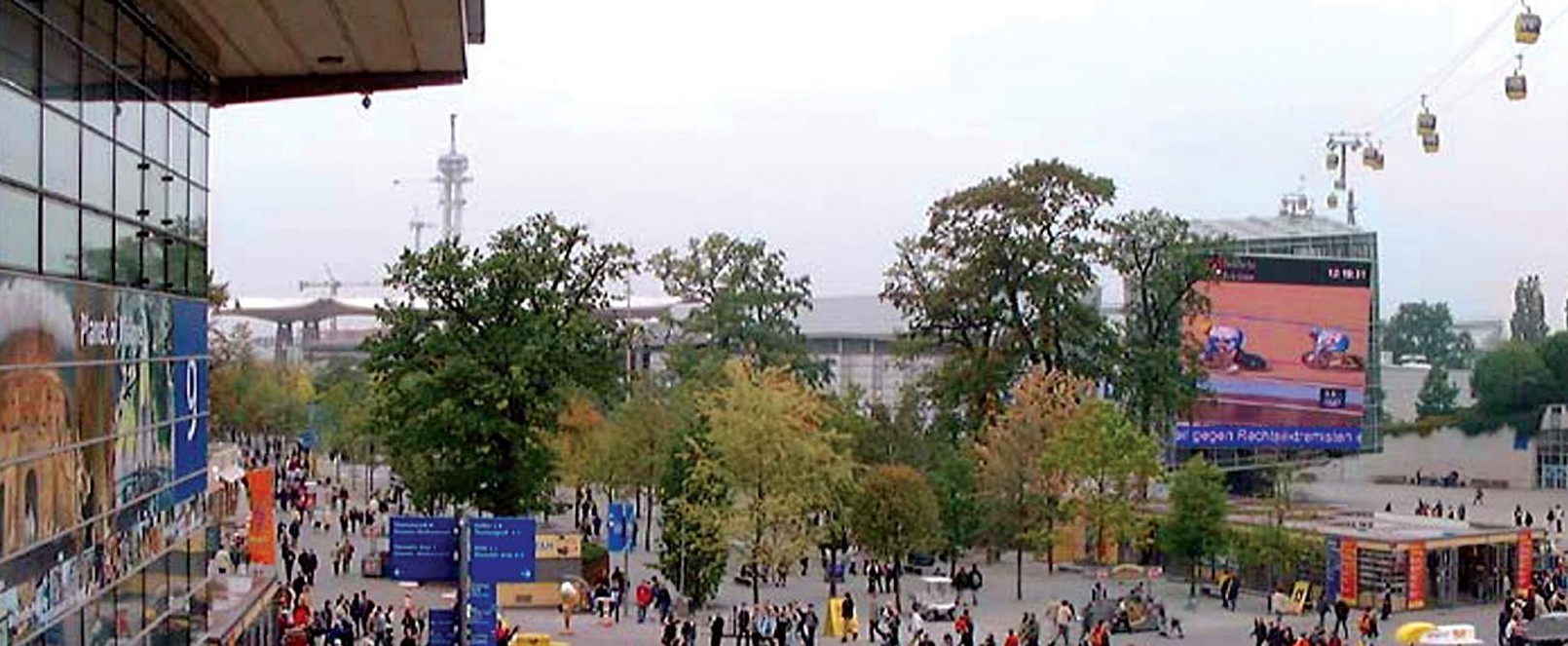
A station for trains on the Hanover–Lehrte¹¹ line was built beside the Expo 2000 fairground, one of the infrastructure measures of the Expo transport plan. With direct access to the ICE railway network, the journey time from Munich to the fairground was reduced to two hours. Building an extensive high-speed rail network (S-Bahn¹²) in the state was important for the citizens of Hanover, who had been deprived of access to the high-speed train network. The execution of these projects — which cost some 2.5 billion German marks in all — was, according to plan, meant to have been carried out years earlier, and the holding of the fair hastened it.
By paying special attention to the functions of the fair’s facilities, buildings, and equipment after the end of Expo 2000, the Expo company kept this site from turning — like the fairground district of Seville, Spain — into a half-abandoned area. The construction of 400 residential building complexes and 2,500 apartments with very-low-energy-consumption technology was put on the agenda. Beyond this, the construction of exhibition spaces and halls was pursued as the main pillar of the programme. Famous and unknown architects alike prepared a great many designs, some accepted and others consigned to the archive. Because the fair was thematic, the buildings had a distinctive character, and this theme park was designed so that after Expo 2000 it would become the site of the “International Academy for the Future.”¹³
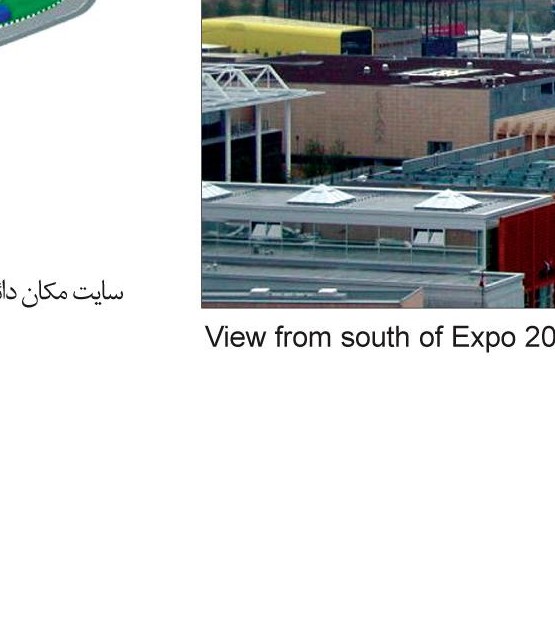
But how were the local costs of this project met? After the budget needed for all phases of the programme had been forecast, the German federal government provided 40 per cent of that budget and the government of the state of Lower Saxony 30 per cent. The city of Hanover took on 10 per cent of the sum, and the rest of the budget required for Expo 2000 was met, in autumn 1995, by private German companies. Hanover’s city management approved a programme entitled the “Hanover Programme 2001,”¹⁴ which was in fact the definition of a framework for the city of Hanover to benefit from the consequences of the fair’s permanence. This programme had eight local headings:
1. City position: optimizing the central part of the city, carrying out traffic projects, improving the city’s commercial centres and their associated facilities and the congress building, increasing tourist-attracting activities, and carrying out programmes to raise employment. 2. Transport: expanding the public transport system, extending cycle routes across the city, building new pedestrian routes, and correcting dangerous traffic nodes and points. 3. Social matters: providing suitable conditions for broad citizen participation in the decision-making and execution of the Expo 2000 project. 4. Environment: increasing green space in the city centre, building rings of pedestrian and cycle routes across the city to prevent air pollution, and substituting clean energy for fossil fuels in residential buildings to reduce CO₂ emissions.
5. Social balance: preventive measures against the widening of the class gap among the various strata of Hanover’s urban society, carrying out social-development schemes in the city, implementing plans to support the city’s vulnerable stratum, expanding public spaces, and creating suitable conditions for the integration of the city’s groups and population. 6. The Kronsberg residential district: creating a residential fabric around the Kronsberg district with priority on water conservation, carrying out water-saving programmes, reducing waste, and extending the forest fabric around the district. 7. The sites: repairing and optimizing various urban centres, the City Hall,¹⁵ and so on. 8. The exhibition site.
The idea of Expo 2000, for drawing comprehensive benefit from the fair in Hanover, is the close connection between city and fairground — something the city of Hanover offered, and what the city of Hanover prepared for it exists. But in the case of the Tehran international fairground, in its thirty-five years of activity, no such connection has ever been achieved. Notes: 1. Expo or Exposition; 2. Bureau International des Expositions; 3. Hanover; 4. Niedersachsen (Lower Saxony); 5. Expo 2000; 6. Die Grünen (Green Party); 7. Helmut Kohl; 8. Kronsberg; 9. Karlsruher; 10. Ruhr; 11. Lehrte; 12. S-Bahn; 13. International Academy for the Future; 14. “Hanover Programme 2001”; 15. City Hall.