



On the occasion of the twentieth anniversary of Memar Publishing Institute, a series of lectures and discussions entitled "The Thought of Building in Architecture" ON OCCASION OF 20 YEARS OF MEMAR MAGAZINE Note Note People / Activities Number Number of Memar Publishing Institute collaborators (average)
Number of individuals who have collaborated with the magazine under the titles of Collaborators' Council, Collaborators' and Writers' Council, etc.
Number of individuals who have written articles for Memar to date
Number of articles written: 989 Number of individuals who have translated articles: 113 Number of translated articles: 549 Number of projects featured: 528 Number of guest editors: 14 Twenty years of publishing Memar, Issue 110 Memar Award Number of participants Number of winners Subject and award categories 1380 SH (2001) First Edition 155 5 Residential and Public 1381 SH (2002) Second Edition 93 5 Residential 1382 SH (2003) Third Edition 38 6 Public 1383 SH (2004) Fourth Edition 75 7 Residential 1384 SH (2005) Fifth Edition 40 6 Public 1385 SH (2006) Sixth Edition 72 6 Individual Dwellings and Apartment Buildings 1386 SH (2007) Seventh Edition 46 5 Public 1387 SH (2008) Eighth Edition 96 6 Residential and Public 1388 SH (2009) Ninth Edition 92 6 Residential and Public 1389 SH (2010) Tenth Edition 142 6 Residential and Public 1390 SH (2011) Eleventh Edition 124 9 Residential, Public, and Renovation 1391 SH (2012) Twelfth Edition 160 9 Residential, Public, and Renovation 1392 SH (2013) Thirteenth Edition 215 11 Residential, Public, and Renovation 1393 SH (2014) Fourteenth Edition 241
Apartment Buildings, Individual Dwellings, Public, and Renovation 1394 SH (2015) Fifteenth Edition 164
Apartment Buildings, Individual Dwellings, Public, and Renovation 1395 SH (2016) Sixteenth Edition 300
Apartment Buildings, Individual Dwellings, Public, and Renovation 1396 SH (2017) Seventeenth Edition 308
Apartment Buildings, Individual Dwellings, Public, and Renovation Total 2,361
*Seventeen editions of the Memar Award The Memar Publishing Institute commenced operations with the publication of the first issue of Memar magazine in 1377 SH (1998). Throughout all these years, this magazine has been the central axis of the Memar Publishing Institute's activities, and the institute's other endeavors — including organizing the Memar Award, publishing 28 issues of Shahr (City) magazine between 1378 and 1382 SH (1999-2003), publishing books, and organizing lectures and discussion sessions in the institute's early years — have been formed around it. Architects and architecture students rightly recognize these activities under the name Memar magazine. In memory of and to honor the late Mrs. Beski, the deceased director of the Memar Publishing Institute and managing editor of Memar magazine, in the three years since she has not been among us, we have endeavored to resume some of the institute's past activities. People / Activities Number Number of articles: 334 Number of authors: 76 *Shahr magazine, 28 issues (between 1378 and 1379 SH / 1999-2000), the contents of the articles remain useful for those interested in urban issues. *Despite the fact that 16 years have passed since the publication of the last issue of Shahr magazine, given the limited number of print copies at the Memar office, the electronic version has been made available to interested readers through the Memar channel. *Number of jurors: 56 / Number of foreign jurors: 8 77 First issue of Memar, Summer 97 One Hundred and Tenth issue of Memar, Summer 82 Last issue of Shahr, Winter
The Thought of Building in Architecture This is a title we have chosen, inspired by the profoundly meaningful phrase of the Norwegian architect Sverre Fehn, "The Thought of Building," for a series of activities whose culmination will be a lecture by one of the world's foremost architectural thinkers. Of course, friends who are familiar with the current state of architectural thought in Iran well know that organizing such lectures without preparatory and follow-up measures yields little result. Therefore, we will endeavor, prior to the lecture, to publish material in Memar magazine — and if necessary, in book form — related to the lecture topic and the speaker's views, and after the lecture, to contribute in various ways to the continuation of the discussion. Criteria for selecting the speaker Like other decisions and choices at Memar magazine, the Memar Award, and elsewhere, ideological criteria have no bearing on our work. What matters is the originality and depth of thought, and the volume and quality of published material. Another criterion that is equally important to us is the speaker's non-affiliation with the interests of large and small international corporations. In a world where state and commercial interests increasingly cast their shadow over the realm of thought, this is of great importance to us. First selection: Professor Alberto Perez-Gomez Professor Gomez was our guest from mid-Ordibehesht (May) for ten days. His lecture, entitled "Attunement: Architectural Meaning as Atmosphere," was held on the 19th of Ordibehesht 1397 SH (May 9, 2018) at the Kuh-bar House designed by Mehdi Alizadeh (we published its poster on the Memar channel). The planning for this lecture took place a year prior. During that year, we published material that aided in familiarizing readers with his views, including the book "Mind in Architecture: Neuroscience, Embodiment, and the Future of Design," which introduces readers to the latest findings of advanced neuroscience and their implications for architecture. The final chapter of this book, "Mood and Meaning in Architecture," is written by Professor Gomez. In Memar 103, we published his very important essay "Poetic Language and Architectural Meaning." Additionally, his collection of seven essays titled "Timely Meditations" was translated into Farsi, and its PDF was made available to participants before the lecture. Memar 108 was essentially dedicated to the subject of atmosphere in architecture, which is closely related to his lecture. Concurrent with the publication of this issue, a selection of Professor Gomez's essays has been prepared in print. In this very issue, the translation of the lecture text and the displayed slides are available to you, dear readers. A film has also been produced of his lecture, the interior of the Kuh-bar House, and the disastrous surroundings. To obtain these two books and the CD of this film, you may contact the Memar magazine office. After leaving Tehran, Professor Gomez sent an email to the Memar magazine office, the translation of whose brief yet eloquent and kind text follows below. Director of Memar Publishing Institute Colleagues at Memar magazine Dear Reza, A brief visit to Tehran, Kashan, Isfahan, and Shiraz revealed to me the passion and depth of the poetic spirit of Iranian culture. The poetic sensibility latent in the fragrant and tantalizing cuisine, in the metaphors of the great poets, and in the wisdom of master craftsmen, is present in its ancient and modern architecture alike. All of this brought to mind a fundamental relationship with water, fire, sky, and earth, which forever keep the tree of life alive. Iran's cultural heritage is exceptional, having always challenged and surpassed ideological divisions. Last but not least, I thank the warmth and hospitality of the Iranian people, especially the colleagues: a memory, like an ephemeral flower, that I shall cherish forever. Alberto Perez-Gomez Lecture poster
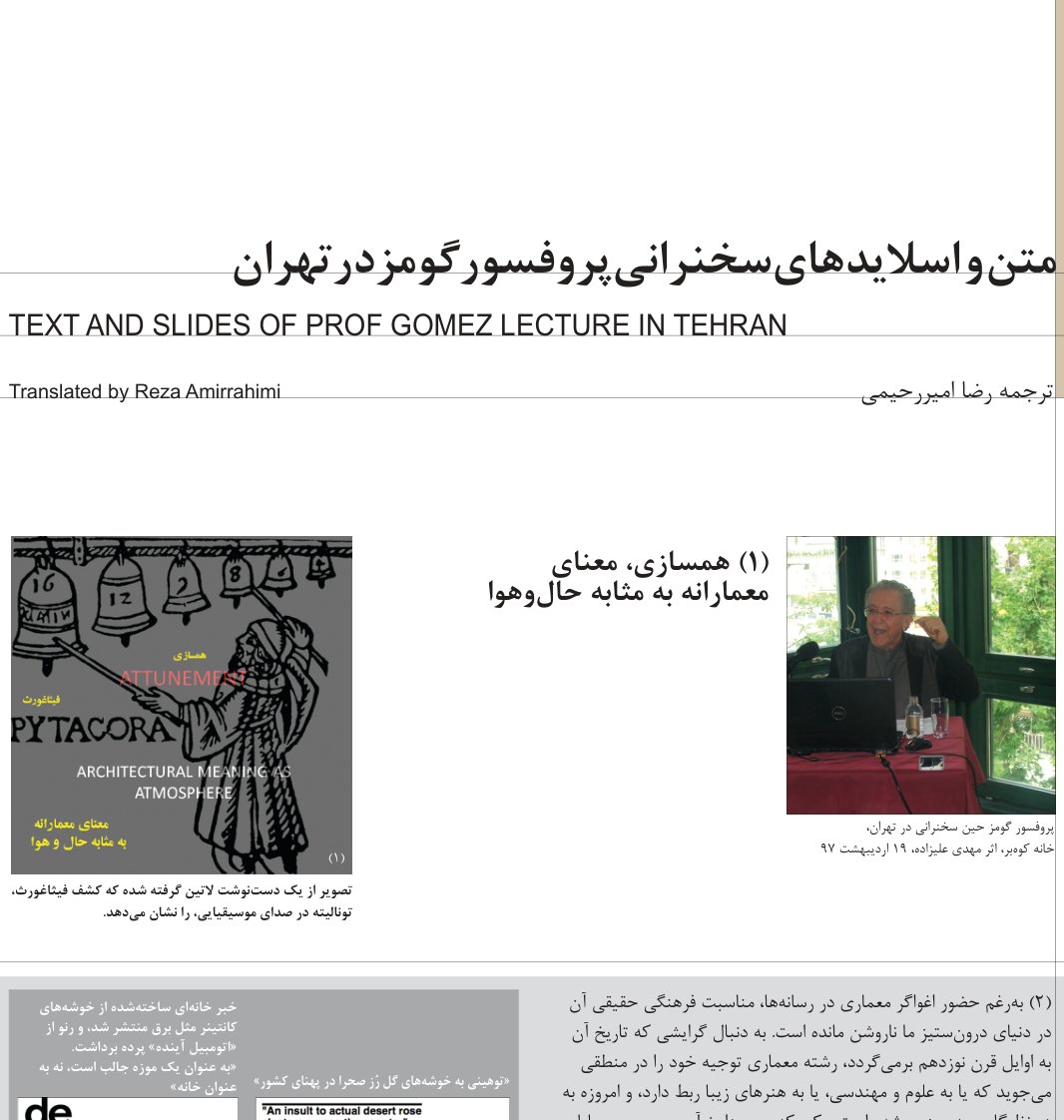
Text and Slides of Professor Gomez's Lecture in Tehran (1) Attunement: Architectural Meaning as Atmosphere (2) Despite the seductive presence of architecture in the media, its true cultural relevance in our conflicted world remains unclear. Following a tendency whose history dates back to the early nineteenth century, the discipline of architecture seeks its justification in a rationale related either to science and engineering, or to the fine arts, and has today led to two dominant viewpoints: one that champions endless — and often spectacular, though frequently gratuitous — formal innovation, and another that pursues obsessive technical sustainability, while taking for granted "development" and perpetual economic growth. Nuances can of course be found in these descriptions, and in rare cases formal novelty and technical expertise converge; yet architecture as a whole seems unable to fully and properly engage with cultural values. Architecture that flaunts its apparently unshakeable nature as a self-ordering act of invention and engineering ignores the meanings present in the social environment — meanings that emerge from the bottom up, through the customs and habits of the cultures that inhabit our planet. Architecture has largely become detached from the places in which it should be rooted, and severed from the ways of life of its inhabitants and the stories that should be foundational to it. (3) That seductive signs of formal allure attract tourists or drive municipalities to bankruptcy through unforeseen costs, as the example of Spain demonstrates, is something the ordinary citizen comprehends nothing of, and it does virtually nothing for their mental and physical well-being. Translated by Reza Amirrahimi The image is taken from a Latin manuscript showing Pythagoras's discovery of tonality in musical sound. Professor Gomez during his lecture in Tehran, Kuh-bar House, designed by Mehdi Alizadeh, 19th of Ordibehesht 1397 SH (May 9, 2018) "An insult to the wild rose clusters across the desert" The news of a house built from clusters of shipping containers spread like lightning, and Renault unveiled its "car of the future." "It is interesting as a museum, not as a house." The sculptural form of the National Museum of Qatar by Jean Nouvel has not convinced readers. Containers give shape to this house in a Californian desert, and readers do not know whether they love it or hate it! TEXT AND SLIDES OF PROF GOMEZ LECTURE IN TEHRAN Reviews and Opinions Reviews and Opinions
(6) Considering contemporary humanity's disregard for the environment — which has subjected nature to exploitation by nation-states and corporations, and urban contexts to a more benevolent but equally consequential indifference, brought about by the culture of distraction and remote communications — it is important to emphasize the vital significance of the physical environment of cities and their architecture for human consciousness. We have mistakenly equated consciousness with attention, imagining that we inhabit our computer screens, that we ourselves exist in social media, and that remote communications are truly avatars of communication. This is not the case. Human communication is fundamentally oral, gestural, erotic, and embodied; other modes such as writing and digital codes convey information but can never reduce human communication to such simplicity. We might suppose that all that matters is what we can represent through our language or our devices. Yet this is far from reality: representational consciousness is like the tip of an iceberg. Eighty percent of our consciousness is pre-reflective — not semi-conscious or unconscious, but pre-reflective when we are awake. And consciousness is performative, never passive; even visual perception bears no resemblance to the production of a photographic image on the retina: we can see with high clarity because our body, acting in the world, is empowered through kinesthetic and conceptual skills to attend to this world, which would otherwise appear regrettably blurred, latticed, and practically granular. We truly dwell within a landscape and an excessively built-up environment that overshadows the biology of the majority of this world's population. Contemporary cognitive science and neuroscience have recognized what had long been an insight in phenomenology during the twentieth century: the environment is a constitutive component of human and animal consciousness. Just as every animal has its own surrounding world (Umwelt) that emerges along with its organic morphology and biology, so too does the human being. For example, the world of a fly and the world of an ape bear little resemblance: the world of each organism, while in the course of life pursuing its particular states of homeostasis, emerges along with it — a balance that allows the organism to prevail in life, which is nothing other than the status of meaning for that whole. In other words: our personal consciousness is not the same as our brain; both are embodied — our nervous system's sensory apparatus, together with our physical morphology and orientation, our bipedalism, with its distinct front and back, left and right, above and below, frontal vision, and the ability to contemplate the orderly movements of the stars — and equally importantly, it is always situated in place. Despite the common assumption of the supposed interiority of consciousness, there is no human consciousness apart from place. Moods and affects are in fact in the world: an apparent paradox, which, following insights I learned from Merleau-Ponty and more recently from Nick Crossley concerning the primacy of the social body, I analyzed in my book. The internal and external components of consciousness always interact through bodily motility — for example, they construct non-representational knowledge as cultural habits, long before they come to our attention. Hence, the internal and external components condition each other, and evolve as they engage themselves in time, along the trajectory that is life itself. The built environment conditions our thoughts and feelings, and contributes either to our well-being or, as I shall demonstrate in the case of the dysfunctions of routine contemporary architecture and urbanism, to our shared psychological harm. (5) Indeed, as globalized and decontextualized architectural firms proliferate, eclipsing smaller firms and becoming international corporations, cities grow exponentially, and while providing shelter for half the world's population, they are experienced as an alien environment regardless of geographical location and their good or bad ecological footprint. The post-industrial city, despite its claim to having become, compared to its traditional counterparts, a more hygienic and therefore better environment for human life, has in fact become a source of enormous malaise, and for those seeking contentment, a source of despair and even fanatical ideological extremism. (4) Indeed, in the past few years, computer software has enabled an acceleration of formal-geometric innovation that would have been unimaginable twenty years ago. Novelty seems inevitable, appearing daily on computer screens and as seemingly indisputable evidence of quality, in the endless images of buildings — some familiar, some unfamiliar, and even bizarre — that architecture and design newsletters offer. This effervescence of creation may be exciting for some. But at the same time, architects, architecture students, and users — even the most radical — are increasingly regarding the merits of such "progress" with skepticism. Because they bear little relation to local culture and indigenous habits, unfamiliar building forms assert themselves everywhere in the world, to the point where it has become harder to accept that all of this constitutes true architectural value (or that appropriate meaning is automatically produced through such formal games). (4)
(7) On this basis, my latest book [Attunement: Architectural Meaning After the Crisis of Modern Science] is an attempt to envisage alternatives to vulgar formalism and rhetoric about sustainability, both in architecture and urban design, while always acknowledging the problematic situation and inescapable responsibilities of the imagination in the form of fundamental mythical and poetic cultural structures — and architectural ones — that the end of traditions has imposed on established modernity since the French Revolution. From the very outset of modernity, fundamental frameworks containing references to artistic symbolism, such as cosmographic images associated with hegemonic religions, were discredited. Nevertheless, relinquishing personal imagination (for instance, in favor of rational consensus, group design, or even algorithmic generation) — embodied and linguistic — is not an option. Modernity demands that the "experimentation" of architects, by empowering the constructive imagination, hold the promise of a better world to inhabit — a kind of state of invention. Yet I would add that, for this state to be meaningful, it must necessarily assume a humble, cultivated, and historically open stance toward concrete reality and its values. Despite the apparent rigidity of a world that does not move from its place when we are not looking at it, matter has no ontological priority over consciousness: quantum mechanics is simple, albeit astonishing, testimony to this reality. From this it follows that the origin of architectural meaning does not lie solely in an object-oriented ontology, and is not dependent upon formal geometries imposed from above and below — whether a "starchitect" has invented it a priori or algorithmic software has generated it. The challenging assumptions that apparently historical work practices have confirmed, going back to the architecture of ancient Egypt, and the recognition that this is specific to modernity, was the subject of my first book, "Architecture and the Crisis of Modern Science." In simple terms: geometry, which is a product of the human mind, was profoundly important as a manifestation of architectural work practices in conditions where the world of experience was assumed to be in perpetual flux — at a time when Euclidean forms and the proportional organization of buildings, being the only reference to stable states of perception, were mediated by the geometry of celestial vaults and the movements of stars and planets that were mathematically determined yet invisible to the naked eye. All of this, especially after the Hellenistic period, led to a kind of architecture that imitated the cosmos. Yet, while geometry became an instrument in the early nineteenth century, and Euclidean principles and their limits were challenged on the basis of the priority of multisensory tactile experience in order to empower those modes of production that had been commonplace since the Industrial Revolution, it was no longer possible to imagine that geometry possessed inherent meaning. (8) I, who share the view of some contemporary architects and writers, including Peter Zumthor and Juhani Pallasmaa, that architectural meaning is more about creating atmosphere than a specific formal vocabulary, have in my latest book explained this subject through a particular multidisciplinary approach, and have set aside a conception of atmosphere that implies the mere harmonization of effects. Rather, I have considered its importance as an expression of mood in lived situations that occur in the course of ordinary human action. My book explains how it is possible to understand architecture — through atmosphere, and as a communicative arena, both cognitive and affective — beyond the conventional but failed definition of architecture as decorated building, derived from the misunderstandings of eighteenth-century aesthetics. The concept of atmosphere has the advantage of immediately prompting us to question objectivist aesthetics — this common misconception of aesthetic experience as aesthetic judgment. But the complexities associated with positing atmosphere as a fundamental category of architecture in contemporary discourse have not been fully understood, and can be misleading. For example, it is obvious that users can change atmosphere and mood: if I light a few candles in an ordinary hotel room, I can transform it, at least to some extent, into a bower of Venus, making it conducive to a romantic encounter. On the other hand, an angry speech can destroy the sacred mood of a church... It is certain that when we act, atmosphere is immediately perceived and affects us not only rationally but also at a pre-reflective level. But in order for atmosphere to function as architectural meaning, a degree of permanence must be established, and forms, materials, and details certainly play a very important role. Consequently, it is crucial to trace the roots of this concept in the history of architecture and its theories, and, closer to our time, to recognize the kinship of atmosphere with the concept of character in eighteenth-century architectural theories.
(9) When I embarked upon this exploration, my first step was to trace the physical environments that are literally attuned to the historical origins of European-Greek architecture and its musical analogy in Roman culture. This analogy is present in all traditional architectural conventions, which even today are the subject of academic essays, student projects, and competition briefs, and usually bring to mind the famous phrase of Goethe: architecture is frozen music. However, this analogy has typically been misunderstood and examined in terms of formal criteria, with the argument that since music employs proportions and mathematics to achieve its harmonic effects and produce beautiful sounds, this should be transferred, through some back-and-forth, to architectural form, seeking the equivalence of a building's parts and its whole through the observance of proportional ratios. In fact, a careful study of the Western theoretical tradition reveals that the musical analogy, from the very beginning, went beyond this formal back-and-forth. The fundamental issue was the design of a kind of human condition that enables the good life — harmonious, balanced, and properly accompanied by gentleness. Consequently, the spatial experience was likened to the experience of music, and was deemed capable of transmitting cognitive and poetic moods through a fundamental affective attunement. Yet, surprisingly, it was believed that attunement was achieved through a kind of atmosphere that is today commonly understood as a matter of subjectivity — strikingly different from the objectivity of mathematics referenced in traditional writings. (10) This musical analogy between music and architecture for the sake of the good life is clearly articulated in the first theoretical architectural text available to us — Vitruvius's Ten Books. Architecture operates in a communicative arena and for communities: indeed, its beauty is its meaning when it contributes to human health and self-knowledge. Innovation or efficient design is not Vitruvius's preoccupation. If parts of buildings must have proportional relationships according to mathematical ratios, this is not a question of purely formal composition. It was believed that the same numbers governed musical and cosmic orders, and served to advance a harmonious and balanced city — an attuned environment that, like music, operates in both time and space, as the fundamental foundation and necessary precondition of good architecture: the stage for a good life and well-being. Throughout the Renaissance and far beyond, until the end of the Baroque period in seventeenth-century Europe, harmony and balance remained as fundamental values of architectural theory. I have written at length in my latest book about the continuity of the musical analogy in architectural theory, and with regard to the cultural centrality of this experience and in relation to music theories. (11) An interesting Renaissance example is the Vicenza Cathedral by Palladio. In the Quattro Libri [Four Books], for the first time in the history of Western architecture, proportion is considered in "three dimensions," and the dimensions of rooms — their depth, length, and height — are harmonized in a way that conveys a consonant experience, which is a continuation of the practices of polyphonic music theory of his time. Palladio in this manner notates his architectural ideas, which appear as drawings related to this work in his own book. On this basis, the cathedral proposes a thorough harmony for Vicenza that is not, however, imposed upon reality by destroying the pre-existing medieval building. If you visit Vicenza and are unaware of the architect's concern, you might easily imagine that the built structure is exactly the drawn one. When I first visited, and considering that at that time I had only a superficial knowledge of Renaissance history, I had precisely this impression — but this is not the case. Palladio did not uproot the old buildings — the literally frozen habits — to construct his ideal building. The ideal music is latent but not imposed; it conditions everyday life to make it more balanced. The harmonious form has a transformative effect on the complex and contradictory functions that Renaissance urban center buildings housed, including brothels, taverns, places for the administration of justice and civic government. When, in the late seventeenth and eighteenth centuries, the meaning of architecture as a cosmic analogy through musical proportions was called into question, ultimately weakening the possibility of employing geometry as a transcendental symbol in architecture, architects recognized the importance of narrative language for preserving the communicative function of architecture. The eighteenth-century theory of character, while still emphasizing the importance of harmony as a goal, adopted a linguistic analogy to replace the musical analogy. The musical analogy
(12) A good example from the late eighteenth century is a treatise by Nicolas Le Camus de Mezieres, "The Genius of Architecture." Le Camus believes that harmony can be sought in the analogy between proportions and human sensations, but this harmony is attained not through theoretical prescriptions or mathematical ratios, but only through meaningful fictions that undertake narratives. The description of architectural "space" in human habitation in his book is unprecedented; moods are described through literary language and metaphor, conceived as befitting the different rooms of the house, and experienced in a kind of crescendo reminiscent of erotic tension. (13) This transformation reached its peak in Romantic philosophy: in the formulation of Stimmung, an authentically German term for atmosphere, which literally means attunement — fundamental to artistic expression. This is both an effect and a knowledge that art provides, far more consequential for our cultural endurance than the relative yet precise truths of instrumental science: hence the work of art enables us to recognize ourselves fully and purposefully, in order to prevail in life. This is the supreme purpose of architecture. To grasp the potential of this concept in contemporary architecture, the linguistic roots of Stimmung are of great importance. Indeed, it is vital to consider that, alongside the connotations of Stimmung — that is, inner or mental mood — its roots point to harmony as well as temperance, key terms in traditional architectural theories. Romantic philosophy, like phenomenology and poets such as Rainer Maria Rilke who came much later, recognized that "the inside is the outside" — my joy or sorrow is in fact the joy or sorrow of the environment, flowing through atmosphere. Furthermore, Stimmung preserved its musical ideals, though not through proportional or geometric relationships, but through poetic language, in the forms of lyric and the narratives befitting the novel. Remarkably, the novel became the primary medium of cultural expression, later adopted by virtually all the world's cultures and realized as film and television: the telling of stories that address human concerns — the modern heir to practical philosophy in the Aristotelian tradition that led to phronesis, which describes a human being committed to truth and making the good life possible. Hence, recognizing the fundamental importance of poetic language for artistic expression emerges as a foundational issue to be explored in relation to the manifestation of Stimmung in post-nineteenth-century modernity up to our own time. (14) To grasp the full scope of Stimmung in contemporary architecture, it is vital to recognize the precedence of embodied place over geometric space in the long history of the discipline of architecture. Prior to Le Camus, architects had never defined the concepts of space, whether qualitative or geometric. Indeed, it must be noted that, until the late nineteenth century, space as the so-called material of art had by no means entered theoretical architectural writings. It was believed that the site of architecture had a cultural and intersubjective importance, constituting a fundamental dimension of meaning that buildings could convey. Throughout history, there have been longstanding relationships between place and narratives, and the manner in which architecture builds upon indigenous meanings and creates its own frameworks for valuable human actions has been instructive for a generation of attuned architecture. In other words: what defines places first and foremost are the cultural narratives related to the natural features of the land, and place is fundamentally situated in the emergence of consciousness. While scientific space, dating back to Galileo, has become the universal technical world — perhaps our location in the global village — indigenous places have taken refuge in concealment. They are present, and it is the task of good architecture to restore them to collective awareness. A fundamental dimension of architectural atmospheres is their capacity to unveil place. Nicolas Le Camus de Mezieres, Le genie de l'architecture (1780) Ledoux, Pavillion de Louvenciennes A true metaphysics is needed, the question why must be asked to be certain of architecture's meaning. Harmony may be sought in the analogy between proportions and human sensations, yet it cannot be attained by theoretical prescription, only through expressive fictions, engaged through narratives. The earliest qualitative description of architectural "space" in human dwelling. (1780) Nicolas Le Camus de Mezieres, The Genius of Architecture Ledoux, Pavillon de Louveciennes A true metaphysics is needed; the question of why must be posed to attain certainty about the meaning of architecture. Harmony may be sought in the analogy between proportions and human sensations; yet it cannot be attained through theoretical prescriptions — only through meaningful fiction and engagement with narratives. The earliest qualitative description of architectural "space" in human habitation. Stimmung: harmony and temperance Stimmung: atmosphere, ambience Stimme: voice Stimmung: harmony and temperance Stimmung: atmosphere, ambience Stimme: voice Historical precedence of embodied place over geometric space Historical precedence of embodied place over geometric space