with a thickness of approximately three centimeters, to communicate with one another and once again build a perfectly symmetrical nest. Of course, the structure they create is always the same nest. Humans who have faced the similar problem of building in a divided habitat have, on each side of the partition, constructed different structures, and if they lacked a certain type of expertise, they risked failure and destruction, or else they would invent a method to perforate the partition in order to exchange information and create a political organization—a matter dependent on linguistic translation, and each time yielding a different city. The Greeks called this activity Poiesis, which highlighted a form of technical making worthy of humanity: a poetic making in the sense that its aim was always something beyond mere survival. Even for the most advanced great apes, desire is externally triggered and can be understood as a closed structure, a type of complex mechanism: hunger is a physiological matter while sexual behavior is seasonal. In contrast, for human beings, desire is experienced as an open horizon. The "erotic," according to Marion,
possesses a rationality that challenges logic and encompasses experiences as diverse as altruism and lust. While the behavior of great apes around a dead conspecific displays indifference, the burial of the dead in early human societies appears to bear a relationship to an awareness of sexual desire and a vague simultaneity with an awareness of death as the limit of life. Many artifacts and mythological narratives in different cultures that reflect a need to possess or alter external reality convey a sense of transgression: shame or guilt. Adam and Eve are condemned to eventual death for the knowledge of love; Prometheus is punished by the gods for stealing fire; and Cain is condemned to work the earth and build cities. In mythological cultures, sacrifice is typically accompanied by technical acts and deeds, in the hope of renewing a sense of reconciliation with a world that transcends the human.
Footnotes: 1- postcritical: the endeavor to find new forms of reading and interpretation that go beyond conventional methods of criticism. Postcritical reading emphasizes affect or sensation and attempts to explain the phenomenological or aesthetic dimensions of the observer's or reader's experience. Tr. 2- hard 3- Plato, Symposium 186 a-b, in Selected Dialogues of Plato, trans. Benjamin
Jowett, orev. Hayden Pelliccia (New York: Modern Library, 2001). (The Symposium, Plato.) 4- Siddhartha: Prince Siddhartha sat for a long time in a state of meditation and enlightenment beneath the bodhi tree, and for this reason people gave him the title of Buddha. Tr. 5- Poiesis: a Greek word that simultaneously conveys the concepts of making and composing poetry; this Greek word is the root of the English word "Poetry." Tr. 6- physiological 7- Jean-Luc Marion: a French philosopher. In his book The Erotic Phenomenon (2000), he emphasizes philosophers' neglect of the subject of love and argues that love possesses its own rationality and can be the subject of philosophical inquiry, which he explores in this book. Tr. 8- Cain: according to the Bible, Cain was the elder son of Adam and Eve, and Abel the younger. According to this narrative, Abel offered a newborn lamb to God and Cain offered the produce of his farming. God was not pleased with the agricultural produce, and Cain, out of jealousy, murdered Abel. This religious narrative, on one level, reflects family relationships, and on a larger scale reflects the conflict between agricultural and pastoral societies—a matter that in the land of Iran continued for several millennia as the clash and struggle between the sedentary agricultural Iranian society and the nomadic Iranian and non-Iranian tribes. Tr.
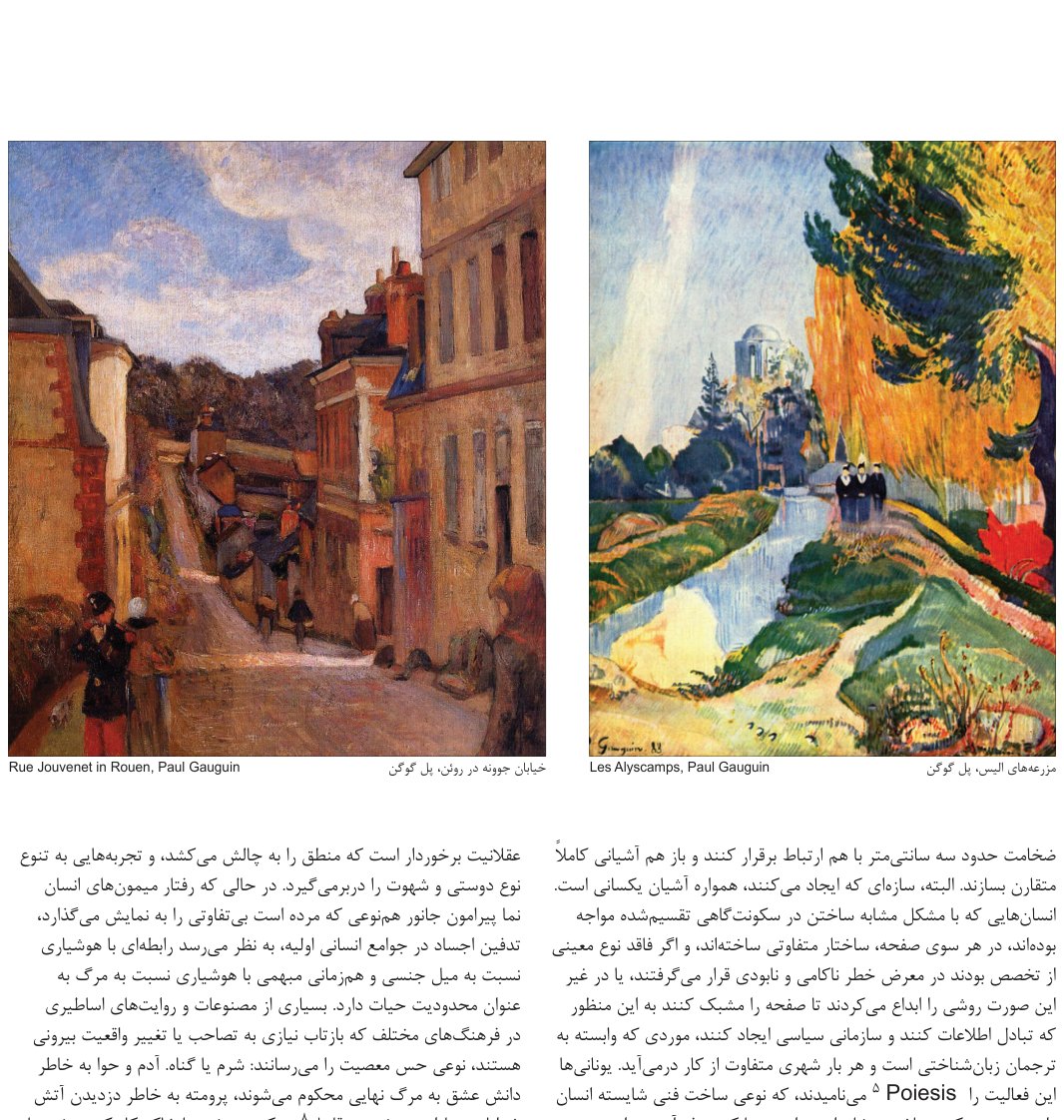
Rue Jouvenet in Rouen, Paul Gauguin. Elysian Fields, Paul Gauguin.
The Cohesion of Love and Architecture: A Dialogue with "Built upon Love"
The fundamental question of the book Built upon Love by Alberto Pérez-Gómez (2006) not only still deserves to be raised, but appears to assume particular importance in the post-pandemic world: can we envision an architecture that is both beautiful and in the service of the common good? The compound phrase "common good" in the book's opening sentences promises an ethical—and indeed democratic—inquiry into the function of architecture in society. This text is an attempt to engage in dialogue with the text along the path that Pérez-Gómez unfolds before us, toward understanding and interpretation through historical and mythological references across the years. (The difference in font size in certain sections of the text is intended to distinguish between parts where the book author's views are being explained and parts where the present article's author initiates a dialogue.) "A meaningful architecture effectively meets the material needs of humanity while maintaining its awareness of the world's resources for the continuity of human civilization." Pérez-Gómez, by critiquing "the epidemic of meaningless formalism and banal functionalism in the modern age," emphasizes the necessity of reconsidering meaning and experience in architecture and invites us to reflect on the role of virtual reality and digital tools in the creative process: "The latest magical algorithms create new products that, despite their fleeting allure, are devoid of love—without regard for the experience of beauty and embodied cultural meaning and proportion and character." From Pérez-Gómez's perspective, these are interrelated, and in his view a large portion of contemporary architecture is indifferent to both. He seeks an antidote to neutralize the contemporary materialist and technology-driven architectural culture. Alberto Pérez-Gómez considers this antidote to be love. Love, in his view, enriches architecture both in the design process and in the experience of the work. Love can be the reason for our transcendent feeling in the encounter with beauty—a feeling that is tied to physical desire and follows a complex, intertwined process of interruption and suspension and ultimately possession and arrival at the destination; therefore it is temporal. He considers love the agent of bodily knowledge in encountering the world, the cause of understanding our place in the world and even our purpose in life. He sees the point of intersection between beauty and ethics in the creative process of architecture as love, and he founds his book on an exploration that goes beyond the conventional rules and laws of ethics and established aesthetics. The ethical dimension of his view relates to the embodiment of allure alongside compassion in the architectural work—a quality that allows beauty to cohere with justice and the common good. But this equation is only possible at the cost of the architect's responsibility beyond digital innovations and the professional satisfaction of the client's demands. Just as ethics cannot truly be reduced to rigid rules, beauty too escapes the grip of rigid aesthetic rules and philosophical logic. Beauty deals with feelings and passions—an alluring, attractive, and even terrifying quality that, while destabilizing through innovation, remains recognizable because of familiarity, and this is what enables compatibility
Of course, from his perspective, the history of architecture "built upon love" is not reducible to "a list of useful buildings with construction dates whose distinguishing feature is the creation of pleasure through more or less irrelevant ornamentation." This definition of architecture and its association with the fine arts dates back only to the eighteenth century, and from this standpoint a vast domain of knowledge and human civilization related to the architectural tradition is overlooked. His inquiry into this matter leads to a deeper reflection on the root concept of architecture: in ancient Greece there was no word specifically for architecture, while for the architect the term architecton was used, meaning the chief or head of craftsmen. This issue bears a thought-provoking proximity to the Arabic-derived word "me'mar" (architect), which in the Dehkhoda dictionary is given as an emphatic form meaning one who constructs much, and even the chief of masons. In the Renaissance period, the word Architectus was used with the concept of the Architect of existence in
1- God as the Architect of Existence, from the Bible moralisée, Paris (1220-30). Presented in Mosaic journal by Alberto Pérez-Gómez in the article "Built upon Love," 2011.
Judeo-Christian culture (Image 1). Although the root of this attribution traces back to the decipherment of early Judeo-Christian theologians' theories, the image that Pérez-Gómez shares belongs to an illuminated Bible whose illustrations were drawn between the years 1220 and 1231. In this image, God is depicted in the act of creating the world by means of a compass—a symbol of the architect's tools. Inside the circumference of the circle, the sun and moon are shown as completed alongside the earth, which appears as formless matter still being completed according to those same geometric principles. The famous statement of Thomas Aquinas: "The relation of God, who is the first principle of all things, to His creatures is analogous to that of the architect to the things he has designed," helps us understand the acceptability of this thinking in the Middle Ages. Yet even in the Renaissance, despite the close proximity of architecture, painting, and sculpture, architecture still encompassed a far broader domain of machine-building, fortifications, gardens, theater stages, and temporary structures alongside buildings. Pérez-Gómez, by referring to the first mythological architect—Daedalus—to whom, in the form of legends, the construction of a great complex of ships, temples, war machines, and more is attributed, reminds us that what is common across this range of inventions and creations is harmony. Daedalus's creations all consisted of small parts connected by ingenious joints that functioned like the parts of a body. The commitment to this harmony continues in the oldest architectural treatise that has come down to us from the first century CE, by Vitruvius, such that the buildings, machines, and sundials described by him all possess the ability to convey
meaning through the representation of cosmic order (cosmos). This holistic vision in architecture is also found in the East, and particularly in Iran—setting aside the historical accuracy of attributing diverse works in design and architecture to architects such as Sheikh Baha'i—the breadth of these domains reflects the vastness of architectural knowledge of that time. But a comparison with the first architect in Iranian mythology is also instructive in this regard. Nezami Ganjavi, in his work Haft Paykar (Seven Beauties), introduces an architect named Shideh, who was a student of Sinmar. Shideh approaches Bahram Gur at the winter festival and proposes the construction of the Palace of Seven Domes, each dome being the dwelling of a princess and matching the color of one of the celestial spheres, corresponding to a specific day of the week, so that Bahram could wear a garment matching that celestial sphere each day and visit the princess residing in the dome of the same color. The construction of the Palace of Seven Domes took two years, and Bahram, avoiding Nu'man's precedent, bestowed the city of Babak upon Shideh (Image 2). The ornament-maker of every black and white / Shideh by name, as bright as the sun / In surveying, an engineering name / A master in the craft of draftsmanship / Everything in his hand like wax / In natural science, geometry, and astronomy / A pattern-maker in portraiture / A meticulous worker in the craft of building / He took the soul of the age, won hearts from Farhad / For from delicacy he opened like pen and chisel / Sinmar had been his first master / He had served his apprenticeship in wisdom rightly / Having assisted the master / In Khavarnaq with exquisite craftsmanship. The attention to the ethical dimension of creativity was unavoidable for the great post-Renaissance philosopher Giambattista Vico, who, despite honoring the power of modern science alongside the Aristotelian poetics and poetic quality of artistic creation, was compelled to reflect on the necessity of a kind of practical wisdom, or phronesis, in the process of understanding. His famous statement—"humans only know what they make"—helps us understand his critique of the Cartesian claim of modern science to the possibility of understanding nature. Vico questioned the legitimacy of mathematical logic as the primary and ultimate basis for a universal language, and above all addressed the poetic quality of this language—a common human language—central to Western civilization, while simultaneously rejecting pure logic and avoiding relativism. His endeavor was to found a kind of practical ethics—ethics that may have been employed in the approach of architects to the world of their creations over past centuries. The futuwwat-namehs (guild charters) of the trades present simplified examples of a pre-ethical approach which, according to Henri Corbin, bears a thought-provoking correspondence with the rules of spiritual chivalry. From Corbin's perspective, the importance of covenant and compact forms the foundation of these futuwwat-namehs, but perhaps at a deeper layer they are also close to what Vico called practical ethics. "If they ask how many rules there are for the mason, say there are ten rules. First, that every morning when he rises he should be informed of learning and religious law, so that his mastery is established. Second, he should assign each person work according to their capacity and ability. Third, he should be generous and charitable. Fourth, he should be a master of his own craft, and whatever he does should be as if he were doing it for himself. Fifth, he should treat everyone with good character. Sixth, he should not be narrow-tempered. Seventh, he should be a friend of the poor. Eighth, he should show kindness to his workers and subordinates in matters of bread and clothing. Ninth, he should cherish the sons of others. Tenth, he should be swift and nimble in his work." Contemplation of the frontispiece image of the book The New Science by Giambattista Vico (Image 3)—a book to which Pérez-Gómez frequently refers—opens another entry point for dialogue with the text. Since these images were typically allegorical, the presentation of numerous interpretations of them was possible, and it appears they were carefully commissioned by the author with the intention of engaging the readers' curiosity and imagination. However, Giambattista Vico, at the beginning of the third edition of his book, explains this image in detail so that, as he himself acknowledges, when reading the book the concepts would be imprinted in our minds: "The lady with winged temples standing atop the celestial sphere above the world of nature is Metaphysics, just as the name implies. The triangle with the all-seeing eye is the symbol of God with the manifestation of His Providence. From this vantage point, Metaphysics in a state of rapture gazes upon natural things from a plane higher than what philosophers have hitherto contemplated. In this work, the lady of Metaphysics, through her ascent, contemplates God and human minds—which is the world of metaphysics—for the manifestation of His Providence upon human souls—which is the world of civility, or the world of nations... But the ray of light from Divine Providence strikes a convex jewel that adorns the breast of Metaphysics as a sign of her pure and clean heart, and is reflected to show that Metaphysics must reflect Divine Providence in public morality, or civil customs—customs by which nations have come into being and maintain themselves in the world... This same ray from the breast of Metaphysics shines upon the statue of Homer, the first non-Jewish author to have reached us, to remind us that thought began from poetic wisdom."
2- Bahram Gur in the Palace of Haft Paykar, from the Gulchin of Eskandar Sultan, 813 AH. Gulbenkian Foundation, Portugal.
Regarding love, Pérez-Gómez, by referring to the works of thinkers such as Marsilio Ficino, Giordano Bruno, Paracelsus, Jean-Luc Marion, addresses the fundamental role of Eros in the creation of the world and beauty. For him, both the Eros who, as the god of love in Greek mythology, accompanies Aphrodite—goddess of love, beauty, and sexual desire—and the Eros who appears in the writings of Hesiod on the genealogy of the gods as one of the primordial deities, share an undeniable cohesion with creativity and consequently with poiesis and ultimately with architecture. Philia, or brotherly or Platonic love, also plays a fundamental role for him in the relationship between architecture and love, since it is "the emotional bond that makes the participation of equal citizens possible." To add another layer of productive complexity to Pérez-Gómez's investigation of love, a reference to Giorgio Agamben's view of the Heideggerian concept of love is perhaps not without grace. Especially since Heidegger himself never addressed the question of love in his philosophy. But this did not prevent Agamben from constructing the concept of love from
the perspective of Heidegger's philosophy. From this standpoint, love is neither a relation between subjects nor a relation between subject and object. Love is an adventure belonging to Dasein—which is always in a state of openness toward the world—and is connected to beings and to Being itself beyond the subject-object relation. In Agamben's view, the fundamental concepts in Dasein's love are truth and desire, which reveal the lover and the beloved while simultaneously concealing them. But this is not an intersubjective relation or fantasy; rather, it is a thrownness into love. Furthermore, Alain Badiou, with an emphatic citation of Arthur Rimbaud, the poet—"Love must be reinvented"—considers love to be one of the truth procedures. A truth grounded in the understanding of difference and distinction between two persons who establish a shared world. In his view, love without risk and danger is nothing but advertising noise. For him, love is of the nature of revolution and resistance, because on one hand it entails difference, and on the other it requires perseverance against Hollywood fantasies and the hypocrisy of media and advertisements. To understand the participation of equal citizens, Pérez-Gómez draws upon Vitruvius, when he writes about the experience of citizens in a space such as the theater—about the cosmic-like harmony of the circular spatial system and the participation and unity of spectators in the act of performance. From Pérez-Gómez's perspective, this participation engages us with an understanding of the meaning of architecture fundamentally different from the analytical and aestheticist approach. This understanding cannot be found in the direct transmission of symbols, nor in a defined aesthetic structure; rather, this understanding of meaning is, in his view, of a poetic nature—one in which the separation of meaning from the experience of the poem itself is not easily possible. "When architecture succeeds, it provides the possibility of participating in meaningful action and understanding the participant's position in space. In this way, architecture offers communities a place for existential orientation." His other example is Le Corbusier's Dominican Monastery of La Tourette (Image 4). In his view, Le Corbusier, despite accepting the axonometric space of modernity—perhaps owing to his painter's temperament—achieves the embodiment of an enigmatic depth that, while creating the most spiritual building in Europe, brilliantly reveals the space of desire and longing associated with Eros. Le Corbusier, by transcending the dogmatism of traditional rituals,
4- Interior view toward the altar of La Tourette Monastery, by Le Corbusier (1953–57). Presented in Mosaic journal by Alberto Pérez-Gómez in the article "Built upon Love," 2011.
3- Frontispiece of the book The New Science by Giambattista Vico (1725). Presented in Mosaic journal by Alberto Pérez-Gómez in the article "Built upon Love," 2011.



