Palace, Fatehpur Sikri, India, 1569-85. Translated by Azita Izadi. The palace that Akbar the Great built at Fatehpur Sikri became the center of a new city, with a mosque, caravanserai, water reservoir lake, and other principal structures. Within the city, only the plans of the mosque and the palace are aligned with the cardinal directions, indicating the emperor's close relationship with Islam. But while the mosque plan, with a pure quadrilateral form, shapes only a single courtyard, the palace is a composition of several series of quadrilateral courtyards with a freer order that rise diagonally along the edge. The entire palace is enclosed and creates a private inner world, a place apart. Within the palace, we find ourselves in a chain of spaces that are layered in a complex manner, and nearly all of them at ground level open onto arcaded corridors through which we move from the exterior sunlight into interior shade and back again, and our sense of time shifts from slow to fast. The sunlit courtyards seem vast and infinite, and crossing them takes considerable time, while the shaded arcaded corridors and the buildings along the courtyards' periphery appear small and domestic in scale, requiring only a brief pause. The palace is experienced as a sun-drenched labyrinth, and the size, shape, and quality of the surrounding buildings of each courtyard differ from the next; therefore, as we move from one courtyard to another, we must orient ourselves and discover the spatial order of the one we now inhabit. What remains constant as the unit of measure for our movement is the 3-meter (10-foot) distance between the columns of the corridors. What remains constant as a tool for orientation within the larger labyrinth of enclosed spaces are the shadows, continuously indicating our relationship with the cardinal directions. The columns, beams, walls, and latticed screens of the buildings and corridors, as well as the courtyard floors, are all made of local red sandstone slabs with intricate carvings that lend the entire place a completely unified quality. The red sandstone floor of the palace is raised and lowered to form a series of platforms and sunken courtyards; this stepped terracing of the ground, visible both inside and outside the palace, weaves the entire palace space together. An elaborate and masterful system of water channels runs throughout the palace, embedded in both the courtyard floors and the building walls, serving both practical and sensory purposes in this hot and dry climate. In the palace, the heat of the sun surprisingly has little effect on us, because the cool breeze that constantly flows through this extremely permeable structure tempers and moderates it. Two very important spaces of this palace — Akbar's residence, where he spent his days, and the harem, where he slept at night — are related to each other in a particular way. From Understanding Architecture.
The harem, the most conventional and symmetrical space within the palace, consists of rows of rooms with thick walls enclosing a courtyard measuring 55 by 50 meters (180 by 160 feet). At the center of each of the four facades stands a large two-story bay that is open at the center and has a tower room at each of its four corners, accessible only from the adjacent interior spaces. Except for the baths, the harem spaces are the most shaded in the entire palace. The central portion of the harem courtyard, separated from its surroundings by the dark line of a deep water channel, is experienced as an island of stone. Akbar's residence, on the other hand, is surprisingly irregular and asymmetrical, with four different facades framing the central courtyard, which is not enclosed at its northwest corner. At this corner, it connects to a two-story bay that has an arcaded corridor at ground level and is more enclosed above. The east, north, and west facades have arched openings, and the residence is multi-layered on the southern side, with all three levels open and shaded by successive arcaded passages. Toward the eastern end of the residence courtyard, a stepped square water reservoir
approximately 30 meters (100 feet) wide is situated, with four small bridges connecting it to a separate space at its center, where a tall square seating platform is placed. This, the largest body of water within the palace, establishes the emperor's residence as a true oasis for the entire complex. A dialogue is also established between two spaces closely associated with the residence. The first is the Panch Mahal — five places, on five stories, entirely arcaded, narrowing on each level as it rises, until it finally reaches a single bay at the top — the tallest building in the palace, resting on four columns at its corners. This columned, transparent spatial pyramid is where the emperor sat in contemplation and in conversation with the leaders of the five great religions of his time — Islam, Hinduism, Buddhism, Christianity, and Zoroastrianism — which he hoped to reconcile during his reign. Today, standing atop the Panch Mahal, feeling the wind and absorbing the expansive views in every direction, we feel powerfully connected to the larger world and to the continuous passage of time. To the northeast and set diagonally is the Diwan-i-Khas, a square, two-story building, each side measuring 14 meters (45 feet), with four bays at the corners of its enclosed roof terrace. This is the most enclosed building in the palace; its thick 2.5-meter (8-foot) walls at ground level are pierced by four doorways, one at the center of each side, leading to an interior central room of 8.5 square meters (28 square feet) with double height. Inside the room, at the center, a single carved stone column stands and as it rises from its square base, first becomes octagonal, then sixteen-sided, and finally circular. Above, an enormous conical capital carries several layers of projecting stepped spiral niches, which in turn support a small circular platform connected by narrow bridges to the four corners of the surrounding gallery. This astonishing structure clearly recalls our experience of the stepped water reservoir with its four bridges in the residence courtyard — only now we are standing not on the bridges above but in a deep pool of cool shade below. This room, with its heavy central column, thick walls, and the profound dark shadows that surround us, feels like a temple carved from stone, set deep in the earth. Immersed in the dark depths of this room, we withdraw from the world, and time stands still.
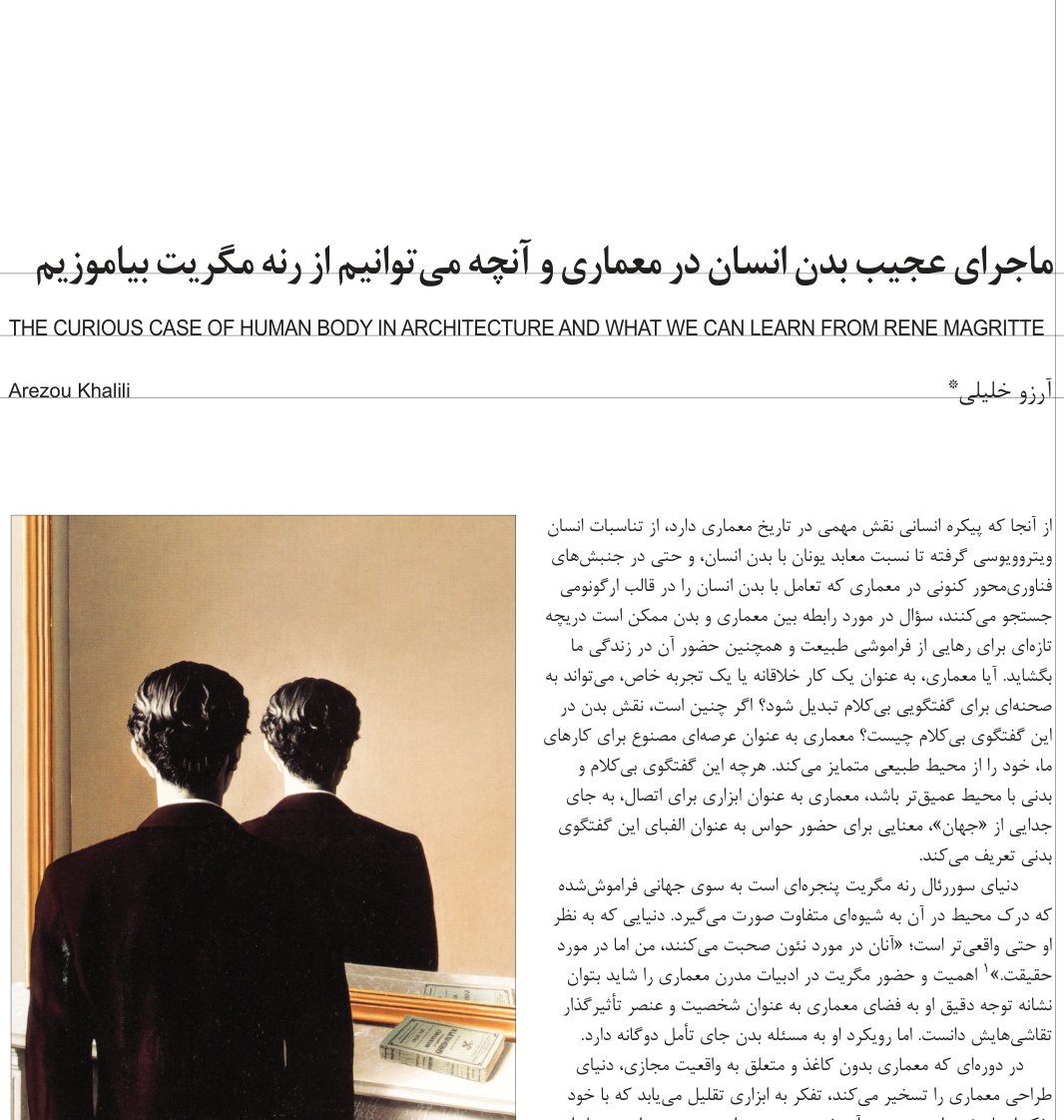
The Curious Case of the Human Body in Architecture and What We Can Learn from Rene Magritte. Arezou Khalili. Since the human figure plays an important role in the history of architecture — from Vitruvian human proportions to the relationship of Greek temples with the human body, and even in current technology-driven movements in architecture that seek interaction with the human body in the form of ergonomics — the question of the relationship between architecture and the body may open a new window for liberation from the forgetting of nature and its presence in our lives. Can architecture, as a creative act or a particular experience, become a stage for a wordless dialogue? If so, what is the role of the body in this wordless dialogue? Architecture, as an artificial arena for our activities, distinguishes itself from the natural environment. The deeper this wordless, bodily dialogue with the environment, the more architecture, as a tool for connection rather than separation from the "world," defines a meaning for the presence of the senses as the alphabet of this bodily dialogue. The surreal world of Rene Magritte is a window onto a forgotten world in which the perception of the environment takes place in a different manner — a world that, in his view, is even more real: "They talk about neon, but I talk about truth." Magritte's importance and presence in the modern literature of architecture can perhaps be attributed to his careful attention to architectural space as a character and influential element of his paintings. But his approach to the question of the body warrants a twofold reflection. In an era when paperless architecture belonging to virtual reality conquers the world of architectural design, thought is reduced to a tool created by thought itself. The result is a gradual departure from bodily experience; therefore, questioning thought and its relationship with the body becomes important, as does reflection on works that are based on thought, such as creativity. It seems that on the path of creation, at this particular moment in human history, digital dominance has fundamentally altered the relationship between the artist and the work of art. Before the digital revolution, the processing of ideas was based on our perception of the surrounding environment. Human perception was bodily and multisensory, dependent on awareness and the sensations of the body. The nature of thought was essentially related to the human interaction with the natural world. Physical experience with work, production, materials, environmental conditions, and the constant change of life's phenomena on earth had provided us with a vast expanse of sensory interaction with the world, and closer relationships within the family and coexistence with domestic animals — as opposed to today's individualistic and scattered life — had created opportunities for contemplation, compassion, and closeness. But this sensory and bodily interaction with the world, in spite of environmental crises such as the pandemic with which we are grappling, requires further reexamination. The word "digit" derives from the Latin word digitus, meaning fingers and toes, and is taken from the act of counting with fingers in the late Middle Ages. Digitus originally comes from Indo-European languages including Sanskrit (diśáti), meaning to show and to point. In Greek, deiknumi means to show, and dikē means manner and custom; in Old English, tǣċan was used in the sense of showing and pointing, which is close to teach and tācen (or token in English). It is interesting that the English word "teacher" derives from the index finger. Digitus (plural: digiti) is also an ancient Roman unit of length, approximately 1.905 centimeters and based on the width of a human finger; therefore, even "digital" has a bodily origin. The relationship between data, information, and knowledge is another question worthy of reflection. Data is a series of symbols such as discrete numbers and facts, while information occurs when symbols are used to refer to something, or when an account is given of these data in the context of an event — such as a diagram containing data. Knowledge is the interpretation of information and the manner in which we use what we know. The use of data as given symbols goes back to Euclid's book Dedomena ("data" in Greek, meaning "given" in English), which in geometric problems is essentially primary, epistemic knowledge — but this does not mean it has not been understood through practical experience. So what exactly has caused this separation between body and thought? T.S. Eliot, in a passage from his poem "The Rock," addresses this subject from another perspective. Not to Be Reproduced, Portrait of Edward James, 1937.



