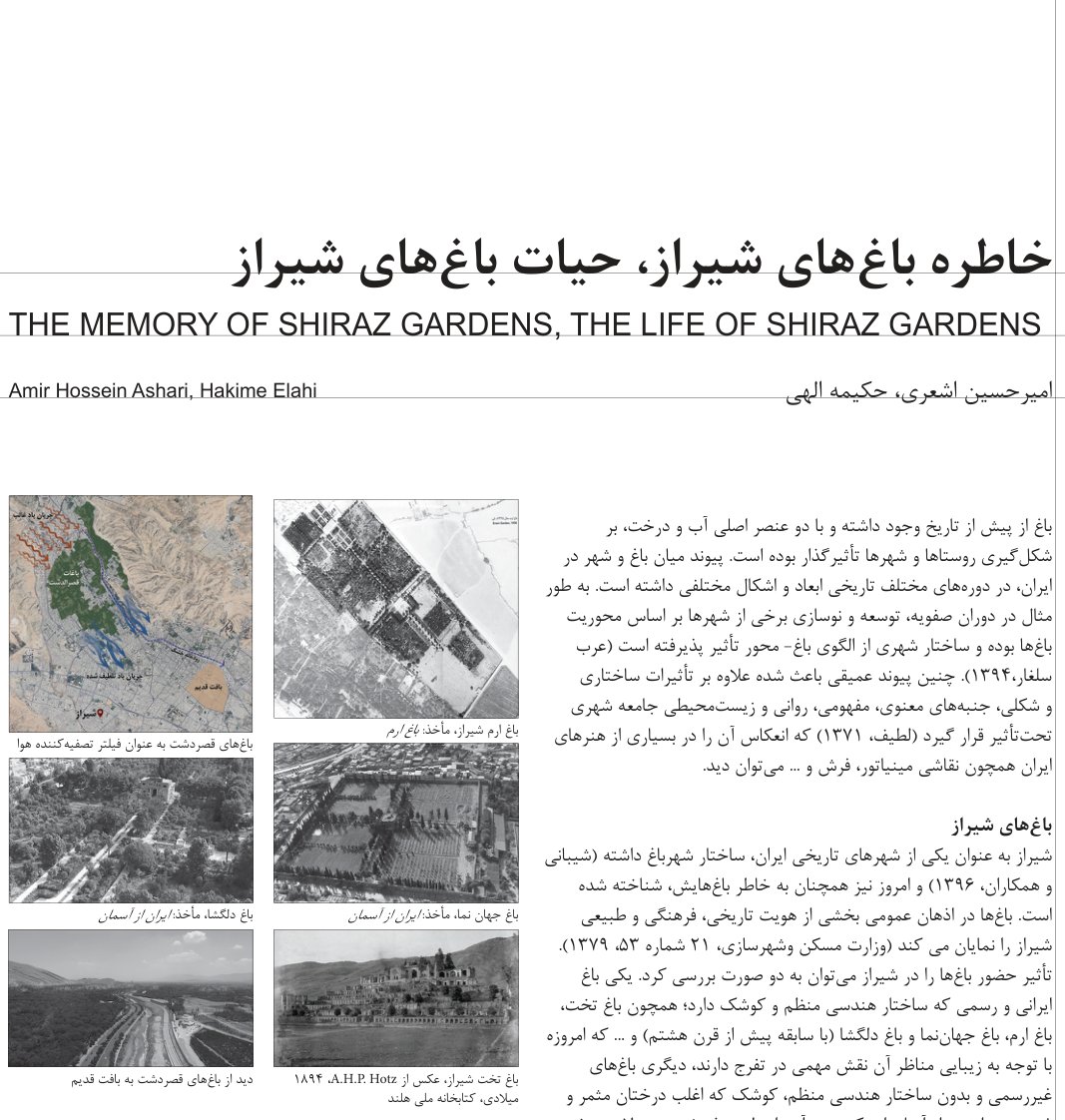
The Memory of Shiraz Gardens, The Life of Shiraz Gardens
The garden has existed since before recorded history and, with its two essential elements of water and trees, has influenced the formation of villages and cities. The bond between garden and city in Iran has taken various dimensions and forms across different historical periods. For example, during the Safavid era, the development and renovation of some cities was based on the centrality of gardens, and the urban structure was influenced by the garden-axis model (Arab Salghar, 2015). Such a profound bond meant that, in addition to structural and formal impacts, the spiritual, conceptual, psychological, and environmental aspects of urban society were also affected (Latif, 1992), the reflection of which can be seen in many of Iran's arts, such as miniature painting, carpet weaving, and others.
The Gardens of Shiraz As one of Iran's historic cities, Shiraz possessed a garden-city structure (Shibani et al., 2017), and even today it remains known for its gardens. In the public consciousness, gardens represent a part of the historical, cultural, and natural identity of Shiraz (Ministry of Housing and Urban Development, 2000, No. 53). The impact of gardens in Shiraz can be examined in two ways. One is the formal Iranian garden with a regular geometric structure and a pavilion, such as Bagh-e Takht, Bagh-e Eram, Bagh-e Jahan Nama, and Bagh-e Delgosha (with origins predating the eighth century AH), which today play an important role in leisure owing to the beauty of their landscapes. The other consists of informal gardens without a regular geometric structure or pavilion, which usually contain fruit-bearing and non-fruit-bearing trees and are used for income generation through the sale of produce and for recreation—such as the gardens of Ghasr-e Dasht (the gardens of Niayesh Boulevard, Dinakan, Zargari, etc.), Bagh-e Haft Tanan, Bagh-e No, Rashk-e Behesht, Bagh-e Dehghani, and others that comprise a vast portion of the city of Shiraz.
The Role of Shiraz Gardens From an ecological standpoint, Shiraz is situated in an intermontane plain and, running from northwest to southeast, has a natural corridor and wind channel. The position of the Ghasr-e Dasht gardens in northwestern Shiraz, at the opening of this corridor, has prevented air pollution and dust carried by the prevailing westerly and northwesterly winds from penetrating the urban fabric of Shiraz (Shahr-o-Khaneh, 2006), and currently, with an area constituting five percent of the city's total expanse, they form the city's largest green zone. These gardens, which until the 1960s were outside the city, now lie within the urban boundary due to the city's expansion and contain a large number of centuries-old trees. These gardens are known as the respiratory lungs providing clean air for Shiraz and are also regarded as the region's natural assets, having positive effects on the local ecosystem. In addition to their environmental function, the gardens possess aesthetic value for the urban environment, enhancing the quality of urban life. In terms of historical-cultural value and socio-cultural function, they are important and form the setting for much of the collective memory of
the city's people. Through their adjacency to important urban networks and roads, they provide opportunities for recreation and tourism development. This green zone, benefiting from the favorable environmental conditions described and owing to the prevalence of climate-based residential preferences in the hot and arid climate of Shiraz, has always been sought after by the city's affluent class for residence and commands high economic value.
The Life of the Gardens The gardens of Ghasr-e Dasht, when the city of Shiraz had an area of 300 to 500 hectares, covered 3,000 to 3,500 hectares. Between the years 1961 and 1991, and especially after 1976, approximately half of the gardens were destroyed as the city expanded. With this trend continuing after the 1990s to the present day, we are witnessing further construction and the shrinking of this green expanse (Ardeshiri, 2009). We know that Shiraz owes its urban vitality to the presence of gardens, and if this trajectory continues, in the near future no trace of the gardens will remain. What factors accelerate the destruction of gardens and fuel this dilemma? The motivation of gardeners and landowners to maintain and protect gardens against destruction and land-use change is of great importance. But the expansion of construction around the gardens has caused the garden areas to suffer from harmful environmental effects such as the destruction of qanats, the decline of well water levels, and rising regional temperatures. These
View from Ghasr-e Dasht gardens toward the old fabric
Bagh-e Delgosha, source: Iran from the Sky
Ghasr-e Dasht gardens as an air-purifying filter
Bagh-e Jahan Nama, source: Iran from the Sky
Bagh-e Eram, Shiraz, source: Bagh-e Eram
Bagh-e Takht, Shiraz, photograph by A.H.P. Hotz, 1894, National Library of the Netherlands
problems, combined with drought, have led to reduced yields and economic difficulties for gardeners. The private ownership of gardens and their subdivision—particularly through the process of division among heirs—causes the loss of garden integrity and creates maintenance difficulties. The absence of a designated authority to address water problems and to assist owners in preserving and maintaining their gardens adds to their difficulties. Another issue is the presence of gardens within the urban fabric and their tremendous added economic value. The incomparability of income from fruit with income from selling the garden and the profits from construction has diminished the desire to maintain gardens among owners, who instead show eagerness for changing the garden's land use.
Despite the Ghasr-e Dasht Garden Organization Plan and the Shiraz City Comprehensive Green Space Plan, which emphasize the obligation to maintain the gardens and increase the tourism-oriented approach in the Ghasr-e Dasht gardens, numerous problems persist—such as the approval of ineffective plans, the failure to engage active stakeholder participation, the lack of attention to climatic conditions especially drought, the disregard for the economic-livelihood requirements of gardeners, and others. Consequently, the urban management of Shiraz now faces a multitude of problems, ambiguities, and implementation issues. For example, the routes available for obtaining construction permits or circumventing laws regarding construction in the garden zone are worth contemplating. Some construct within the gardens without permits and continue their work by paying fines. In this process, the relevant organization profits from the income generated by fines and remains silent, while landowners, after paying fines, continue to enjoy substantial financial gains—and this cycle continues.
1- Gozar, Taveh Restaurant, Paya Pirang Architecture Group. 3- Mehr Residential Project, Ali Sodagaran, Nazanin Kazeroonian.
4- 1345 Building, BAU Urbanism and Architecture Atelier.
2- Khatereh-ye Bagh (Memory of the Garden) Residential Apartment, Ash'ari Architecture Group and Associates. 5- Khaneh-ye Afragh, Studio Tarh-e Mana.
The lack of integration among the relevant administrative bodies—such as the Agriculture Department, Jihad-e Sazandegi (Construction Jihad), the Environmental Protection Organization, the municipality, and others—together with the ineffectiveness of laws and regulations and the incapacity of oversight bodies, has led to the destruction of these gardens. The obstacles that have existed thus far for the protection of this urban green expanse were noted, and we know that the extensive area of the gardens—like any living part of the city—requires growth, development, and also connection with the urban community. Therefore, a comprehensive, long-term program is needed that takes into account the various dimensions of garden preservation as well as the development opportunities in this sector. But in the absence of law and necessary infrastructure, individuals may make decisions based on their own personal gains and losses. Under such circumstances, should we expect stakeholders and influential parties of the gardens to make ethical decisions in favor of society—even if it conflicts with their economic conditions?! Perhaps today such an expectation from landowners, investors, or designers is optimistic.
The Role of Architects in the Life of Gardens The advance of construction into areas with rich vegetation is one of today's concerns for Iran's and Shiraz's architectural community. By examining the infrastructure for garden preservation, the role of architects becomes somewhat clear. In Iran, a landowner approaches an architect only after having received the land-use change permit and construction license authorizing development on the land; under these circumstances, the buildable area on the land has already been determined. Legally, architects may undertake design in such contexts. From the perspective of some academic experts and theorists, accepting such projects that encroach upon green spaces is fundamentally wrong, and they advise architects not to accept the responsibility of designing such projects. But the main agent and driver of land-use change is the very permits issued by the responsible authorities. Despite the existence of a construction permit, sometimes a professional architect declines such a project and the client assigns it to another designer, the results of which are unpredictable. Perhaps rejecting such a request may not be entirely effective in solving the problem. In the opinion of some architects, their manner of engagement and consultation with the client and their design approach can play a role in preserving the values of the project's context, and design decisions can be helpful by considering methods such as preserving existing trees, integrating green space into the design, using compatible materials, construction techniques with a low environmental footprint, and others. Examining architects' approaches and the strategies they choose can help analyze the problem. In our own country, we see projects where architects have faced such a dilemma. For example, the "Khaneh-ye Darun" (Interior House) project by Olgoo Architecture Studio was designed in a context where the area had fallen prey to speculators, and an ongoing development was causing the destruction of pristine nature and the memories of the old Emameh gardens. Mehran Khoshro criticizes the unauthorized development and conversion of gardens into apartment buildings. By reducing the project's area below the permissible limit and taking the building volume underground, he has prevented the impact on the natural landscapes of the area. This project reconsiders the relationship between nature and people. Similarly, in the Niavaran Residential Complex project, designed by Zandigan Consulting Engineers, Mohammad Reza Nikbakht, situated alongside Niavaran Street—the main arterial road of Shemiran—this area formerly had abundant gardens and pleasant air, and even now retains a large number of old trees. The design team, by prioritizing tree preservation in the design and through consultation, succeeded in convincing the client to forgo a portion of the buildable area approved by the municipality (13,000 square meters) and reduce it to 11,000 square meters in order to preserve the trees and prevent their felling. Thus, the mass, volume, and overall form of the building are entirely influenced by the trees in the middle.
Architecture in the Gardens of Shiraz In the green zones of Shiraz, many projects are executed that disregard the garden and the value of the city's green expanse. But concerned architects strive to see the values of the project's context and to work toward preserving or honoring them. The Taveh Restaurant project, by the Paya Pirang Architecture Group, is situated in a commercial complex dating from the 1990s, during a time when construction had caused parts of the gardens of the old Talkhdasht neighborhood of Shiraz to disappear. This commercial complex sits like a dam between Setareh Khan Boulevard (an active commercial boulevard) and the gardens of the old Talkhdasht neighborhood. To connect and merge the dense, crowded urban fabric with the gardens of this old neighborhood, the designers proposed that the restaurant be transformed into a fusion of passageway and restaurant. A passageway that was once a garden lane—a place for the passage of all—but is so no longer. Therefore, using the potential of the existing space, two entrances are connected by a passageway whose adjoining wall alludes to the walls of old passageways, creating an opening between the boulevard and the gardens. In this project, the marks of the cut trunks of the old garden trees have been recorded on panels in the Taveh passageway. This project, through its passage-like spatial structure and use of materials that recall the old passageway walls, endeavors to create an emotional connection with the gardens that no longer exist (1). The Khatereh-ye Bagh (Memory of the Garden) project was designed and executed in one of the lanes off Ghasr-e Dasht Street. When the design proposal was made, the project had already progressed to the structural frame stage, and across from the project stood grand old trees. One of the design team's concerns was preserving and connecting the old trees with the project's interior; therefore, by centering the trees, the facade panels around them begin to play and move. On the courtyard-facing facade, in order to increase greenery, flower boxes have been provided that create abundant greenery before the windows. Facing this facade is a solid concrete wall where, through the installation of box sections and mesh netting, a green wall substrate has been created. A person standing in the courtyard can experience greenery in a three-dimensional space—as the plant cover begins its movement from the roof and facade, extends from the courtyard floor to the opposite wall, and the memory of the old gardens is recalled. In this project,
Bagh-e Safa sidewalk, Mehrdad Iravanian
through the use of facade form, roof and landscape design in a manner that makes the presence of greenery prominent, an effort has been made to remind audiences of the memories of the former Ghasr-e Dasht gardens (2). The Mehr Residential Project, by Ali Sodagaran and Nazanin Kazeroonian, is located on Mehr Street in the Ghasr-e Dasht district. In the project design, by setting back from the south, a small courtyard has been created where the green space, in connection with the greenery of the balconies, the building facade, and the garden roof, is reminiscent of the greenery and gardens of Ghasr-e Dasht. The random pattern of openings and the vertical wooden sun shades, by departing from conventional apartment volumes, endeavor to recall the historical past of the area (3). The "1345 Building," an office-commercial building designed by BAU Urbanism and Architecture Atelier and Mehdi Zaker Haghighi, has its project site at the junction of the remaining Ghasr-e Dasht gardens and the urban blocks of the Ma'ali Abad district, on an irregularly shaped plot of land. The design draws upon its adjacencies and selects a form consonant with the project site's shape to create maximum interaction between the urban body, the surrounding nature, and the project's context. For the continuation of the urban body's fabric from the project's western side, brick has been used, while glass has been chosen for the outer skin on the side extending toward the remaining Ghasr-e Dasht gardens. The transparent volume adjacent to the gardens beautifully fulfills its role in the interaction between architecture and the existing green space and nature. This project appears to have created, through the organization of form and the use of glass—both in the interior space and the urban facade—an opportunity for audiences to experience nature, while also emphasizing the importance and value of gardens, trees, and urban green expanse through the reflection of the Ghasr-e Dasht gardens in the opposite facade (4). The Afragh House, designed by Studio Tarh-e Mana, is located on Shahed Boulevard, one of the boulevards in the Ghasr-e Dasht area. According to the architects' statement, human beings, due to the expansion of urban spaces and reduced interaction with nature, have fewer opportunities for mental and physical energy recovery. For this reason, the design team strives to counter the disruption of natural systems in the course of everyday life. To this end, the use of spacious terraces on the floors, the reinforcement of existing green space and the surrounding pathway, the expansion of green space on the facade and building roof have all been considered. This project, in addition to preserving trees, has incorporated strategies for energy efficiency, a smart irrigation system, and the use of natural ventilation—such climatic strategies with a concern for helping preserve the project's natural environment are highly valuable (5). The "Bagh-e Safa" project, designed by Mehrdad Iravanian, is a sidewalk within the urban fabric covering approximately 2,000 square meters. The main issue is creating a space of pause and stillness on the sidewalk—something whose absence has been felt in the city of Shiraz.
It also aims to revive the feeling of a Qajar-era garden that has disappeared. In the sidewalk design, following the change in historical context from new Shiraz to old Shiraz, the architectural language shifts, and the manner of employing different materials and textures in the sidewalk paving reflects these changes. Thus, in the area of new Shiraz, the arrangement of materials is free, while in the Bagh-e Safa area—representing old Shiraz—it becomes rule-bound. In this project, the architect's intention is to induce a surrealist sensation of the garden into the urban space. This is achieved by extending the garden walls into the sidewalk, reconstructing its gateways, and using elements such as water channels and cypress trees, which can evoke in pedestrians the feeling of entering a garden space (6). The project for the extension of the Cultural and Recreational Complex of Shiraz University, by Charak Architecture Studio, is located in the Rashk-e Behesht garden area near Bagh-e Eram in Shiraz. In the complex's grounds, ancient trees and dense orange groves surround the main building, which, in addition to tempering the air, have created a delightful view. According to the designer, the project's objectives include sensory richness, memory evocation, liveliness of interior spaces, visual connection of resting spaces with the outdoor landscaping, and the preservation of all the orange grove trees. In the design of the open-air grill as an extension of the restaurant, given the constraint of the building's northwestern space by the orange groves, individual concrete columns with individually sized balconies have been designed in the open spaces between the trees, connected by wooden bridges. Thus, in addition to preventing tree removal, they have succeeded in creating a charming view and an exhilarating, memorable space. This project essentially blurs the boundary between inside and outside nature and creates an opportunity for the garden to be better seen, while, through the use of organic geometry, enabling an unmediated experience of nature and a wide, evocative panorama before the user (7). In conclusion, with a reminder that every development entails a certain degree of destruction, in the valuable urban green expanse the manner of development is of great importance and must involve minimal destruction and damage. In the projects examined, architects with a concern for nature have made efforts to preserve, interact with, or commemorate the past nature of the area, offering different approaches by employing materials, structure, form, organizing interior and exterior spaces, and creating conditions that foster sensory interaction and connection with the garden. If we look realistically, architects' efforts have been very modest and no significant impact has yet been made. Perhaps in the future, with greater concern and commitment to the socio-cultural mission of the architectural community, a change in the current trajectory may come about.
References: - Ardeshiri, Mandana et al. (2009), "A Perspective on the Feasibility of Systematic Development of the Ghasr-e Dasht Garden Complex of Shiraz," National Conference on Humans, Environment, and Sustainable Development. - Ministry of Housing and Urban Development, General Directorate of Housing and Urban Development of Fars Province (2000), Ghasr-e Dasht Garden Organization Plan, No. 53. - Shahr-o-Khaneh Consulting Engineers (2006), Shiraz Strategic Structural Plan. - Shibani, Mehdi et al. (2017), "Garden City: The Urban Structure of Old Shiraz," Quarterly Journal of Art and Civilization of the East, Year Five, No. 16, Summer 2017. - Arab Salghar, Neda (2015), "The Garden as an Institution of Urban Development: Garden-Axis Development of the Historic City of Shiraz," Bagh-e Nazar, (33), 82-89. - Abolghassemi, Dr. Latif (1992), Garden, Tehran: Organization of Parks and Urban Green Space of Tehran. - Zareh, Soheila et al. (2014), "A Study of Ghasr-e Dasht Gardens as the Respiratory Lungs of Shiraz (With a Green Space Approach to Sustainable Urban Development of Shiraz)," National Conference on Urban Management and Sustainable Development. - In Memory of Shiraz, Old Photographs of Shiraz (2001), Mansour Sane'i. Nazar Publishing. https://www.caoi.ir/ https://www.memarmagazine.com/fa/ https://iranian-architect.ir/ https://isoarch.ir/
Extension of the Cultural and Recreational Complex of Shiraz University, Charak Architecture Studio-7



