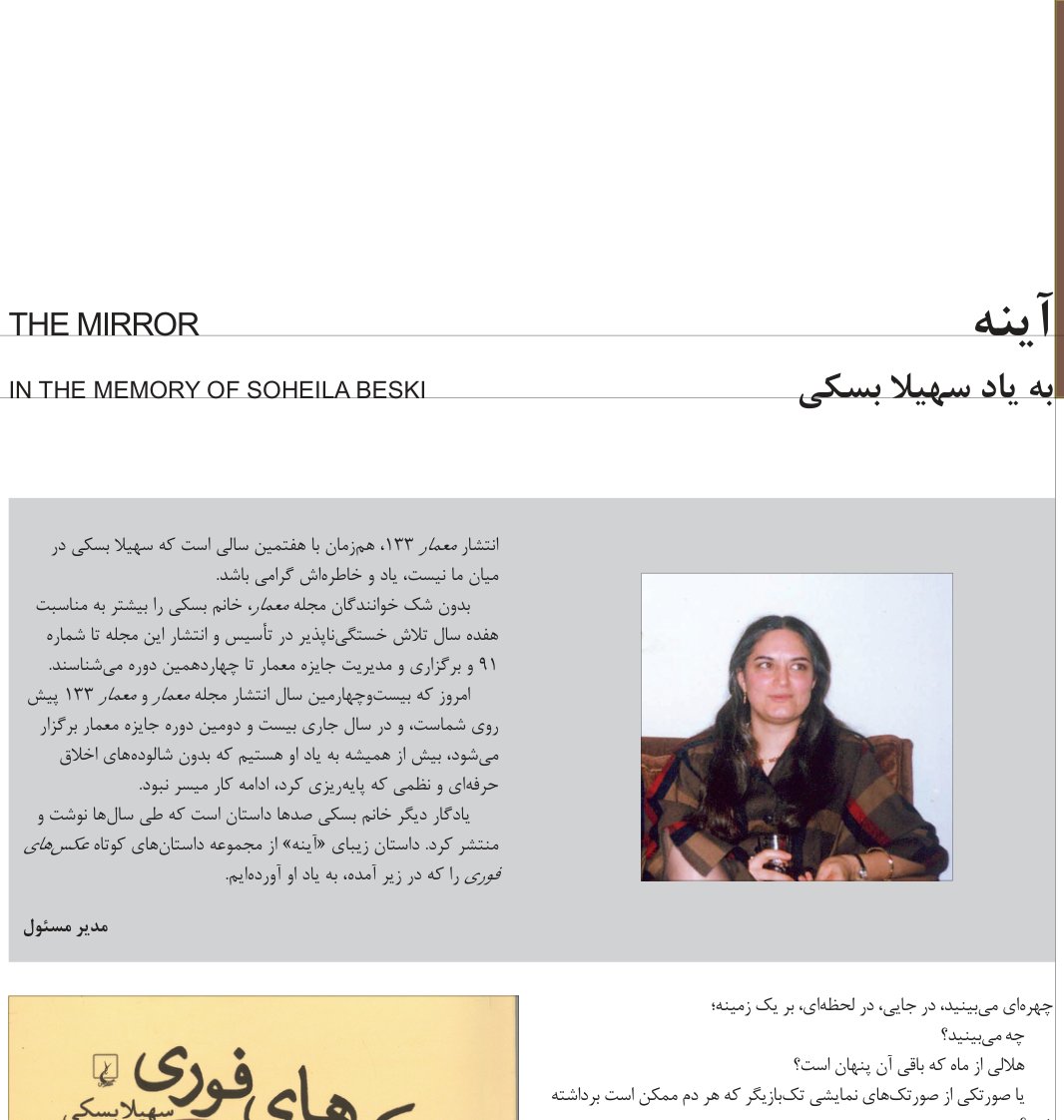
The publication of Memar 133 coincides with the seventh year since Soheila Beski is no longer among us—may her memory be cherished. Without doubt, the readers of Memar magazine know Ms. Beski primarily for her seventeen years of tireless effort in founding and publishing this magazine through issue 91, and for organizing and directing the Memar Award through its fourteenth edition. Today, as the twenty-fourth year of Memar's publication draws on and issue 133 lies before you, and as the twenty-second edition of the Memar Award is being held this year, we remember her more than ever—for without the foundations of professional ethics and discipline that she laid, continuing this work would not have been possible. Another legacy of Ms. Beski is the hundreds of stories she wrote and published over the years. We have recalled the beautiful story "The Mirror," from her collection of short stories titled Instant Photographs, in her memory.
You see a face, somewhere, in a moment, against a background—what do you see? A crescent of the moon whose remainder is hidden? Or one of those theatrical masks of a solo performer that might be lifted at any moment? And what is it that you see in another moment, against another background? Or what is seen from a little closer? Which one is truly "them," that "other" who exists without the interference of your "self"—as unique as any fingerprint? What you are about to read is a collection of solo portraits, each fixed within a frame, in a single moment, against a single background; sometimes they are group portraits too, with faces that are no longer there, vanished in the sum total; and sometimes it is only nature and landscape, in a single moment, where the human face is also a part of the background, a part of nature.
The Mirror. You press the doorbell once more. This time the door slowly opens halfway. In the glow of a bright lamp hanging directly opposite the door, two eyes enlarged behind the lenses of brown-rimmed glasses peer outward. The dilated pupils, like children's marbles, roll within the frame of the glasses and gaze at you. The eyes' gaze passes over your head. You glance behind you. The hallway is empty and dark. When you turn back, you see that she has unfastened the chain lock and is standing in the doorframe. She is wearing a red sleeveless dress. Her thinning, dyed hair has been styled in the manner of elderly English ladies, and a harsh red lipstick has set upon her lips.
With a nervous gesture she runs a hand through her hair and presses the large, adhesive red clip-on earring firmly onto her right ear. Her nails are not long, but they bear red polish. Wrinkled skin slides over her thin arms and the sharp points of her elbows. "I've come to see the console mirror. We spoke on the telephone yesterday." A timid smile reveals her crooked teeth. She steps aside to let you in. The apartment is small and clean, empty and silent, and it gives off a strange odor—slightly sour, like diluted vinegar, mixed with the smell of acetone and the smell of solitude. A small room faces the entrance, with a narrow bed and a large vanity table. A small television on the vanity is on, but its sound cannot be heard. Colorful bottles of nail polish, tubes of lipstick, and golden powder compacts are neatly arranged before the mirror. In a trembling, slightly hoarse voice she invites you to sit. You know she is Russian, and her accent does not sound foreign to your ear. You sit on a floral sofa with a golden-yellow background—the kind of sofa you have seen in many furniture shops and did not expect to see here—and directly across from you, you behold the old console mirror: delicate, tall, elegant, with beautiful carvings on the wood and gracefully turned legs. Another mirror, its twin, stands at a corresponding angle beside the window. The woman anxiously follows the direction of your gaze and opens a chocolate box adorned with images of French soldiers and aristocratic ladies holding fans. She insists you take a hardened chocolate. She gestures toward the mirrors: "This one is my mother and that one is my father. Last night I dreamed of my father. He was saying, 'Don't you dare wipe the wood with a damp cloth.' He thinks I want to sell the mirrors." "But don't you?" "Only these mirrors are left. We had brought everything from Russia. When the Bolsheviks came, Tsar Nicholas summoned my father. He had an emerald cross around his neck—a real emerald, not the kind you see in jewelry shops. He unfastened the cross from his neck, kissed it, and hung it around my father's neck. My father kissed his hand... Last night he told me not to wipe the wood with a damp cloth..." "You've had this dream because you've been thinking of selling the mirror..." She rises. From the six-person dining table, whose legs are covered by a long plastic tablecloth, she picks up a plate of pastries: "I have an old silver cup—I don't know whom to leave it for. For the neighbors, who are all waiting for me to die?" Her voice breaks and she looks anxiously toward the door. A film of tears gives a strange expression to her enlarged eyes. She goes away and returns a moment later with a silver cup with a handle and a small spoon, on whose slender stem Latin letters are engraved and from whose end a tiny ring hangs. "It's real silver—whom should I leave it for? My mother died last year, and my father died many years ago..." You know that after the Russian Revolution they came to Iran, changed their names—hers became Rana. She used to work and retired some years ago; she never married; she lived with her mother; her mother died last year, and she has no one in this city... "Would you like the cup? It's genuine Russian silver..." "I've come to buy the mirror. I was told you wanted to sell one of them..." She rises and, without saying a word, disappears behind a door. You stand up as well to examine the mirror more closely. Its surface is clear and luminous; its arched legs are so delicate you can hardly believe they could bear the mirror's weight. The metal ring of the drawer is shaped like a flower and as thin as a ring for a finger. You hear the sound of a door. The woman is standing in the kitchen doorway
with a tray and a glass of sherbet. The dilated pupils of her eyes roll with fear and anger within the frame of her glasses, looking at you and the mirror: "It's clean. My father never allowed a damp cloth to touch it..." She sets the sherbet on the table and sits down: "You don't want the silver cup?" "I've come to buy the mirror." She rises abruptly. She picks up the silver cup and, haltingly, disjointedly, and unintelligibly, says things about the delicate engravings on the cup and its value. "You're quite right, but I don't want a cup..." She does not hear. She goes on talking—about silver cups, silver cutlery, china plates—things they had brought with them from Russia. You say loudly, somewhat angrily: "Please tell me whether you want to sell the mirror or not!" She falls suddenly silent. She gazes at you with a bewildered look... and walks away. You wait a few moments in perplexity. You hear the sound of a drawer being pulled open in the bedroom. When she returns, the silver cup is no longer in her hand. She picks up the plate of pastries and offers it once more, and all the while she talks—about the neighbors, the malice of the neighbors, their waiting for her to die... You are compelled to take another pastry and try to steer her toward speaking about the mirror. She sets the plate of pastries on the table and sits down. She runs her thin fingers over the skirt of her dress, presses her earring firmly in place, speaks of her mother's death, and wipes her tears with her fingertips. You are at a loss. You take a pen from your bag and write your telephone number on a scrap of paper: "Well then, you don't want to sell the mirror. I'm leaving. If you change your mind, call this number." She becomes flustered. She rises. She picks up the chocolate box and offers it again. You decline and make to stand... "It's the holiday season now. Until the thirteenth day, I'll have guests and can't let you take the mirror away..." "Why?" "Its place will be empty—I have nothing to put in its place..." Once more, disjointedly, haltingly, and unintelligibly, she speaks of her troubles, her loneliness, the harassment of the neighbors—out of fear of whom she hardly dares go outside. You interrupt her: "Very well, you can keep it until after the thirteenth day. Then my friend will send it to Tehran for me. Now, do you want me to pay you now?" She stares at you, dazed and bewildered: "Money?... No, I can't keep money in the house right now. Everything is closed... Let me bring you some fruit." Involuntarily, in a sharp tone, you say you have no time, that you must go, that people are waiting for you at home, that you must return to Tehran tomorrow, and that you therefore need to know what arrangement to make for paying and taking the mirror... After a few moments of silence she asks: "By the way, where is your house in Tehran?" "Near Sa'ei Park. Why do you ask?" "You see, I want to know—in case any of my acquaintances in Tehran should happen to pass that way and recognize the mirror." You look at her. Frail, diminished, and exhausted, frightened, wounded—she resembles an abandoned little girl who has dressed herself up to look like her mother. She gazes at you with sorrow as you rise. She insists you stay. You bid her a hasty farewell without looking at the mirror one more time. You forget to turn on the hallway light. And the image of her in her red sleeveless dress, frightened and sorrowful, in the small apartment suffused with the smell of diluted vinegar and acetone, follows you through the dark corridor.