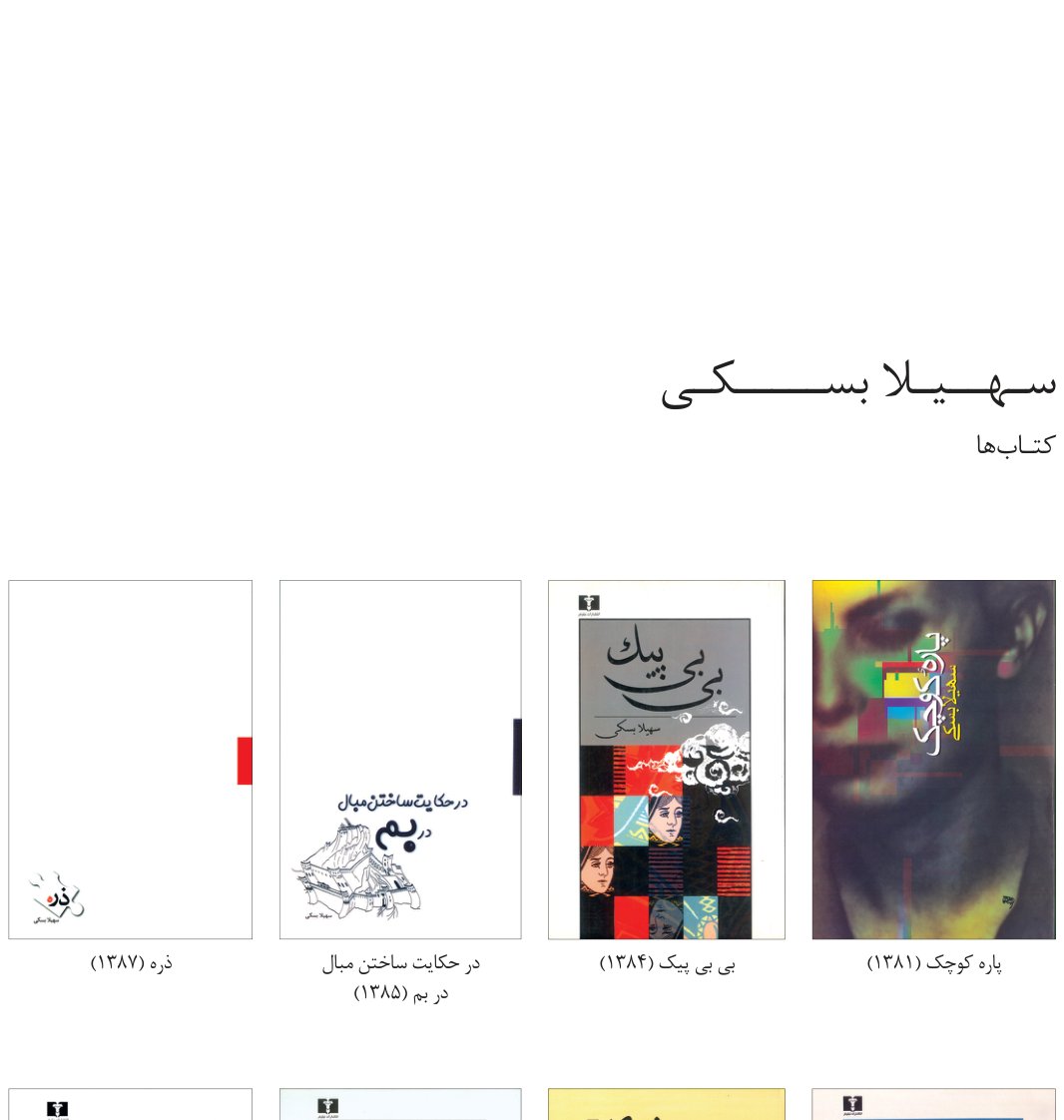
On the Tale of Building a Toilet (1385/2006) — In Bam (1387/2008) — Particle
Biography of Virginia Woolf (1369/1990) — translation — The Way I Lived (1388/2009) — translation
(1388/2009) In Eclipse — (1393/2014) Snapshots
(1381/2002) Small Fragment — (1384/2005) Bibi Peyk
A solitary road, remote, at the end of the world, across a straw-colored expanse of desert, amid purple mountains, and suddenly, beyond a pass beside a hill, in the shelter of a rock, beside water that seems to spring from the earth by magic, an oasis the size of a palm, where the dense leaves of its spreading trees, stirred by damp wind, tremble. This is no more than a green mirage, an astonishing green blotch that seems to have settled upon a yellowish-brown and grayish-purple background as if in a dream. These green blotches sheltered in the furrows of the earth, in the landscape of deserts covered with silvery thorn bushes, hemmed in by distant snow-capped mountains, amid hills so red that a single palm of green upon them makes a complete spectacle, or in the depths of endless, silent valleys — wherever shelter can be found or fashioned, from the wind, from the scorching sun — mingle with the white and crimson blossoms of apple, peach, and almond trees peering from behind poplars, and in the old earthen towns, still on the far side of the walls of cool, tree-shaded garden lanes, or in the depths of houses and in the sunken courtyards of cells in the old bazaars, they lie hidden. And the image of a branch heavy with split-open red pomegranates on a green bough, framed in the turquoise-blue doorway of a shop in the cool covered bazaar that smells of earth, revives the fragrance and memory of the garden. The memory of the garden with its Lombardy poplars, plane trees, and sprawling, leafy elms beside tall walls that, like a latticed canopy, transformed the blazing whiteness of light into a gentle shade, into a beautiful play of light and shadow on the streams at the foot of the trees; a boisterous stream confined within the sharp scent of basil growing in the stonework along the channel, tumbling like a small waterfall from one pool to the next — and merely hearing its sound was enough to consign to oblivion the thirst of the blazing sun outside. The garden, a theater of eye-soothing colors for eyes weary of the hue of earth and the purple of mountain ridges, in flower beds filled with blossoms whose stems were covered in thick fuzz and whose colors were wild and bold — not the soft colors of cultivated flowers; the bold color of village women's garments, not without fragrance, but with the sharp, vegetal scent of nature: daisies, cockscombs, garden balsam, four o'clocks, hollyhocks, snapdragons, dahlias, violets, and the fragrant climbing vines of yellow jasmine, purple jasmine, white jasmine... and the profusely flowering bushes of dog rose, damask rose, the forgotten Iranian rose, and the suri rose; the garden of delicate fruit trees in beds on both sides of the streams: apple, peach, apricot, cherry plum, sweet cherries and sour green plums, and a bit farther away the stately walnut trees with the sharp fragrance of their leaves and the indescribable taste of fresh, crisp walnut, and the grapevines climbing the trellises; the garden of small vegetable patches in the less shady part, with small unripe watermelons and melons, slender cucumbers and tiny red tomatoes — the infants of the fruits that stirred a warm tenderness;
the garden full of nightingales, hoopoes, wagtails, sparrows, turtledoves, and crows, and the long hours of childish anticipation beside baskets propped on a stick with an invisible thread for catching birds; the garden as a theater of the contrast of light and shadow, colorlessness and color, warmth and coolness, the safety of the tall wall and the terror of the boundless nature beyond the garden: the endless chain of towering mountains and the plains and deserts without horizon, faded in the shimmer of sunlight; the garden that inspired the images of paradise in Persian miniatures, full of sweet fruits, streams of honey and milk; gardens where not only souls but bodies blossomed and were renewed, and the coolness of their shade, the color of their flowers, the scent of the cucumbers in the small patch, the sweetness of their white mulberries, the fragrance of their roses — could be found nowhere else... And what truth could be truer than this Iranian garden, with its geometric order and calculated bed divisions and the enclosing composition of flowers, trees, and fruit saplings, to make the most of every drop of water, every particle of moisture, every piece of soil in a land thirsty for water.
Short story from the book Snapshots
By founding Memar magazine, Soheila Beski left an enduring impact on the elevation of the social standing of the architectural profession and discipline, transforming the internal discourse of architects into a matter of broad, interdisciplinary concern. Soheila Beski was not an architect, yet as one of the few powerful women in architectural media, she played a significant role in articulating the social and professional standing of women active in the field of architecture in the contemporary era. By establishing the Memar Award, she facilitated the emergence and visibility of a dynamic network of young architects who became recognized nationally and internationally. Iranian architects, during Soheila Beski's lifetime, never had the opportunity to speak and write about her role and place in the shaping of contemporary Iranian architecture in the manner her stature deserved. Rambod Ilkhani and Nashid Nabian
I became acquainted with her in 1371 [1992] through the journal Abadi, and this acquaintance and relationship continued until before her last trip to Istanbul. Although our connection was mostly within the framework of our shared work — Memar magazine — we occasionally stepped outside this framework, and I cherished those moments deeply, taking pride in being a conversant of such a lionhearted woman. For months I had realized that Ms. Beski would not be our guest for much longer. I wanted to hear and record, in her own words, about her life, feelings, works, and preoccupations under the circumstances she was facing. One day I went to the Memar magazine office for this purpose, but it was so difficult and painful that it proved impossible. When my gaze fell upon her curious, perceptive eyes that could see to the depth of my being, I could not bring myself to say: I know you are leaving, and I have come to hear your final words. After a brief conversation, I settled for taking a few photographs of her and her colleagues and returned home. That was my last meeting with her. Zohreh Bozorgnia
Much has been said about the impact of Ms. Beski and Memar magazine on the architecture of Iran today, from the Memar competition to the introduction of young architects and many other matters. But I think one can point to another very important dimension that is, in fact, far more enduring in its impact. Over the years, the structure of language in architectural writing had gravitated toward the structure of Latin languages, meaning that long sentences were written and the use of unfamiliar words was considered a sign of the author's erudition and expertise. Furthermore, the influence of the language common in mystical discourse shaped the general atmosphere of architectural articles and books. Because Ms. Beski was herself a writer, she steered the language of Memar magazine toward the inherent structure of the Persian language, and by intervening in the linguistic form of the articles — not their content — she brought the magazine's language closer to spoken language while preserving Persian grammar.
Short sentences, familiar and common words, and ultimately the de-mystification of architectural writing was the great achievement of Memar magazine, which made it readable. For this reason, whenever I write about architecture, Ms. Beski guides me with a living presence and draws a line through my errant sentences. Ms. Beski will forever live on in the language and literature of Iranian architecture. Faramarz Parsi
Speaking in praise of Ms. Soheila Beski is difficult. She was not an architect, but she knew architects and architecture. She was troubled by the disarray of architecture and harbored a grand aspiration: a sense of order for architects and artists and a proud Iranian built environment. To reach this goal, she became a candle that burned to warm a gathering that bridged veteran and young architects and melted the coldness that ruled the relations between these two generations. Her light shone equally upon all — free of restrictions, red lines, and factionalism. She made attention to veterans and nurturing the young for flight her guiding principle — a flight that has been the driving force behind the flourishing of Iranian architecture over the past two decades. It can rightly be said that without her tireless efforts at Memar magazine, such rapid growth in Iranian architecture and such a dialogue between the veteran and young generations of architects would not have come into being. This transformation and development in the history of architecture is unprecedented or nearly so, and I must confess that the emergence of such individuals, though not impossible, is undoubtedly rare. I hope that in her absence, friends will continue her path and guide Memar magazine forward in the service of cultural development in architecture within society, and I believe this will be possible when we observe balance among different tastes, set aside the self and become a collective "we." Hassan Tajoddin
In the late 1370s [late 1990s], while studying at university: we are the second entering class at this university. Our education at best consists of playing with functional bubbles and volumetric compositions. Architecture magazines still have the mood of the 1360s [1980s], with second-rate printing and a prescriptive tone, mostly focused on urban planning or identity debates. The first issue of Memar had published contemporary global projects in high quality with content analysis, and articles in fluid prose that examined foundational concepts: form, volume, space, and idea. The magazine's atmosphere suggested a pleasing form of "understanding and future." And working at consulting engineers: 1381 [2002], the first year of the Memar Award — small and large projects have been built that I always believed could not be achieved at that quality in the conditions of today's Iran. The extensively written discussions of the jurors approach the level of argument, I am stirred to
Friends, Colleagues, and Architects
excitement. The strengths and weaknesses of projects have been compared and examined. I read the words repeatedly and attentively. The following year, we have rented a room in Towhid Square with a friend. We deliver our project designs to Memar magazine. Ms. Beski sends word: bring your work when it has been built, and we will publish it. 1387 [2008]: We have been invited to a dinner party by the magazine for winning our first built project. I see Ms. Beski for the first time. We talk about her book Small Fragment and about literature... . Alireza Taghaboni
On the margins of these bitter and sorrowful days, I wish to speak of a wealth of vivid and enduring memories — nearly four decades of knowing "Soheila Beski" — but recounting this volume of memories would fill many pages and naturally does not fit within these few lines. The vivid memories of friendship with cultivated human beings, whether happy or sad, usually leave a lasting imprint upon our souls and spirits, and at times become part of our intellectual and spiritual identity. It is amid these enduring memories that we realize these friendships and companionships have opened doors for us, paving the way to knowledge and awareness. How magnificent is the friendship of those like Soheila Beski, who gaze from the depths of their being and always, without compensation or obligation, smooth your path toward awareness and independent thinking. Soheila Beski was a woman who, from her translation of Virginia Woolf and Emma Goldman to the flight of her creative mind in the stories of Small Fragment and On the Tale of Building a Toilet, and finally to her Snapshots, managed to open many unopened doors for us, her readers. With her translations and writings, Soheila tried to make the not particularly pleasant atmosphere of our times bearable. And truly, without all this knowledge, creativity, and intellectual passion, how dark and mournful life's atmosphere would become. She also worked sincerely for the growth of young and novice researchers, and I witnessed how she invested heart and soul, without the slightest expectation of return, in the advancement of young people interested in the architecture of this land, because she believed that we must strive for the betterment of our city, and she would say that even we who are educated and have studied geography and history among our lessons have no conception of our vast, four-season homeland. Dear Soheila, I learned so much from you. You left, and we remain with doors that are no longer easily opened. Though you are not among us, your works, your path, and your memories are enduring. Tala't Taqinia
I came to know Soheila Beski through several brief meetings in Iran. About 10 years earlier,
she invited me to come to Iran as a member of the Memar Award jury. This was my first contact with my birthplace — a place more foreign to me than anywhere I had ever lived. I think it was this very distance that had heightened my longing and yearning. Beski's invitation was a remedy for me. That year, she presided over the jury, sometimes with firmness and sometimes with gentle dissent, with intelligence and astuteness. Soheila Beski should be praised for creating a platform for discussion, dialogue, and exchange of ideas in the field of architecture, especially at a time when a great void had emerged in this area after the revolution. With Memar magazine, she became the voice of a new generation of architects, enabling them to engage in dialogue with a world that had until then been beyond their reach. Despite her illness, she continued her work, and I was once again honored to serve as a juror for the tenth Memar Award, where, despite significant disagreements among the jurors, she guided the sessions masterfully with her diplomatic approach and sense of humor. My last contact with Ms. Beski was a few weeks before her passing, when she invited me to come to Tehran for a third time as a juror. Alas, this time I was denied the pleasure of seeing her. But all of us will see the fruits of her years of effort in the work of the young generation of architects. Nader Tehrani
Soheila Beski made a significant contribution to the advancement of modern Iranian architecture. She was a capable, authoritative, and highly competent woman. She perhaps managed Memar magazine with a somewhat dictatorial approach, but this very management style was the secret of the magazine's success and longevity. Architectural awards in Iran began with the Memar Award, established by her, and she was always an encourager of young architects. In recent years, though battling a severe illness, she continued her activities with unprecedented perseverance. Memar magazine was not merely a job for her; it was her entire life, and she strove with her whole being to elevate its quality. All of us architects of this land are in some way indebted to her, and it is a pity that we did not honor and celebrate that dear soul before her passing. May her soul rest in peace and her memory endure. Faryar Javaherian
Soheila Beski was not an architect, but she possessed a very high architectural discernment and an unparalleled resolve, so tenacious that when the foundations of Abadi grew weak, she built sturdier structures: Memar magazine and the Memar Award, which still stand firm. Soheila Beski was not an urban planner, but she possessed a very deep urban planning vision. She published Shahr magazine and created a platform within Memar magazine for urban planning discussions to continue. In all this, the essence of the matter is not that fate linked her sphere of influence with contemporary Iranian architecture, or that she turned to this field by personal choice.
What fills one with wonder and astonishment is that in these three decades, thousands of architects have graduated from universities large and small, and not one-thousandth of them have had the impact on contemporary Iranian architecture that Soheila Beski — who was not an architect — did. The essence of the matter is this: she was a woman of words, a woman of the written word, a woman of being — and her presence, how enduring; her departure, how swift. Mohammad Reza Haeri Mazandarani
My first acquaintance with Soheila Beski dates back to many years ago, during my student days, when the course of my thesis research led me to the offices of Memar magazine. Her comprehensive vision, management, and belief in presenting superior quality became from that point onward a model for my professional activity. Beski will remain in our memory not only as a masterful writer and the editor of the most prestigious magazine on the Iranian construction scene, but her efforts to provide a proper platform for professional criticism and her dedication to creating a credible competition will make her name enduring in the arena of Iranian architecture. Soheila Beski, however, will remain in my memory beyond all these things, because she was a powerful encourager of a younger generation like mine. In mourning this dear friend, I feel deep sympathy with her husband, family, colleagues at the magazine, and the architectural community of Iran... Soheila Beski, thank you. Negar Hakim
I saw Soheila Beski in 1374–75 [1995–96] at architecture programs organized by Abadi magazine at the Ministry of Housing, where she and other magazine colleagues organized and directed these events. The programs were of a very high standard and, for me, who was at the beginning of my professional career, were entirely impactful. Later, at her request, I prepared articles and interviews for Memar magazine. It was a good collaboration, and valuable discussions arose from it. She was frank and commanding in her work, and she avoided frivolity. Several years ago, when I was in Turkey on a business trip, the wife of our Turkish host — a cultured lady familiar with Iranian culture — told me she had lived in Iran for some time and envied the power and independence of Iranian women, something that apparently was different in Turkey. For me, Soheila Beski was the embodiment of that description. Reza Daneshmir
I arrived at the building entrance right on time. We had arranged with friends to visit Ms. Beski on the pretext of New Year's greetings. I had always preferred to use the dark stairs to reach the second floor of the building. I have never liked elevators. But today I broke with habit. After entering the magazine office, I saw her. She was sitting in a wheelchair, and yet, as always, everything was under her direction. Her face, since our last meeting — and unfortunately not all that much time had passed — was more her own than ever before. I asked how she was, and we sat down to talk until the friends arrived. As always, we discussed the state of affairs and its impact on the magazine, and as always she listened with keen curiosity to others' opinions, and in the end stated her own view with decisiveness. It was a brief visit, given her diminished energy and lessened patience. At the end, she offered us the sweet gift of the greeting visit, and she herself searched for the chocolate with the blue wrapper. I had never before thought that in a box of chocolates — whose name, "Merci," bore a curious affinity with the purpose of our visit ("thanks") — one could search by color.
That was our final meeting, but I have no desire to remember her through our last encounter. Ms. Beski did not once use the word "must" that day, and perhaps this was our meeting most free of imperatives. There had been times when I could not bear her imperatives, but in all fairness, they were highly effective.
Today Memar magazine exists, the Memar Award exists, but Ms. Beski is no longer among us. Yet her legacy must be preserved — just as she herself wished. Armand Derror
Soheila Beski was the rightful heir of two deeply enduring figures in the history of social transformation, literary vitality, and the promotion of enlightenment in Iran. The first Iranian woman journalist was Ms. 1289 SH [1910], Dr. Kahhal, daughter of Seyyed Razi, the Chief Physician of Naser al-Din Shah's army, who in 1289 SH played a pivotal role in the journal Danesh — a weekly publication of eight pages in folio format and lead typesetting. Though it lasted only one year, it signaled the beginning of a different form of women's presence in the entirely patriarchal Iranian society. The other distinguished figure was Maryam Amid Semnani, also known as "Mozayyen al-Saltaneh." She was an intellectual woman of the Qajar era and an active member of the Hemmat-e Khavatin Society, founded with the aim of literacy and social engagement for women and girls. She was the first woman to serve as managing editor of the Iranian journal Shokufe. Maryam Amid sustained the journal's publication until her death in 1298 SH [1919] by selling her dowry, and simultaneously established two girls' schools in Tehran. She was not only the magazine's managing editor but also translated educational books from French and practiced photography. She ultimately passed away at the height of her journalistic activity during a trip away from Tehran... a life and story strikingly similar to Soheila Beski's. May the memory of all Iranian women, from Maryam Amid Semnani to Soheila Beski, who over 110 years, despite countless hardships, have been active and persistent in the arduous arena of the press and the great work of enlightenment, the generation of ideas, and the promotion of art in the sky of Iranian culture, be honored. Babak Zirak
A road and a roadmap are among humanity's engineering masterpieces. Connecting an origin to a destination through a thousand twists and turns that lead to the beauties and adversities along the journey. Many of these roads are initially built with limited means and over time are widened and refined, making the journey easier. The one who designs the roadmap, upon completing the work, sits back to observe its functioning. Without her, the road stands firm and travel upon it continues. What Soheila Beski accomplished was the design of a roadmap for introducing distinguished contemporary works to the whole of society, and over the years she gradually and meticulously accounted for all the twists and turns along the route, correcting them as far as possible to make the journey smoother. Today, Beski is not among us, but the road she built is smooth and well-traveled. So it is better to say that Beski is always "along the road" with us — so she is. Alireza Sharafati
I always recall this saying of the late Ms. Beski, who would say: Our happiness in daily life is like our electronic devices that constantly need charging, and since they have grown old, their batteries need to be permanently connected to a charger — and usually either no outlet is at hand or the charger has been misplaced somewhere. Whereas the batteries of grief, sorrow, and our internal and external troubles are so plump, robust, and vigorous that they never need recharging in all eternity. Dear Soheila had many such witticisms. How can one read On the Tale of Building a Toilet in Bam and not laugh and not be moved? She was truly a lionhearted woman who, in her principal vocation of fiction writing, had achieved the utmost in skill and maturity. She understood the inner relationships between her characters superbly. Her women characters in particular were so familiar and compelling that it was as if you were conversing and bantering with your wife, your sister, or your mother — lively conversations with familiar people from the aware urban middle class.
But Soheila Beski's work in the realm of architecture was even more prolific and beneficial than her fiction. Through her efforts, Memar magazine became one of the best. Through her efforts, the Memar Award was launched and introduced talented young people to us. The example I still cite for the future of Iranian architecture is the work of these young award-winning architects in the Memar magazine competitions. Also through Ms. Beski's efforts, we had monthly lunch gatherings that continued for several years. At these meetings, in addition to seeing old friends, diverse cultural, artistic, and architectural discussions would arise that were so enjoyable and instructive. After the New Year of [13]94 [2015], I called. In a feeble and weak but hopeful voice, she said that this year we absolutely must reinstate the monthly lunch gatherings — alas, alas, a thousand times alas. Ali Akbar Saremi
I have never been fond of the time-honored custom of elegy writing, and I do not wish to speak of death. It is architectural selfishness to reduce Soheila Beski to architecture alone — someone who, through her works over a short life, forever intertwined her name with the cultural history of this land. Our acquaintance dates back to 1371 [1992] and the organization of the first architectural competition after the revolution in Abadi magazine, and beyond friendship, from 1381 [2002] it led to collaboration and partnership at Memar magazine. She was a pioneering individual who understood the needs of her time. Wherever she sensed a need, she was courageously present — whether in creating an architectural award or in the tale of building a toilet in Bam. One can confidently say she was an architect. Is architecture anything more than creation and creativity?! An architect who built a platform that government officials were incapable of building. One had to be a lover to be able, like her, tirelessly, with a great and demanding spirit, to never cease striving toward one's ideals — and despite all this, she harbored no desire for fame. Principled ethics in personal and social conduct was one of her conspicuous traits. She spoke with frankness, without ceremony and without veil. She was rule-bound, and never, contrary to the prevailing custom in Iran, did she allow personal connections to encroach upon the domain of work. Indeed, as partners, she was even harder on us. In her novel Particle, we read: "When I was a child, my mother had given each of us the name of an animal. She also called me — the one she loved most — lamb, which I did not like at all. Because lambs do not get much of a chance to live. I told her I wanted to be a crow — ugly and harsh-voiced, no one catches it to put in a cage, and it lives 300 years." Today, after a quarter century of knowing her, I have no doubt about her being a bird; she was a peafowl whose unmatched breadth of vision helped architects strive toward the loftiest goal. She did not live 300 years, but her memory will endure for years to come in the history of Iranian architecture. Truly, Soheila Beski has not died! For Memar magazine is alive, the Memar Award is alive, and will remain alive. Mohammad Reza Ghanei
She who was like no one — That woman came / and that woman came with a magazine / and architects spoke less ill of one another / That woman came / and was strict / and demagoguery and flattery packed their bags / That woman was tall / taller even than the trees of the House of the Architect / and she could read and write / all the difficult words in architecture books / and how good was the light / and how much I love good things / That woman came / and spread a tablecloth / and divided the bread / and divided enrollment day / and divided the traditional-versus-modern quarrel / and divided our architecture-on-the-go / and that woman left / That woman left on horseback...
A free adaptation of the poem "Someone Who Was Like No One" by Forough Farrokhzad — Mohammad Reza Ghodusi
When I heard the news of Soheila Beski's passing, many memories of her ran through my mind. From my first acquaintance with her through Mr. Hashemi, to being the director and manager of Memar magazine, from the trip to Bam to help earthquake victims, to articles and competitions and meetings and consultations and aspirations and illness and... The few days I spent thinking about her changed the meaning of being "good" in life for me. She was not, on the surface, a warm or affable person, and for this reason some did not like her. Her frankness was sometimes very harsh with people, and it offended thin-skinned or self-satisfied individuals. But beneath this hard exterior lay a kind heart and a responsible conscience. I understood her personality well, because it bore great resemblance to my ailing father's. The thought of flattering or showing deference to certain individuals — even those who might affect her interests — never crossed the minds of such people... and in this pandemonium of ethical decline in society, they are exceedingly rare. And in all these memories, I reviewed the personality of a woman who taught me a great lesson — the lesson of honesty, integrity, and steadfastness. May I and the many other architects who consider ourselves and even the state of our contemporary architecture partly indebted to Soheila Beski's labors learn her great lesson: that professional ethics and integrity take precedence over personal interests. Ali Kermanian
Soheila Beski's personality has been discussed from various angles: her management ability, her frankness, her command of language and literature, and so forth. The achievements of her efforts in sustaining the publication of Memar magazine can be enumerated as follows: Creating an opportunity for young architects to manifest their latent talents in conditions where this group had no standing in the country's technical-construction system. Introducing the new wave of contemporary architecture. Attracting industry support for the architectural profession by highlighting the added value of quality. Establishing democratic mechanisms for qualitative evaluation of the profession. Reflecting the profession on a transnational scale. Developing the culture and literature of architectural criticism (with the participation of the young generation). And finally, connecting veteran and young architects. But Beski was a woman who wanted to be a source of impact. Despite all constraints, she knew she could be influential. She was committed to democracy and possessed self-confidence. Memar magazine was launched with the aim of arriving at a platform of the mental principles of advocates of traditional values and advocates of modernity. The dynamic process of the Memar Award and the continuity of dialogues and debates that characterized it were the beginning of this conversation. It is hoped that Soheila Beski's companions will earnestly devote themselves to the sustainability and continuity of this dialogue. Iraj Kalantari
I became acquainted with Ms. Beski in 1380 [2001], at a time when I was not sure whether I would stay in Iran or emigrate like most of my classmates. One morning, I took my thesis and, without any prior introduction or appointment, went to the old office of Memar magazine. Ms. Beski was not at the magazine office that day, and to see her I sat there for several hours, occupying myself by perusing Memar magazines and reading the posters on the wall related to the first Memar Award. The few insignificant hours I waited to meet Ms. Beski later played a role in my professional destiny and in my decision to remain in



