



Dresden is a city of the arts, once known as the pearl of the Baroque. But after the fires of the last war, the city never properly restored itself. In today's image of Dresden, the predominance belongs to post-war modernism — in other words, the predominance of open plans and "urban vistas, from grey to green." Nevertheless, the citizens of Dresden maintain their reputation for bourgeois rigidity — bigoted, narrow-minded patriots and provincial conservatives who, it is said, put on their Sunday best and collect millions of marks to rebuild from scratch their magnificent Church of Our Lady, destroyed and levelled in 1945. In return, they have a thoroughly standard relationship with modern architecture — the product of the drafting tables of East German building bureaucracy. Their hearts ache for the historic urban landscape of their city. At the very least, they want proper granite facades and tile roofs to soothe the pain of the grandeur lost in 1945.
In this atmosphere of nostalgic longing, the deconstructivist high school designed by Gunter Behnisch two years ago caused an uproar. And the waters stirred by that event had not yet fully calmed when yet another occurrence began to swell the veins of the citizens' necks. This time the object of contention is a multiplex cinema complex for UFA, situated right alongside Prager Strasse — the commercial hub, a very busy shopping centre. This "crystal palace" — as one might guess, and indeed what else would one have expected? — was designed by Coop Himmelb(l)au.
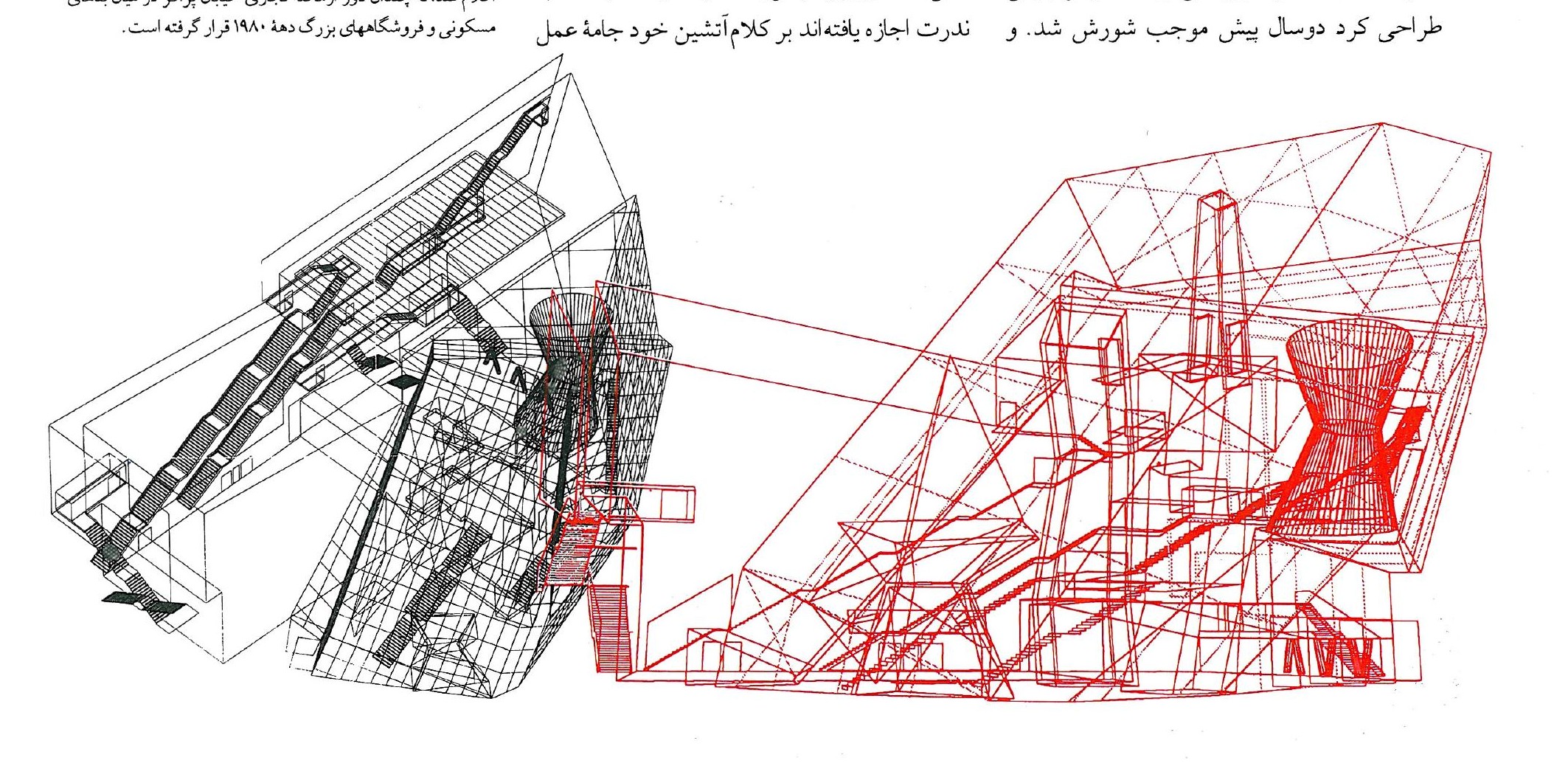
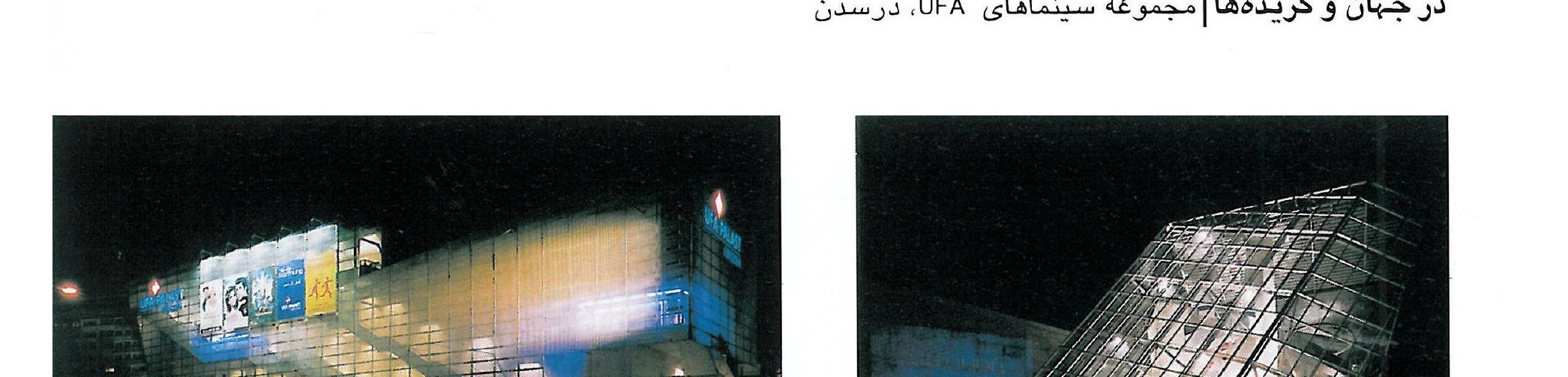
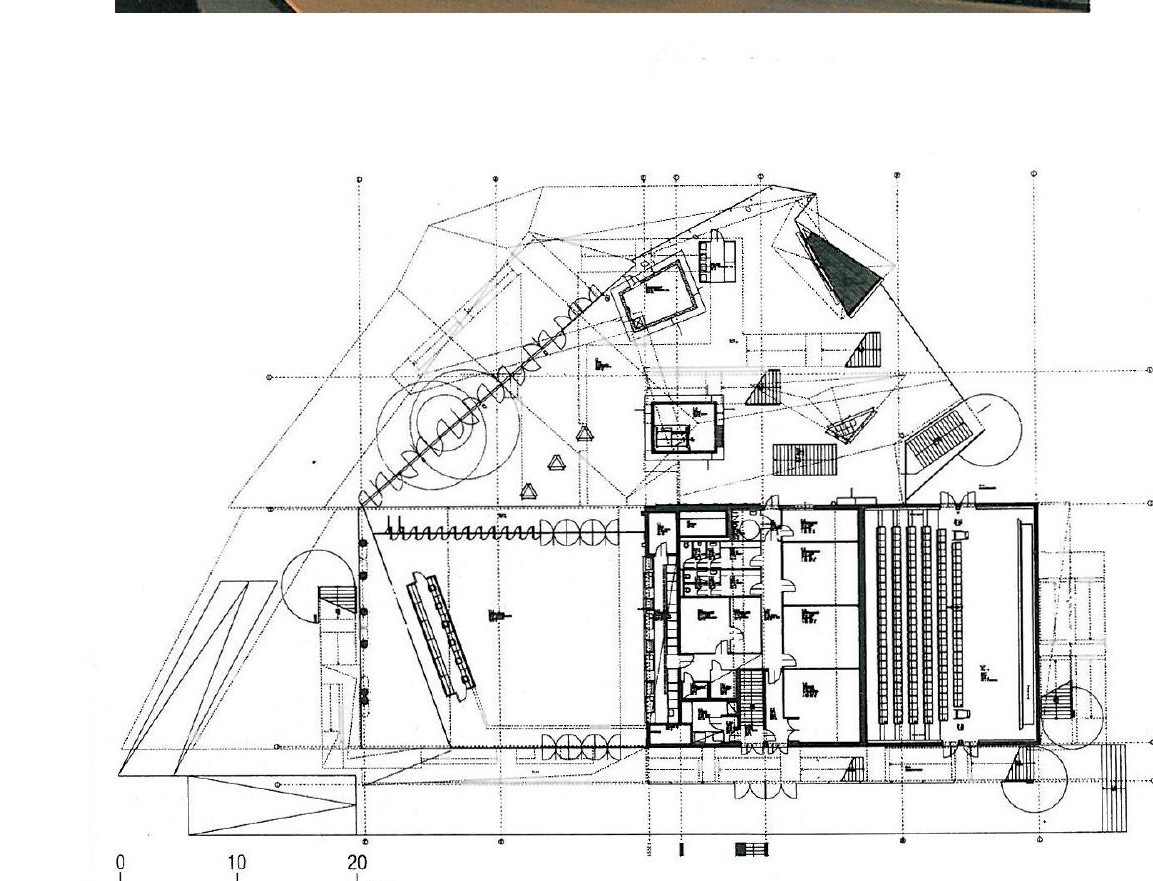
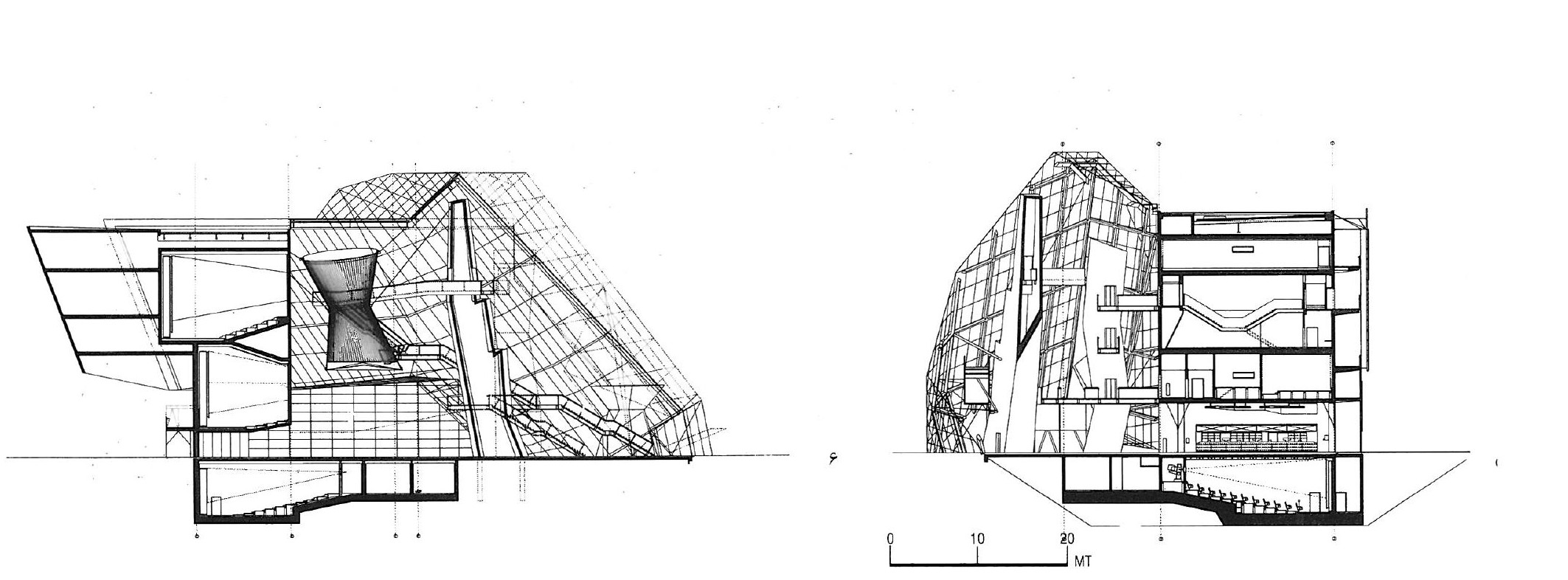
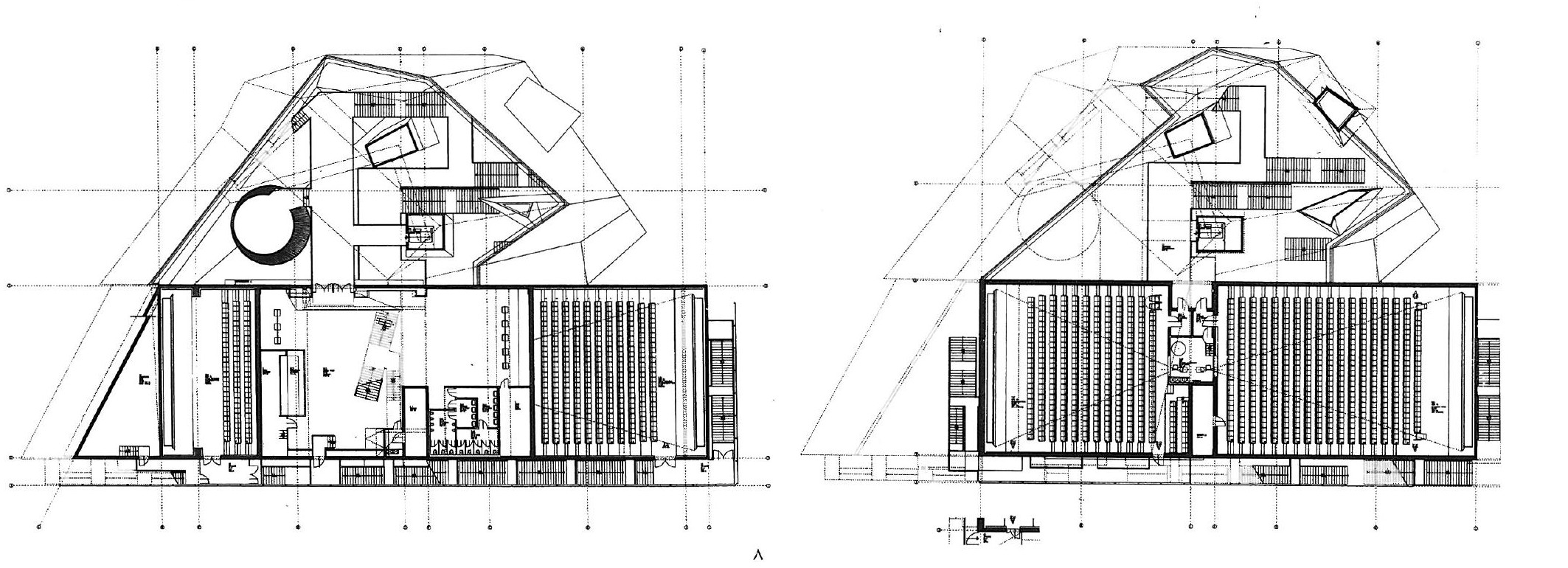
The complex consists of two distinct elements: a concrete bunker — a monolithic, self-contained body whose only exterior expression is structural, housing eight cinemas (or more precisely, only four above ground; the other four are underground); and a "crystal" foyer structure of metal and glass in the form of an enormous irregular crystal that juts out in every direction. These two elements meet without mediation at a single direct joint: nowhere do the two volumes physically interpenetrate. This uncompromising division provides an opportunity for different design languages to be presented from different viewpoints, resulting in distinct modes of treatment for the separate parts of the building.
In any case, as a consequence, the complex internal mechanism of this architectural body has been reduced to a kind of unexpected forwardness: the cinema is here, up there, this way. The vast exterior surfaces of the concrete bunker, through the use of diagonal lines and openings, have been arranged to create unexpected encounters. Unfortunately, the halls have required several fire escape staircases, and these emergency stairs are hidden behind large mesh wind-screens on the exterior walls. Although this necessity has produced a motif that is not without appeal at this unconventional scale, the staircases have required so much space between the wind-screens and the concrete wall that it becomes difficult to distinguish the wind-screens from the actual facade wall.
The halls themselves look as though economic considerations have caused them to be crammed one on top of the other by force. The only space apparently left for corridors and intermediate foyers — indeed, for the main ticket-selling corridor — is on the ground floor. The remaining room beneath the sloped roof scarcely lets people stand without hitting their heads on the ceiling.
Clearly, this oppressive sense of confinement was intentional — designed to contrast with the glass "crystal," whose surging, upward-moving form apparently defies all laws of gravity. The spatial experience promises an undeniable boldness. But this promise is kept only from the outside. The glass shell, through its moving, eruptive form rising above and apparently mocking every law of attraction, turns the conventional spatial clichés and customary perspectives into such turbulent disarray that if we are not to call it self-consuming aggression, it has devolved into unbridled chaos. Deception or illusion? The last things one might have expected to see inside a glass crystal amount to nothing: the prisons of old age.
The repulsive horror of this visual terror is doubled by the choice of materials — a choice that alone could make the hair stand on end even of Brutalist advocates of honesty in construction. Inside and out, there are three levels of material: concrete, glass, and galvanized steel. Inside and out, only one colour stands out — that of the raw concrete from which the structure was built. Without any finishing, all evidence of sloppy workmanship can be seen upon it. All metal elements are so coarse that any craftsman with even a modicum of self-respect would be ashamed by the bolted connections and industrial fittings. If this was the intention, we can only say they have gone astray here too. Wherever construction elements have been excessively sharp — in the literal sense — the cinema management was forced within days to cover them with rubber sheaths. Likewise, in the near future they will probably have to coat the matte and uneven surfaces, which otherwise lose the battle against dust and grime.
When the cinema opened, the citizens of Dresden were left wondering whether the criticism raised was merely a reflection of the simple-minded dismay of provincial folk — or something more. The finesse and sophistication that even avant-garde artists would accept was a far cry from what they saw. The only question that remains is: what benefit does the urban landscape derive from this controversial work of building art?
Second Article by Wolfgang Bachmann
Dresden is a stage set. The Baroque city, "the Florence of the Elbe," was destroyed in February 1945 by American bombers and became a landmark in German history. Happy are we who could rebuild the west of the country — we sent care packages to Dresden. At that time, in the 1950s, all of us had relatives in the "Eastern Zone."
When, after the fall of the communist regime, I travelled to Dresden for the first time, once again I had that feeling of experiencing a better history, almost by pure chance. There were still real ruins there, with streets as wide as airport runways stretching between them. The vacant lots in the city centre had investors in a gold-rush fever. Western architects, experienced in the rapid production of enclosed space, descended upon their Saxon roots and the war ruins, well-intentioned post-war reconstructions, and then the space-filling constructions periodically scattered about, once more prompting us to ask ourselves: what have we lost here, and what should we leave behind?
This cinema, recently opened, was the result of a competition held in 1993. Prager Strasse, which was to have been redesigned at its northern end, came into existence in the mid-1960s. Both its sides are flanked by blocks of apartments, shop arcades, and hotel slabs that rise to the sky like honeycombs. It was once a pedestrian zone with a restaurant, a circular cinema, and a large department store — considered a faithful implementation of the Athens Charter principles.
On the northern side, the tall slabs of chain department stores have been placed where once there were small arcade shops. The street has been transformed into an enclosed space: narrow alleys and staircases have created a cosy ambience — on a shopping-bag scale — that has been tested in the west. The materials too — light-coloured granite, grey glimmering steel, masses of glass, and a touch of thermal cladding with a reddish glow — are all part of the standard requirements of a pedestrian zone designed to squeeze purchasing power, east and west alike.
Coop Himmelb(l)au, in the design they submitted for the competition, had proposed to leave the ground floor open and create an urban passage or arcade between the high-rises and residential complexes: "public spaces conceived as the intersection of urban activities, not merely neutral commercial spaces." But this proposal would have caused investors to lose their best retail space. We must still wait and see whether the cinema, situated behind the busy Sankt Petersburger Strasse, can survive — especially since a ramp leading to underground parking separates them further.
But this reality is beyond doubt: what we see before us has been specifically created for this site. This is a cinema. The aim was to reclaim a piece of urban space, even for those who do not wish to buy anything or watch a film.
The cinema itself is a narrow and very economical silo of stacked halls. On the side facing Sankt Petersburger Strasse, it stands like a soundbreak wall. The exits lead to independent staircases hidden behind galvanized mesh screens that rise to the full height of the concrete facade, embracing it. The metal meshes serve as billboard space and simultaneously as a kind of safety filter for spectators exiting the dark halls at height — a sign that something detached from reality is taking place here: in other words, a screen behind which to hide. The concrete body of the building, in the shape of an acute triangle, rises above the rooftops — unfurling its flag, as it were, above the post-war urban landscape, proclaiming itself. It is clear that Coop Himmelb(l)au, too — unlike many citizens of Dresden, and indeed architects of Dresden — has no intention of setting aside its own "light, air, and sun" in the future.
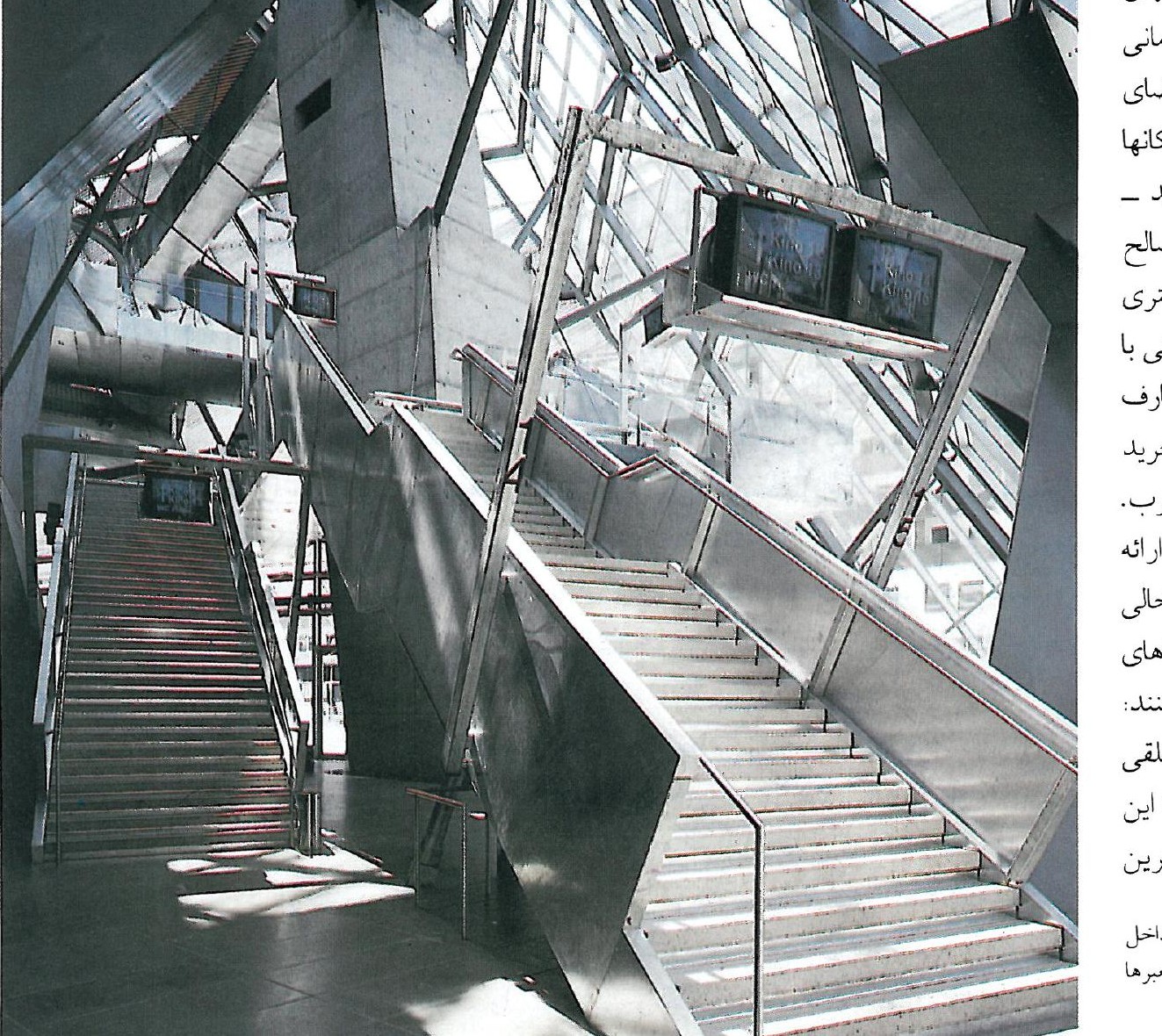
There is no "velvety Swiss concrete" to be seen — on any highway overpass one can spot the same oil stains, gravel accumulations, broken edges, and water marks. They say that when the time came for finishing the details, there was no budget left. But this is not true. Everything was meant to be exactly as it is. It is not coarse; it is honest. Railings made of folded sheet metal have produced handrails as thick as biscuit tins, not unlike ventilation ducts mounted on walls. These are simple safety railings from which fluorescent light emanates, playing on spotted silvery zinc panels. Video screens sit on console-like "paddles," acting like flashing traffic signs. Concrete slabs and black asphalt are a continuation of the city centre and the outdoor space. The only reason children take off their roller-skating shoes is the carpet that covers the cinema floor.
Whether the foyer will one day be accepted as a "dynamic urban spatial sequence" depends on the extent to which the glass walls will open their arms in welcome. The cactus pots placed there unfortunately suggest that the operators are investing their money in people who come to watch German comedies.
About this architectural "event" — in many cases quite spontaneously — one can hear many opinions. It suffices, at the height of shopping season, to wander around. A father says to his small son, who is dragging his feet behind him: "What a terrifying thing!" The boy nods in agreement. Then, thinking it over, he asks: "Why?"
Dresden is a stage set.
Source
Originally published in domus, no. 809, November 1998. Translated into Farsi by Farzaneh Taheri.