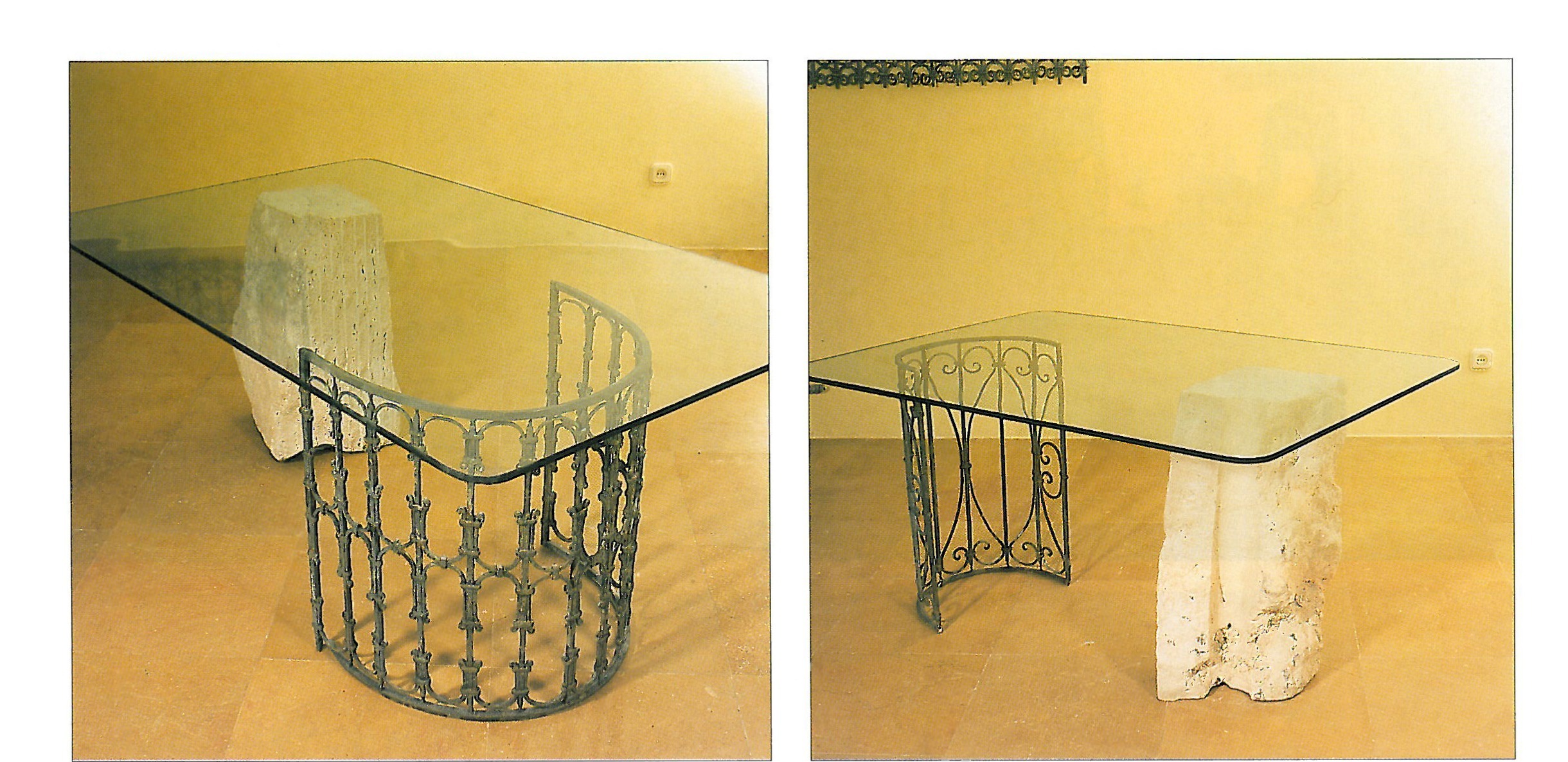
Photographs: Houman Sadr.
Vahid Malek, born in 1973, completed his academic studies in 1995 and has so far held many group exhibitions and twelve individual ones in interior decoration — with old mahjar grilles and nomadic textiles, curtains, hangings, tribal chests and the like. Among his intellectual concerns over the years of his working life has been the question of how to preserve the works of Iranian art. For this reason in 1993 he began his activity in the field of nomadic textiles, with the aim of a fresh look at these works. His aim is a fresh reading of original Iranian artistic works and the granting of new, practical, contemporary uses to them.
By joining these forgotten works to contemporary materials — such as glass, stone, wood, bamboo and so on — he has designed interior-decoration pieces such as tables, dressing units, mirror-and-candlestick pairs, screens, curtains and decorative hangings. The mahjar (meaning a guard, covering or partition) has, from the Zand period onwards, held a particular place in Iranian architecture; in old buildings it was used behind windows or in the form of a railing. The period of the making of mahjar grilles required that these works be made by hand, with sledgehammer and smith's forge — so that in their making no screws, rivets or welds were used. Vahid Malek, in his designs employing the mahjar, has continued this technique, and even in their colouring he has used the technique of the restoration of older works.
In 1996 Vahid Malek founded Pasargad Gallery — designed by his father, Parviz Malek — to serve as a place for the exhibition of original Iranian works.
On architecture
A better saying about architecture is this: with poetry one cannot make architecture, but with architecture one can compose poetry; with music one cannot build architecture, but with architecture one can play music. With the performing arts of theatre and literature one cannot bring architecture into being, but in architecture one can perform, speak eloquently, compose poetry and play music. In the art of cinema, too, architecture is present: the creation of cinematic space is indebted to architecture, and many good film directors know architecture. Architecture is neither poetry, nor music, nor cinema; yet it takes in all these arts, from within and without. The scope of the reach of architecture takes in everything from the depth of history to the imagined spaces of the centuries to come. For this reason it cannot be taken lightly, regarded as a diversion or not believed in.
* From an interview with Henri Ciriani — Memar magazine, no. 4.



