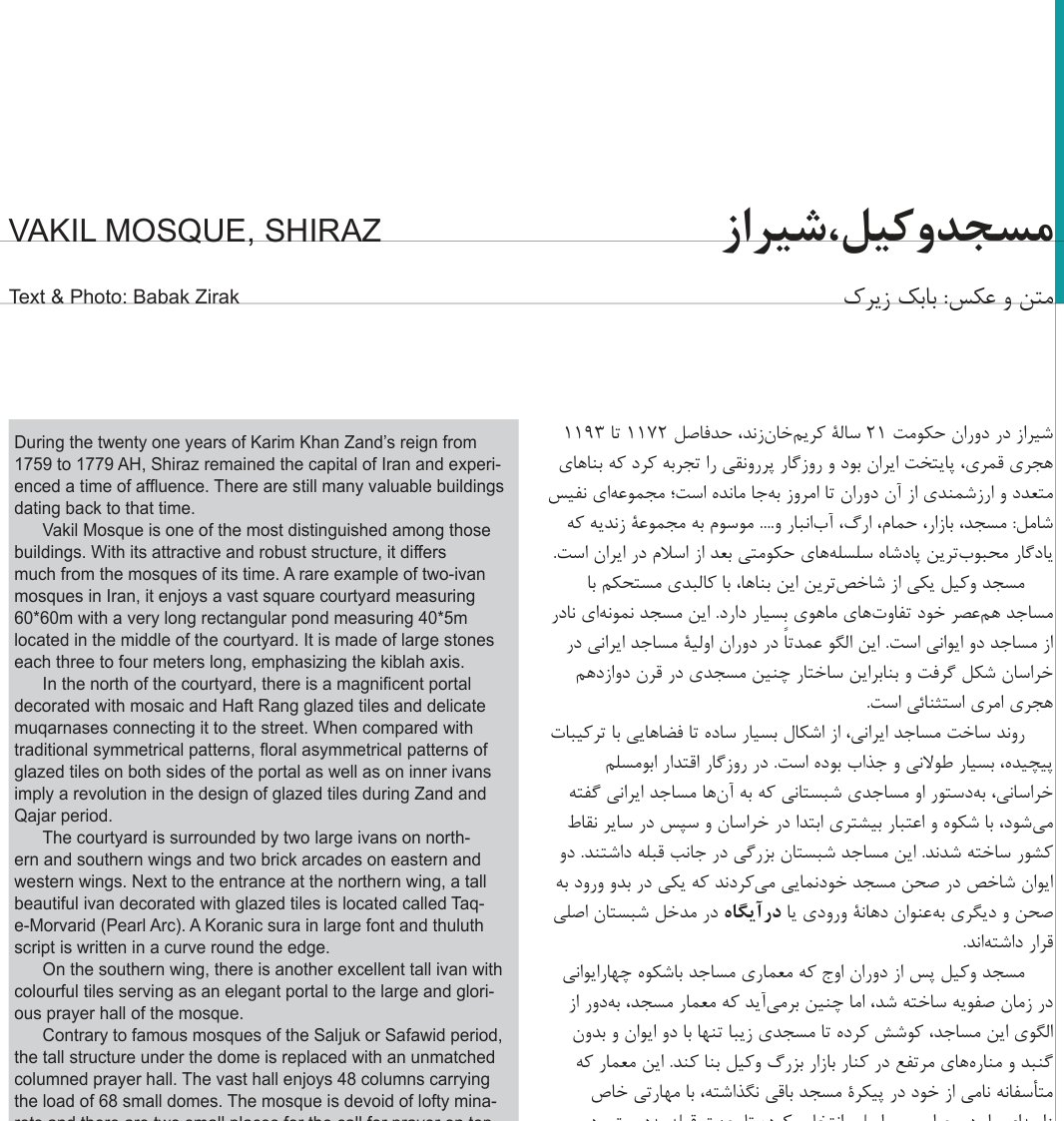
During the twenty-one-year reign of Karim Khan Zand, between 1172 and 1193 AH, Shiraz served as the capital of Iran and experienced a flourishing era, from which numerous and invaluable buildings have survived to the present day — an exquisite ensemble comprising a mosque, bazaar, bathhouse, citadel, cistern, and more, known collectively as the Zandiyeh Complex, the legacy of the most beloved sovereign among the post-Islamic ruling dynasties of Iran. Vakil Mosque, one of the most distinguished of these buildings, differs fundamentally from its contemporary mosques in its robust form. This mosque is a rare example of the two-iwan typology. This pattern took shape primarily during the early period of Iranian mosques in Khorasan, and therefore the construction of such a mosque in the twelfth century AH is exceptional. The evolution of Iranian mosque building, from very simple forms to spaces of complex composition, has been a long and captivating process. During the reign of Abu Muslim Khorasani, at his command, hypostyle mosques — also called Iranian mosques — were built with greater grandeur and distinction, first in Khorasan and then in other parts of the country. These mosques had a large prayer hall on the qibla side. Two prominent iwans were featured in the mosque courtyard: one at the point of entry into the courtyard, and the other as the entrance portal or threshold to the main prayer hall. Vakil Mosque was built after the zenith of the magnificent four-iwan mosque architecture of the Safavid era, yet it appears that its architect, departing from that model, endeavored to build a beautiful mosque with only two iwans and without a dome or tall minarets, beside the great Vakil Bazaar. This architect, who unfortunately left no name inscribed upon the body of the mosque, selected with particular skill an angled site along the main thoroughfare so that the qibla direction would be correctly observed within the mosque. Vakil Mosque has a large square courtyard measuring approximately 60 by 60 meters, with a very long rectangular pool at its center — 40 meters in length and 5 meters in width — built from massive stone slabs 3 to 4 meters long, emphasizing the qibla axis as an extended line. This immense pool, with its singular proportions, reflects the image of the sky upon the stone courtyard of the mosque like a vast mirror — so long as no worshipper disturbs the water's stillness for ablution. On the north side of the courtyard stands a magnificent portal adorned with mosaic tilework, haft-rang tiles, and delicate muqarnas, connecting to the outer passage. The free and asymmetrical floral motifs of the tilework on both sides of the entrance portal and the interior iwans, in comparison with traditional symmetrical patterns, bear witness to a striking transformation in tile design during the Zand and Qajar periods. This portal beckons visitors from both sides of the main arcade of Vakil Bazaar into the mosque's interior. Within the mosque's open space, large iwans on the north and south flanks and brick arcades on the east and west sides encircle the courtyard.
Upon entering, on the north side of the mosque, there is a tall and beautiful iwan decorated with tilework, known as Taq-e Morvarid (the Pearl Arch). Around this arch, one of the Quranic surahs is inscribed in a crescent form in bold thuluth script. In describing the beauty of Vakil Mosque's ornamentation, reference to Pierre Loti's travelogue Vers Ispahan is not without benefit: "Today I fortunately managed to enter the mosque of Karim Khan (Vakil). No doubt, if I stay here for some time, I shall gain entrance to all the places that are now entirely forbidden to me. The people of this city are very gentle and kind toward me. The architectural lines and motifs of the mosque are simple and unpretentious, yet everywhere one sees enameling and the colors green and red, and this splendor has reached the point of excess. Not a single portion of the wall can be found that has not been meticulously enameled. We are now in a palace of lapis lazuli and turquoise..." Vakil Mosque has suffered severe damage on several occasions: the impact of several cannonballs during the conflicts of
1255 AH, and then severe damage caused by two earthquakes in 1280 and 1310 AH, necessitated the mosque's restoration and reconstruction during the reigns of Fath-Ali Shah and Naser al-Din Shah. The mosaic tiles of the Fath-Ali Shah era, with their arabesque floral and vine motifs and numerous inscriptions, are among the ornamental additions of the Qajar period. On the south side of the mosque, an exquisite iwan with colorful tilework and a lofty stature serves as the magnificent threshold to the mosque's grand and splendid prayer hall. Unlike the renowned mosques of the Seljuk and Safavid periods, the towering space beneath a dome has given way to an extraordinary prayer hall that evokes serenity and order in a spiritual atmosphere. The vast expanse of the prayer hall contains 48 finely carved stone columns that bear the weight of 68 small domes. These columns, hewn from monolithic stone in shades of grey and light cream, were brought from a quarry in Maragheh to Shiraz by order of Karim Khan. They display beautiful ornamental features including spiral grooves along the shafts and raised petals on the capitals. The color harmony of these stone columns, the brick ceiling covering and the squinches, and the gandamak stone paving the floor bestow an unparalleled harmony and beauty upon the Vakil Mosque prayer hall. Within this space, a beautiful tiled mihrab, a 14-step pulpit, and a unique minbar carved from marble double the grandeur of this setting. This prayer hall, by virtue of its remarkable expanse and its simplicity combined with dignity, sets Vakil Mosque distinctly apart from its contemporary mosques. Apart from the main prayer hall, on the eastern side of the courtyard there is a smaller prayer hall with 20 columns, surmounted by a small dome. Its entrance lacks any prominent architectural element or transitional space. As noted, the mosque has no tall minarets; only atop the northern iwan are two short mu'azzin platforms provided for the call to prayer.
Professor Arthur Upham Pope, in a reference to the architectural masterpieces of the Safavid era and while discussing the values of the Madar-e Shah Mosque and Madrasa as the last building possessing distinguished architecture, also mentions Vakil Mosque: "Perhaps this madrasa (Madar-e Shah Madrasa) is the last important Iranian building. Some later buildings, such as the Vakil Mosque in Shiraz or the Hakim Mosque in Isfahan, possess charm and appeal, but the era of significant Iranian architecture has come to an end..." Contrary to Pope's assertion, Vakil Mosque bears abundant signs of the taste and ingenuity of its anonymous and brilliant architect, who, despite familiarity with the well-known and established models of the grand four-iwan mosques, returned nine centuries and designed the mosque drawing upon the criteria of early Iranian mosques, with remarkably bold proportions and the creation of delightful spaces at a human scale. It is as though he too, inspired by the humble disposition of his sovereign, was more concerned with an architecture of the people than with grandeur and pomp.
Footnote: Pierre Loti (1850–1923) was a French writer and traveler known in Iran primarily for his book Vers Ispahan (Toward Isfahan). In the late nineteenth century, Loti was dispatched by the French Ministry of Foreign Affairs to travel to India to convey France's friendship to the Maharajah, and then to proceed from India to Iran to visit Isfahan. This book, written in the form of a diary, recounts the story of that journey.
Sources: Archives of research conducted by Aran Consulting Engineers, Iranian Climatic Architecture Research Group. — Upham Pope, Arthur. Persian Architecture, translated by Gholamhossein Sadri Afshar. — Pirnia, Mohammad Karim. Iranian Architecture, compiled by Gholamhossein Memarian. — Ganjnameh: An Encyclopedia of Islamic Architectural Works of Iran, Center for Documentation and Research, Faculty of Architecture and Urban Planning, Shahid Beheshti University. — Studies of the Directorate of Promotion and Education, Cultural Heritage Organization.