Looking at Mahmoud Pakzad’s photographs of “Old Tehran (1941- 1975)”, the thing that is common between them all, whether a street or an airport hall or restaurant is their physical and formal cleanness, brilliance, and unmolested and unsullied state: free of all of this tackiness … Some used to refer to Tehran as the Paris of the Middle East [not at all tenuous, since Paris really was the main model for the fascinating local imaginings]; however, now we have to say the Las Vegas [“Sin City” of the Middle East instead.] In this city everything is for sale. For the “bazaari” (dealer) mentality, anything can be a commodity. Nothing is sacred. “Bazaari” [vulgar] had been the adjective to describe bad taste: attracting clients by means of glitz and gloss. Now kitsch has become the taste norm, and off course has been – to different degrees – a global syndrome and part of the “Postmodern condition”. Because of its exceedingly high, but apparently unperceived architectural qualities, Tehran could have been an exceptional city at the world scale. I do not mean only a few official and showy buildings, but its democratic architecture, the buildings [generally residential] that had built every street, big and small. There are two kinds of cities: one whose decisions are culturally oriented [in the true sense of the word], and another in which profiteering [by the least culturally oriented strata] is the norm. The presumption might be that the many urban projects that are constantly commissioned cannot but improve the city. However, it would have been much better if things had been left alone, only protected, restored, repaired, cared for, instead of abused. And if there was any need [craving] for building and Dubaization [even though Dubai lacks even one square meter of architecture, since it was built by the commercial sectors of British and American construction with the aid of the “neo-modernism”, but actually the same Postmodernism that had succumbed to prostitution, rather than the Modernism that had envisaged the making of a better world], same as Dubai, as many Dubais as desired, could have been built on open land. Tajrish, in north Tehran is buried under a nauseating amusement arcade. And in the Tehran’s central bazaar, false historicization is in process in the name of “tradition” [while the authentic tradition of Tehran (including its outstanding Modernism) is at the same time being eroded]. But of course in a theme park, historical accuracy is not only of little importance, but is even expected. Such a wide-ranging and profound destruction [quantitative and qualitative] has not been witnessed anywhere [with the consequence that living in a house is not possible anymore and has no – economic – meaning either, while in Tokyo, London and …]. At the same time that the architectural assets of the cities are bulldozed, ludicrous “traditional” concoctions are implemented here and there in shopping malls. Concern with deterioration is not for the sake of memory. When one encounters an object, a place or a building, In the first place it is
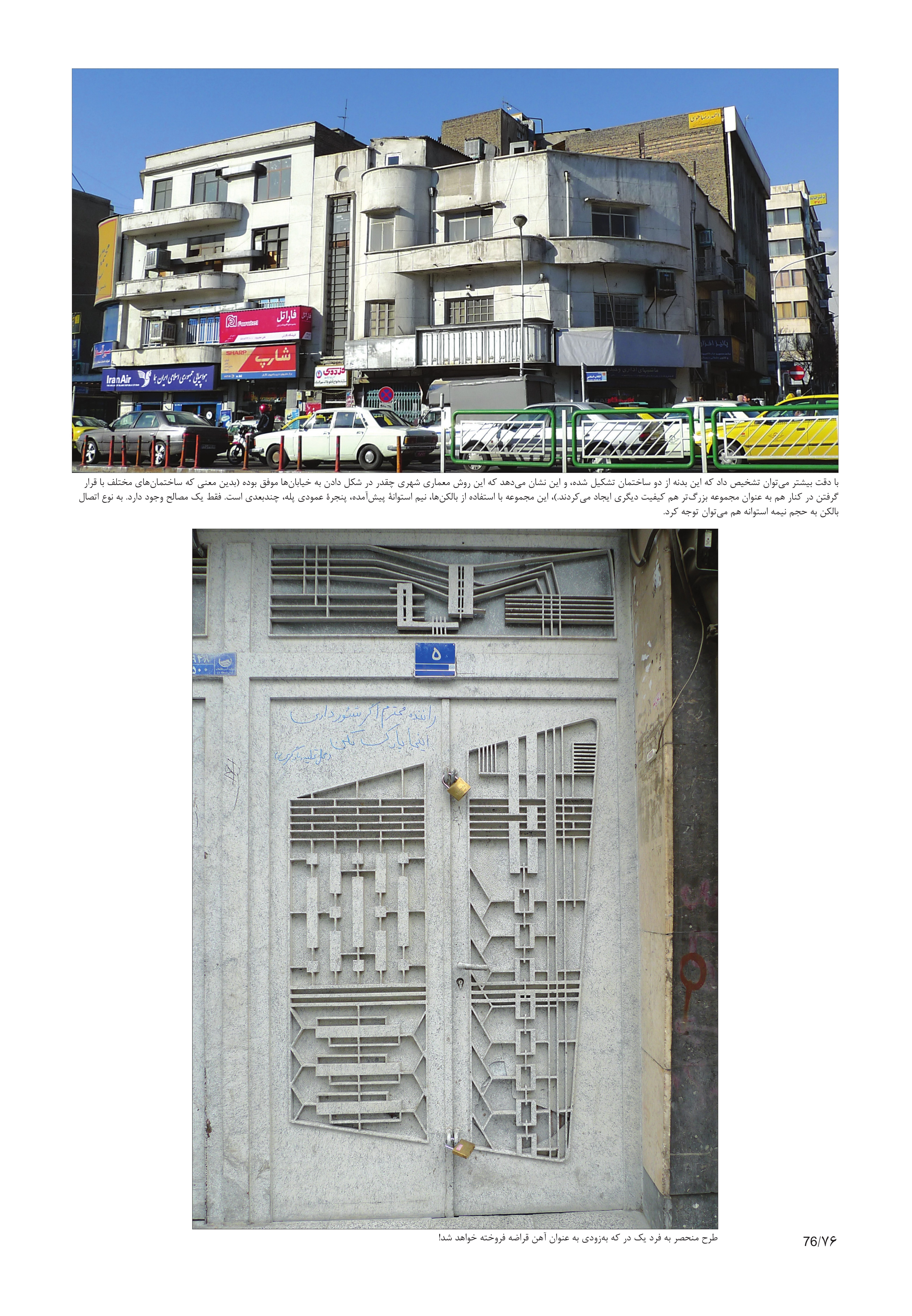
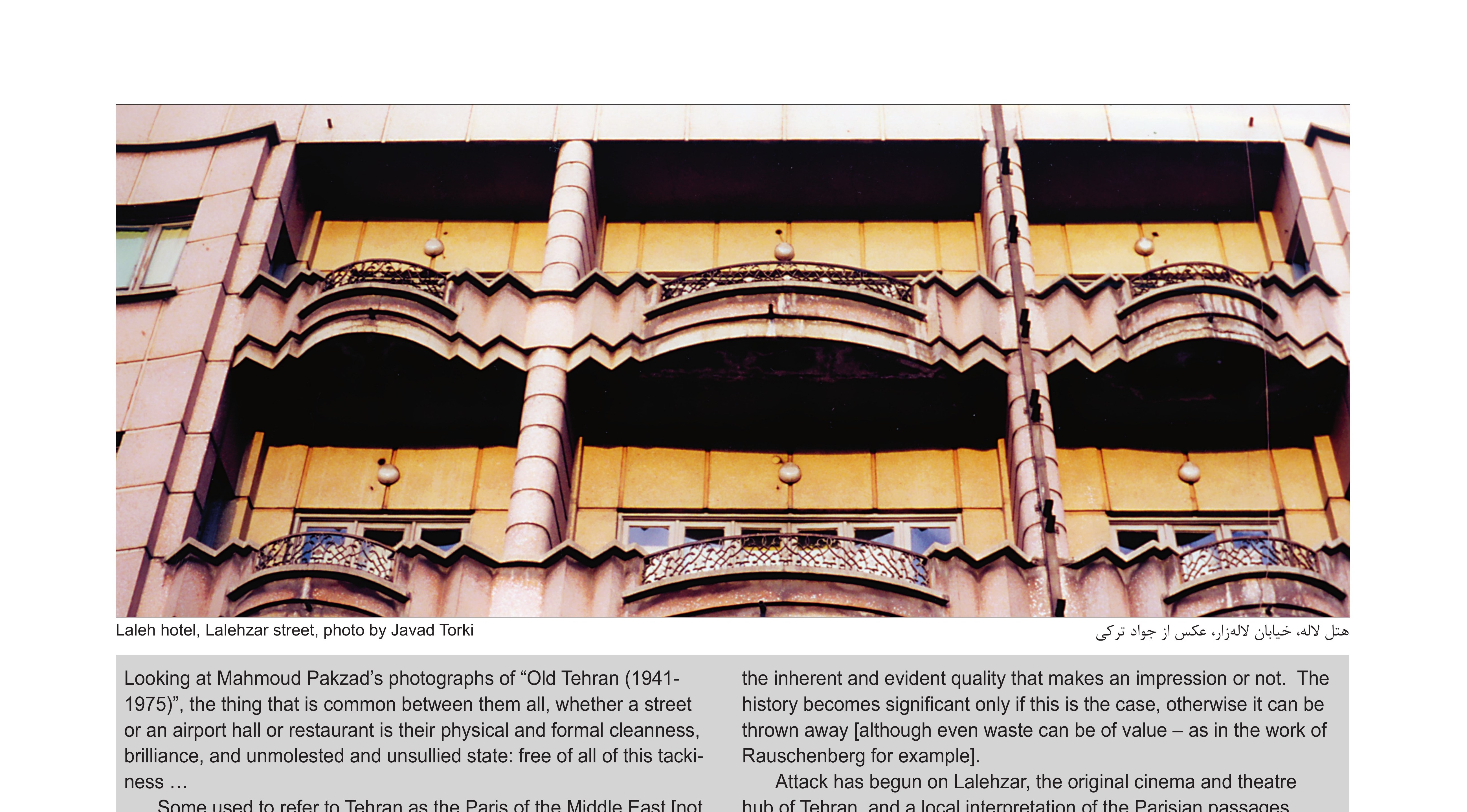
the inherent and evident quality that makes an impression or not. The history becomes significant only if this is the case, otherwise it can be thrown away [although even waste can be of value – as in the work of Rauschenberg for example]. Attack has begun on Lalehzar, the original cinema and theatre hub of Tehran, and a local interpretation of the Parisian passages ambience: demolitions or ludicrous ‘traditional” elevation schemes. And what kind of a situation can destroy the likes of places such as Lalehzar…. The characteristics of Tehran’s fine architecture are as follows: - High level of execution and details at the same time as great variety [reflection of accuracy, care, craftsmanship and delight]. - The correctness [faultlessness] of the overall form as well as details. - Diversity of styles [presence of a variety of styles as well as variety within each, such that new qualities would emerge from their interaction]. - Specialness [not having an exact equal] and the presence of remarkable solutions. - Architectural nature [having gone beyond mere construction, and reflection of thought –concept / idea … - and the sense of delight and enthusiasm]. - Three-dimensionality in most cases, even in buildings with only one side on street line, by means of projecting in and out, balconies, and in particular using cantilevers. - Tendency towards fineness and the minimal [the authentic Persian sensibility], as opposed to the recent tendency to fatness and coarseness. - Cleanness, brilliance and joyfulness as opposed to dullness. - Rational use of materials: one material (brick or render in early/ Deco, and selective variation on separated surfaces or volumes in the later usually white buildings.) - Reflection of the period of supreme architecture. Demolition should be halted. Railings and in some cases even signs and neon lights must not be removed, and lit in the case of the latter as readymades. Priority must be given to the main streets, but the depths should not be forgotten. Stylistic analysis of the varied architectural qualities in Tehran can be quite complex and difficult, and international assistance should be sought to this end. Tehran’s unique local Modernism can at the same time be a model for the future. Genuine tradition would be in paying due attention to this injured heritage, that is to the qualities of the actual place. Pollutions must be reduced or removed, not added to. Quality must be integral to the environment, not applied. The above also apply to the other cities and places.
* Kaveh Mehrabani graduated from the Architectural Assiciation AA school in 1980, he has since been teaching in AA and in Oxford Brooks Univ., and working in London as an architect. It is almost 10 years now, he carries on his career in Tehran.
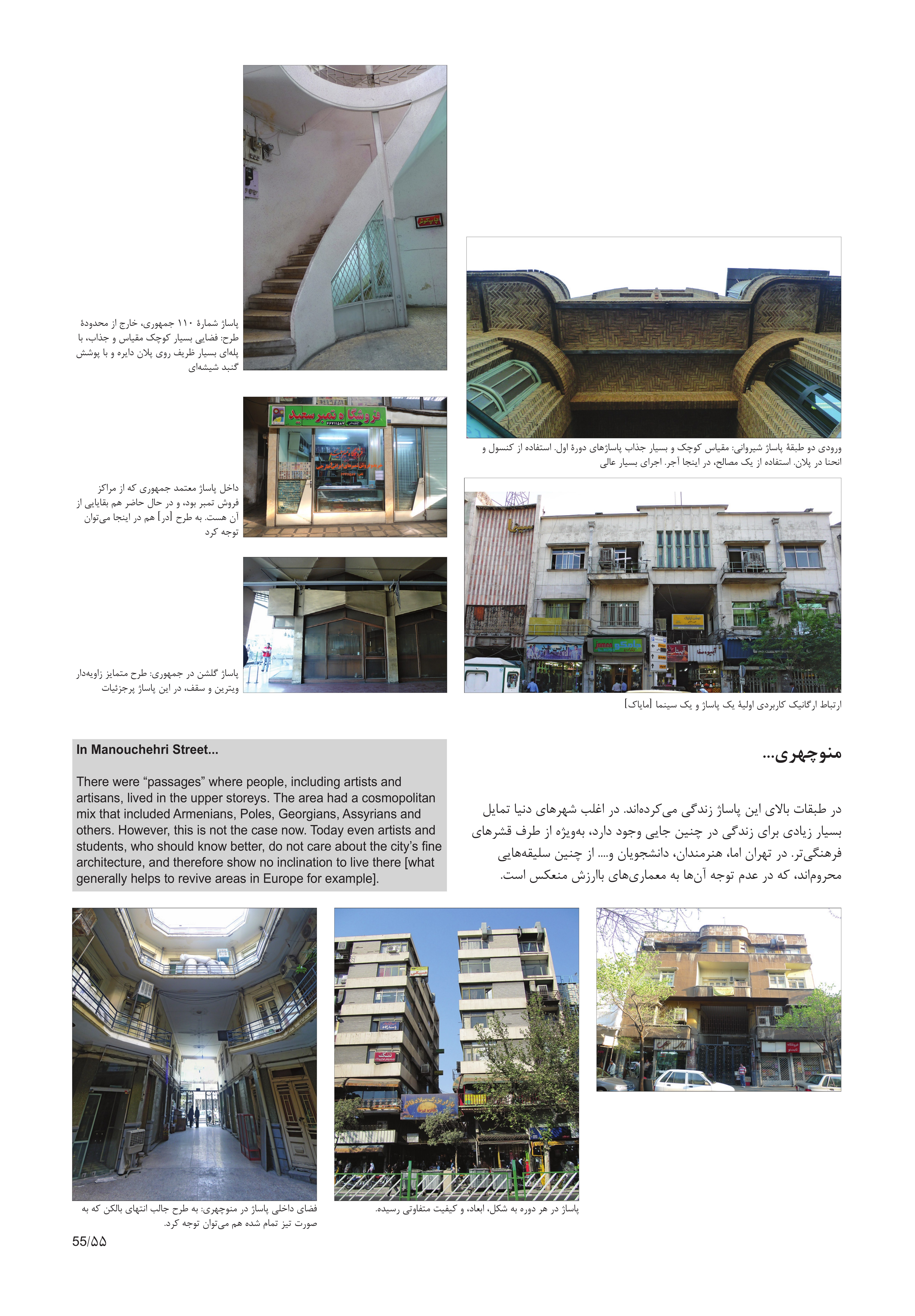
هتل لاله، خيابان لاله زار، عكس از جواد تركيLaleh hotel, Lalehzar street, photo by Javad Torki
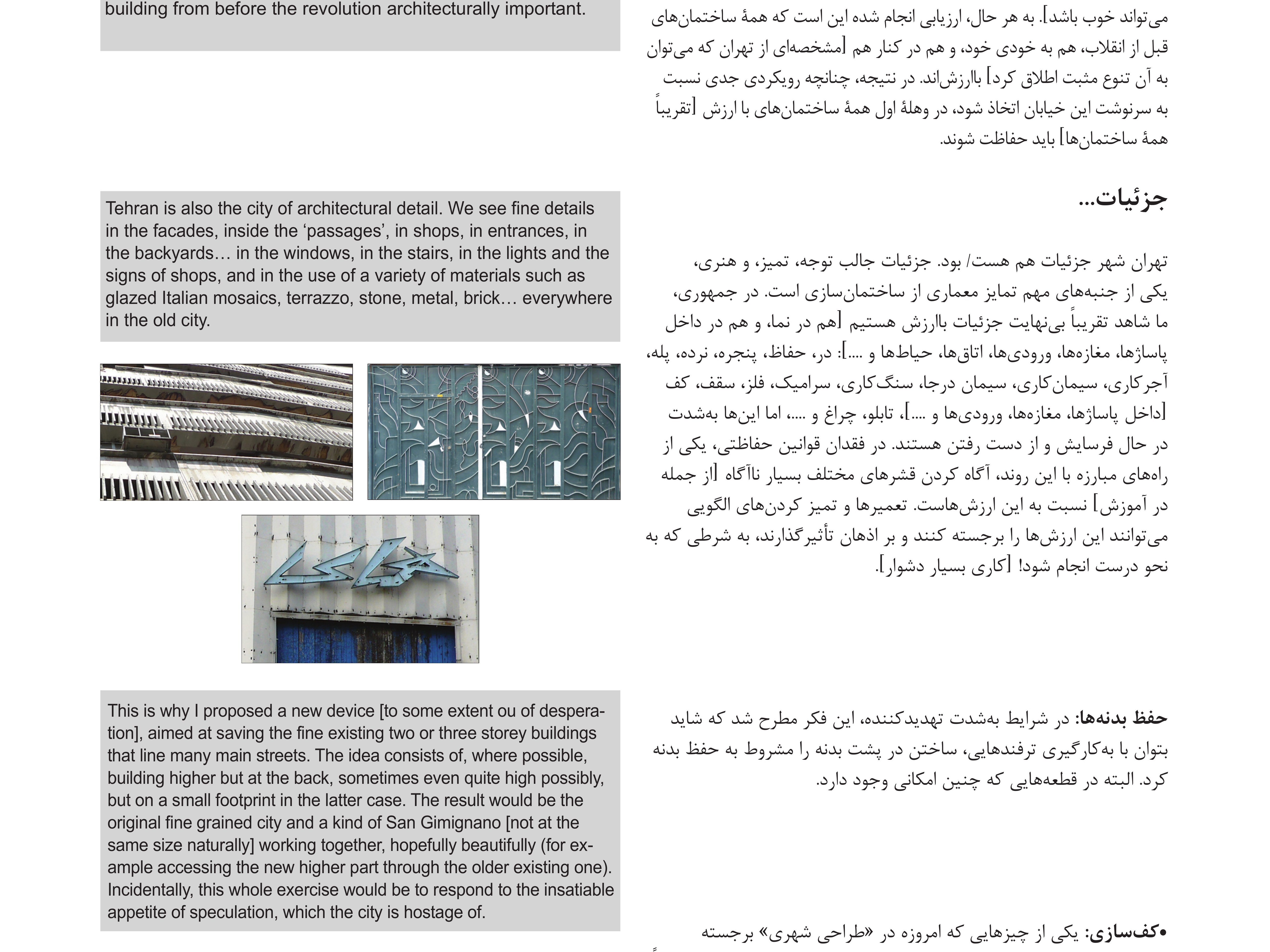
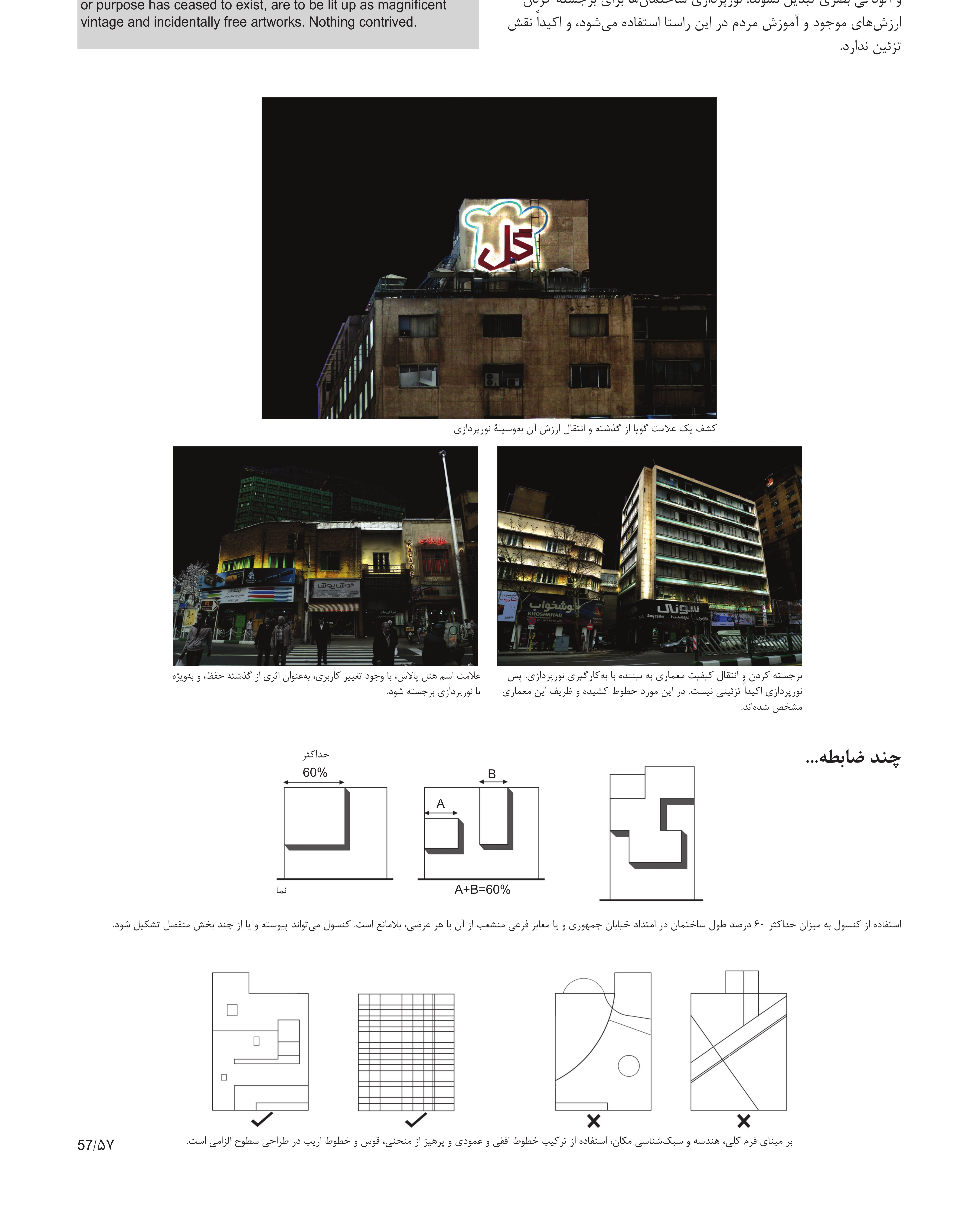
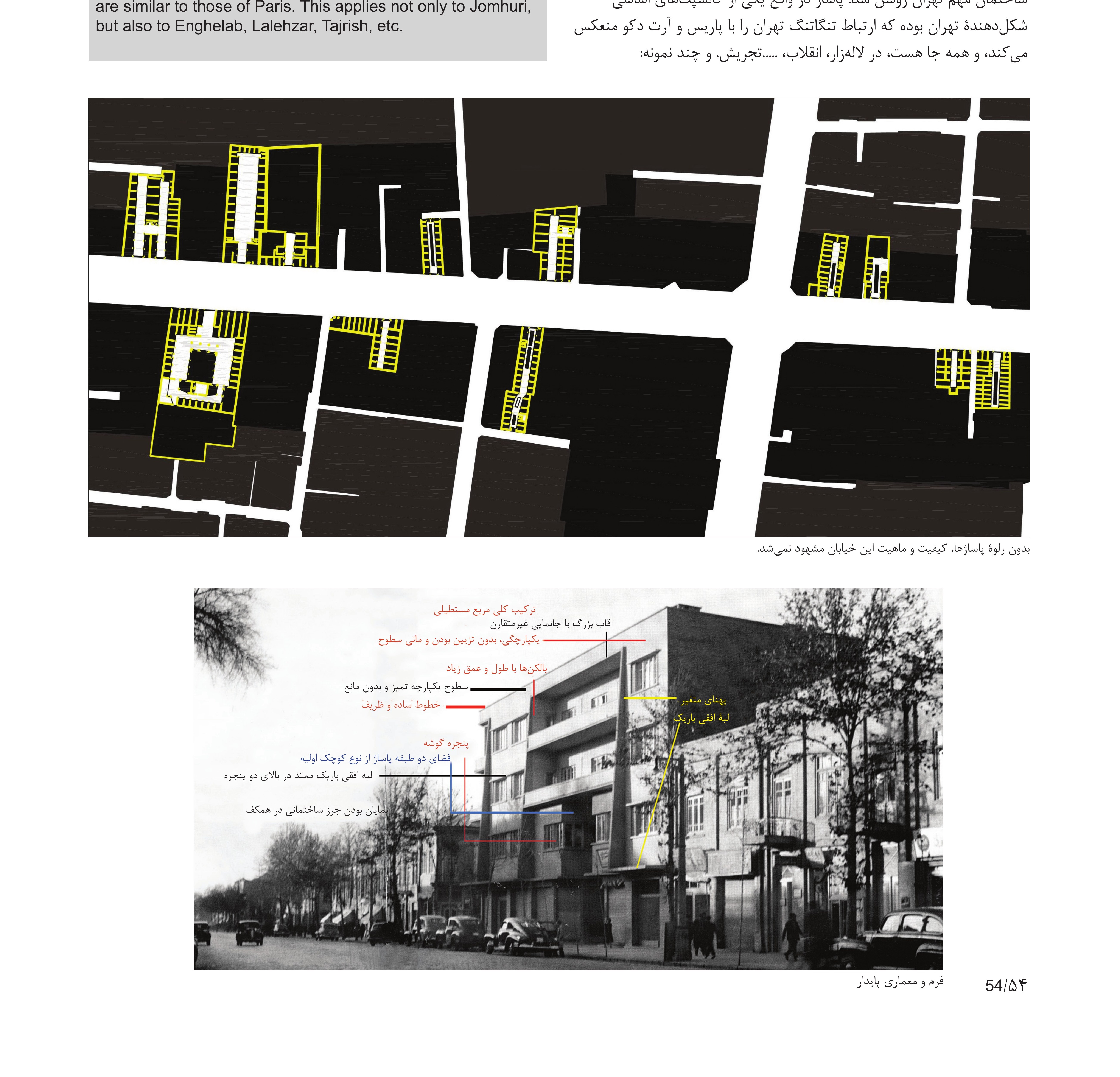
The ‘passages’ In Jomhuri or any other street of central Tehran, we do not have only the facades. The depth of a building or the depth of a smaller side street or alley leads to new ambiences and demands a deeper look, a deeper approach. When I began work on Jomhuri, the maps and drawings that were around did not at all reflect the real spatial characteristic of the street. That’s why I had to step beyond the inadequacy of the technical norms – existing maps, drawings, regulations, and thus initiated a survey of the “passages” [after the Parisian type, and pronounced the French way]. I think that such public or semi-public spaces should be included in the drawings for everywhere in Tehran and most of the other cities as well, in particular because with the present trend, not only will the buildings and even whole streets be soon destroyed, but there will not remain any sign of their existence, even on paper. The new plans gave a completely different impression of what the street is like, and now one can see how Tehran’s passages are similar to those of Paris. This applies not only to Jomhuri, but also to Enghelab, Lalehzar, Tajrish, etc.
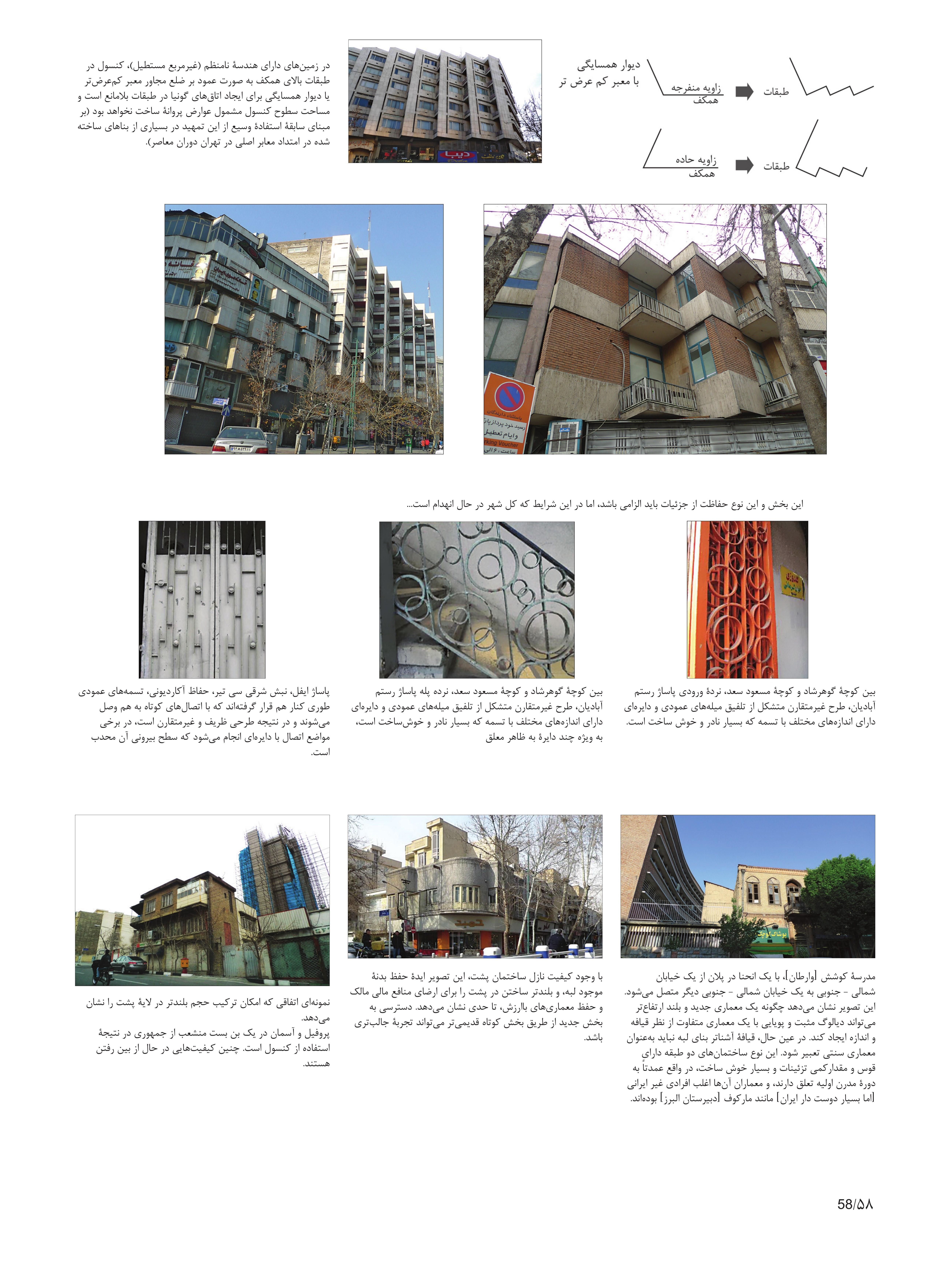
There were “passages” where people, including artists and artisans, lived in the upper storeys. The area had a cosmopolitan mix that included Armenians, Poles, Georgians, Assyrians and others. However, this is not the case now. Today even artists and students, who should know better, do not care about the city’s fine architecture, and therefore show no inclination to live there [what generally helps to revive areas in Europe for example].
Unfortunately the heritage conservation appraisals made by myself of the buildings in Jomhuri will not become binding. There is practically no meaningful heritage protection, with the result that Tehran is rapidly sliding into the category of cities devoid of artistic and architectural importance. I think the criteria for conservation should not be limited to the date of construction, the architectural style, or the building being ‘traditional’, ‘national’, etc. or not. It should instead be based purely on quality. This approach would make nearly every building from before the revolution architecturally important.
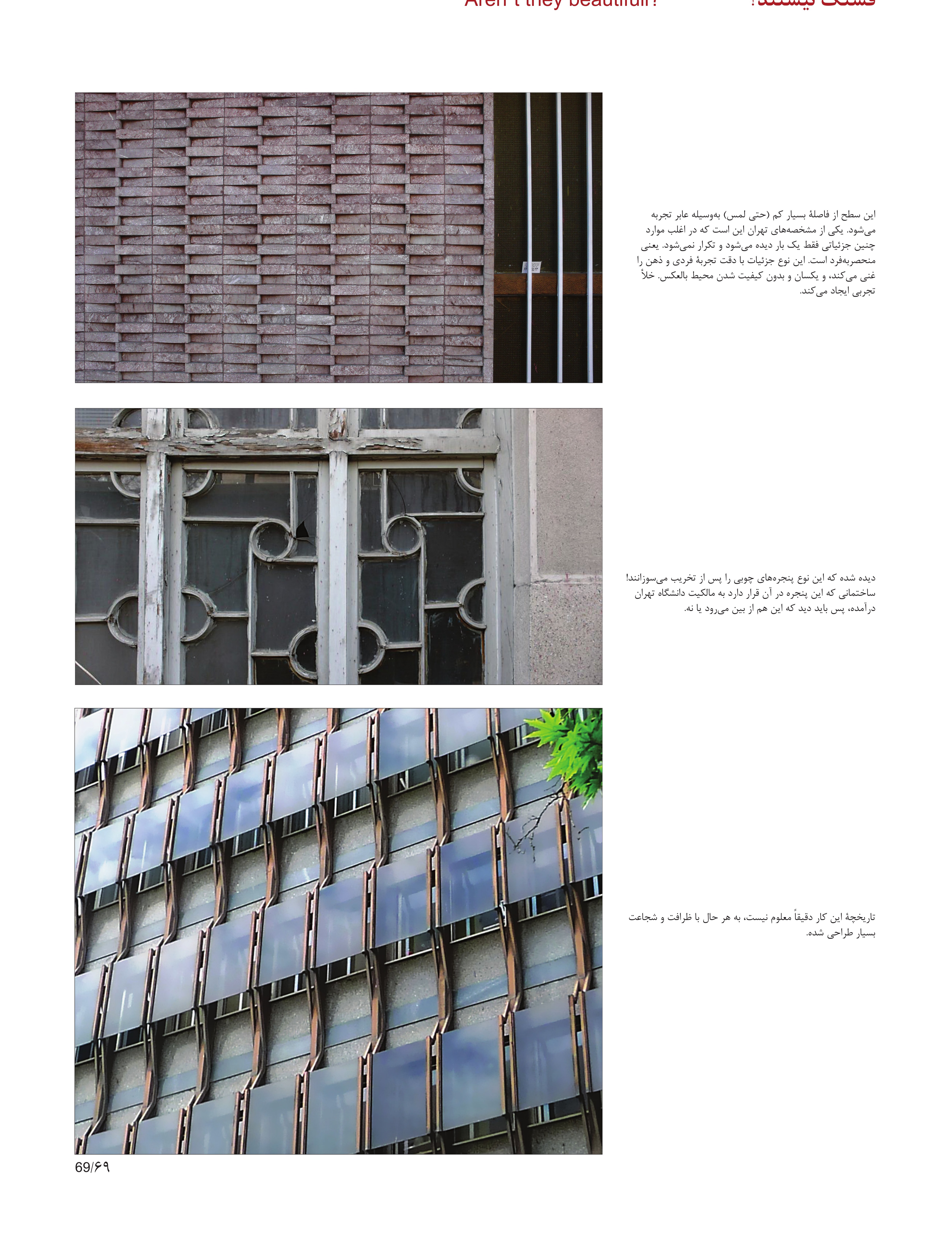
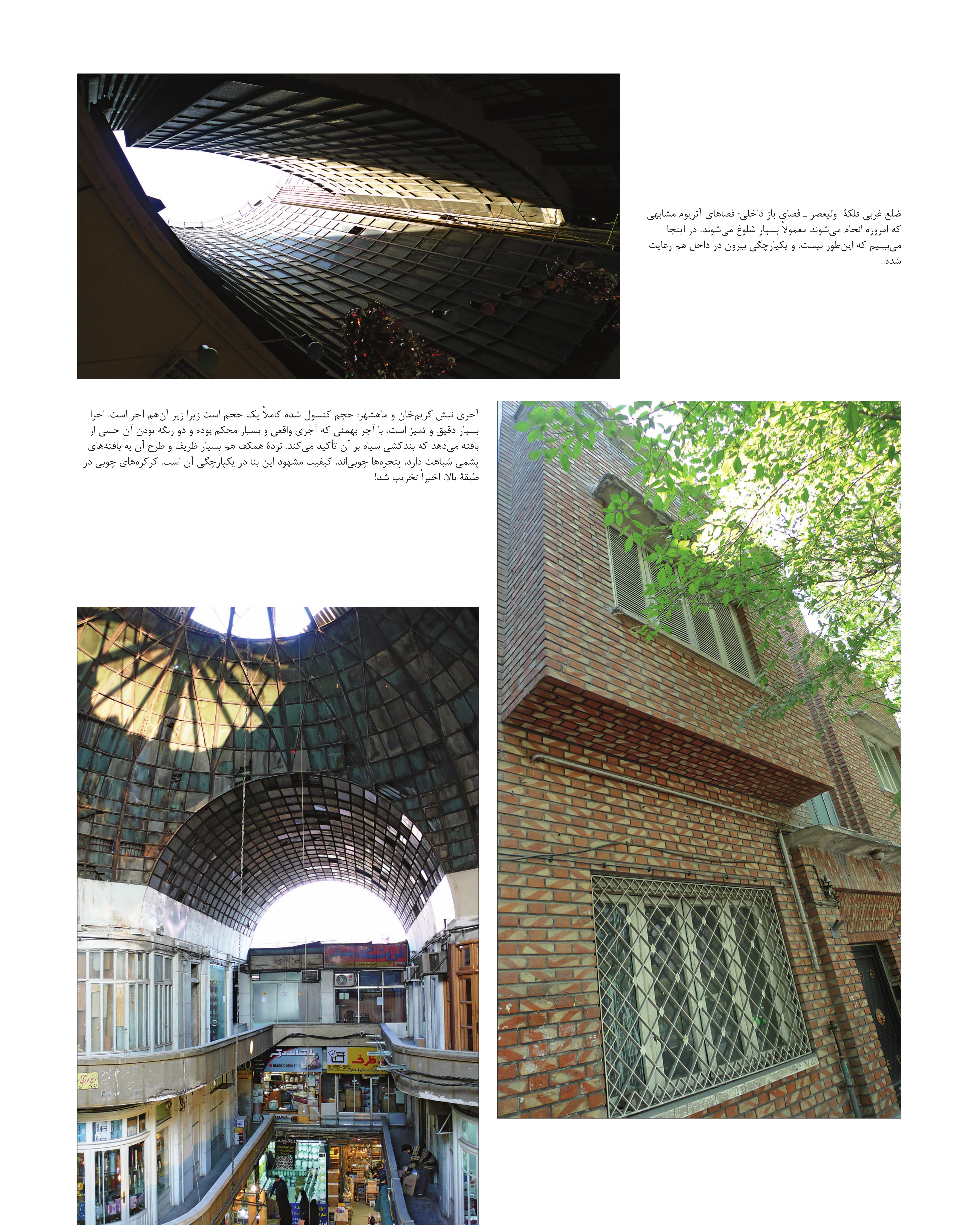
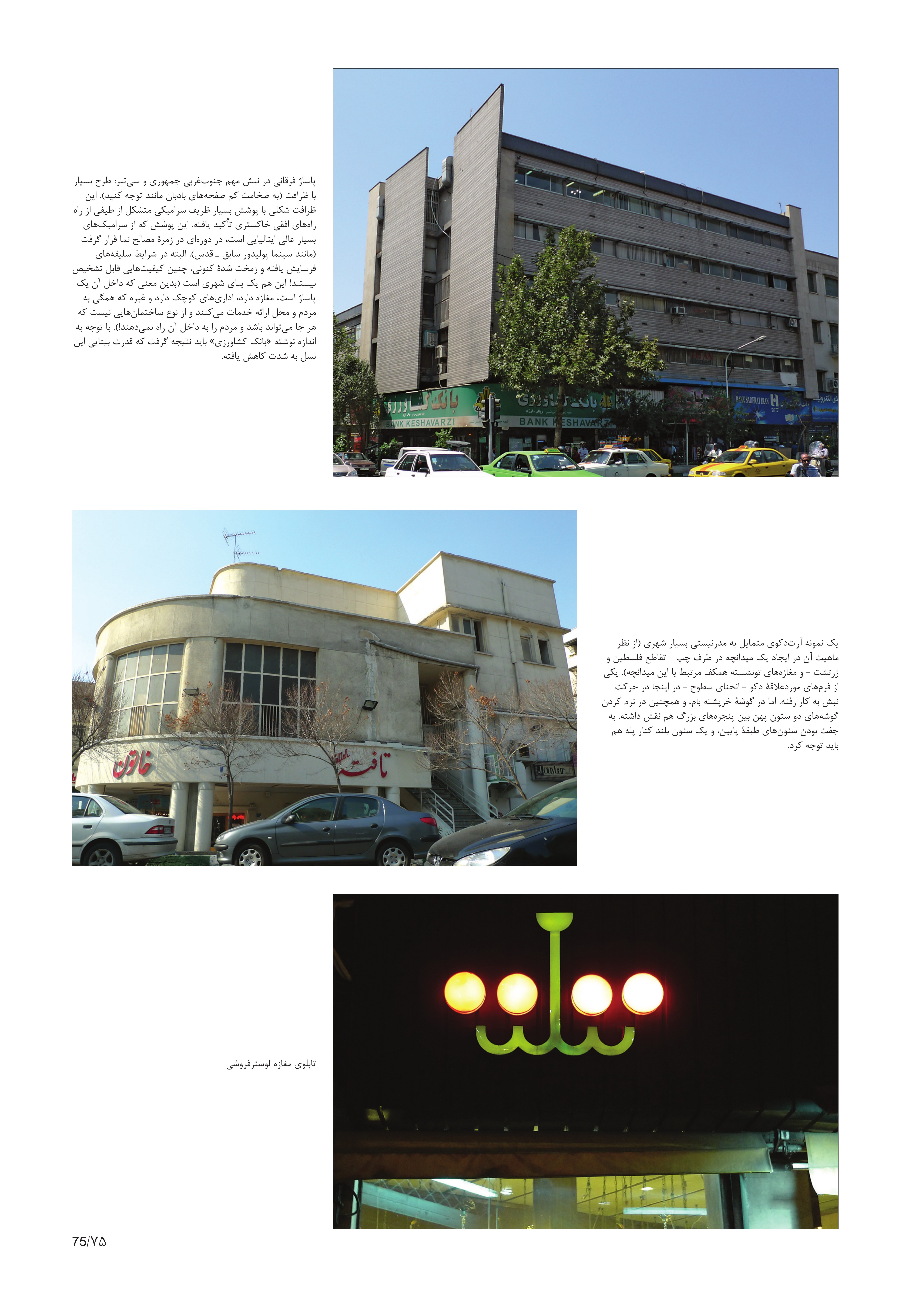
Tehran is also the city of architectural detail. We see fine details in the facades, inside the ‘passages’, in shops, in entrances, in the backyards… in the windows, in the stairs, in the lights and the signs of shops, and in the use of a variety of materials such as glazed Italian mosaics, terrazzo, stone, metal, brick… everywhere in the old city.
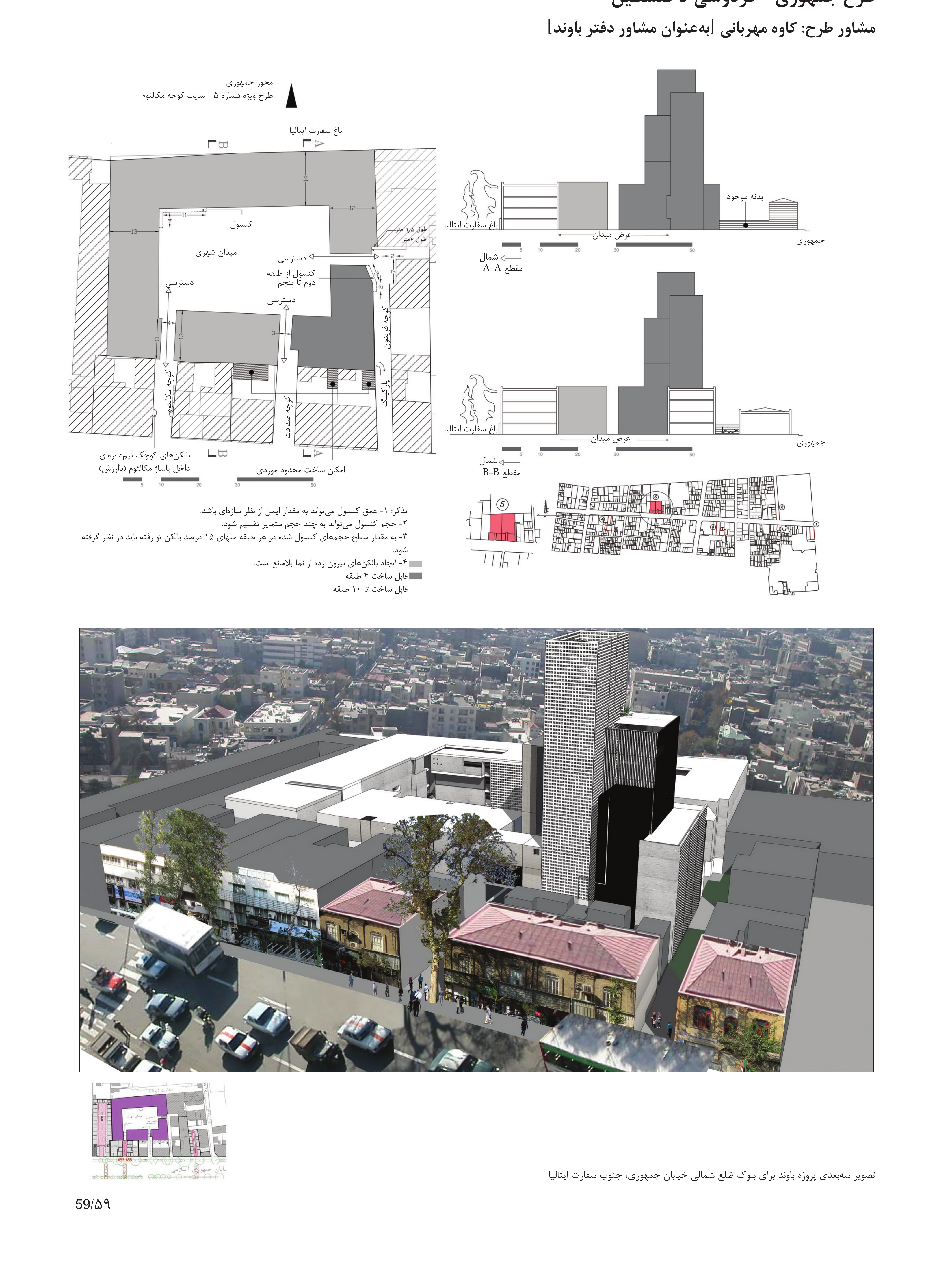
This is why I proposed a new device [to some extent ou of desperation], aimed at saving the fine existing two or three storey buildings that line many main streets. The idea consists of, where possible, building higher but at the back, sometimes even quite high possibly, but on a small footprint in the latter case. The result would be the original fine grained city and a kind of San Gimignano [not at the same size naturally] working together, hopefully beautifully (for example accessing the new higher part through the older existing one). Incidentally, this whole exercise would be to respond to the insatiable appetite of speculation, which the city is hostage of.
The paving of the sidewalks is also a very important element that should be designed with care; for example to attract attention to the interiors of the ‘passages’ and to interlace with the complexity of the primarily asymmetric characteristic of the urban form, which I saw akin to Jazz, in its vibrancy. The paving design is thus varied, and usually draws some key lines and patterns from interiors onto the pavements.
Lighting is also a very sensitive aspect, especially because in Tehran it usually becomes a form of visual pollution also during daytime because of the excessive number of visible lighting sources. Here Lighting is used to bring into relief and remind people of the fine architecture and surroundings that they have learned to ignore and abuse. Old neon lights, even where the original business or purpose has ceased to exist, are to be lit up as magnificent vintage and incidentally free artworks. Nothing contrived.
•Design consultant: Kaveh Mehrabani •Design associate:
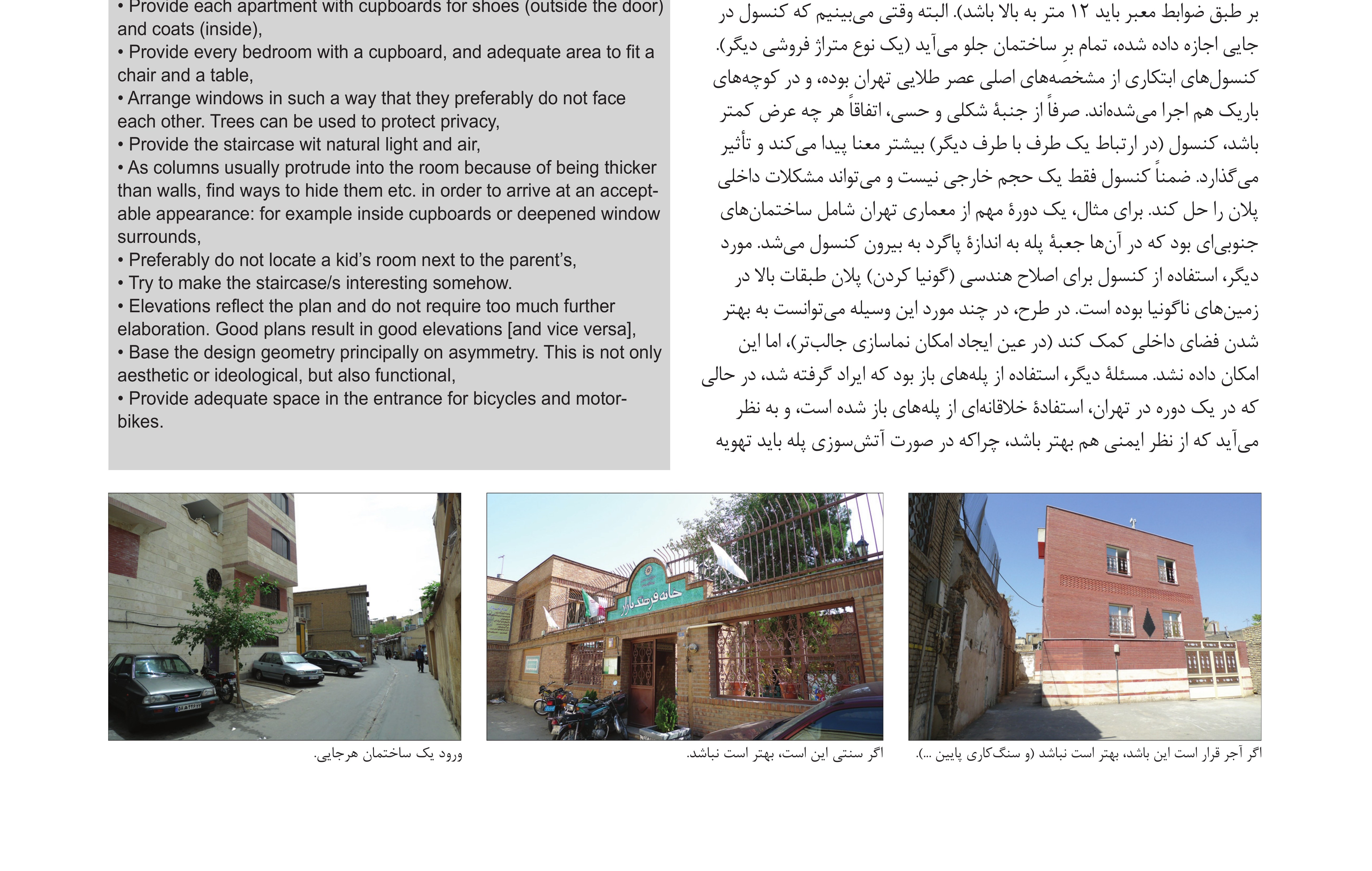
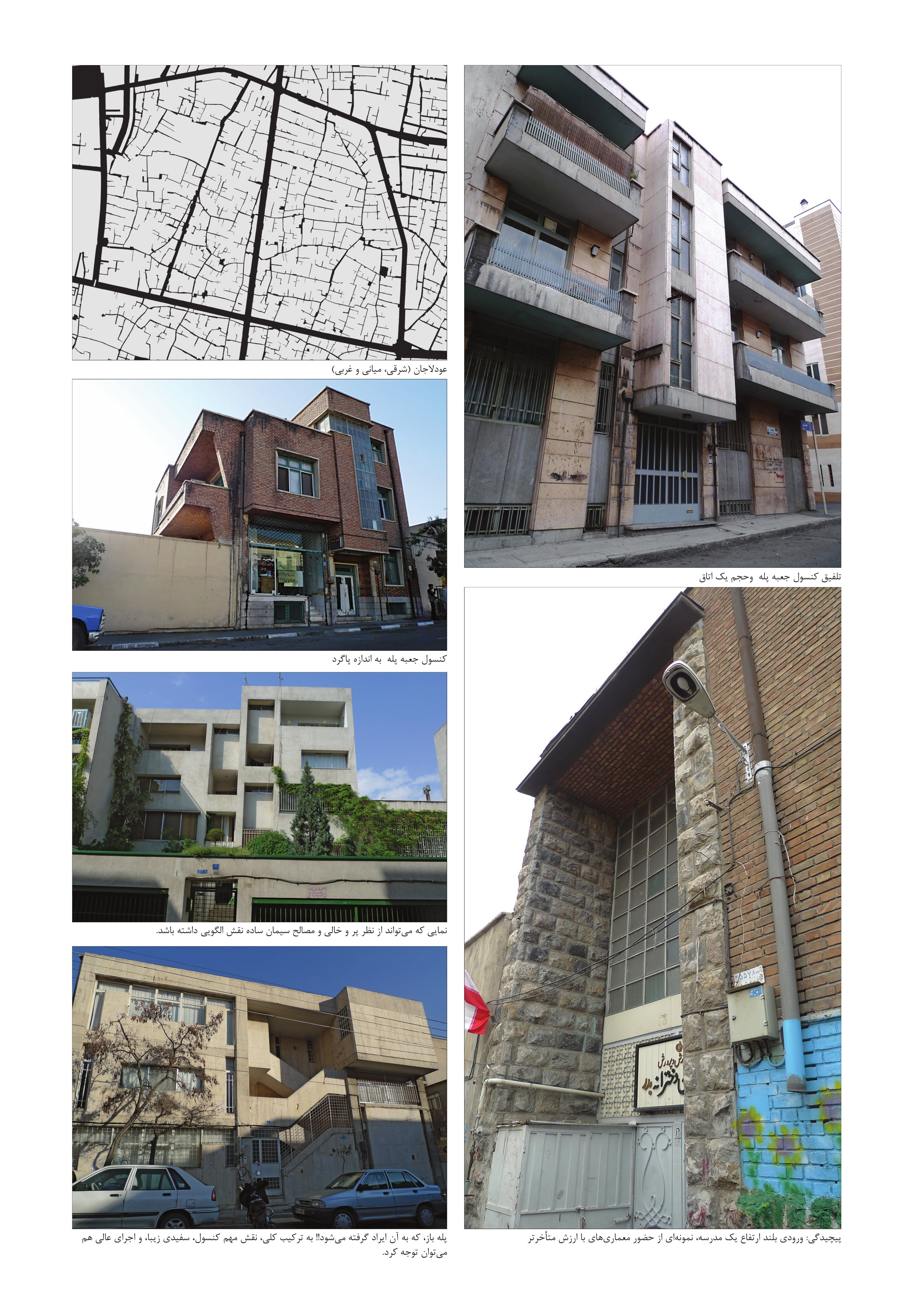
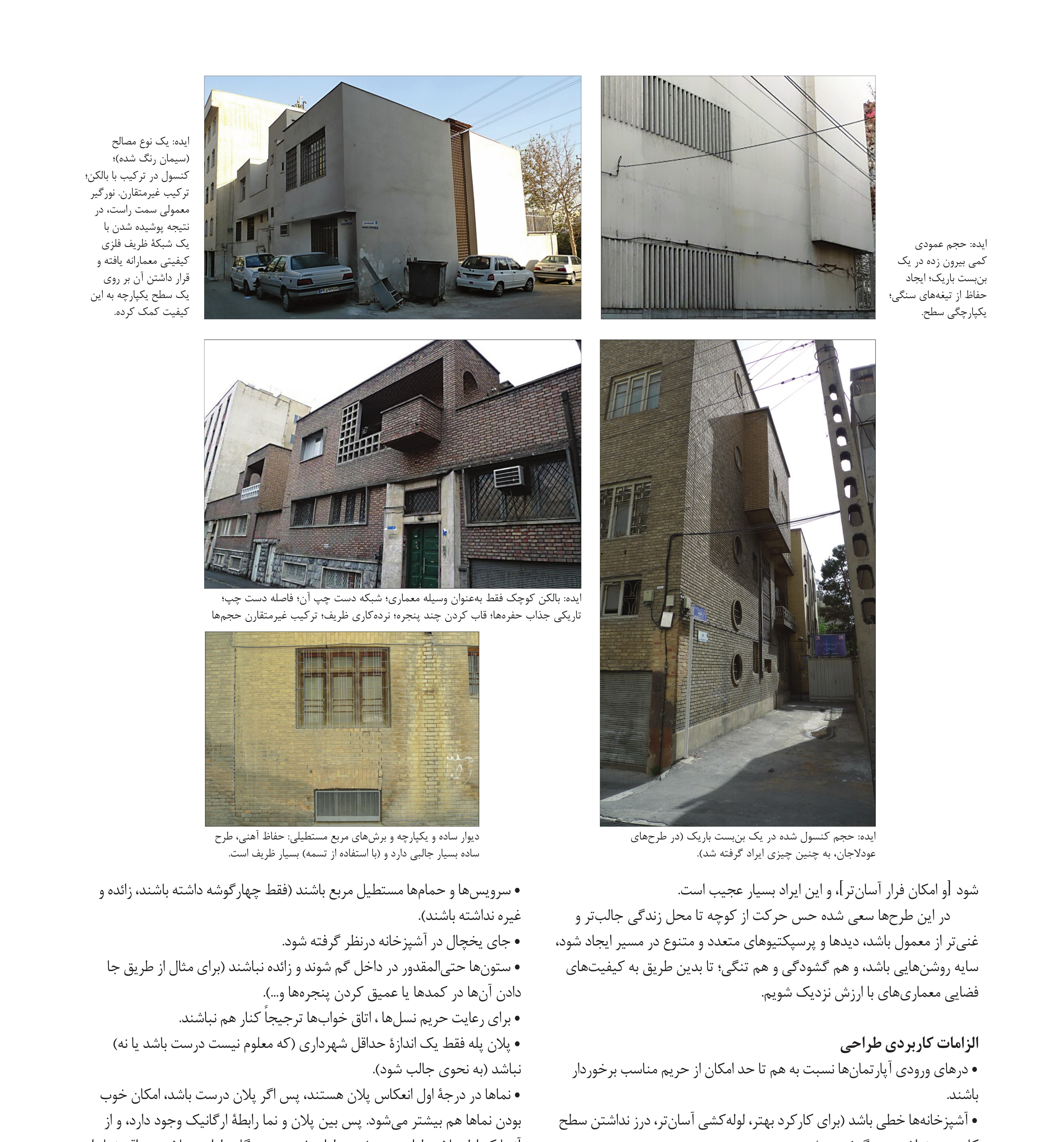
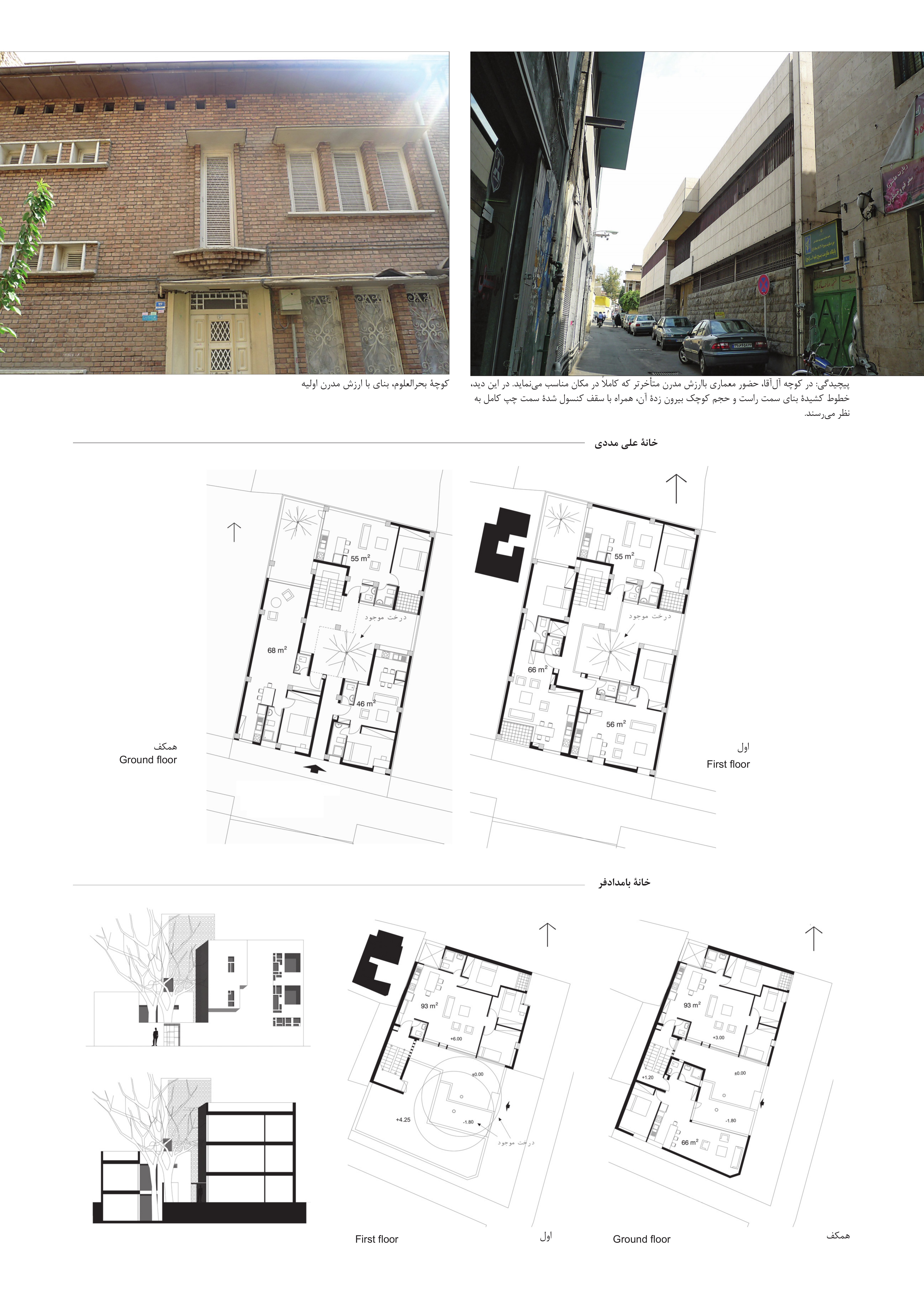
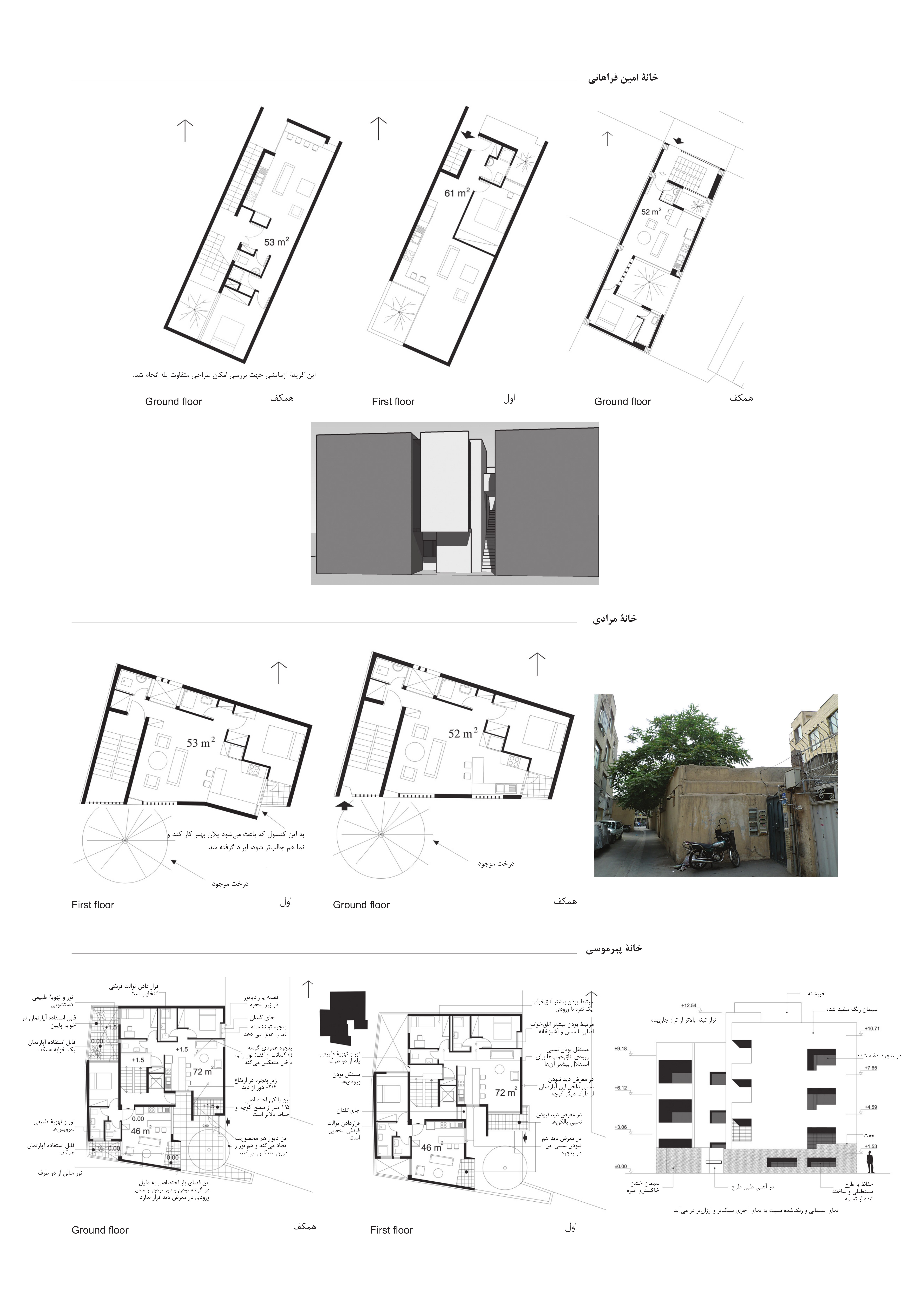
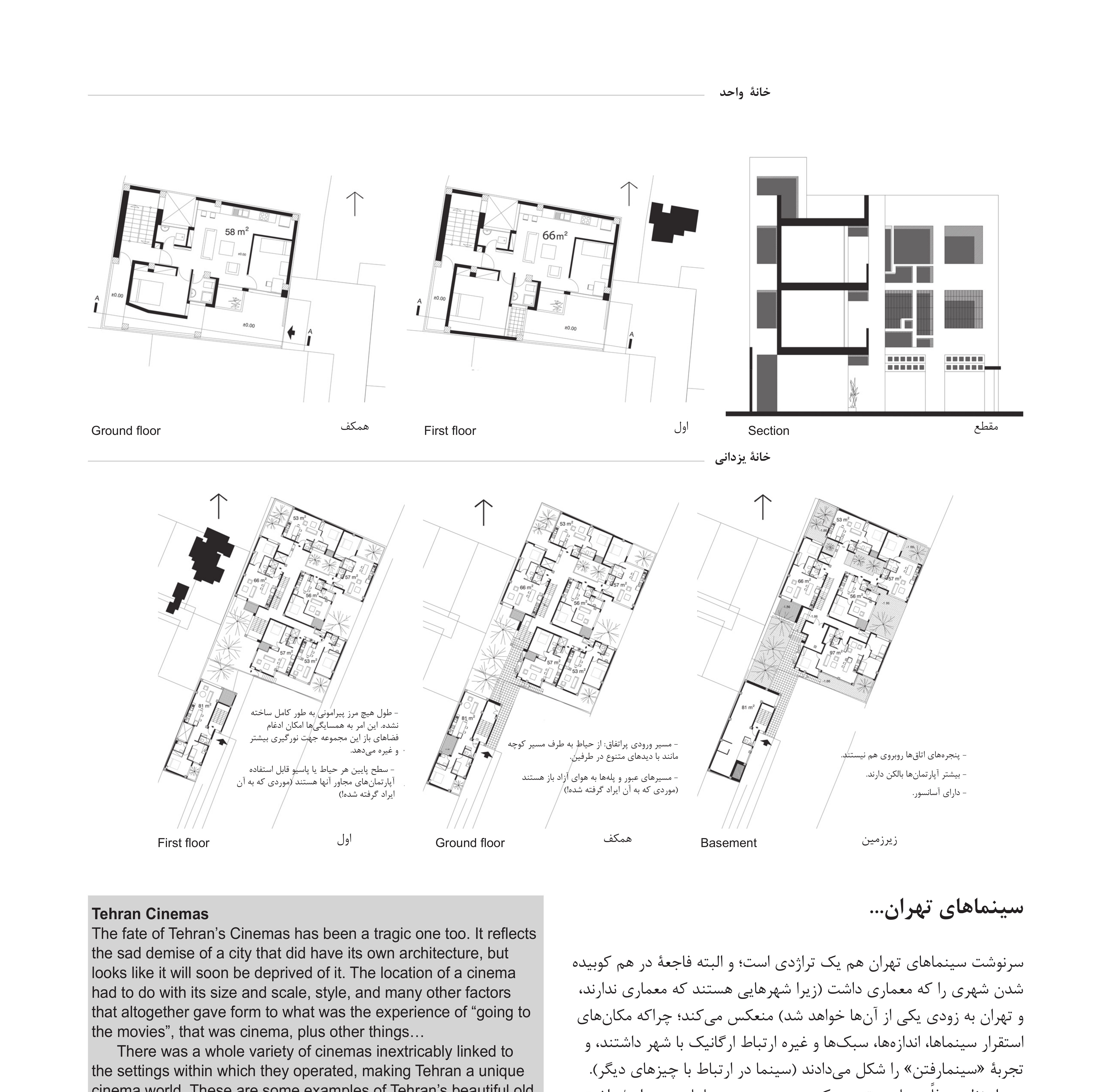
Oudlajan is a complex place; it is the oldest neighborhood of Tehran, but it also has an attractive diversity made up of traditional courtyard houses as well as good Deco and Modernist architectures [Parvin E’tesami School by the French architect, Roland Dubrulle]. In its narrow alleys one can find qualities that cannot be found anywhere else in Tehran. It is like an island. And it should not be lost. The characteristic of Oudlajan is its old brick courtyard houses. Although there is an insensitive across the board regulation that defines building footprint as 60% of usually the northern side of a land plot, Oudlajan has been exempted from this, apparently in order to keep with the existing grain. The apartments that we designed as a result are for the actual owners, but with no fees involved. However, a myriad of obstacles kept creeping up, such as the urge to widen the streets up to 10 or 12 meters, an infuriating rejection of staircases that would be open to air, an equally irritating rejection of cantilevers, etc. This insensitive, bigoted, arbitrary, and mystifying approach on the part of the authorities means the end for all historical and traditional urban environments in Iran. If we were to consider places such as Siena and Yazd, in other words masterpieces of world architecture, this approach would be tantamount to their eradication. If such regulations can become obstacles in the way of not just good architecture, but any trace of it at all, then it would be better not to have regulations at all [after all, architecture thrived when there was near absolute freedom]. There is also this strange thought in the mindset of those who write the regulations that everything of what was before us, every dimension and proportion, is wrong; that those before us basically got everything wrong, and now these “mistakes’” must be put right. An issue that was particularly annoying for me was that cantilevers were not allowed [only above 12m widths], although it is a generic and key precedent in Tehran. Cantilevers were implemented even in very narrow streets. Actually the narrower the street [even alley], the better, and more meaningfully cantilevers worked. The same attitude is adopted in relation to the open staircase, a prominent feature of a later period in Tehran’s architecture.
These are the criteria that we imposed on ourselves in the design brief for Oudlajan: • Provide adequate privacy around each apartment entrance door, • Arrange the kitchens linearly, and provide a place for the refrigerator, • Provide WCs and bathrooms with natural light and ventilation, • Provide each apartment with cupboards for shoes (outside the door) and coats (inside), • Provide every bedroom with a cupboard, and adequate area to fit a chair and a table, • Arrange windows in such a way that they preferably do not face each other. Trees can be used to protect privacy, • Provide the staircase wit natural light and air, • As columns usually protrude into the room because of being thicker than walls, find ways to hide them etc. in order to arrive at an acceptable appearance: for example inside cupboards or deepened window surrounds, • Preferably do not locate a kid’s room next to the parent’s, • Try to make the staircase/s interesting somehow. • Elevations reflect the plan and do not require too much further elaboration. Good plans result in good elevations [and vice versa], • Base the design geometry principally on asymmetry. This is not only aesthetic or ideological, but also functional, • Provide adequate space in the entrance for bicycles and motorbikes.
اول همكف همكفFirst floor Ground floor Ground floor
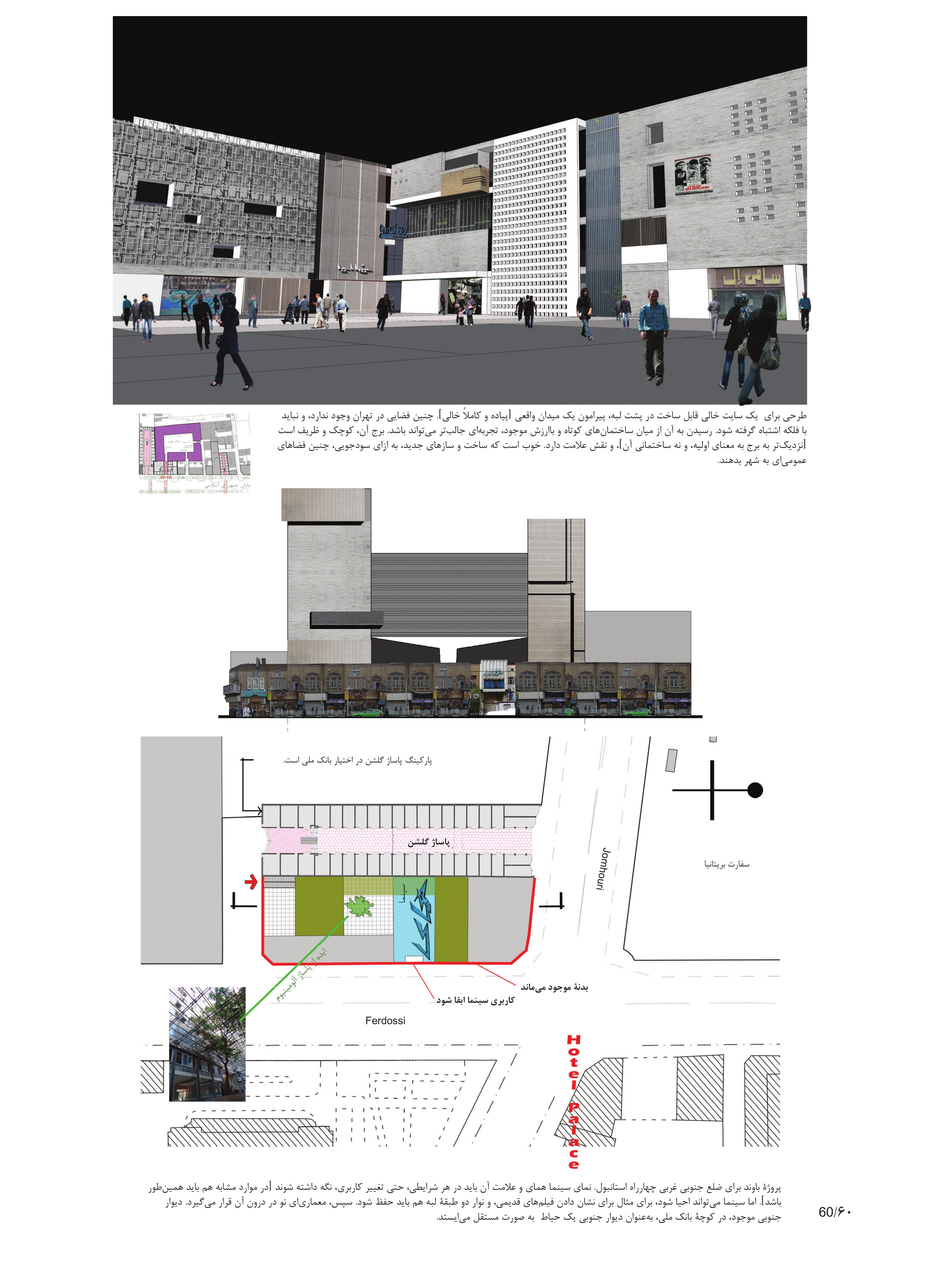
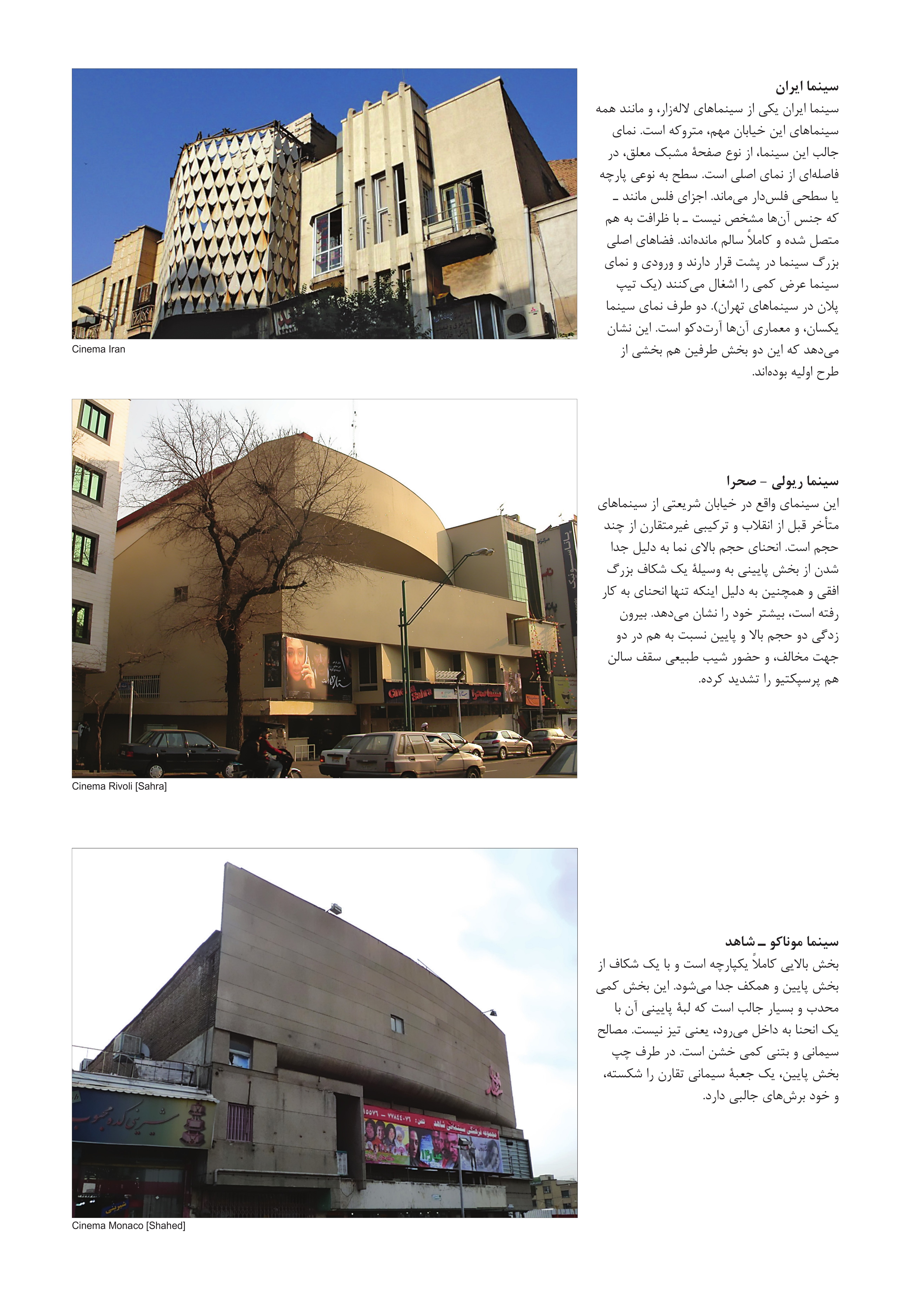
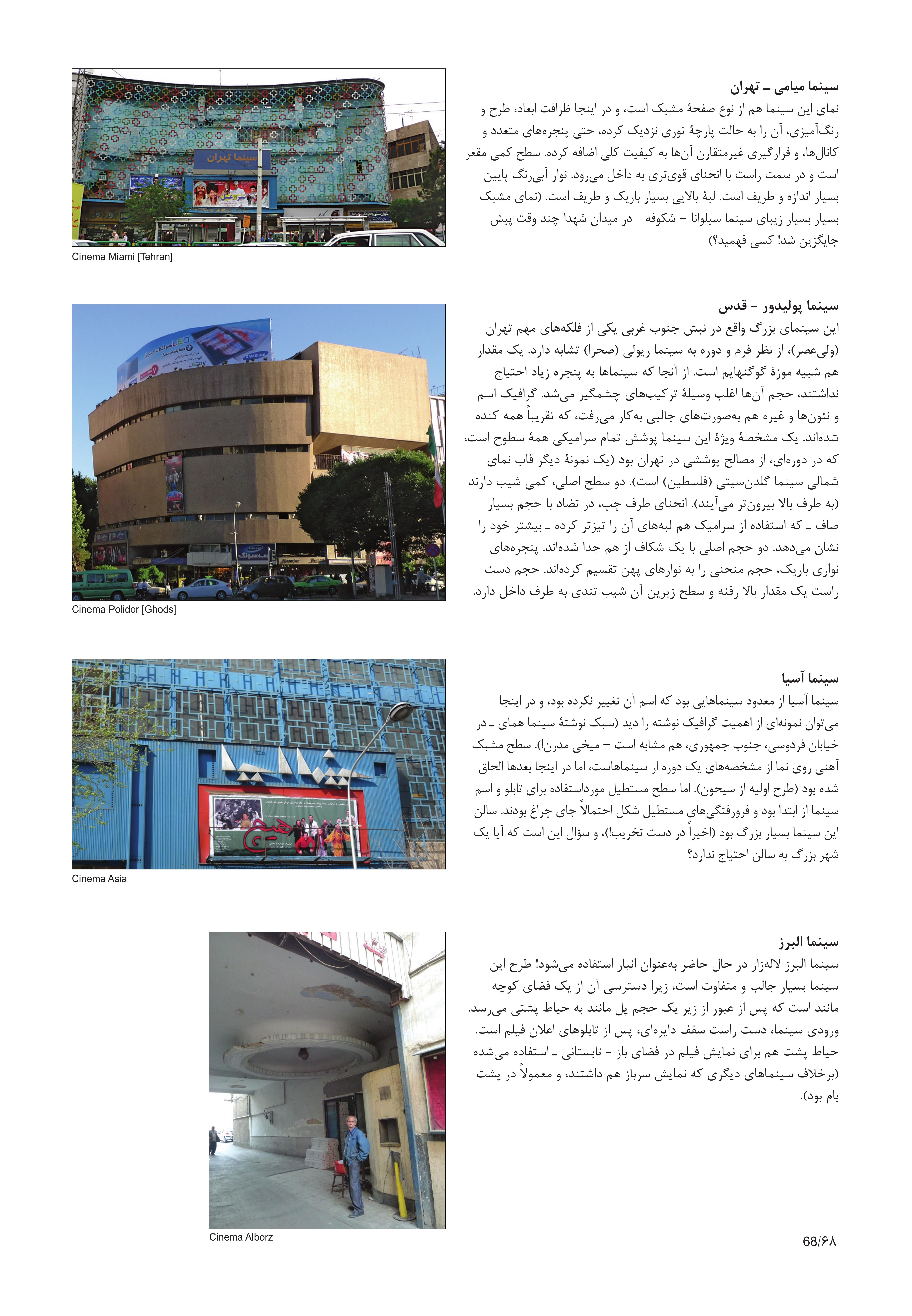
Tehran Cinemas The fate of Tehran’s Cinemas has been a tragic one too. It reflects the sad demise of a city that did have its own architecture, but looks like it will soon be deprived of it. The location of a cinema had to do with its size and scale, style, and many other factors that altogether gave form to what was the experience of “going to the movies”, that was cinema, plus other things… There was a whole variety of cinemas inextricably linked to the settings within which they operated, making Tehran a unique cinema world. These are some examples of Tehran’s beautiful old cinemas, whose memories persist in the minds of many Tehranis: Cinema Iran, in Lalehzar Street has been derelict for many years, as is the case for most of the other cinemas on Lalehzar, unless used as a warehouse. Its small but elegant exterior, a suspended latticed surface made up of tear shaped scale-like segments, hovers effortlessly above the pavement. It is in pristine condition, and looks exceptional between the two identical Deco facades that must have been part of the original scheme. Cinema Rivoli [now Sahra], on Shariati [ex Old] Street consists of an asymmetrical composition of curved volumes, elegantly put together to emphasize its corner perspective view. Cinema Polidor [now Qods], on the important Valiasr Square, resembles Rivoli in style, but has also an uncanny resemblance to Gugenheim. It is covered with small beige-coloured glazed mosaics. Cinema Monaco [Shahed] – a curve in concrete, Cinema Asia – blue iron lattice, and Cinema Alborz – originally with a rear area for open-air screening, are also beautiful old cinemas. The question is: does the city not need halls and theatres?
...و كمي بيشتر قشنگ نيستند؟ And some more... Aren`t they beautifull?