In the early 1970s the total population of the suburbs became equal to the population of the cities themselves. To the champions of the “suburban dream,” this seemed a victory. But Robert Fishman, in his influential book Bourgeois Utopias, called this view mistaken and wrote that it was precisely in that decade that the era of suburbanization came to an end. Fishman, one of the foremost historians of suburbanization, did not utter this claim in a fit of sudden academic zeal; he simply held that the “suburb” in America had become something entirely different from what had been expected over the past 200 years.
In Fishman's argument, a “suburb” is a place dependent on the central city — like the dormitory towns of the 1950s, or, before that, the railway and tram suburbs of the 1880s. Historically the suburb was a residential refuge for escaping the city — that is, the active factory of capitalism — and it continually broke and renewed itself to answer the market's ceaseless whims. The historian Kenneth Jackson, in his book Crabgrass Frontier: The Suburbanization of the United States (1985), wrote of the daily flight to clean, free space, full of sunshine and healthy air, and the exhilarating notion that disorder, corruption and turmoil could be left behind at a distance, within the fetid cities. But in the 1970s the suburb in America was transformed and became a kind of urban existence with great variety and, economically, a full-fledged one. In his book, published in 1987, Fishman wrote: “We have no suitable name for this new city.” That problem still stands.
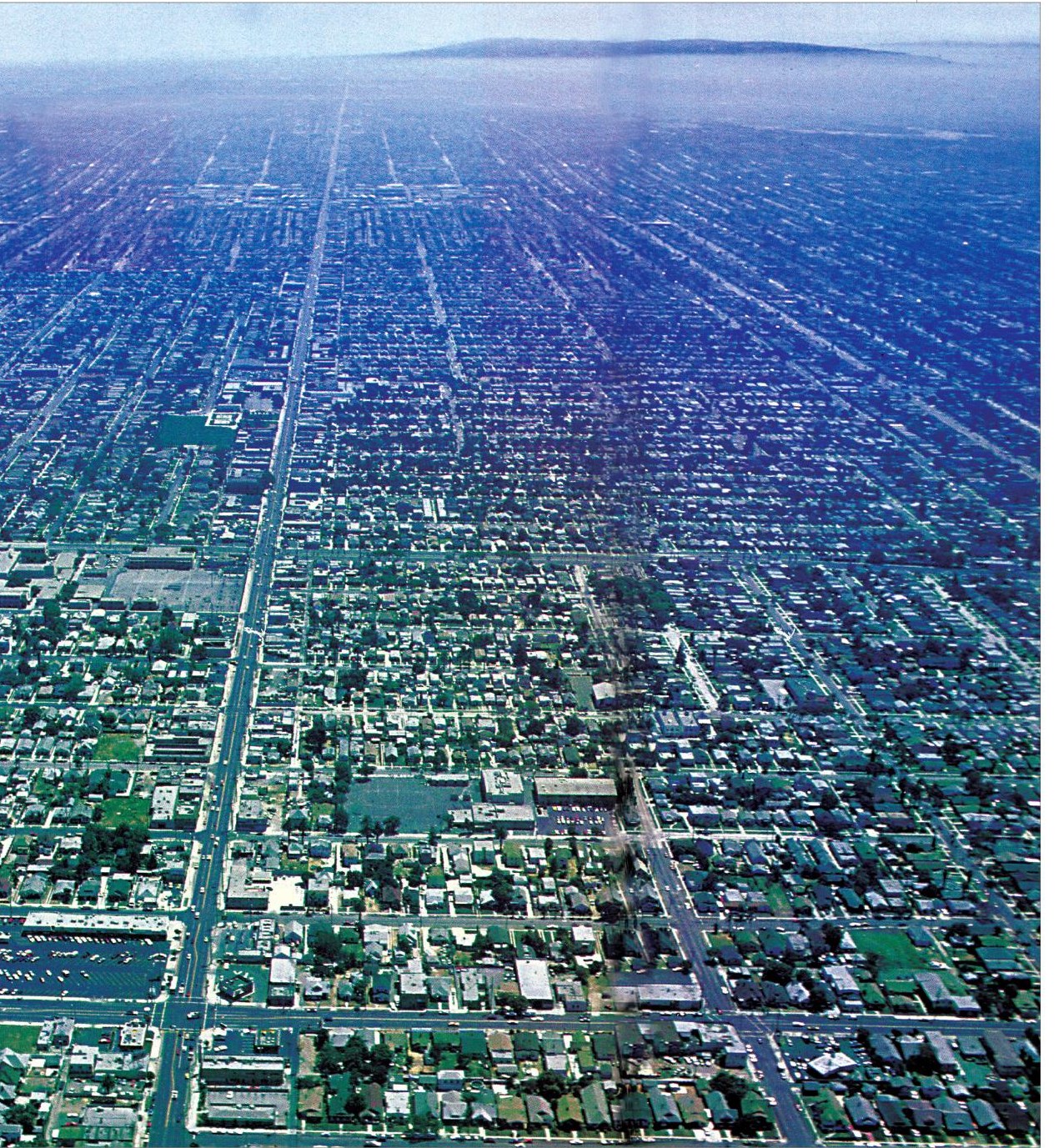
Americans have not yet fully come to terms with the incongruity between the historical regime of the suburb and what has today emerged in the form of an exurban reality. But as soon as you enter the peripheral roads you grasp this reality: even the quietest, most tree-lined cul-de-sacs today seek to join the eight-lane highways and connect to the network of ring roads and cross-country freeways. Turning onto exit ramps five lanes wide — the width of a jet runway — you see a cluster of identical towers with no distinct identity glinting alongside the dust-covered cars, and you will very likely ask yourself what became of the simple life that “the suburb in the American dream” had promised. That dream turned the calm dormitory suburb into sprawling, low-rise urban landscapes side by side, a landscape that covered the villages and the districts around the cities. The place-names and administrative boundaries that once marked the small residential refuges of the suburban era may remain, but they are all now knotted together by highways and freeways and counted as a part of a machine for producing and consuming wealth — an economy we call the exurb (abr-hume).
It is not a pretty term, but it is not meant to be popular; it is meant, rather, to mark a conceptual distinction with precision. Many millions of people live in what we habitually call the suburb. In many places over the past thirty years these areas have grown a hundredfold or a thousandfold; they have been the site of nurturing and supporting high technology, research and advanced production. Today the beltway townships and the low-rise, centerless cities overshadow the central cities in both population and economic activity. Silicon Valley in California, the “drug belt” in northern New Jersey, and the two-state suburbs of Washington, D.C., have created economies that can be compared to the economies of full-fledged nations.
Except for schools and libraries, the suburbs have set aside little share for specialized architectural services; yet architects can help localities to bring into harmony the urban development arising from various economic opportunities with the order and comfort demanded by the dream suburb. This will not be easy. Incompatible but deeply rooted values lie at the bed of the challenging problems that continually fragment the townships — problems such as land use, traffic and open space. The psychologist Robert Park held that “the city is a state of mind.” The exurb is an economic reality, and it is easy to imagine it as something other than what it is. Most residents of the exurbs live in a place governed by relatively small government and social institutions close to the people.
The boundless frontier
The edge townships lie along the beltways; but it is the townships 20 to 40 kilometres out that have the most accelerating growth — what Robert Lang of Virginia, in his book Edgeless Cities: Exploring the Elusive Metropolis, calls “boundless cities.” As the name implies, these townships have no boundary, yet the presence of the city in them is also not very strong. The edge cities are scattered over lands of several thousand square kilometres, but the boundless cities occupy only a few dozen square kilometres. In his report to the Brookings Institution, Lang writes: the independent components of the boundless city may rarely appear to the viewer as a meaningful unity; amid the remaining farms and forests and the large houses and the houses of the suburban districts, together with strips of low-rise buildings and big box structures, it looks like blotches on the surface of the earth.
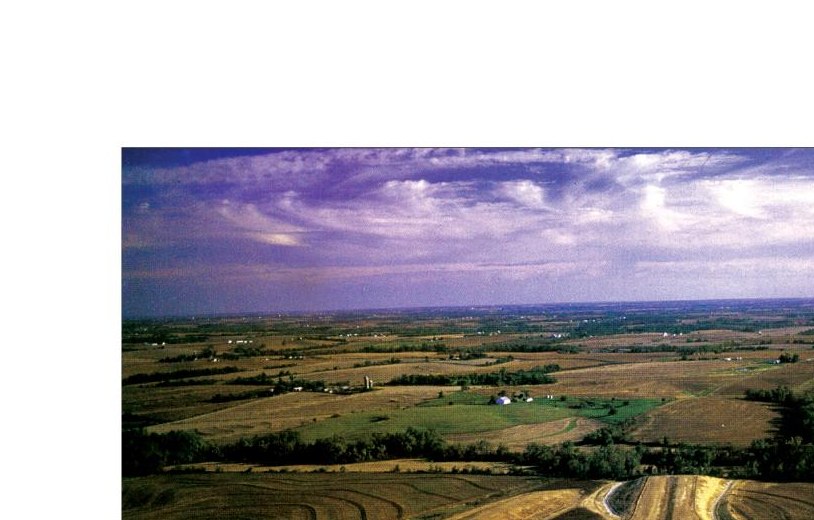
By Lang's claim, the construction of boundless cities accounts, in some metropolitan regions, for up to 60 percent of the rate of growth — far more than the edge cities — and these leaps are reported equally in regions that have had rapid or slow growth. This is exactly what makes the situation the more ambiguous and shows it to be unmanageable. For example, in Orlando a suburban freeway network has been built that well covers the built-up areas in a loop 45 kilometres in diameter, yet the greatest growth is seen in regions much farther out — in what Bruce McClendon, former head of the Orange County planners (which also includes Orlando), calls the “far suburb.” He adds: this region now looks rural, and it does not matter that you have to drive 25 miles to reach a Publix; but in his view this is only the initial stage.
Portland, Oregon, and the suburbs of Los Angeles (which are among the most extreme of many large cities) — in order “not to become Los Angeles” — have drawn a circle and declared that everything within the circle may be considered “urban,” while the region outside the circle must remain rural. The urban growth boundary has done exactly what its advocates promised: preserving open space within the boundary while, at the same time, increasing density and transit. A cry has risen from liberals over the violation of the private right to property — a powerful argument for the independent Western mind. Oregon has explicitly committed itself to the theory that the people, and not the landowners, will determine what counts as urban. This theory is a declaration of war on the respected tradition of landowner choice (the idea that anyone is permitted to build as much as they wish, wherever they wish), which has turned the suburb into the exurb.
Free-market critics, including the Reason Public Policy Institute, insist that setting a growth boundary — with an artificial limitation of the land supply — raises the cost of housing. But if builders find ways to build more economically and at higher density, the supply of housing exceeds demand. Gary Ridic is an architect who has found a way out in this area: he persuaded owners to build housing at higher density [see Architectural Record, December 2000, p. 148]. Architects in expensive cities such as San Francisco, Los Angeles and Boston have found new ways of high-density construction (many of them affordable for the market) that can serve as a model for denser suburban growth [see Architectural Record, October 2002, p. 227, and February 2002, p. 149]. Likewise, if the reduction in the cost of providing the infrastructure needed for construction is passed on, the “penalty” of reduced supply need no longer be paid.
Unlocking the transit network in the edge cities
For most people, the greatest problem of the suburb is traffic, which is constantly worsening. Everyone — experts and exhausted commuters alike — knows that the exurb cannot build roads fast enough to answer the growth of traffic (nor is there enough money for it; see Architectural Record, August 2003, p. 117). On solving this problem, urban analysts have little disagreement: if the decisions related to transport, land use and development are not coordinated, the traffic will not ease. A single twenty-storey tower with parking for 1,500 cars — in Atlanta, or beside Interstate 5 in Costa Mesa, California — does not send its cars onto the minor roads and the broad avenues at the city's edge, but pours them onto the main highways. A medium edge city sends about ten thousand cars into the freeway network and needs at least one ten-lane freeway (in most cases, two or three).