An opening
Ali Jahanshahi, born in 1344 (1965), a graduate of Industrial Design from the Faculty of Fine Arts of Tehran University, has for almost ten years now — alongside illustration and caricature — been designing and building his own designs, with stubbornness! He says of himself: 'I have never sought to be a celebrity car designer. I have always wished to equip a small workshop and build my own designs, but I still do not have one.'
A bond between form and function
Most of his works carry within them an exciting bond between form and function while remaining plain and direct. In his designs, he has a strong taste for the re-definition and re-description of the subjects and functions of objects — as if these objects had not existed before and he were encountering them for the first time; and that very quality is what makes the designs attractive. Form's compliance with function, and the wish to merge the two and to remove their excess, leads to the making of useful objects which, while avoiding overstatement, carry a quiet allure.
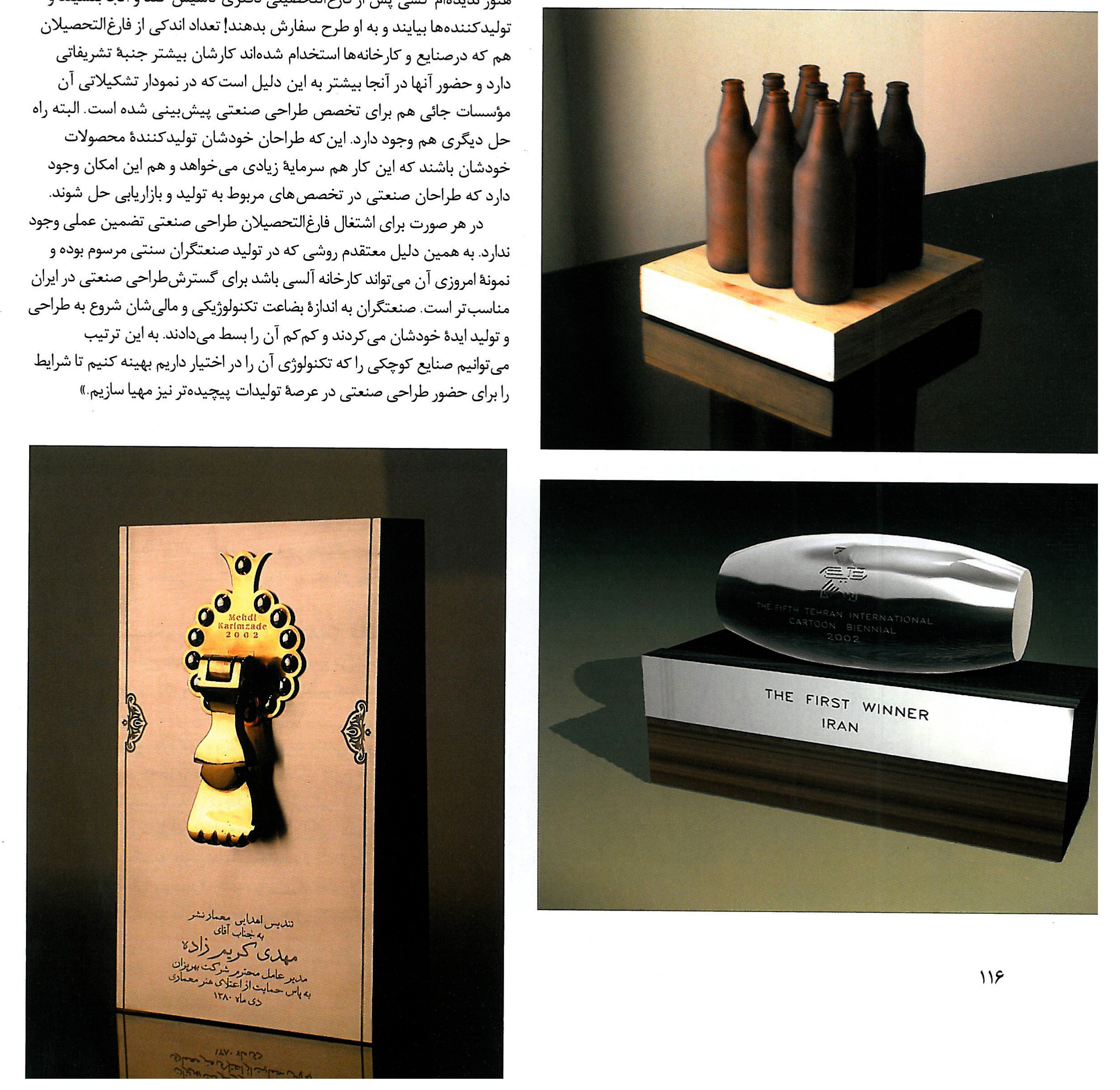
In a number of his works, the details so merge with the subject that they dissolve into it, and the subject becomes a plain but very direct allusion to its function: a kitchen knife not unlike the objects of the Neolithic age; a salad-server resembling a shrimp; bottles which, by their rhythmic repetition, become a veil to the dazzle of the light — these are the puzzle-pieces with which Jahanshahi, by setting them side by side, tries to put on display his own way of speaking. Being a caricaturist and an illustrator, he is acquainted with the grammar of the image and applies its rules to the ironic reading of objects in his own particular manner.
A cup whose handle has turned into an organic limb for drinking — that may express his exact and refined gaze on encountering an object called 'cup' and its plain function (a vessel for drinking). The visual description of the cup as an act of drinking gives a fresh narrative — modern even as it is fresh — and, by its function in the space of a café such as the Café Shoka, it shifts from a personal reading to a shared sense of the space; just as the kitchen knife, with that primitive but firm shape, returns us to the re-definition of the very meaning of cooking and the kitchen.
A talk with the designer
The kitchen knife. 'This is my first serious practical experience. Seeing the practical contexts and the skills that exist in knife-making in Zanjan set me thinking about its design. To convey the idea to the maker, I built a wooden model of it; from the wooden model the maker built me a sample. The design of this knife is highly idealistic, and it may have weak points in function, but as my first work, I love it.'
The candle-warmer. 'Its dimensions are matched to the candle-pellets on the market — it could have been designed with four or three legs; the height of the legs is matched to the distance needed for the maximum use of the candle's heat. Its material is brass, for ease of manufacture and form-giving.'
The fruit tray. 'This plain way of seeing and arriving at the minimum can perhaps also be found in the fruit tray. Its weakness — the chance that round fruit will roll out — is the price paid for the simplicity of its form. At the same time, this vessel can be used specifically for placing watermelons and melons.'
The kettle. 'In the kettle I tried to lessen the busyness of the form by merging the spout and the handle into one another, and by drawing the curve of the handle and the body close to one another to lend it a rhythm.'
Colour and texture — part of the form
The choice of colour and the use of texture in Jahanshahi's works is not an added trait. Colour and texture in his designs count as part of the form, in such a way that one feels that, with a change of colour and texture, the form too should change.
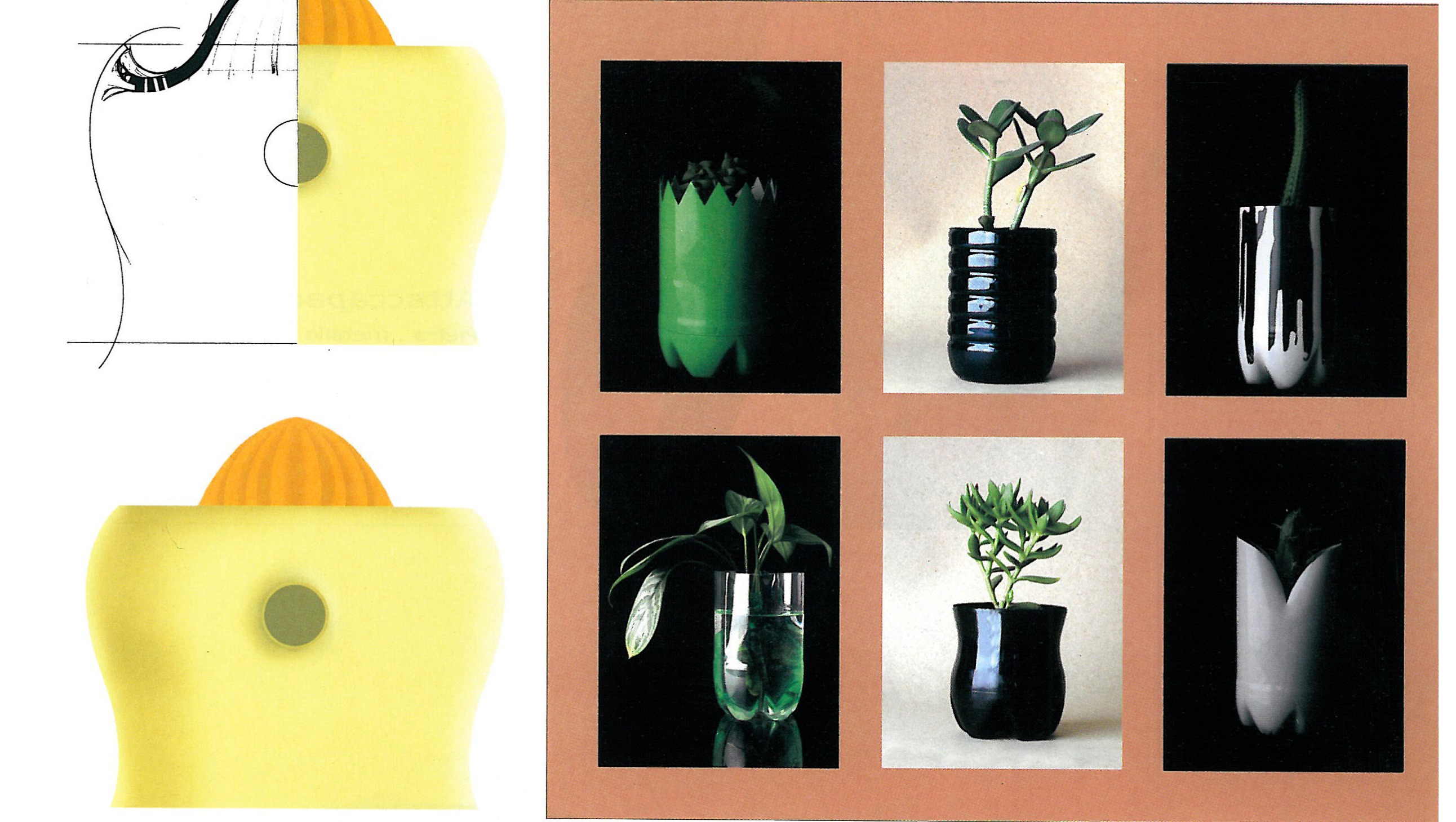
Jahanshahi draws on the objects and matters around him as occasion for visual experiments, in some of which he arrives at considerable results. His use of small pebbles as clothes-pegs, or of plastic soft-drink bottles for various uses, is among such examples. In the stone clothes-pegs, he uses stone as a half-prepared material with chance forms, and — by a final selection — leaves the designer's and the user's hand free to make use of varied forms.
On playing with plastic soft-drink bottles: 'I started as a visual exercise and as an experiment with soft-drink containers. With a fixed material and form and the most basic means of form-giving, I wanted to grant a different identity to these objects, and I do not at all consider it a process in design.'
On the standing of industrial design in Iran — in Jahanshahi's words
'A high percentage of consumer items, beyond the more complex industrial products, are made domestically — and all of them are grounds for design work. The importance of product design is determined not by the product, but by the pure design values it carries. One of the ways to broaden industrial design in Iran would have been the holding of a few annual industrial-design exhibitions, and these exhibitions could have been effective in winning the trust of producers in the use of industrial-design specialists. We always count the producers as the responsible party — but in my view this is a cost the designers must bear; it is necessary first to nurture our own professional capacities, so that, through them, we can broaden our trade.'
'Many producers have not yet come to trust Iranian designers. I have not yet seen anyone, after graduation, set up an office, sit there, and have producers come to him to commission designs! The few graduates who are employed in industries and factories — their work is mostly ceremonial, and their presence is more because the organisational chart of those institutions has reserved a place for industrial-design as a specialism.'
'There is, of course, another solution — that the designers themselves be the producers of their own products; this requires both considerable capital and the chance that industrial designers may dissolve into the specialisms of production and marketing. For that reason I believe that the method customary among traditional craftsmen — and whose contemporary example may be the Alessi factory — is more fitting for the broadening of industrial design in Iran. The craftsmen, to the measure of their technological and financial means, would begin to design and produce their own objects, and would gradually broaden them. In this way, we may optimise the small industries whose technology we have at hand, so as to prepare the conditions for industrial design's presence in the field of more complex products as well.'



