Bolles + Wilson
Julia B. Bolles-Wilson was born in 1948 in Münster, the port city in old Westphalia (since merged into North-Rhine Westphalia, on the Dutch border). She studied architecture from 1968 to 1976 at the Karlsruhe Hochschule under Professor Egon Eiermann and Professor Ottokar Uhl. From 1976 to 1978 she worked at the K. H. Götz office in Karlsruhe and Berlin. She did her postgraduate work, on a DAAD scholarship, from 1978 to 1979 at the Architectural Association School (AA) in London under Rem Koolhaas and Elia Zenghelis. In 1980 she founded the Wilson Partnership in London with her husband Peter Wilson, and in 1989 she founded the Bolles + Wilson office in her home city of Münster. From 1996 she has been Professor of Architectural Design at Münster University of Applied Sciences.
Peter Wilson was born in 1950 in Melbourne, Australia. He studied architecture from 1969 to 1971 at the University of Melbourne and from 1972 to 1974 at the Architectural Association School in London, where he won the AA Diploma Prize. From 1974 to 1975 he was assistant to Elia Zenghelis and Rem Koolhaas at the same school. From 1976 to 1979 he was an intermediate-unit master, and from 1980 to 1988 a Diploma master. From 1994 to 1996 he was visiting professor at the Hochschule für Kunst Berlin (Weißensee).
Bolles and Wilson have entered many architectural and urban-design competitions and prizes, taking the first prize seventeen times — most of them in Germany, once in Japan, and several times in the Netherlands. Their work has been published repeatedly by the AA London, by El Croquis, by AMC, and others. For the present issue we have chosen Mirko Zardini's essay (translated by D. Samargandi), together with images of the buildings named in it, and the detailed presentation of the New Luxor Theatre — drawn from El Croquis 105.
Strategies and Grounds
Mirko Zardini
Red Dots and Black Dots: The Splatch
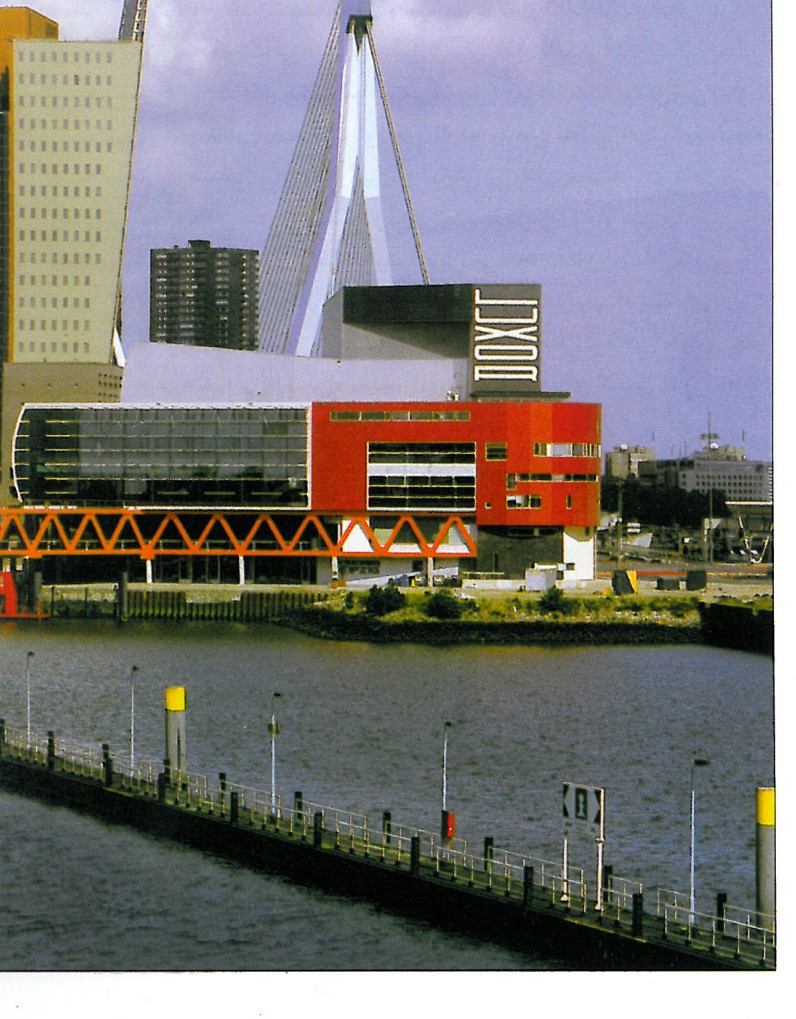
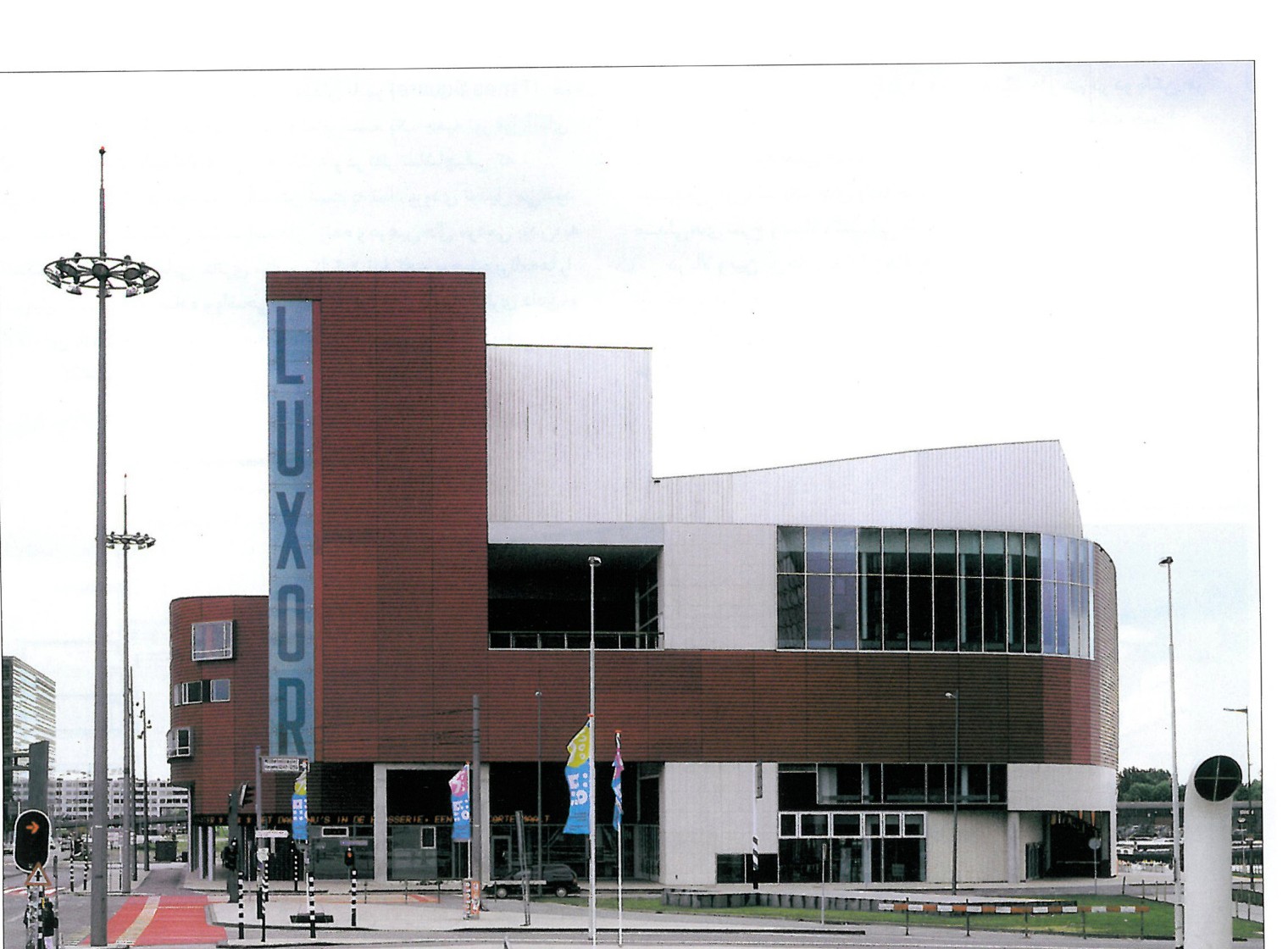
A red dot above the harbour: that is the New Luxor Theatre as seen by an observer who has left behind the city centre — rebuilt in the 1950s after the World-War-II air-raid destruction — and is heading for South Rotterdam. Or by an observer coming from the other direction, off the A16, toward the city centre, who arrives at Ben van Berkel's bridge, which is like a hinge between the two halves of the city. In either case the eye is caught by this red object — an object whose scale is hardly modest, but which is small in comparison with Renzo Piano's 'tall and somewhat banal' Dutch Telecom building and the matte volumes (the pure exposition of the cubic order of office space) of the buildings around the new metro station.
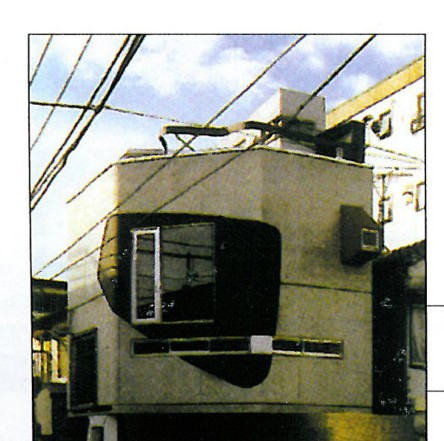
The figure is made of wooden boards behind which several structures, including a stage, are housed. This shape is no exception in the work of Bolles and Wilson. In a Tokyo house designed in 1992 for the critic Suzuki we meet another dot, this time a black one set on the building's façade. The house has an irregular, indistinct shape, with rounded corners and two pilotis under it … but it is the black dot that takes the eye. Peter Wilson sees the dot as a 'splatch' or a 'Ninja' — something with no particular form, yet none the less defined.
This strategy may seem accidental, but it is, on the contrary, very studied: the aim is not to make a new image, but only to edit an existing image, to bring out points within it, to emphasise it, to add a touch of colour or that black mark to it. The red splatch of the Luxor Theatre can now be better understood: colour and shape go only as far as is needed to give the building its slight standing-out from the ground around it, and to mark its belonging to another world — though not to a strange one. An unexpected presence, but at the same time a circumspect one.
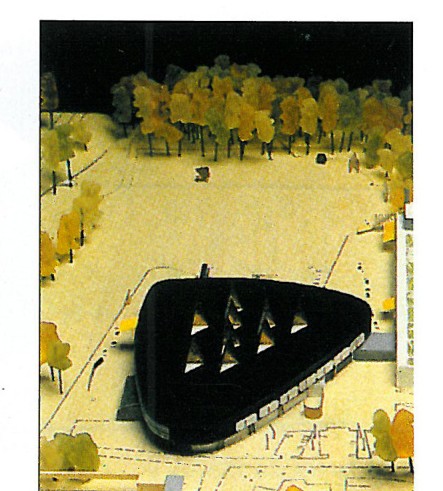
Bolles and Wilson advance the same strategy in the formless field that suburbs have today become. Their high school at Gievenbeck near Münster (1992) takes the form of an indistinct triangle set against a linear building on the street side. Once again it is exactly this irregular shape, this splatch, that emphasises the special character of the act — the placing of a new focus of attention on Münster's edge.
From the Ship-Shapes to the Münster Library
Their splatches have antecedents in the ship-shape projects of the 1980s — although they no longer use the metaphor of a ship which has accidentally come to rest on a school of fish (the helmsman ignorant of the school below) that they had used in the Bastille-Opera scheme in Paris. These projects offered the ground for a search after a new definition of buildings, freed from the constraints of conservative usage, but without falling into the futurist excesses of the 1970s. Bridgebuildings and Shipshape is the title of the catalogue of Peter Wilson's early work.
These designs, by their measured prominence within an ordinary fabric, draw our attention to the presence or arrival of a different world in which traditional expectations no longer have a place. Like the case of the Kassel Documenta hall (1989), they put forward the force of an object that drew its life from a shape entirely its own — an object that could at the same time redefine the ground, by playing a part such as defining an edge, making a connection, or clarifying a position.
The splatch and the ship-shape building were quite distinct from the many schemes Bolles and Wilson had drawn for the city of Münster, beginning with the Münster City Library in 1994. Münster was the constant ground of these interventions — a wholly particular ground, formed largely by the buildings put up during the rebuilding of the 1950s and 1960s, after the heavy bombing of World War II. Perhaps it is for this reason that urbanity has so particular a value in Münster: it had first been lost, and then was eagerly rebuilt.
Through these years many experiences sprang from the Library work — and all of them, whether next to the great buildings of the centre or scattered through the surrounding fabric of housing and offices, pursued a common aim: the redefinition of new urban spaces. The buildings shed their colourful and protective skins, the splatches, and the ship-hulls, and present themselves to the city; from their parts and pieces they make up a deft patchwork that allows the various pieces of the city to be re-organised and reinterpreted, and the rebuilding work begun after the war to be carried on.
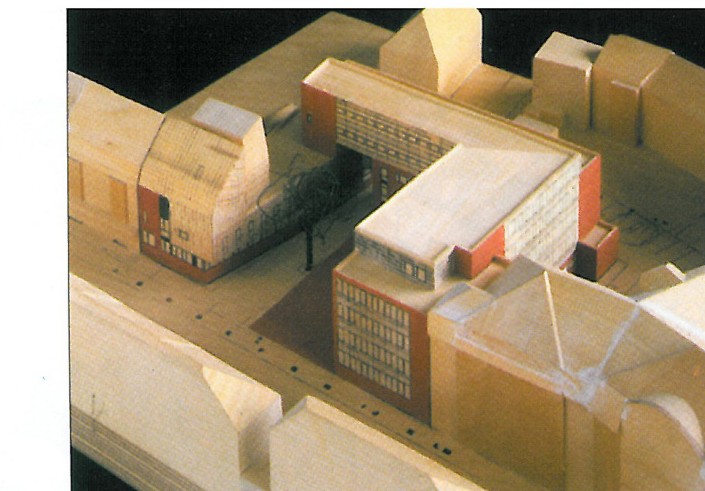
An example of this manner is the roof of the Münster City Library, whose two metal wings come forward toward the road, run the whole length of the building, and lay down a fresh urban path parallel to the historic St. Lambertus Church. Another is the ZKV-WVK office building on Sumsanderstrasse: from one side the new building joins the old buildings of the street, while from the other — taking up the metal roof of the computer centre — it becomes and reinforces the form of one of the row-houses next to it.

Landscape as Strategy
The strategy of design-as-landscape opens up a single horizon for interventions and projects that, by virtue of meeting the city's growth at different stages, are entirely different from one another. The idea of landscape also lets a building be seen not only as part of a landscape but as a landscape itself — as in the scheme for the Centre for Art and Media Technology (ZKM) at Karlsruhe (1989), in which the new arts centre, just where it turns into an artificial ground for the pavilions to sit on, gathers landscape views in their most traditional form.
Above all, the landscape strategy makes an operation possible in a field of intervention with the smallest of means: a paved square, a small building, a stair with a footbridge — as in the case of the reshaping of the Kop van Zuid quay in Rotterdam (1997), before the building of the Luxor Theatre, or the dressing of the surroundings of Hotel New York (2001). Such works show that even in small-scale interventions one can set out not only the rules of the game but also the spirit of the place, anticipating and preparing the arrival of further buildings.
The idea of landscape, then, calls for our not relying on the scale of the intervention alone, but for our continual searching after relationships — relying on variety, on repetition, on opposition, or on resemblance. Bolles and Wilson, by their continuous control of the relations among the various elements at play, prove that the idea of relation can stand in the place of the idea of dimension — and that on this basis the idea of intensity can be brought to bear, as a guiding idea, in the most varied of interventions, within the field of forces that the urban phenomenon today produces.
The New Luxor Theatre — Rotterdam, 1996-2001
Kop van Zuid, in Rotterdam's docks district, is fast turning into a new urban quarter. The New Luxor Theatre is a major cultural injection that, by its strategic and conspicuous site, must give a fresh life to that office-residential quarter by bringing in public life. Just along the new Erasmus bridge, with the Maas in front and the Rijn-haven behind, the New Luxor is a fresh actor on the city's stage — a hinge between the office-towers of the Wilhelmena Pier and the imposing tax-office building facing the river.
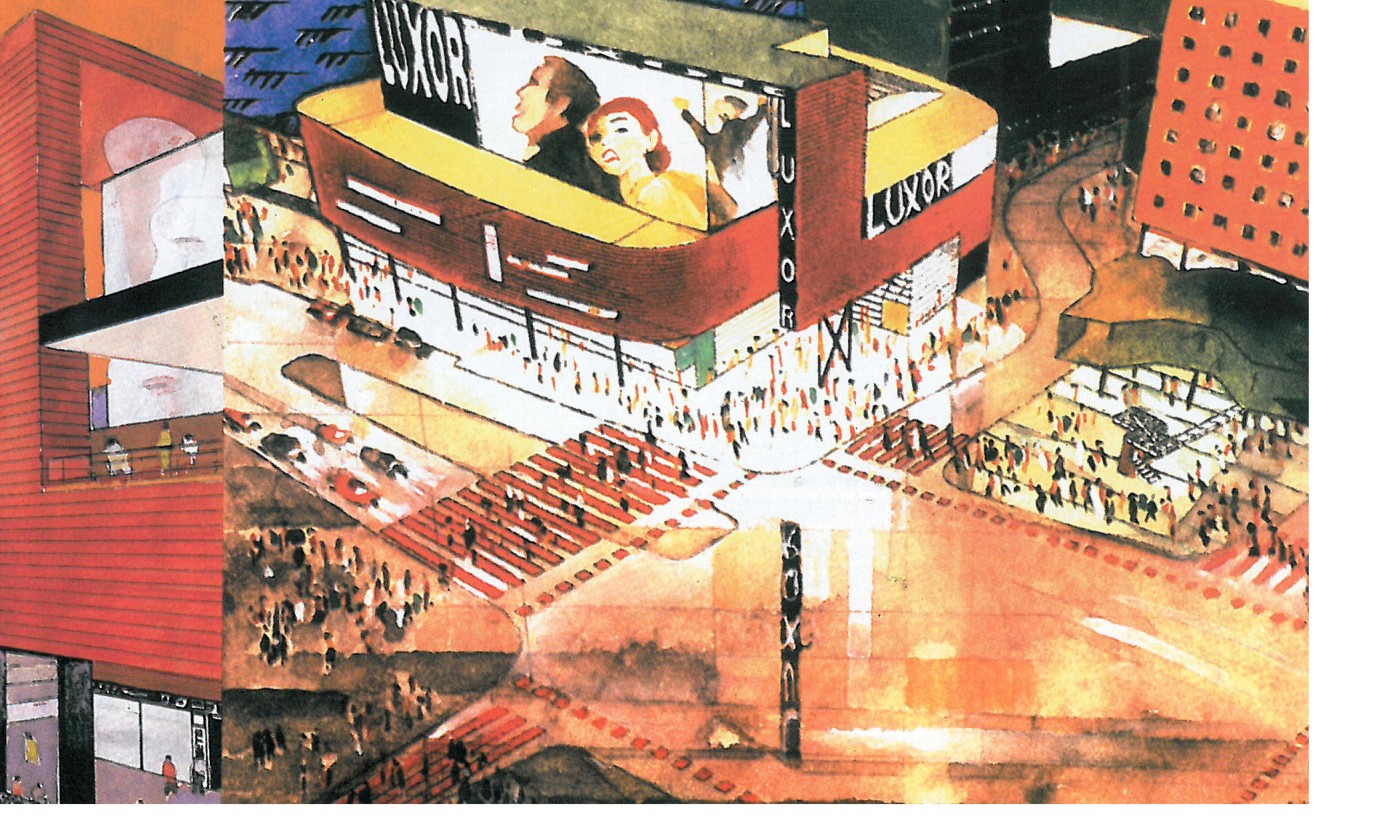
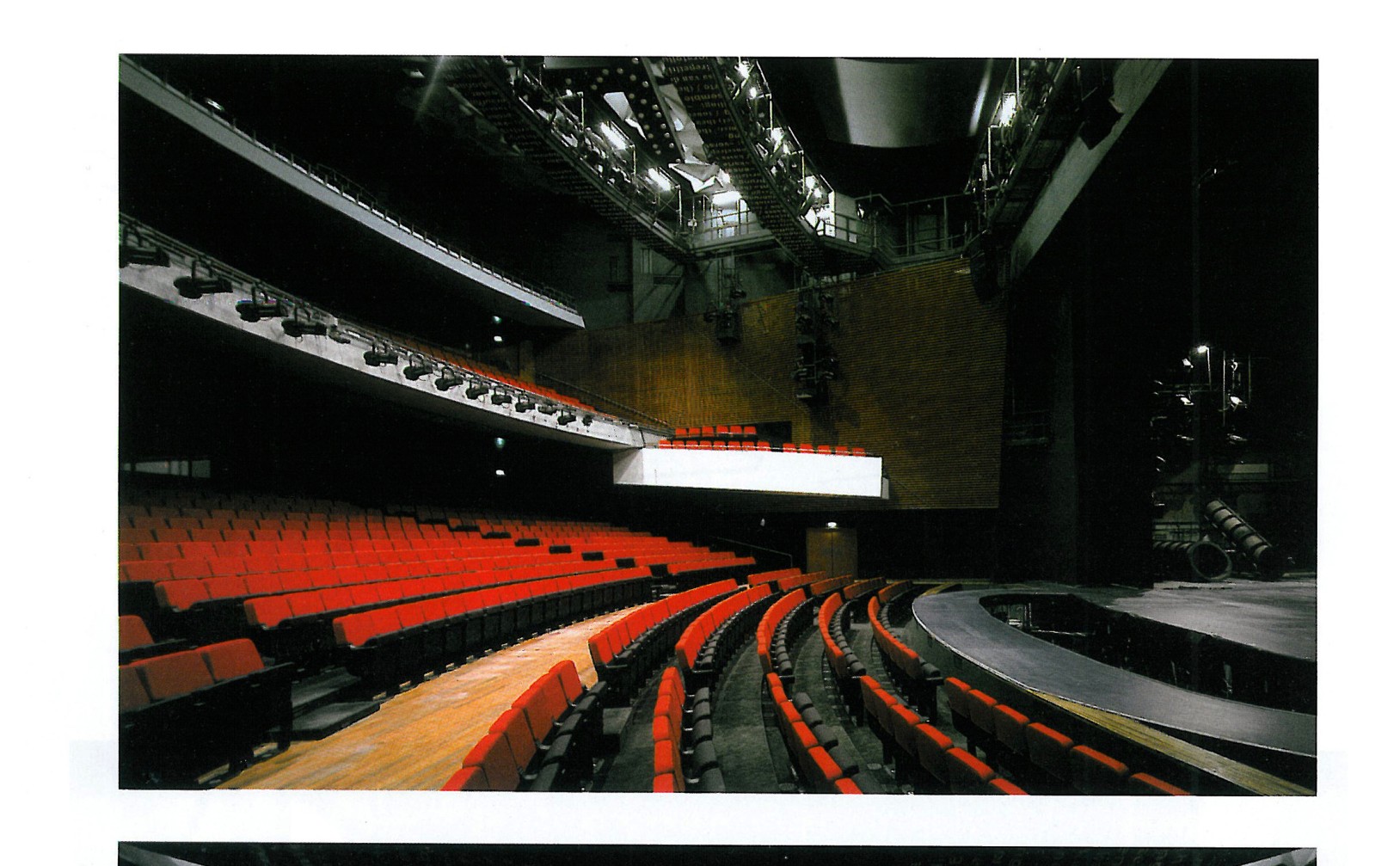
The New Luxor turns the multiplicity of orientations of its site into the theme of a 360-degree elevation: a 360-degree dynamic building that addresses every direction at once, a focal central object in a complex urban field. Rotation around an axis at once organises the space and brings forth the form. An internal ramp, for the loading of materials to a parking-place for 18-metre trucks, runs up to the very edge of the stage on the first floor (the stage, by rising, frees the ground floor and the paved square around it for public use, and resolves the problem of the small site). The form clinging to the ramp wall, with its straight stretch and its circular turn round the symmetrical form of stage and foyer, sets the ground for an unexpected, dynamic scheme.
The roof of the ramp, by reflecting the movement of the trucks beneath into the foyer and by turning visitors from the ground-floor entry toward the spectacular views of the foyer and the south-facing terrace over the Rijn-haven, gives a path of its own architectural character. The tent-pole around which this successive expansion of foyer spaces is wound is the continuation of the stage-tower and the auditorium (around which the inner continuation of the spiral exterior elevation is wrapped).
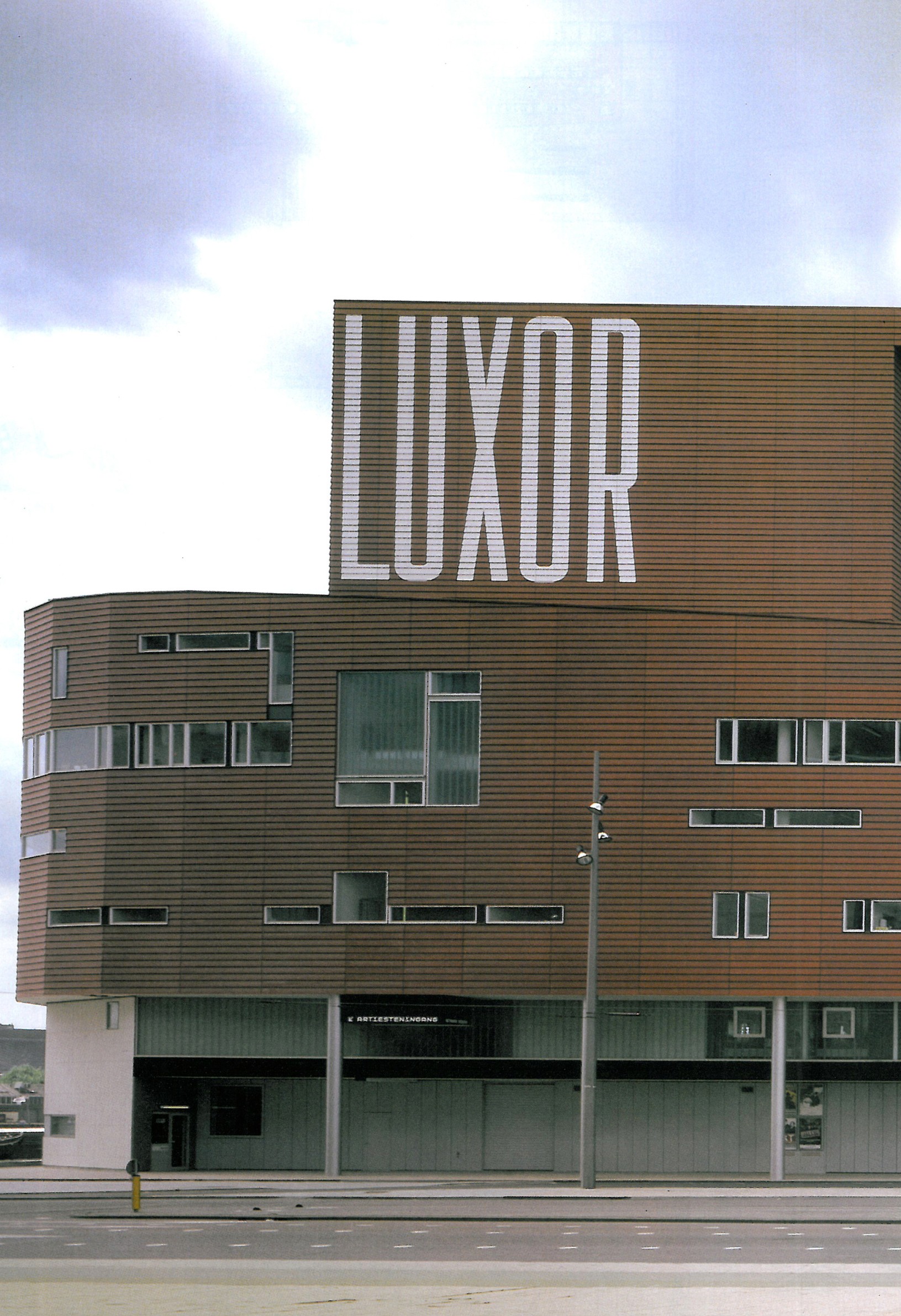
The exterior elevation is of red fibre-cement panels, falling on one another with overstated shadow-lines like the bent boards lying in a wooden boat. The wooden façade-cladding harks back to the wooden-temple tradition of Vitruvius's Omnia Publica Lignea Theatre and of Shakespeare's wooden 'O'. This manner and these materials of cladding allow the vertical curve of the western elevation and the gradual play of light on the building's horizontal curves — like a computer animation.
The proscenium tower facing the city distorts images: the faces of five actors from the Luxor archive, each at half its proper size, have been so stretched in exaggerated perspective that they read from the Erasmus bridge — a kind of non-electronic virtual quality, a direct theatrical experience. The Luxor is also brought to life by another fundamental medium: the typography on its façade. The tradition of J. J. P. Oud's Café Unie.
Footnotes
1 Ninja: in former Japanese usage, a professional assassin. 2 Oz: the name of an imaginary magical city; the story has appeared in Persian as The Wizard of the Emerald City. 3 Bridgebuildings and Shipshape: the title of the catalogue of Peter Wilson's early work.



