Faramarz Sharifi is among those architects who have become known more through their buildings than through the media. Graduating from the Faculty of Fine Arts at the University of Tehran some 14 years ago, he established Artiman Consultants, Architects and Planners, and over a period of approximately 15 years carried out some 150 public and private projects. Since 1994, he has been working as an independent architect.
Sharifi belongs to a generation of Iranian architects whose design philosophy evolved through hands-on practice rather than theoretical manifestos. His work demonstrates a consistent concern for the relationship between structure, material, and space. In an era when many Iranian architects have turned to superficial formal gestures, Sharifi has remained committed to an architecture rooted in structural honesty and material expression.
What distinguishes Sharifi from many of his contemporaries is his direct engagement with the construction process. He does not merely draw buildings and hand them over to contractors; he is present on the construction site, making decisions about details, materials, and junctions. This intimate involvement with the act of building gives his work a tectonic quality that is rare in contemporary Iranian architecture.
In these two new office buildings, Sharifi demonstrates his mature architectural language: steel frames as the primary structural and expressive element, glass and brick as complementary materials, and a spatial organization that creates interplay between horizontal office floors and vertical circulation cores illuminated by natural light.
Office Building, Kordestan Boulevard, Mulla Sadra
Construction Management: Hamid Tayefeh · Structure: Kourush Elmi · Mechanical: Farhad Nafisi
Design team: Mehran Panahi, Hossein Bahmani, Sadeq Rashidpour
The Kordestan Office Building is located at the intersection of Kordestan Boulevard and Mulla Sadra Street in Tehran. The building occupies a relatively compact urban site, and Sharifi's response to the constraints of the site is characteristically inventive.
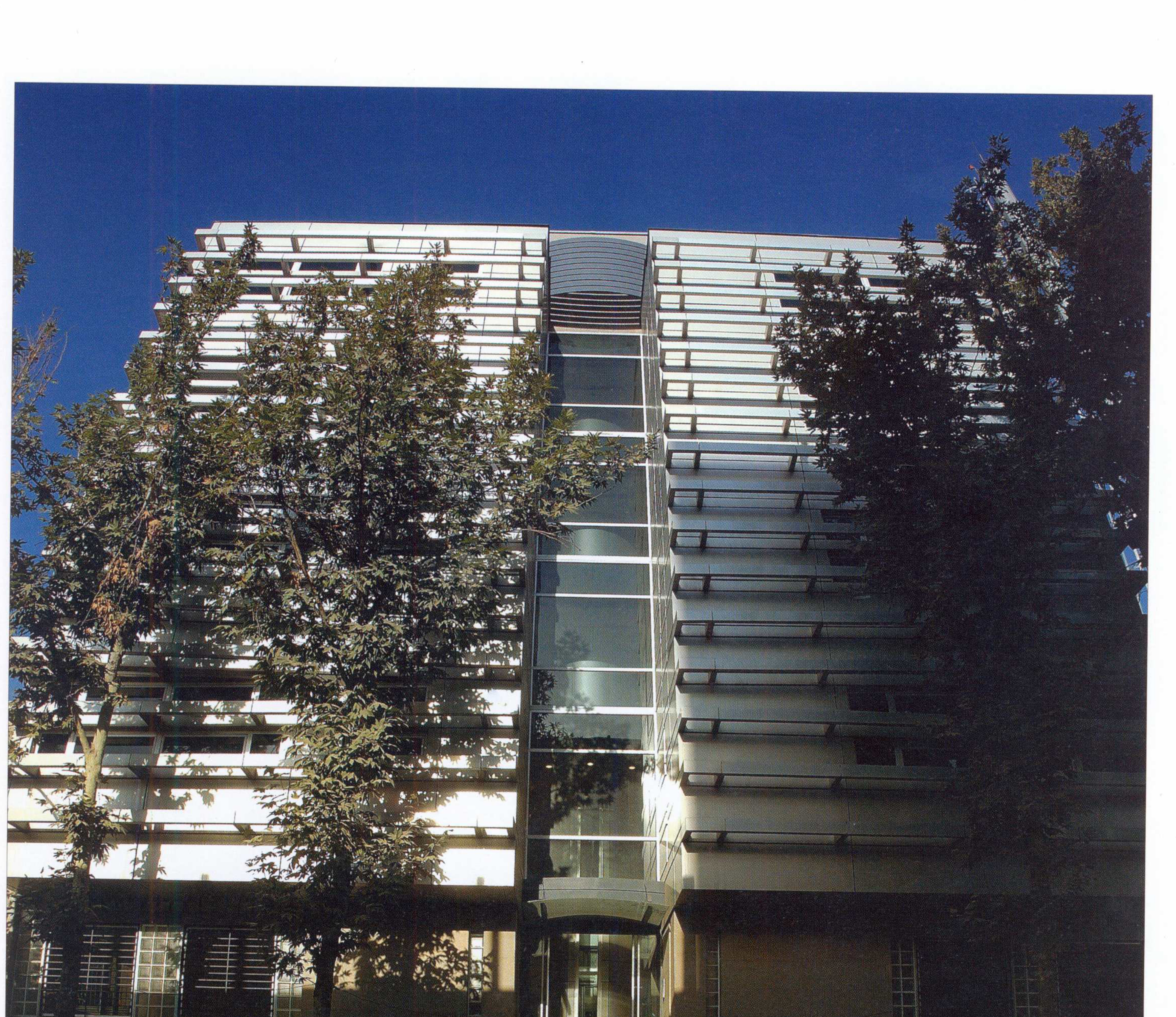
The entrance is positioned at an angle, dividing the building into two sections. Each section is served by a dedicated staircase and elevator core. The vertical circulation, rather than being hidden away, is expressed as a glass-enclosed spine that runs up the centre of the facade. This transparent core allows natural light to penetrate deep into the building while also creating a visual connection between the interior and the street.
The facade is composed of horizontal steel louvers that control solar gain while maintaining outward views. These louvers, combined with the expressed steel frame, give the building a strongly tectonic character. The steel structure is not merely a hidden skeleton; it is the primary architectural language of the building.
Inside, the office spaces are organized around a central hall with a mezzanine level. The mezzanine is connected to the main floor by a sculptural steel staircase and a glass bridge that spans the double-height space. These circulation elements transform what could have been a utilitarian office interior into a spatially rich experience.
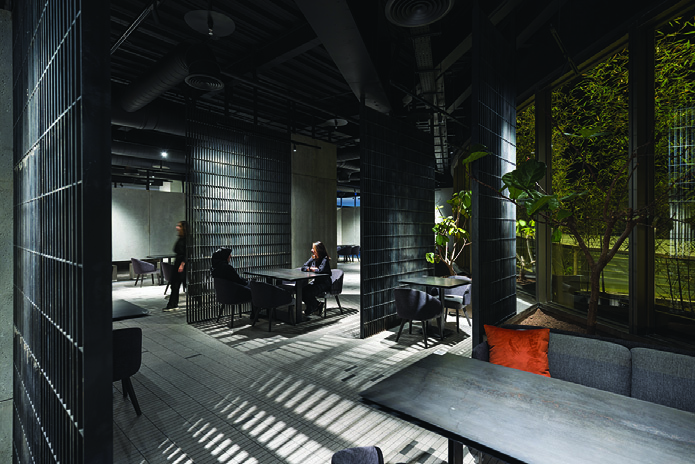
The material palette throughout is deliberately restrained: exposed steel structure painted dark, glass block walls that filter light while providing privacy, granite floors, and minimal partitions. The result is an architecture of honest materials and clear structural logic.
Office Building, Mahmoudiyeh, Alef Street
Associate Architect: Shabnam Monadzadeh · Decorator: Sharasin Yansi
Structure: Adnan Vosouqi · Mechanical: Farhad Nafisi
The Mahmoudiyeh Office Building on Alef Street is located in a narrow lot in one of Tehran's older commercial areas. Despite the severe site constraints, Sharifi has created a building of considerable spatial interest.
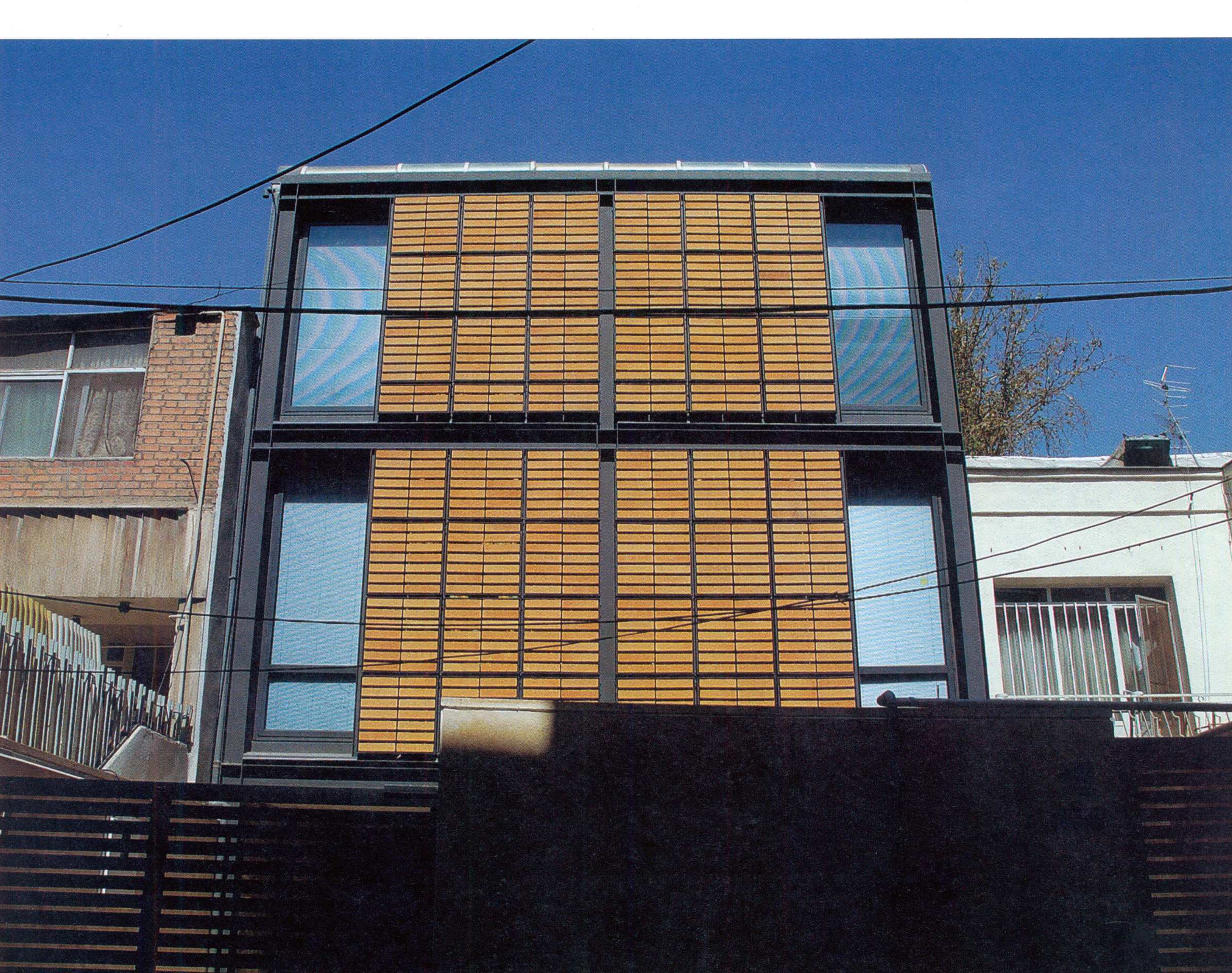
The facade is the building's most striking feature. A steel frame supports a system of wooden and bamboo blinds that can be adjusted to control light and views. When fully deployed, these blinds give the facade a warm, golden tone that contrasts with the dark steel frame. When partially open, they create a complex pattern of light and shadow on the interior surfaces. This facade system is both functional and deeply expressive.
The building is organized on three levels plus a mezzanine and basement. The ground floor houses the reception and parking. The upper floors contain office spaces organized around a central staircase. This staircase, like the one in the Kordestan building, is a major architectural set piece: steel stringers, stone treads, and glass balustrades create a circulation element that doubles as the building's primary source of natural light and spatial drama.
The use of exposed brick walls alongside the steel structure connects this work to a long tradition of brick-and-iron construction in Tehran. But Sharifi's handling of this combination is distinctly contemporary. The details of how steel meets brick, how glass meets stone, are resolved with a craftsman's precision that reflects his long experience on construction sites.
The conference room at the top level features an exposed steel roof structure that creates a powerful spatial effect. Steel trusses and cross-bracing are left visible, and the ceiling's industrial character is softened by warm wooden blinds at the windows. The interplay between the industrial steel structure and the traditional craft of the blinds creates a synthesis that is characteristic of Sharifi's mature work.
The interior detailing throughout demonstrates a High-Tech sensibility on one hand and references to traditional Iranian construction on the other. The brick walls, assembled with care from selected bricks within a thin steel frame, read simultaneously as a contemporary screen and as an echo of traditional Iranian brickwork. The interior spaces, despite their simple appearance, are organized with considerable subtlety. The arrangement of the internal spaces appears simple, and for this very reason it is successful: a warm and inviting interior. The relationship between brick elements in the facade and interior is such that one might, with greater attention, discover even more nuance and artistry.