



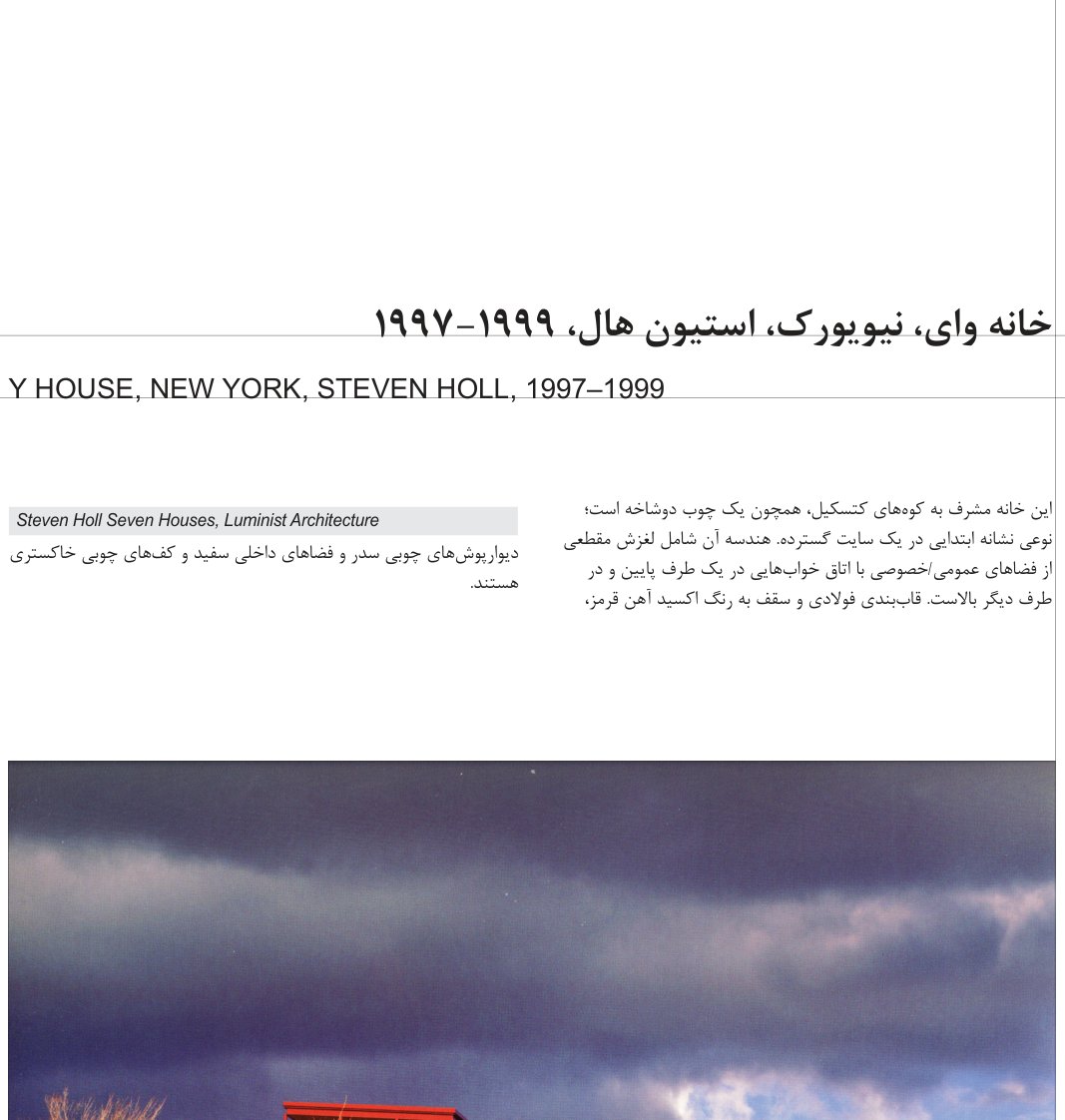
This house, overlooking the Catskill Mountains, is like a forked branch — a kind of elemental mark upon an expansive site. Its geometry involves a sectional slippage of public/private spaces, with bedrooms on one side low and on the other high. The steel frame and roof are iron-oxide red,
the wall cladding is cedar, the interiors white, and the floors are grey wood.
Y House, New York, Steven Holl, 1997–1999
A dual and interwoven thinking about space and raw materials sets architecture in motion.
Architecture founded upon a limited concept begins with heterogeneity and oscillation. It illuminates the singularity of a particular situation.
The house is a vessel for the imagination, for laughter and emotion, and a quiet place for reflection.
The inner core of every room is a kind of reverie.
When we enter or move through a small building, the excitement of interior views opens, closes, shifts, and opens once again.
A concept can unfold as a precise order, free from any ideology or claim to universality.
Architecture is a bridge across the "logically unbridgeable" divide between the world of concepts and propositions, and the world of sensory experience.