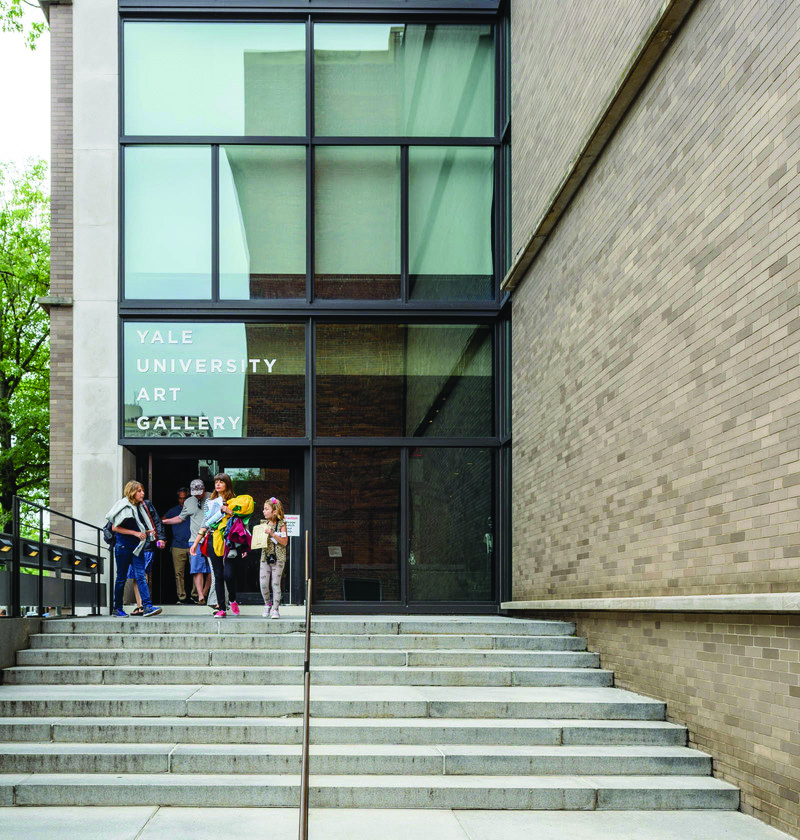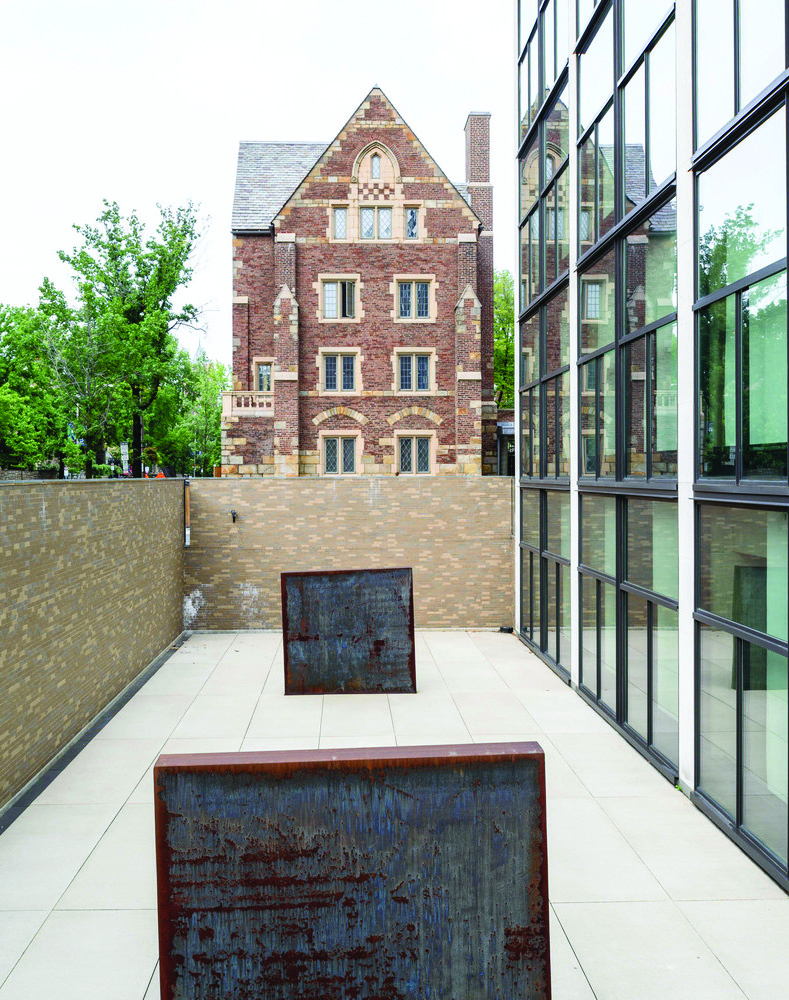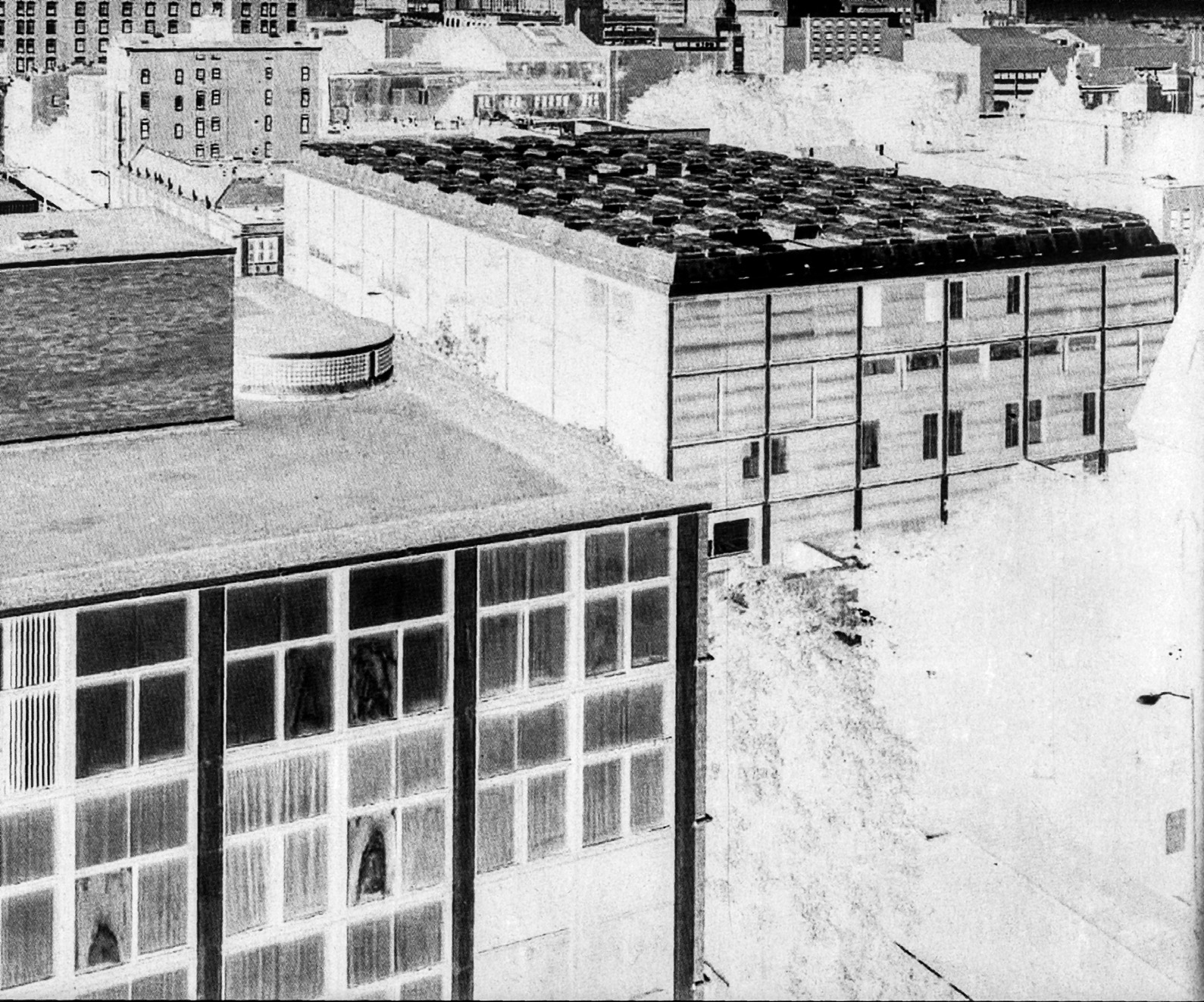
In the early 1980s, when I was an architecture student at Yale, on many a morning I would stroll across the rooftop of the Art and Architecture Building, spent after a night at the drafting table, watching the sunrise. If I found any consolation in between, it had nothing to do with the drawings I had left behind; it had to do with the street below. There, the Yale Center for British Art by Louis Kahn, freshly completed, lay in ambush. Its skeletal grey concrete frame shivered in the dawn half-light, while the gossamer steel infill, clutching at pools of glass in a sea of blackness, hid in shadow. As the sun crested, it would strike and arc off the roof to reveal the relentless parade of skylights, a kind of military formation whose dazzle was quickly lost. Unlike other buildings on this street, and in contrast to Kahn's earlier straightforward Yale Art Gallery, which stands firm in the foreground, the Yale Center for British Art was never quite the center of my attention. It was a kind of specter, even as the day drew to its close and light announced its illumination elsewhere. The Center remained in a state of becoming — never relinquishing darkness, never reaching piercing light.
We rarely describe a building as becoming, if we do at all; a building, as a physical fact, is either there or not. In truth, well before my morning visits, historians and critics had insisted that the Yale Center for British Art is, in specific ways, there. Shortly after its opening, William H. Jordy and Vincent Scully pinned the Center within the dual legacy of Louis Kahn: Modernism and the Beaux-Arts. As one of the second-generation Modernist pioneers, Kahn was adept at the formal possibilities of the rectilinear frame, and with the Trenton Bathhouse, by revealing the frame's capacity to create discrete rooms as well as continuous space, he had collaborated with his generation. Kahn was also diligent in his execution of new technologies: he integrated mechanical systems within a matrix of servant and served spaces, including in the Yale Art Gallery, and with reinforced concrete he developed uncanny facilities, most spectacularly at the Salk Institute for Biological Studies. On the other hand, his Beaux-Arts training had instilled in him the belief that historic buildings should be embraced rather than cast aside. Kahn wrote, "They have magnificent common characteristics that buildings of the future must, in one sense or another, lean upon." Kahn's mature works restored to architecture the resonant echoes and compelling materiality of tradition that Modernism lacked and that postwar institutional buildings seemed to need.
Jordy and Scully were generous, but a concealed sense of disappointment runs through their assessments. This last of Kahn's buildings in the United States held out the promise of a final revitalization of Modernism, one fused with an enduring Greek clarity and a Gothic structural integrity. Both historians gave Kahn full marks for the commission he had undertaken: Jordy praised its lucid structure and the eruption of its refinements, and Scully made comparable observations, ranking the Center alongside the authentic Greek-Gothic of the nineteenth century, Henri Labrouste's Bibliotheque Sainte-Genevieve. Of course, both historians recognized that something was wanting in the delivered work; the Center, though it drew a clear structure to the eye, lacked weight. Jordy lamented the absence of the sculptural massing that energized Kahn's earlier works and clearly articulated the institutional functions within. Scully was more blunt. He recognized that the Center was "static, trabeated, laconic," implying in his assessment that this work of Kahn's no longer stirs our sympathetic response — we cannot regard this building, as it is settled, as a model for our existential strivings, forthright and steadfast, against an intractable world. It seemed the Yale Center for British Art was by no means settled. The Center was Jordy's "lidded casket," Scully's "incomparable and neoclassical monument" — Kahn's.
I grant that my first impressions of the Yale Center for British Art are the daydreams of my sleeplessness; all the same, over time I find them more compelling, not less. My argument is that we can accept their diagnoses in general terms without surrendering to their prognoses — that the Center's evanescent qualities can excite rather than disappoint us. In a more optimistic frame (and after much study and more sleep), I hold that Kahn drew upon historical precedent, but not straightforwardly, and that he delivered a convincing materiality, but not a simple one. Kahn swept away the proclivity of a building he had nicknamed the "Palazzo Melloni": the dismantling of the Italian Renaissance urban palace down to its constituent formal elements and then inverting them. Pursuing these inversions entailed a strange materiality. Kahn abandoned his earlier fundamentalism: his insistence on materials that possessed timeless qualities and the architect's moral duty to execute them. Kahn's materiality was now emergent, not declarative: instances where connections are more often concealed than revealed; where the phenomena of seeing and touching contradict rather than support each other; and where light no longer achieves clarity through chiaroscuro but seems to merge with the building, as if light itself has a physical presence.
My argument may be far-fetched, since it relies as much on reverie as on verifiable facts. The detailed articulation of specific materials through making matters, but equally so the elusive effects these materials occasion. To launch my far-fetched argument, I catalog a reverie of Kahn's own. In 1965, in a lecture to students at Rice University, he intimated his understanding of the building's purpose and its mode of expression, both of which he would pursue in the Yale Center for British Art:
"I feel that this is the time that we should test all our institutions against the sun. I grew up at a time when sunlight was yellow and shadow was blue. But I see it clearly as white light and black shadow. Still, this is not so alarming, because I believe that a new kind of yellow will come and a beautiful blue, and that the revolution will bring a new sense of wonder. Our new institutions can only come from wonder... They certainly cannot come from analysis."

As we know, Kahn was an architect of institutions: religious, cultural, and civic. If Kahn recognized that this was an era to "test all our institutions," he could not have wished for a more challenging project than the Yale Center for British Art. In the fall of 1969, when Kahn received this commission, the town-gown conflict between Yale University and its host city, New Haven, had long been worsening — with the collapse of New Haven's industrial base and the growing isolation of Yale, the abrasions of urban renewal, the erosions of suburban flight, and the polarizations of class and race. Other tensions included the aftermath of the social upheavals of the 1960s: rioting in the decimated Hill neighborhood, fierce anti-war protests at Yale, and the Black Panther criminal trial of Bobby Seale and Ericka Huggins. The broader world of art was by no means immune from these upheavals, reverberating with them. Artists abandoned the conventions of painting and sculpture and turned to an array of practices — video, performance, conceptual art, landscape art, and urban interventions — all of which questioned the institutional function of museums and galleries in legitimizing art and defining its social role. Thus, the generous proposal of the distinguished alumnus Paul Mellon, to donate and house his vast collection of eighteenth- and nineteenth-century British art, had both its good and its bad aspects. Above all, this collection displayed paintings and prints (the spent modes of artistic production) belonging to the British aristocracy (beneficiaries of ill-begotten privilege) that the scion of a wealthy American family (ditto) had amassed and was to be housed in a "palazzo" or "lidded casket" (take your pick) and hurled onto Chapel Street, the principal street forming the boundary between the city and its divided university.
If Kahn harbored any doubts about the Mellon commission, he never voiced them. As always, he endeavored to prophesy what he called the "order of the building," an archetypal form that encompassed the essential human activity within. During the early design phases, Kahn kept these matters in mind: "Yale," the circulation paths and spatial requirements of a university research collection; "Center," the contextual imperatives of a public museum on a dense urban lot; and "British," the display requirements for small wall-hung paintings and prints. Of course, "Art" was the essential human act. Kahn never tired of repeating, "All of science, all of knowledge, is in the service of art... for we live only for one purpose, and that is to express." Above all, art's liberating capacity was Kahn's lived truth. Kahn's career only gained momentum late in life; that it got started at all is itself a matter of wonder. Kahn, a poor, shy Jewish immigrant whose face was scarred in childhood, aspired to a distinguished career in Philadelphia, a city where, at the time, the oligarchy of power and wealth was as close to blue-blood as is possible in the United States. Kahn had an astonishing talent for drawing and a razor-sharp intellect, but, whatever the power structure of his adoptive city, it was the nexus of vibrant institutions that provided an exceptional range of cultural and public educational opportunities. Late in life, Kahn recalled Philadelphia as "a place where a little boy, when he walks through it, can see something that will tell him what he wants to be in his whole life." Though Kahn understood that American institutions had been tested in the 1960s and the cities that sustained them were in decline, he also insisted that "availability is the American characteristic. It's been bandied about, some people have been denied it, but I believe it's right there." For Kahn, the finest resource a city can offer its citizens is art, and the Yale Center for British Art gave Kahn the opportunity to play a role in that availability.
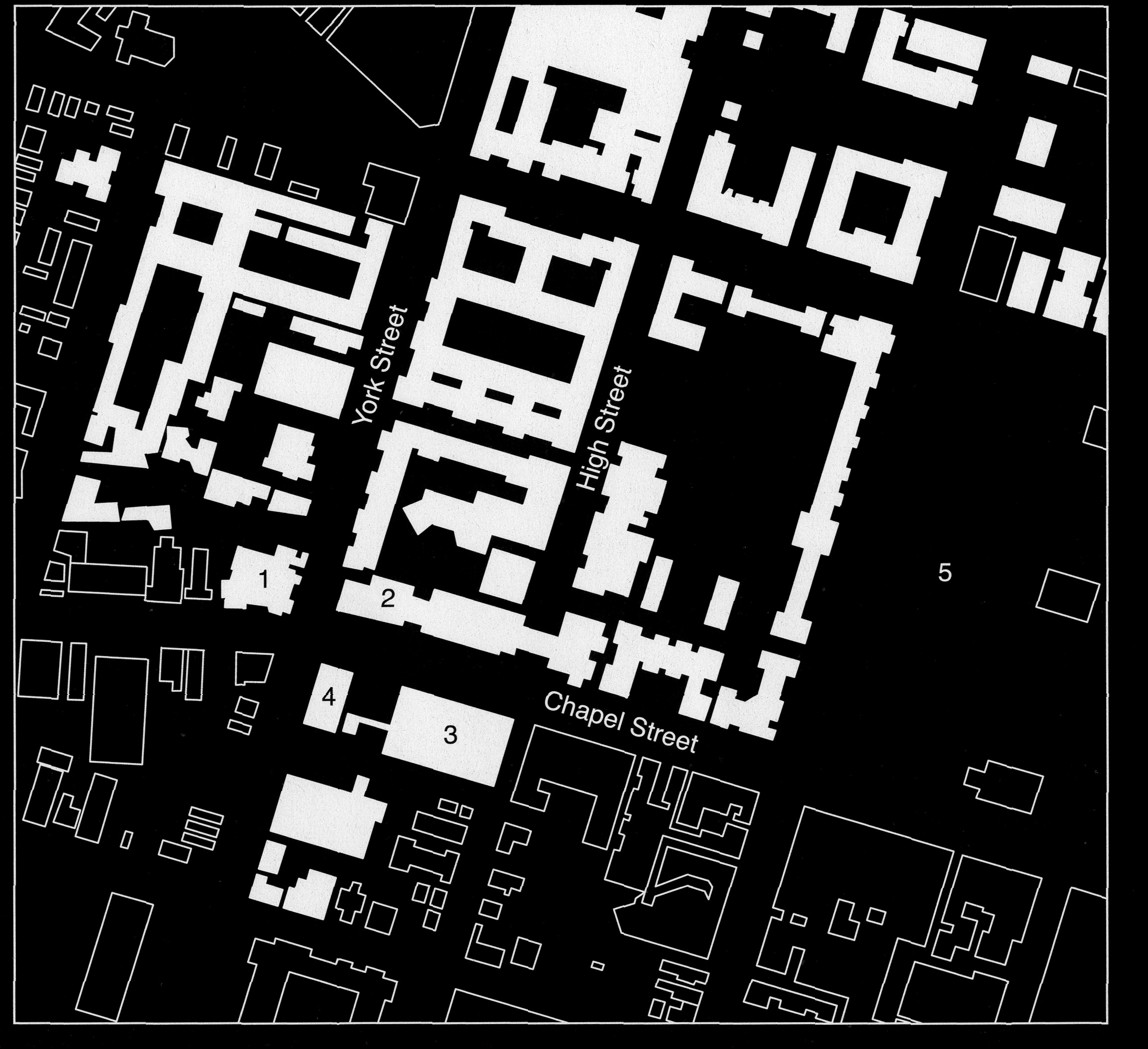
In any case, Kahn began his design with the order of the palazzo, a standard type of museum, but one that, since the fifteenth century, has been an emblem of familial power and prestige. It goes without saying that this Center addresses the public street. When we stand at the corner of York and Chapel Streets, we can see the Center's concrete columns, which are scaled to the street and taper gently as they rise. The horizontal lines of concrete beams also knit it to neighboring buildings; the thickness of the beams, calibrated to urban codes for base, upper floors, and entablature, follow the pattern of columns. And note the addition of the welcoming street-level shops, a request from the university that Kahn embraced — he set their facade back so that shoppers would have some protection from rain and snow. But Renaissance palazzi more often than not incorporated street-level shops, and architects more often than not study their complex contextual strategies. In fact, it is just such careful analysis that reveals the far-fetched disjunction of Kahn's facade.
We need not even look closely. A Renaissance facade has a base devoid of refinement, as though it wrestles with the ground beneath; middle floors bound by an interwoven, taut surface; and a kind of attic, showing the greatest compression in its vertical dimension and clad in an elaborate, detailed cornice that casts deep shadows to crown the building against the sky. The Center has a base, but it is columnar, and the columns are so planted as though driven into the ground — its coherence is minimal. The continuous weave of the middle floors breaks right at the center line of the building. Its attic, most unexpectedly, instead of being the most compressed story is the tallest, and its capping entablature has an inverted profile — set back rather than projected — casting no notable shadow. While the Renaissance facade relates to its surroundings by directing a hierarchical order against the pull of gravity, this Center slides into the ground rather than sitting upon it, dissolves into the sky rather than profiling against it, and its proportions are ungainly, as if it might topple over.
Another type of building offers itself as an alternative to the palazzo, one less respectful and more contemporary. The Center's structural frame is expressive: its cladding defers to it, rather than hiding it behind a conventional curtain wall. A building so boldly expressed rarely appears downtown, but more often in the suburbs — not in public buildings but in factories. Yet the same disjunctions infiltrate this modern type as well. A kind of undermined foundation, a broken rectilinear order, and ungainly proportions all undercut the stubbornness of a functional grid and lend it a more variegated texture. The Center, then, from top to bottom, is a kind of hybrid that dislodges hierarchies and recalibrates order.
When we stand at the corner, we can look through the lenses of modernity more precisely, and focus on the building technology advances. The Yale Center for British Art is, once more, and at first glance, reassuring: it is a building of steel and concrete. Yet, I would wager that if you asked ten architects to design a building of steel and concrete, the building they returned would have a steel frame and a concrete cladding. Assembling a steel frame is quick, and more often than not cheaper than a concrete frame, though concrete is fire-resistant and accommodates an array of curtain-wall configurations. At the Yale Center for British Art, the matter is inverted: it has a concrete frame and a steel cladding. If we were to insist, we might ask the same ten architects which of these modern materials delivers the most beguiling effect: steel, concrete, or glass. Two to nothing, I would wager that at least nine of them would answer "glass," on the spurious assumption that it is seamless, transparent, and reflective. Once again, the Yale Center for British Art proves them wrong: in application, glass is the most conventional.
True, the Center's glazing plays a shifting role. Sometimes the glazing is opaque, drawing us into infinitely deep black holes; sometimes it is transparent, taunting us with fleeting glimpses of galleries within; and sometimes it is reflective, hurling cinematic fragments of the surroundings toward us that from a distance appear joined — all of these impressions registering transient atmospheric conditions and our shifting gaze. These moments are striking, and in Kahn's work unprecedented (previously, he was inclined to conceal glazing in deep shadow); these effects, by the early 1970s, were the rule in modern architecture, not the exception. What is exceptional at the Yale Center for British Art is how unstable steel and concrete also are.
The steel cladding of the Yale Center for British Art is stainless steel. The manufacturer added other elements to the iron and carbon alloying process — most importantly chromium — so that a protective skin of chromium oxide would form on the alloy's surface, preventing the oxidation (rusting) of the iron. This skin is, more often than not, self-healing because scratches expose chromium to oxygen, and thus another protective skin forms. Stainless steel is not, in fact, stainless — its durability depends on corrosion, though. Stainless steel can be finished with a spectrum of surface treatments: from the rawest, still bristling with a thick nap of rolled mill scale that refracts light, to the most polished, with the reflective silvery surface we associate with stainless steel. The stainless steel of the Yale Center for British Art is of a medium grade, or matte finish. On Kahn's orders, the manufacturer ground the alloy to remove the mill scale, but, without polishing too much, did not erase the marks of the grinding rollers.


In a brief note to the president of Yale, the Center's first director, David Prown, wrote, "The character of the British art collections is a reminder: the unsuitability of unfinished sheathing with brutal texture; gossamer screens whimsical in nature; or cold, sheer, soulless surfaces of glass and steel." Understandably, the Center's building committee grew anxious when Kahn proposed just such a cladding material. When Kahn was pressed to explain what his steel would look like, he did not waver: "On an overcast day it will look like a moth, on a sunny day like a butterfly." It is a testament to the committee's patience and Kahn's mischievous personal charm that the committee did not fire him on the spot.
Kahn may not have been entirely straightforward in arriving at steel, but once there he did not lie. The complex mix of opacity and reflectivity, of rough grain and chromium sheen, produces multifaceted effects. On an overcast day, the steel is mothlike: the warm dark undertones of neighboring masonry are absorbed into the depths of its rolling surface, even as silver glimmers point to the near. On a bright day, moreover, the steel is butterflylike: it trembles with blue sky in wisps of cloud. Kahn boasted of his office's ability to keep the steel surface flush with the glass, so as to compel the mullion, glazing, and cladding to occupy a single continuous plane. In a standard curtain wall, these building elements separate into different planes, and their material effects tend to sit alongside one another so that, for example, our eyes move from matte steel mullion to patterned cladding to transparent or reflective glass. Kahn's office, by keeping the elements coplanar, elided material effects. The unstable dance of glass transitions to steel.
The closer we are to the steel, the more interesting it becomes. The distant impression of transient atmospheric effects resolves itself into the surface lines of the steel ground, which Kahn called "sgraffito." As we draw closer, the lines decompose and we surrender to a kind of microfield with its own gravitational pull; we attain a sense of depth. We can touch the steel, feel its hard, sloping surface even as our sight falls below it. At such moments, the steel is cold and resistant to touch, yet soft and intimate to the eye. The perceptions are discordant rather than mutually reinforcing, as though they convey the steel's suspended decay. The steel is both there and not there.
And here, Kahn departed from a fundamental understanding of building materials, what I call his fundamentalism. The much-quoted early aphorism, "You say to brick, 'Brick, what do you want?' and brick says to you, 'I like an arch'" — of course this dialogue was a device of Kahn's wordplay, used most often when teaching. Kahn knew that bricks are taciturn sluggards, and he warned his students not to repeat such things in public. But Kahn's wordplay remained in the logic of making. Since the Romans, bricks had lent themselves to the construction of arches, and Kahn was implying it was in their nature to continue doing so. The Yale Center for British Art confronts us with a very different attitude. Kahn employed steel, the essential structural material, as cladding. This cladding, moreover, evokes the senses of seeing and touching, which, rather than supporting each other in a unified and harmonious perception, contradict each other. Even as a device of wordplay, imagining brick as arch is worlds apart from imagining steel as butterfly.
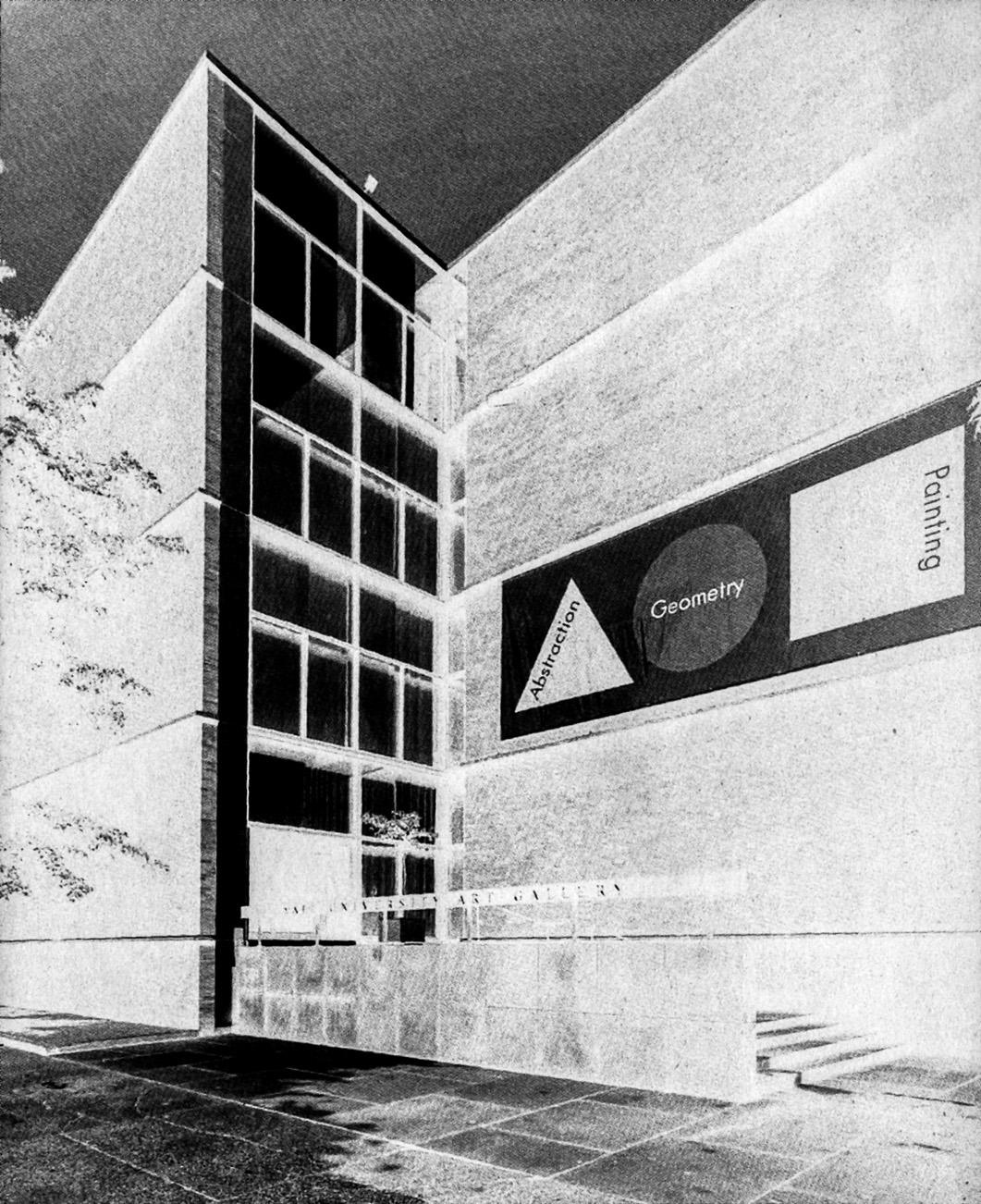
Let us for a moment suppose that the comparison of brick and steel is misleading. As Kahn declared, brick is an ancient building material with known properties, while steel is a product of modern technology whose qualities continue to evolve. When we turn to the brick facade of the Yale Gallery directly behind us, we can argue that its coherent, static presence results from the intrinsic nature of the material — what brick wants — rather than from a shift in Kahn's sensibility. I take the risk and adopt Kahn's wordplay, and contend in return that brick tells us its identity is not static but fluid. The brick in the Yale Art Gallery is not a thick structural arch but a thin, non-structural curtain wall. As Kahn insisted we understand it: removing its heavy base course, projecting the lintels in the doorways that bind brick to structure at each floor, and eliminating the brick wall at the entrance so that we confront its thinness and the concrete frame that supports it. True, Kahn's use of brick in later projects was not consistent. Kahn insisted on brick with all its primordial bearing force where it was the inescapable and available reality of construction methods, including at the Indian Institute of Management in Ahmedabad, as well as where it was not, including at the Exeter Library. Brick seduced Kahn, summoning his appetite for timeless varieties, and he more often than not could not resist. But, at the height of his powers, Kahn resisted the easy seduction of fundamentalism and offered a more complex understanding of the physical world. Concrete was a more serious companion than brick.
Though Kahn maintained the far-fetched conceit of brick's fixed identity, he more often referred to concrete in contradictory terms, such as "hollow stones" or "liquid stones"; however, not until the turn of the twentieth century had engineers and builders developed techniques to combine concrete with ribbed steel reinforcing bars — a combination that matched the formidable compressive strength of concrete with the tensile strength of steel. Now, reinforced concrete responded with an almost alchemical transformation: the heavy, earthen mass of concrete could become a light, reinforced frame. Of course, as Kahn apparently recognized, this was no simple answer — reinforced concrete left much unsaid and more promised. Unsaid was the structural dynamism of concrete. Unlike a wooden or steel beam, whose size and composition closely approximate its stress and strain, a concrete beam can assume a range of shapes if the steel reinforcement is properly sized and — most importantly — concealed. And, if reinforced concrete can transform earth into frame, it also promised itself to be a thick bearing wall (or a thin canopy), a supple sensuous form (or a rectilinear datum), a coarse aggregate (or polished veneer). Reinforced concrete answered the question "What do you want?" with "Whatever you desire" — concrete, more than any building material, responds to our longing to shape the mute dough of the natural world — clay — according to our will. Yet with this answer, concrete discloses two questions of its own: How do you express a construction that must be concealed? How do you employ the natural world that you now control?
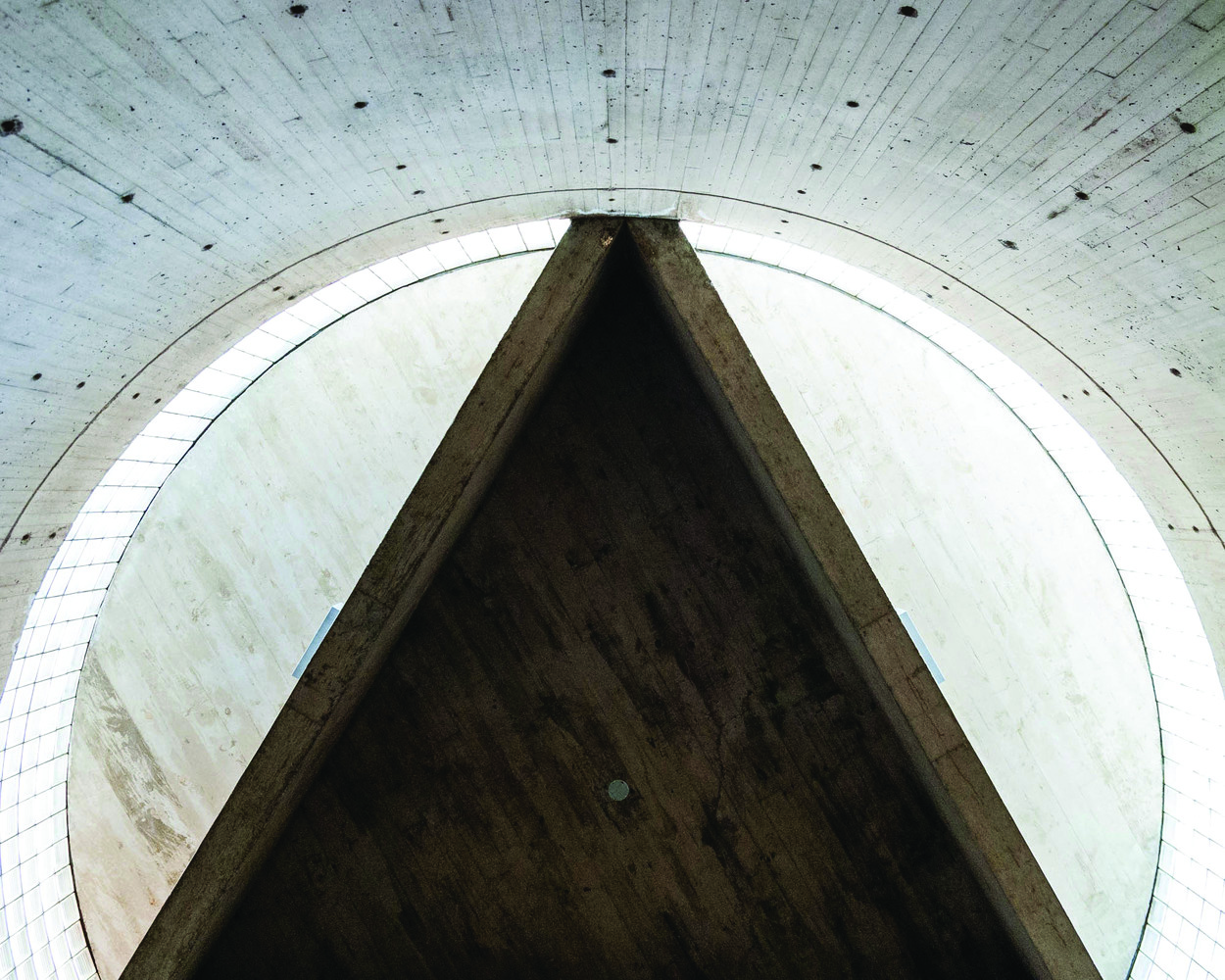
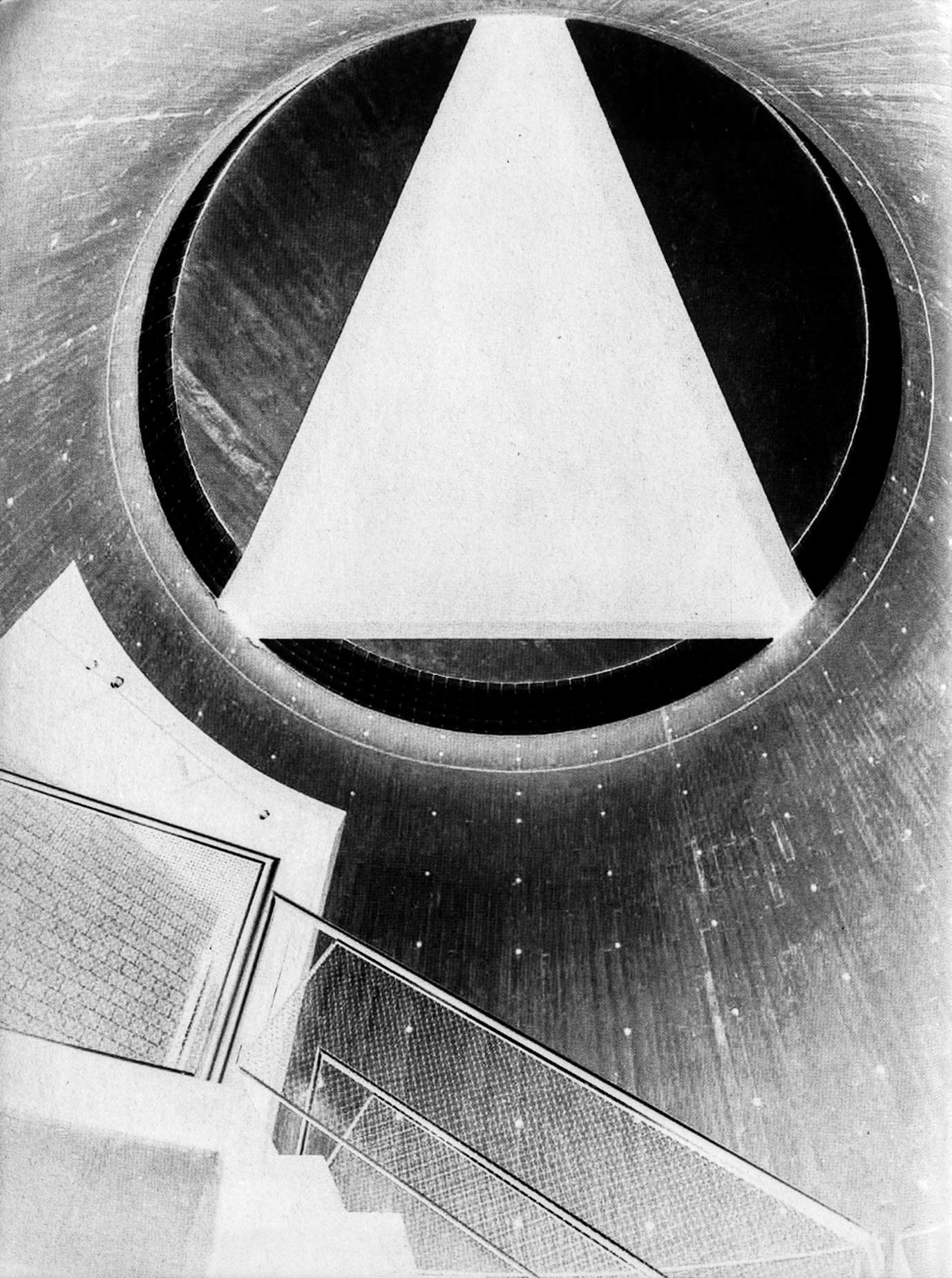
If we enter the Yale Art Gallery, we can identify two questions that Kahn grappled with from the outset of his professional life. Kahn enclosed the Gallery's public stair with a concrete drum, one that recalled his earlier admonishment: "If we were to train ourselves to draw as we build, from the bottom up, put our pencils aside at the pouring or erecting joints, from our love of perfection in making, ornament would grow and new ways of making would emerge." Kahn expressed the primitive realities of construction: with inset planes he marked successive concrete pours; where metal ties held formwork in place he left holes; with rough wooden boards he gave shape to coarse concrete aggregate. The steel is concealed in the ceiling overhead — we know this because, were it not for the steel reinforcement, the looming concrete triangle wedged in the clerestory wall would crash down on our heads. Everything is on display: the primordial physicality of weight and mass, which Kahn shaped into fundamental geometries with rough timber that was then raised with steel. Kahn crowned this display with the tinsel of natural light, a kind of architectural chiaroscuro that bears down on every mark in the thick impasto of concrete, charging the triangular clerestory with thunderous accents. It is a fundamental world, one in which the human will is exerted upon intractable materials, where the simple act of climbing stairs becomes a heroic exploration.
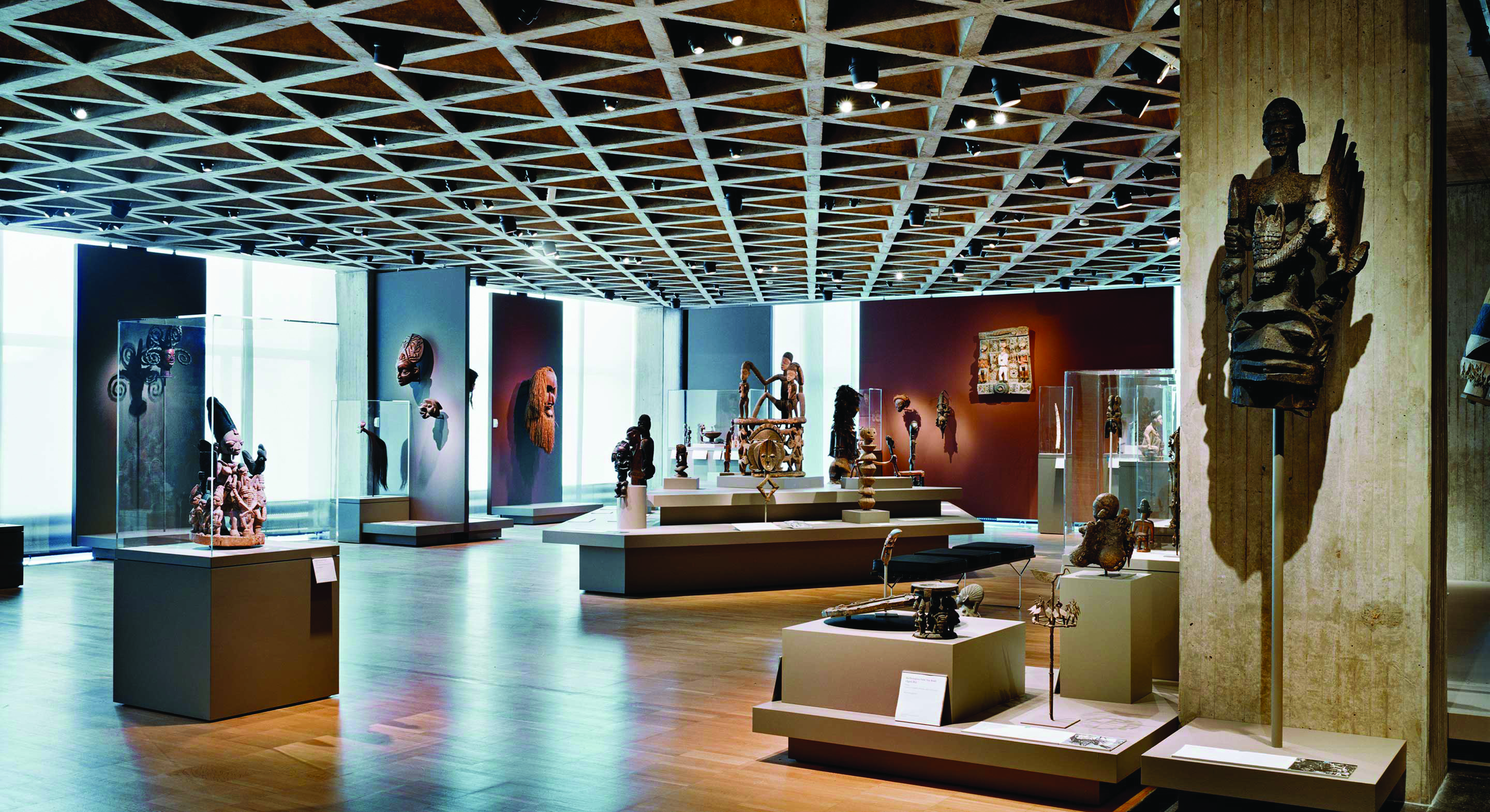
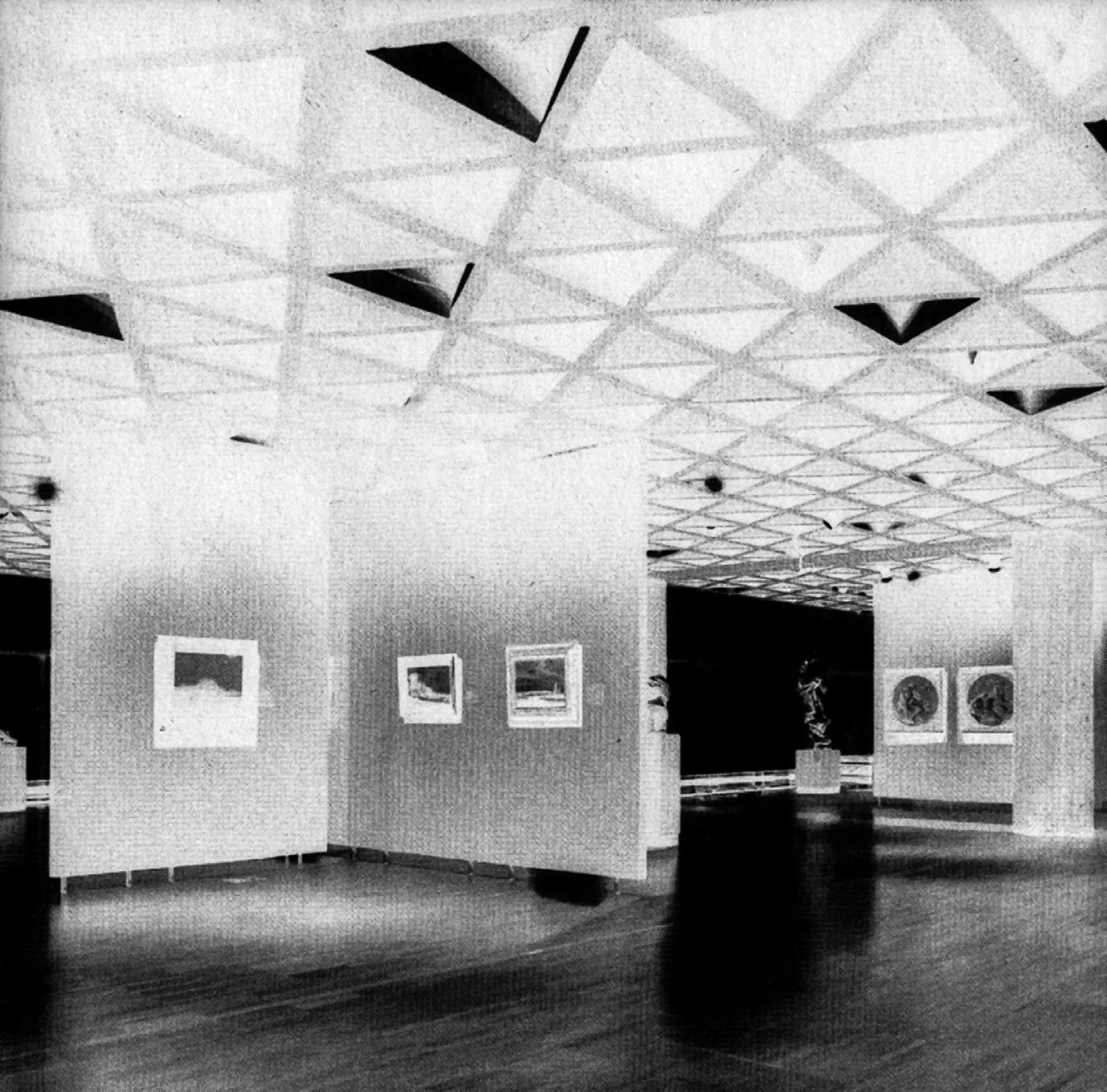
But, as we enter the Gallery, we discover that reinforced concrete plays a far more ambiguous role. The Gallery ceiling assumes the form of a three-dimensional interlocking truss, as if a steel space frame were translatable into the enduring primitivism of concrete — roughly formed. Perhaps, but the concrete may merely serve as fireproofing for the essential steel structure concealed in its depths. Even this conceit collapsed during construction because building inspectors forced Kahn's office to supplement the frame with a more conventional array of beams. Regardless of the ceiling's success or failure, it is clear that Kahn was eager to test the structural possibilities of reinforced concrete and its perceptual effects. Were we to visit Kahn's later projects, we would find him experimenting with multiple strategies, often in collaboration with the brilliant and efficient, if increasingly bitter, engineer August Komendant, and in conversation with his more sympathetic and inventive colleague at the University of Pennsylvania, Robert Le Ricolais (with whom he could exchange ideas after hours). In our tour, we find a more convincing interlacing: in the Vierendeel trusses of the Richards Medical Research Building; the warped slab standing in the air of the Unitarian Church of Rochester; the bearing walls so aptly suited to the velvety sheen of the Salk Institute; and the cycloid beams cast with metallic luster at the Kimbell Museum.
In continuity with these strategies, Kahn employs natural light. Once more, the Yale Art Gallery is instructive. Its blazing cycloid lighting of exhibition spaces is a salient example of the diverse conclusions drawn from Kahn's early, cursory efforts — though, as we have seen, its stair drum employs daylight as a theatrical tinsel for its heroic achievement. Kahn, in his later works, went beyond both function and heroism; for example, the hallucinatory effects of the Kimbell vaults depend on the fugitive chemistry of natural light and building. As his daughter, Alexandra Tyng, has observed, Kahn's later poetic diagrams followed a similar evolution. Kahn no longer embodied silence, "the desire to express," in combat with light, "the giver of all presences." Instead, he imagined them as "two brothers." Silence itself, in one of the more memorable images, springs from the depths of the natural world, "from water in the depths of the forest." By the time Kahn began work on the Yale Center for British Art, he had passed from a dogmatic insistence on the chthonic mass of concrete in the brisk relief of light, to a more complex understanding of concrete tempered with a measure of steel reinforcement in company with natural light as its gentle companion. Kahn was no longer answering the contradictions of concrete and the resistance of the natural world with an insistence on will. He was responding with something closer to humility.
The lightness of the Center's concrete is startling. Kahn's office provided detailed specifications: a mix brightened by the addition of volcanic ash, formwork assembled with cabinetry precision, pours coordinated with the increments of framing, and placed concrete vibrated so that a thin slurry was driven to the edges, leaving a luminous finish. The reveals in the concrete frame always break along the length of beams, which adds to the perception of lightness because they are level with the ground rather than confronting it (as they would if they broke along the length of columns). As we draw closer, we notice the concrete is also flush with the steel cladding and shares its contradictory effects. The finish of the concrete is atmospheric — clouds of grey undertones are ushered across its silky surface. Once more, as sight descends into depths that touch cannot even imagine, touch is not altogether reassuring. What touch emphasizes are the rough corners of columns where the delicate concrete chamfer is blocked by a coarser aggregate and then chipped away during the stripping of formwork. Sight and touch converge — concrete insists on its physicality just when it appears to surrender. Like the stainless steel: it is both there and not there.


Just as some frustrated visitors have complained, "there and not there" also applies to the Center's entrance. The Center evacuates the entrance as much as it announces it. Strange. Stranger still, Kahn's previous investigations, his favored design process — the movement from archetypal order to its unconventional form, attending to the particularities of client, site, and making — are not reversed. That is, rather than progressing from the simple palazzo to a more expressive version of the type, Kahn edited a complex iteration of the building committee's brief, so that the plan approximated the ordinary order of a palazzo. Following our earlier observations, we can argue that Kahn, by grafting the hierarchy onto the ordinary grid of the factory, sets it aside. The result: Kahn obtains the best of both types — a palazzo democratized and a factory individualized. Well then, palazzo or factory — why does Kahn enter the building on the diagonal rather than taking the direct, frontal path?
Allow me to offer two reasons: the first ordinary, the second more enigmatic. The first was a client request. Jules Prown conveyed President Brewster's concerns to Kahn: that the Center was to be accessible to both the university and the city, and suggested to Kahn that the entrance could be at the corner of Chapel and High Streets, facing the university and connecting it diagonally to the Town Green, one block to the east. Kahn complied with all his force. As he advanced the project, he eliminated the axial entrances from Chapel and High Streets that he had initially proposed and the organization apparently mandated. A short, dim undercroft punctuated by a single column welcomes us; we are drawn forward only by a bright courtyard beyond. A kind of far-fetched confluence, then: though we stand at the site's most public corner, we are compelled to rediscover the entrance for ourselves.
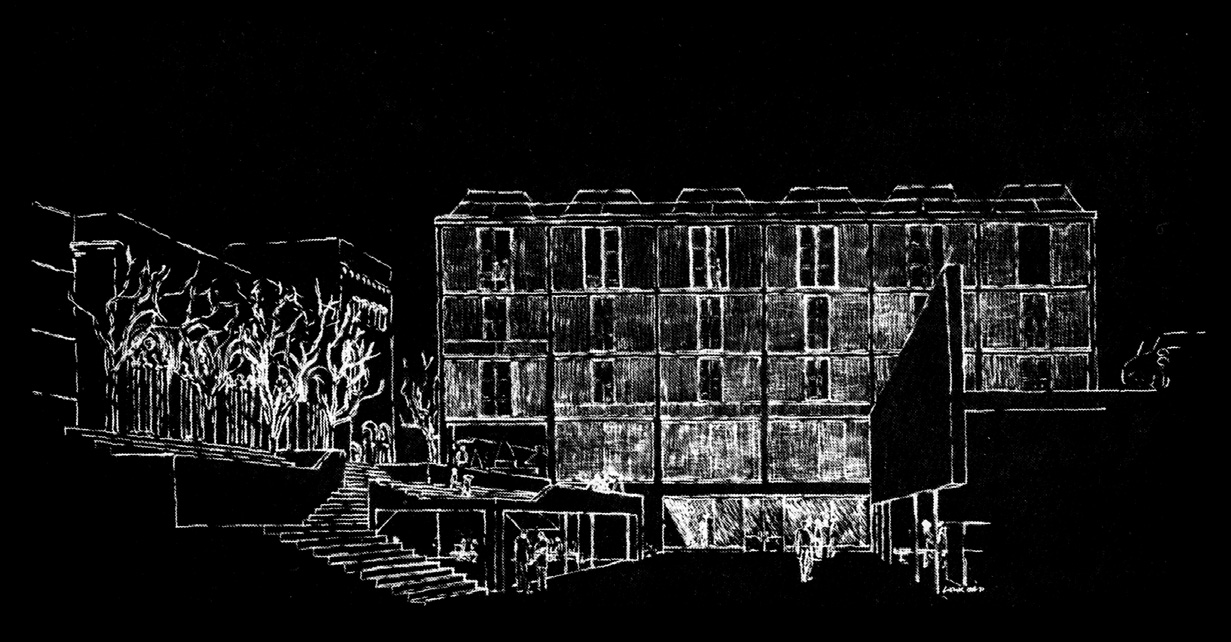
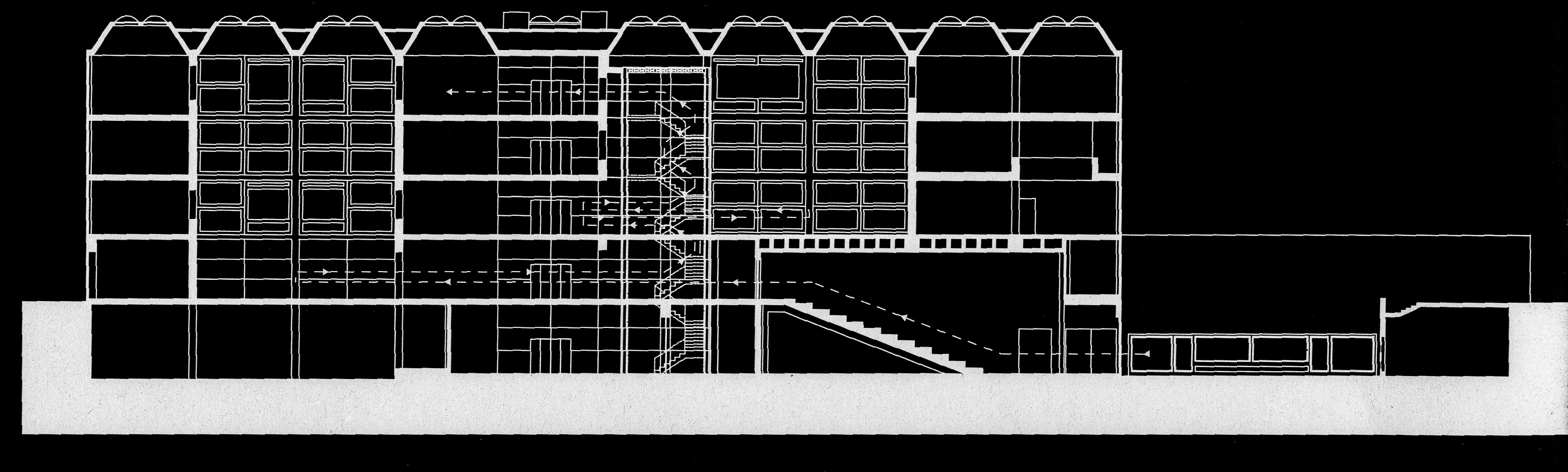
Allow me to offer the tantalizing possibility that, at one time, the palazzo may have been breached twice. Even today, the plan shows two courts, along with a disenfranchised third. The third court, marked as a square just outside and facing west, between the lecture hall and the repertory theater, is sunken. Now, the court is more or less an abandoned cavity, cut off from the street and occupied only by seasonal kiosks. But, in Kahn's design of October 15, 1971, the court was enclosed on three sides by shops, packed with stepped festival seating, and on its fourth side open to an assembly hall. It was no simple court: it connected the street and theater to its own assembly hall and led people to the assembly hall, which then became a memorable staircase. The vertical sequence could not have been more clear — thrown from the assembly hall to the entrance court to the library court and pinned by the circulation drum that makes the final connection to the gallery spaces. And, very much like the present entrance, we discover this sequence: a kind of challenge, a kind of breach. To use a political term of that era, this sequence was underground.
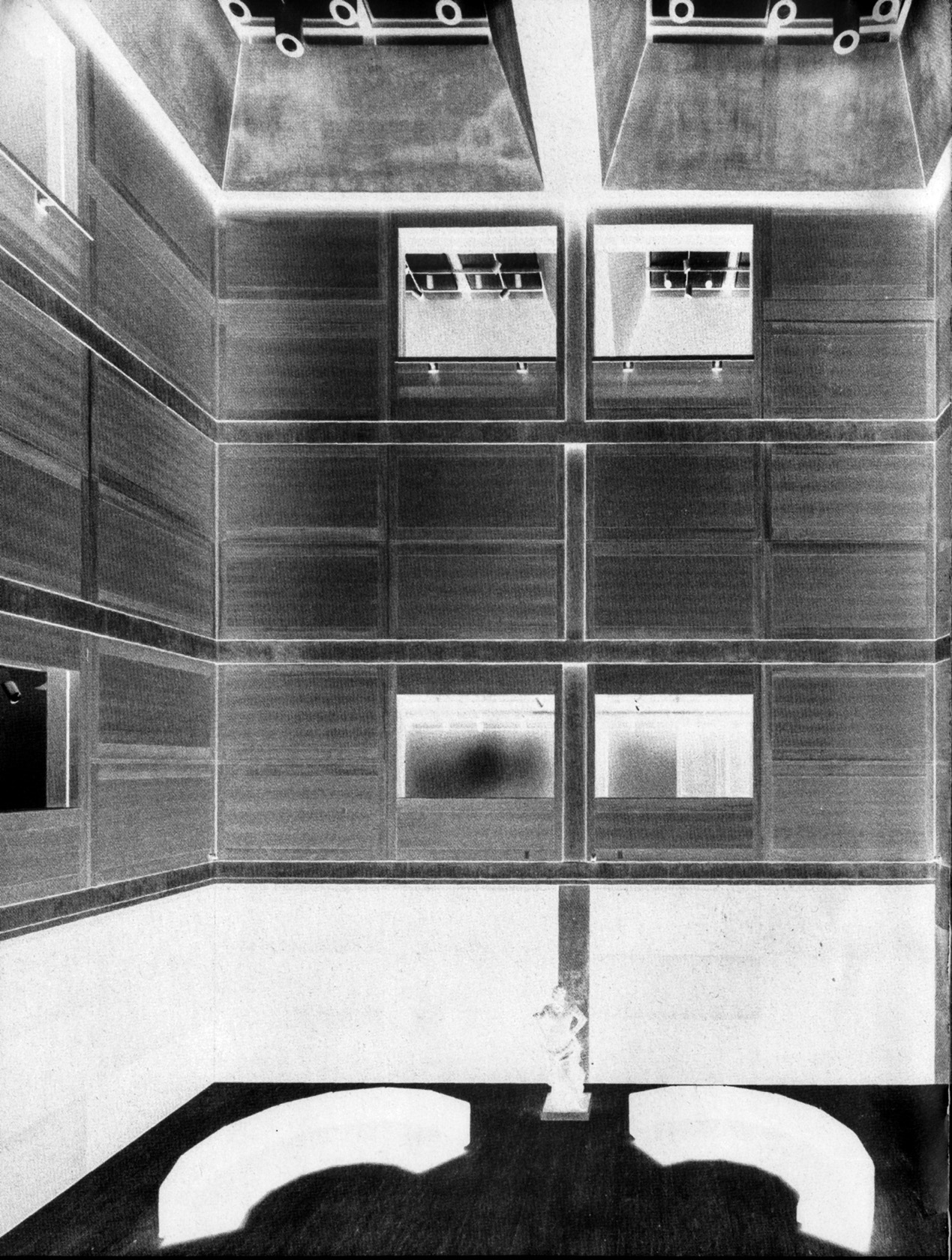

Once inside, we wonder what we are meant to make of the entrance court. James Stirling once remarked that it reminded him of an English gentleman's club, with a solitary suit of armor set amid wood paneling. Given Stirling's Cockney accent and his penchant for schoolboy mischief, I suspect this was garbled praise. There is something very still and grave about these spaces. But first we can take stock of what Kahn intended.
Once again, Kahn's drawings describe a very different court. The first level, now covered with steel framing, Kahn had envisioned as open shop fronts. The second and third levels, now clad with oak framing, completed the work in stainless steel. The upper gallery level, now marked by a few windows, Kahn had opened with floor-to-ceiling glass lightened by interior shutters. And the roof, now with skylights, Kahn left uncovered and exposed to the weather. In short, a space that is now sealed and separated from the street was imagined as a continuation of the street, with commercial activity, exterior material finishes, and the unpredictable New England weather. While the entrance court as it stands is more or less a faded copy of the piano nobile library court, Kahn had conceived of it as a celebration of the library court: more commercial than ceremonial, animated by street life rather than contemplation, and open to the elements rather than sheltered from them. One final and thematic note: the entrance court would have had more varied light, emphasized by dark metal. Even at present, the skylights do not filter the light and cast deep shadows. And even at present, especially against the concrete beams, those shadows are blue.
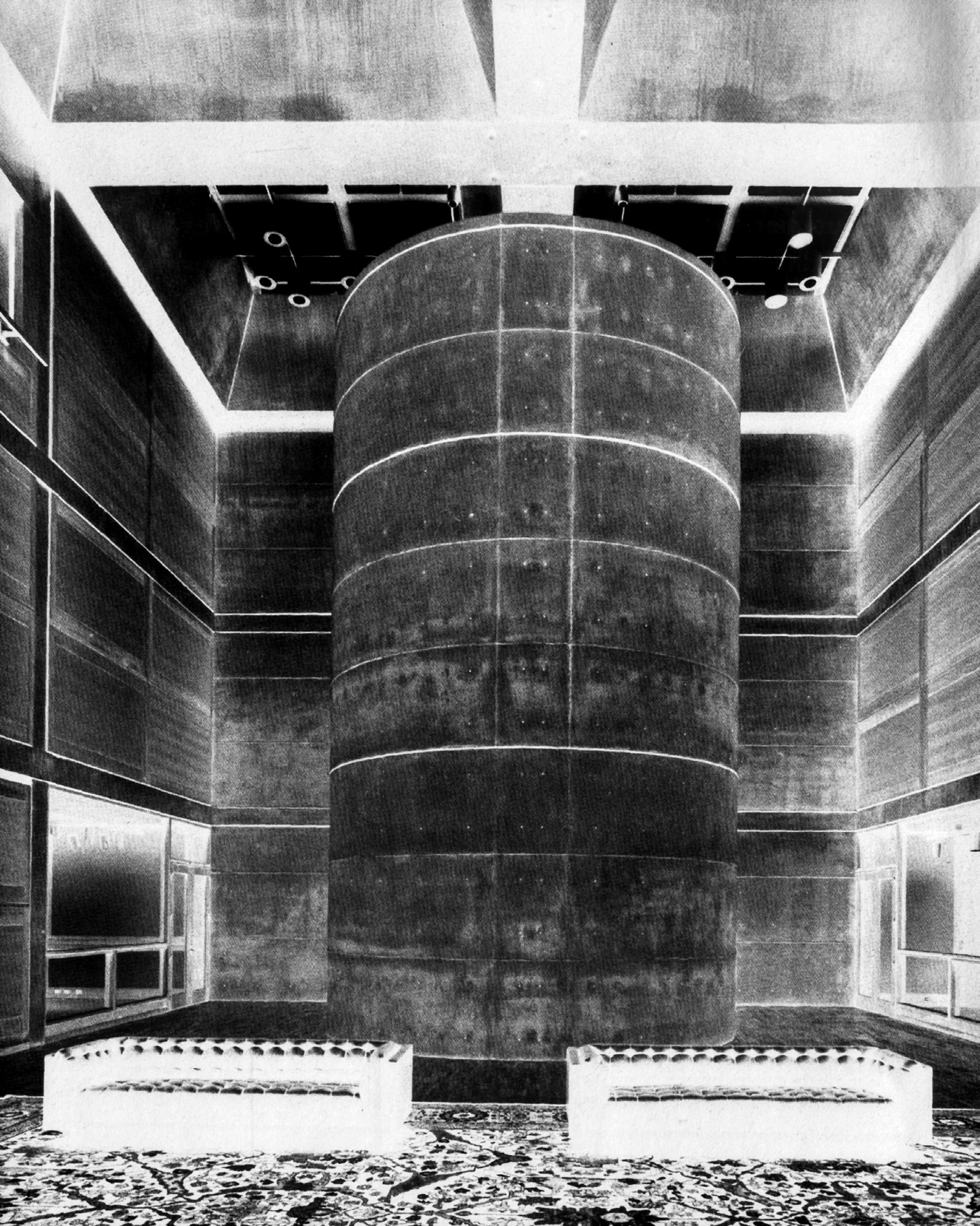
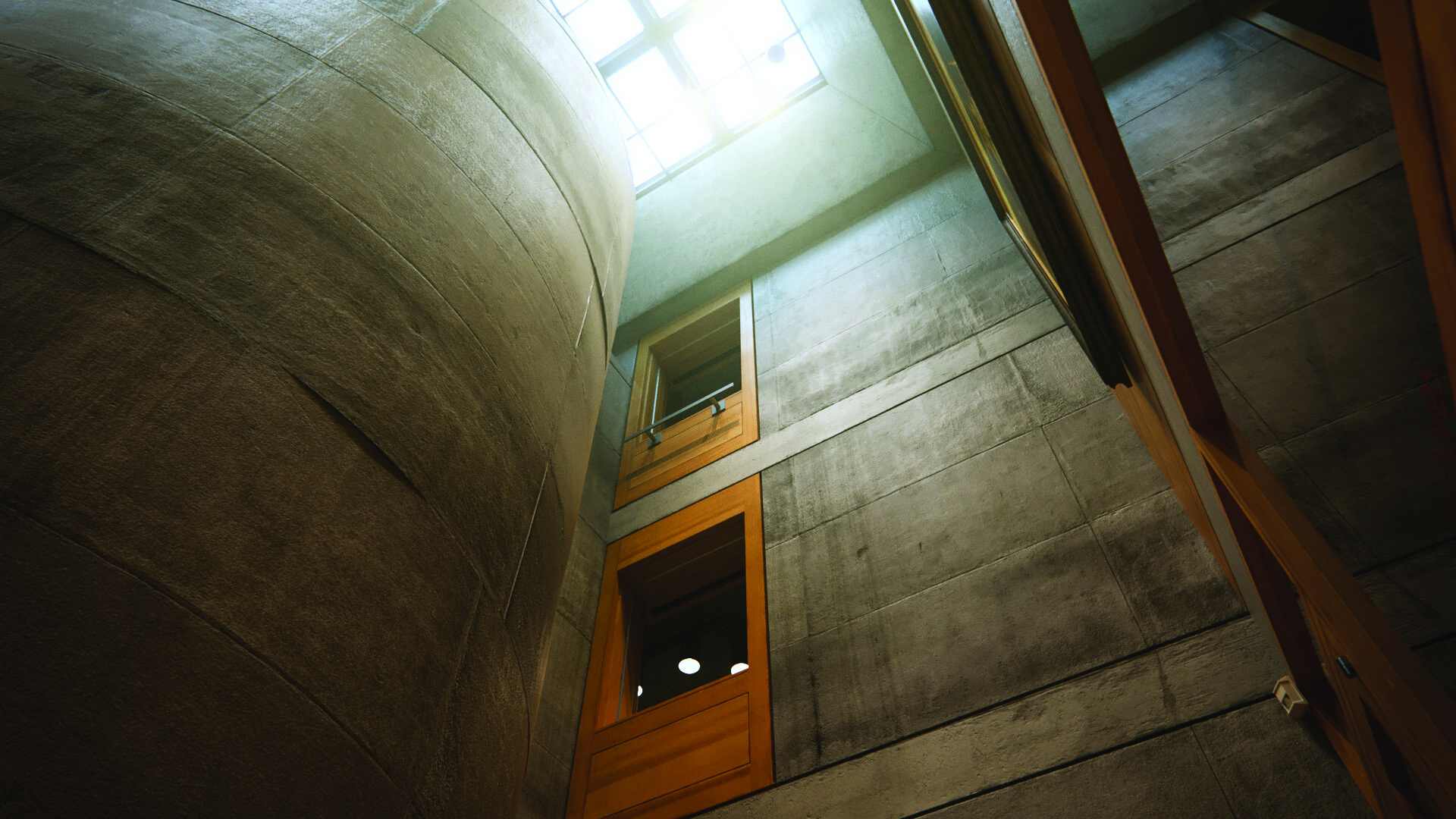
A circulation drum reappears, just to the right of the entrance court. As we know, Kahn departed from the open plan of Modernism by distinguishing between supportive service spaces and the more important spaces they serve. It is therefore strange to discover that the main staircase — the most honored public space in a palazzo and a museum — has been placed among flanking elevators in the service portion of the building. The materials further confuse the matter; what this small lobby lacks in scale, it gains in a luxuriating intimacy that the most humble materials deliver. The steel elevator doors and their surroundings gleam with a velvety luster. The atmospheric finish of concrete, freed from the constraints of column and beam, ripples across broad planes. We press our hands against the rough concrete of the Yale Art Gallery to reassure ourselves that the drum is not crushing us. We tap the soft concrete of the Yale Center for British Art to reassure ourselves that, indeed, it is there. Once more, touch makes a promise that sight declines. Sight and touch agree only along V-shaped extrusions whose beveled edges mark the formwork. The extrusions were chipped during construction and use of the building, and their cut lines are evidence of fallibility and not infallibility, of transience and not permanence, and of the inevitability of the building's ultimate breach by the ravages of time. Concrete teaches us this dark lesson. With such understatement that we are prone to overlook it, having accustomed ourselves to Kahn's bolder tonalities.

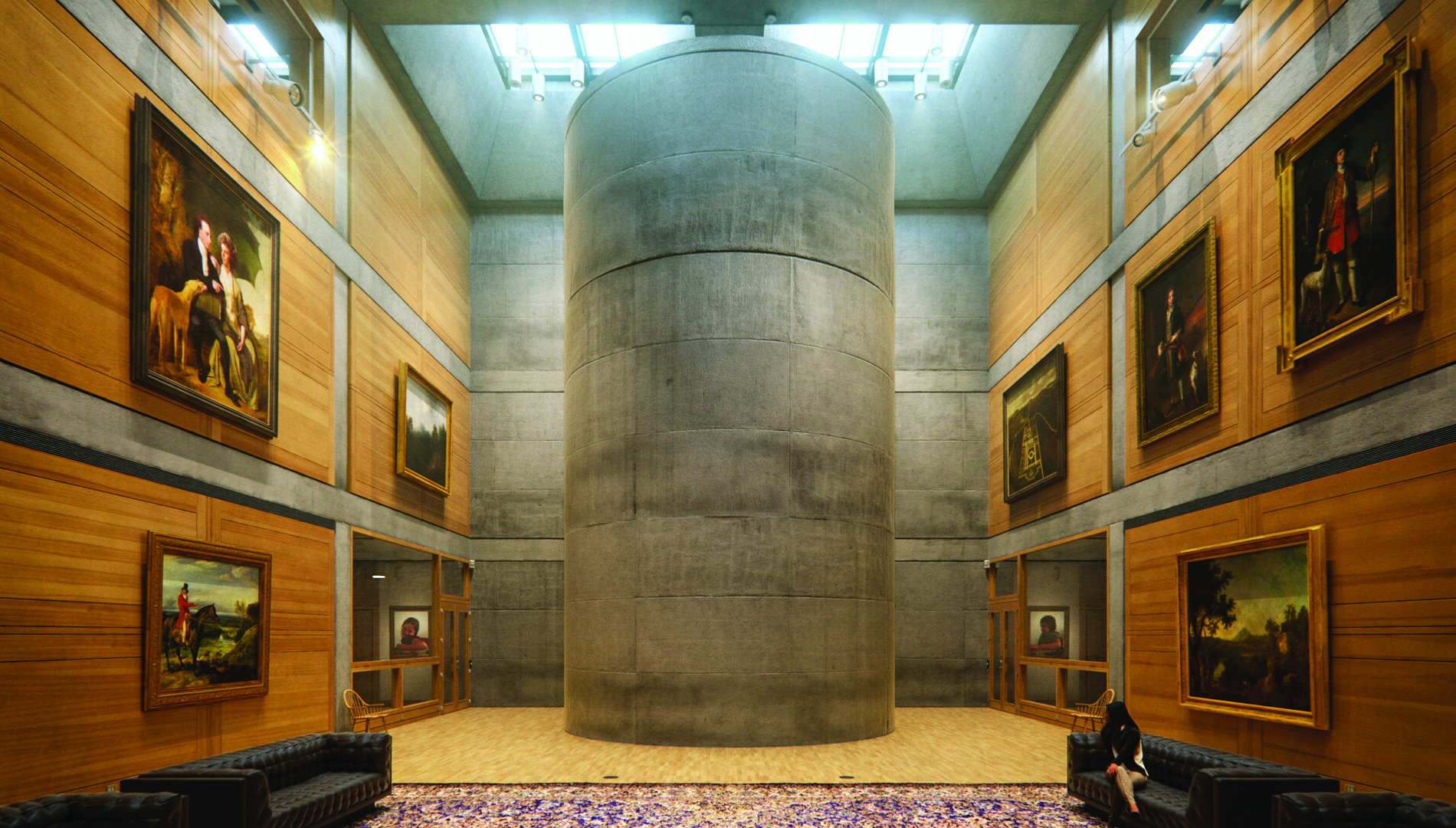
As we climb the stairs and emerge onto the main floor and into the library court, we make contact with the outside of the drum and measure its girth by gait, touch, and sight. Yet there is something not quite real about this drum. The atmospheric surface of concrete now loops endlessly. On cold winter days or during autumn storms, some of the bluster of the Yale Art Gallery appears — not by its own volition as it exists in the Gallery, but by the command of nature. More often, and especially in the softer light of spring and summer, its size appears greater than grand — its reveals suggest that it was formed by the accidental alignment of matched tub-shaped sections that might come apart. The drum evokes a specific pair of associations — fortress tower and grain silo. Kahn had a longstanding fascination with medieval fortifications, and, like most modern architects, he revered industrial buildings, including the Buffalo grain silos canonized in Le Corbusier's photographs. Whether medieval or modern, the drum's progenitors are humble, not proud. The drum, brazenly, rises from the service below and encounters the most ceremonial space of the museum. I am tempted to write that the drum is the museum's most engaging object, excepting its two dark brothers. As we look right and left, I see steel again, now in the side libraries, its surface a deep, matte blue. Were we to consult the plan, we would understand that the steel sheathes mechanical risers, a series of squares turning around quartets of circular ducts: mechanical systems as mandalas. The horizontal extensions of the mechanical towers either enlarge the floor sections or extend outward as delicately scored aluminum ducts. Servant and served, artwork and mechanical systems — these are hierarchies that exchange places with such regularity that their opposition breaks down. We may have come to the Yale Center for British Art in search of Turner's landscapes, but we cannot leave without having appreciated the work of the ducts.
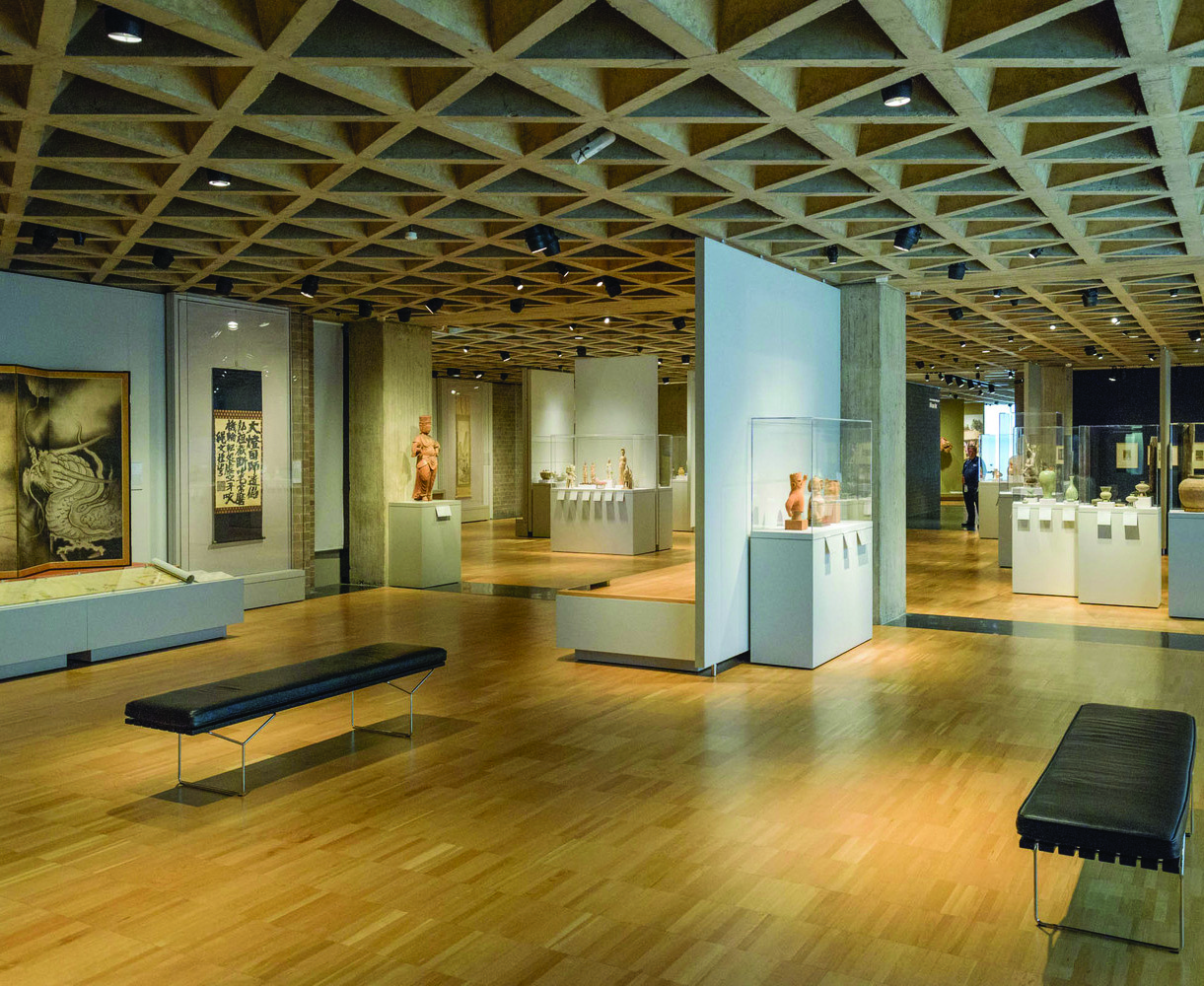
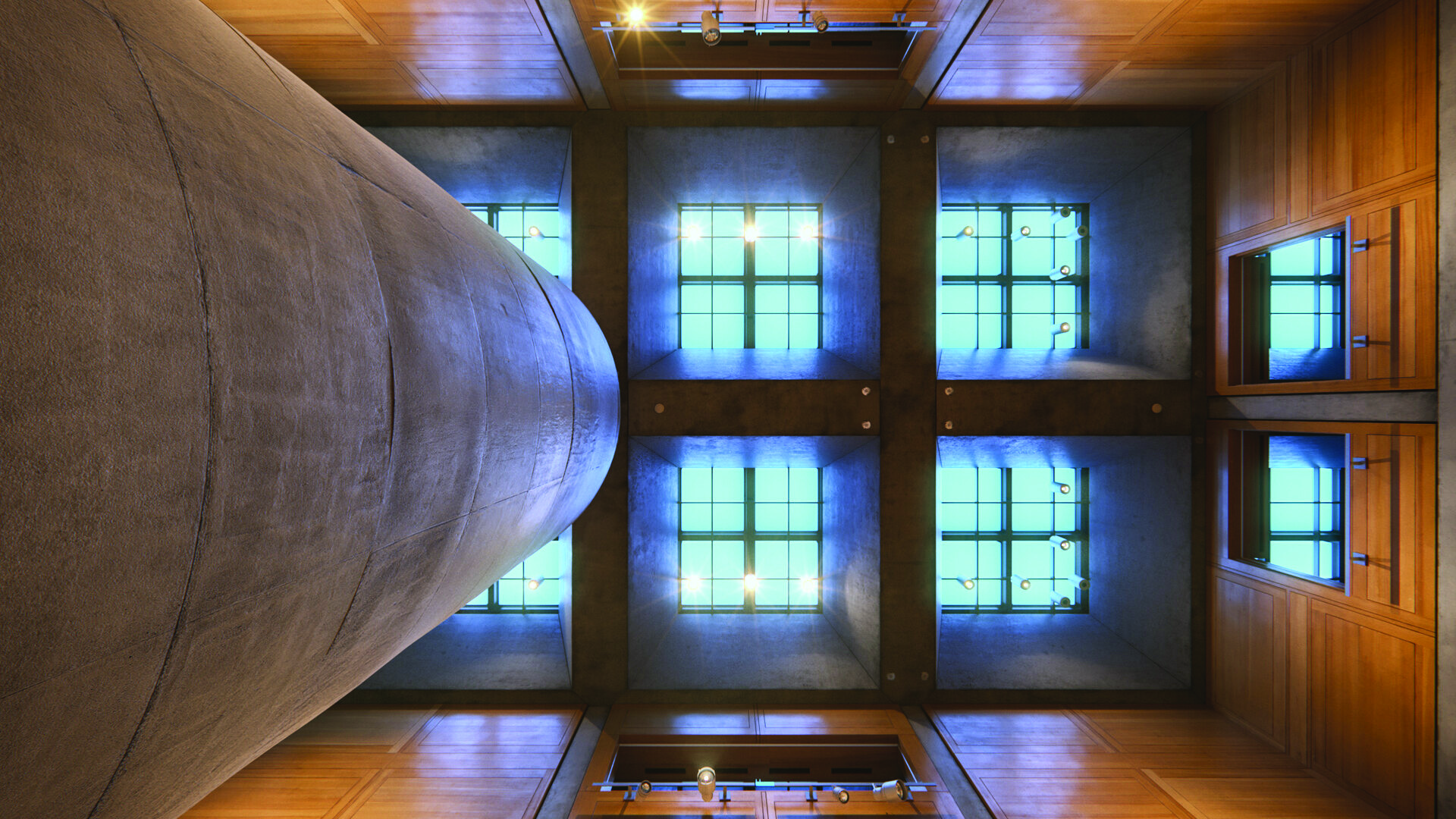
The library court also has its own strange power. The blessing comes to mind when we speculate about the trappings of the baronial, the honeyed light, the masterful oak framing, aristocratic busts, and paintings of faux animal savagery. But, very soon, the ungainly proportions invade the space. Once more, horizontal surfaces gain the upper hand, passing before columns that, as they rise, step back. Once more, the columns stretch; once more, the entablature shirks its crowning role. Now the entablature consists of concrete beams approximately three feet wide at their base that, as they rise, flare outward — at a dimension that is nearly absurd. We cannot imagine the delicate, smooth columns holding the beams, or discern any sort of connection, because the connections have slipped into dark pockets. And the beams are very light. Gone now are Kahn's former thunderbolts; the skylight diffusers filter harsh shadows, and then the oak adds a golden sheen. We are, in fact, in a court of yellow light.
The oak frames maintain the scale of the column grid and the concrete formwork. Yet this is not a stable relationship. Kahn's office detailed the oak so that it appears thick; it presses against concrete columns that have respectfully stepped back. Which is structure, which is infill? Especially at corners, the wooden frames steal the prominent role of the columns; wood slides and leaves a ghost of the columns behind. Above all, wood was there from the first, just as in all concrete buildings. Wooden formwork provides hollow spaces that concrete fills. Even now, seemingly two places are swapping. A ruin becomes another building. Ruins fascinated Kahn: he dreamed of wrapping them around buildings, marking the linear time of history with the decay of a building and the cyclical time of nature with the daily rotations and seasonal changes of the sun. Here, the concrete frame performs this task with greater subtlety, because a concrete building is always a memory of its wooden building — a memory that the Center's dark reveals and the weathered shape of lines eulogize. In conjunction with a materiality that harmonizes with, rather than battles, the rays of the sun, there is a poignancy that steel joins. The dark steel of the exterior and the entrance court is the unseen wood. The ghost of wood, and the gleaming oak frames, seem inclined to fade into light as they too slide into the hollow, frayed spaces of concrete. All of this is presented with such delicacy — the considerable will to create has now been tempered by a kind of resigned acceptance in the face of nature's serendipitous decay. No longer is this a battle of mass and void, light and shadow, man against nature — rather, it is simplicity, a kind of light-footed illumination.

This mood carries us to the top of the stairs. The soft concrete enclosure wraps us like a sheet. The steel handrails match our gripping hand, ductile and compliant. Light from above, through the glass block of the drum's ceiling, bounces. Unlike the worshipful ascent in the Yale Art Gallery, this drum does not trap us in an anxious struggle, but rather buoys us, as though through shimmering water. We stand just below its surface and are drawn into the galleries.
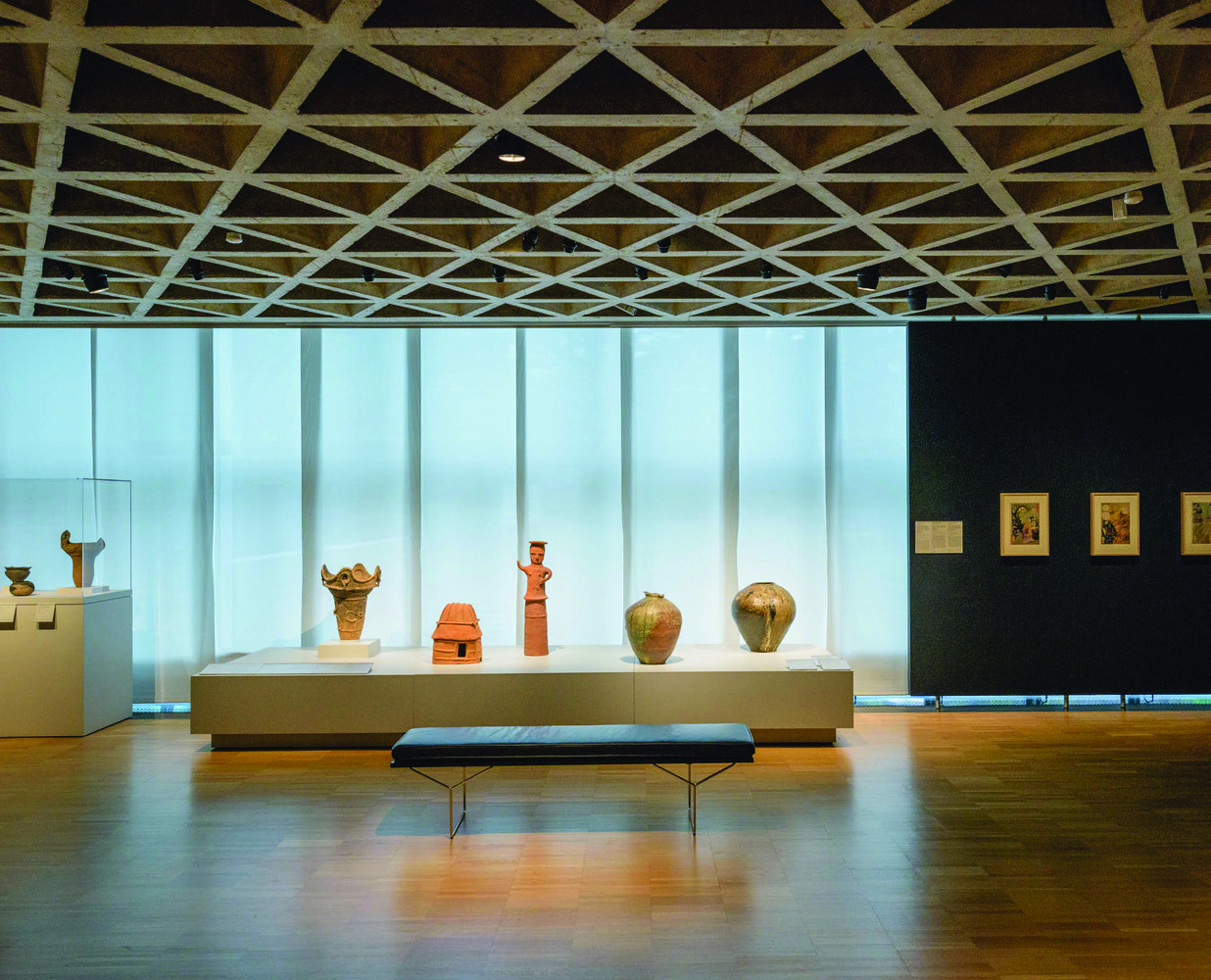
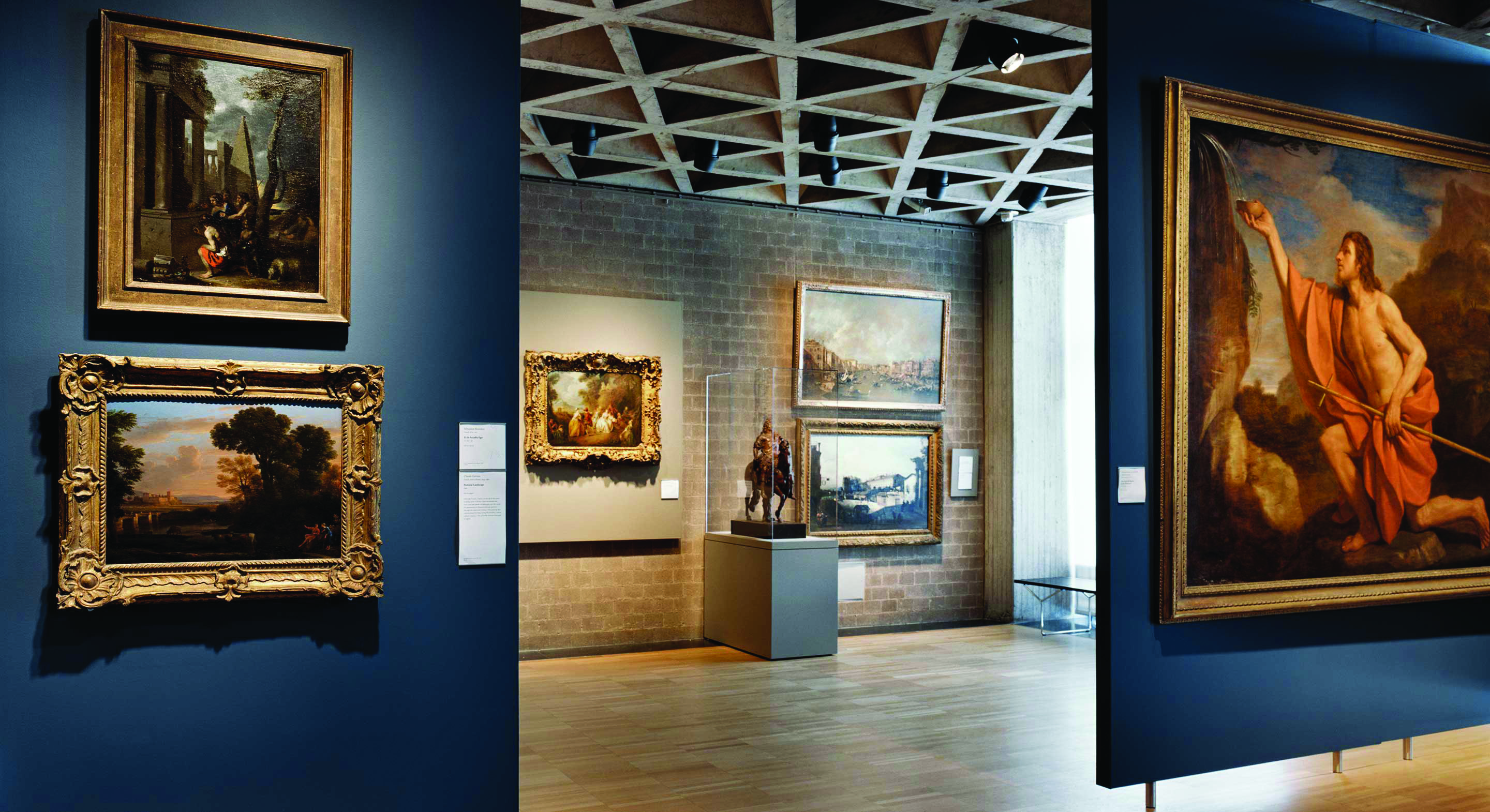
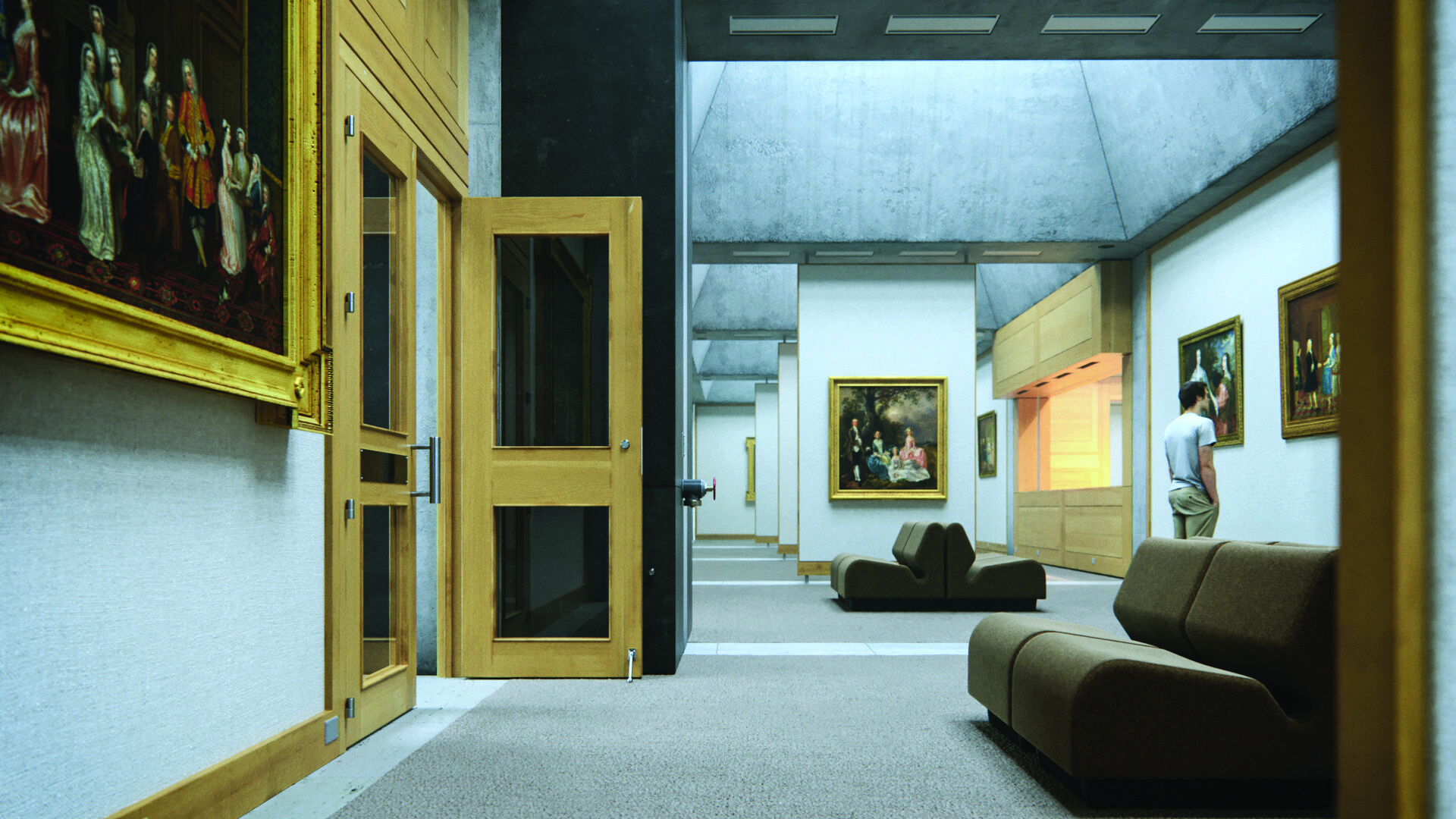
There, strange inversions continue. We are in the attic of the palazzo, a place where, rather than the squat, dark quarters of servants, we find ourselves floating in gentle light, strolling through galleries that house the museum's most valuable paintings. The column bays establish a measure of roughly twenty by twenty feet, close to the scale of a large English country house. But we are not in closeted rooms; we expand, boundlessly, through alternating movable panels covered in unbleached linen. The paintings, scaled to the bays, command our individual attention. Even when the galleries are open as long enfilades, their size and bays insist on our attention rather than amassing paintings as prizes in uniform English galleries. Kahn has abandoned the strict separation of servant and served spaces, because the Center's offices adjoin the galleries rather than being isolated in their own labyrinth. The plan of the palazzo: empty, quiet, without hierarchy. Almost a factory. Staff and the public circulate together in a kind of democracy of use and art — seeing art loses some of its preciousness, while we never lose the sense of a specific space with particular effects. It is as though Kahn returned to his first important project, the unbuilt Trenton Jewish Community Center, and was no longer rebuffed by either the discrete room or the endless grid; he married them with a masterful sense of scale, light, and material.
Now the V-shaped concrete beams are much closer to us. They should overwhelm us, given that they are close to half the height of the galleries, but they do not. The precast concrete lacks the color variations and telegraphic form marks that signal concrete poured in place elsewhere. Fine incisions along their lower surfaces house air diffusers and indicate that these beams are in truth hollow stones (they contain air-handling systems in their folds). Once more, recessed connections and delicate columns conspire against our perception of concrete as something solid and heavy. Concrete is not the tinsel of light; it is its companion — Kahn's chiaroscuro has matured into a kind of gentle light. It is not that concrete has been dematerialized, because light has a material presence. Concrete is out of reach; like light itself, we cannot touch it. Concrete is light.
As we look across the galleries, we see the luminous concrete against its gentler counterparts in the library court and its darker blue-shadowed brothers in the entrance court. Yellow light and blue shadow — as we stand in its separability, a strange luminescence of concrete that might stir our wonder. This feeling is so ethereal that we hesitate to accept it. Despite the palazzo's disruptions and the factory's adjustments, the sense of light's indescribable capacity for intimacy with newly formed possibilities seems a frail strategy. Surely, the sound and fury of the late 1960s demanded something more powerful. Even now, we are inclined to confuse the generosity of this building with its intransigence.
In defense of Kahn, I am reminded of certain remarks by Michel Foucault. Foucault exposed the mechanisms of architecture related to power and control, but late in his professional life, in an interview with Paul Rabinow, he modified his position. Rabinow asked whether the plan of a building always accounts for relations of power. Foucault replied, "No, fortunately for the human imagination, things are a little more complicated than that." Architects, who are more often vilified as affluent authoritarians or celebrated as heroic revolutionaries, Foucault releases to assume a more realistic role. As he explained earlier in the same interview, "Architecture can have more positive effects when the liberating intentions of the architect coincide with the real practice of people in the exercise of their freedom." Kahn, at the Yale Center for British Art, does his part: a new kind of yellow, a beautiful blue, and a new sense of wonder. The rest is up to us.
Editor's Note
* The text above is a translation of the final chapter (Chapter 4) of Michael Cadwell's beautiful and complex book Strange Details. The other three chapters are devoted to:
Chapter 1: Carlo Scarpa's Querini Stampalia Foundation, published in Memar 144.
Chapter 2: Frank Lloyd Wright's Jacobs House, published in Memar 145.
Chapter 3: Mies van der Rohe's Farnsworth House, published in Memar 146.
Nader Tehrani's rich foreword to this book also deserves its own place.
In this era of hollow media talk, reading this book is a gift. If conditions permit, we hope to publish a complete translation of this book.
— Editor, Memar Magazine
Yale Center for British Art in Images


Yale Art Gallery in Images