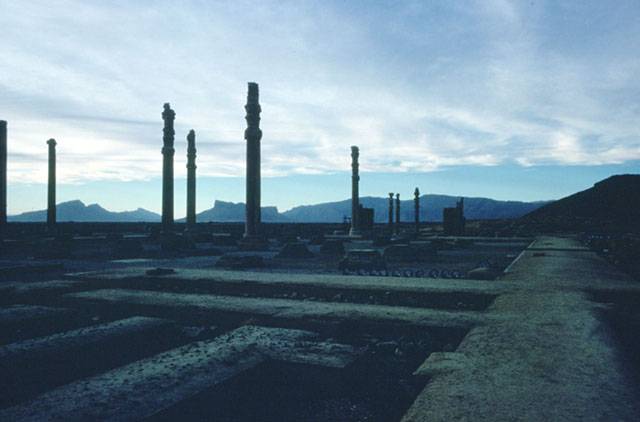
Founded by Darius I around 518 BCE, Persepolis served as the ceremonial capital of the Achaemenid Empire, the largest empire the ancient world had yet seen. Built on a massive stone terrace measuring roughly 450 by 300 metres, the complex was constructed over a period of more than a century by successive kings including Darius I, Xerxes I, and Artaxerxes I.
The site encompasses some of the most remarkable structures of antiquity. The monumental Gateway of All Nations, flanked by colossal stone bulls, welcomed delegations from across the empire. The great Apadana audience hall, with its original 72 columns reaching nearly 20 metres in height, featured elaborate bas-reliefs depicting representatives of 23 subject nations bearing tribute — a visual encyclopedia of the empire's diversity. The Throne Hall (Hall of a Hundred Columns) served as a grand reception hall for military commanders and dignitaries.
The extraordinary stone reliefs carved along the staircases and facades represent the pinnacle of Achaemenid art and architecture. These carvings depict an idealized vision of imperial harmony, showing Persian and Median guards, tribute-bearers from Ethiopia to India, and ceremonial processions connected to the Nowruz (Persian New Year) festivities.
Alexander the Great conquered and partially destroyed Persepolis in 330 BCE. Despite centuries of exposure and looting, the ruins remain breathtaking in their scale and artistry. Inscribed as a UNESCO World Heritage Site in 1979, Persepolis stands as the foremost symbol of Persian civilization and one of the most important archaeological sites in the world.