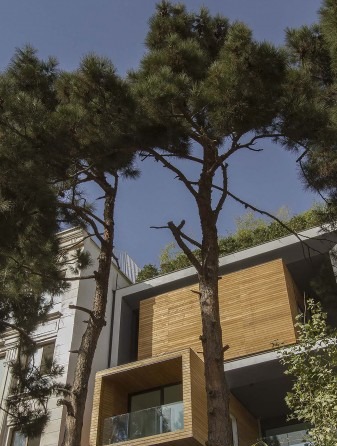
Sharifi-ha House in the Darrous neighborhood of Tehran, on Saleh Hosseini Street, was designed by Alireza Taghaboni of Nextoffice with associates Roohollah Rasouli and Farideh Aghamohammadi, receiving First Place in the Residential Buildings category at the 13th Memar Award (2013). This seven-story building with a total area of 1,400 square meters was built for the Sharifi family. The main characteristic of this project is flexibility and indeterminacy. With the movement of the revolving rooms, both the interior spatial quality and the exterior form continuously change, creating an opening and closing -- an introversion and extroversion -- of the project. These changes can be utilized across different seasons: in summer, an open, transparent volume with deep, large terraces; in winter, a closed volume without terraces and with minimal openings, functioning like the traditional Iranian concepts of winter quarters (zemestan-neshin) and summer quarters (tabestan-neshin). Like many urban blocks, the project site had considerable depth but limited street frontage, so the transformation of the two-dimensional facade into a three-dimensional volume took on a deeper meaning. The rotation construction technique was quite simple -- the same system used in revolving theater stages, automobile showrooms, steel smelting, and shipbuilding. The basement levels are dedicated to sports and recreation, the ground floor to parking and a caretaker unit, the first and second floors to public functions, and the third and fourth floors to bedrooms.
Galerie
Emplacement
City-levelLoading map…
Tehran, Iran(35.689, 51.389)