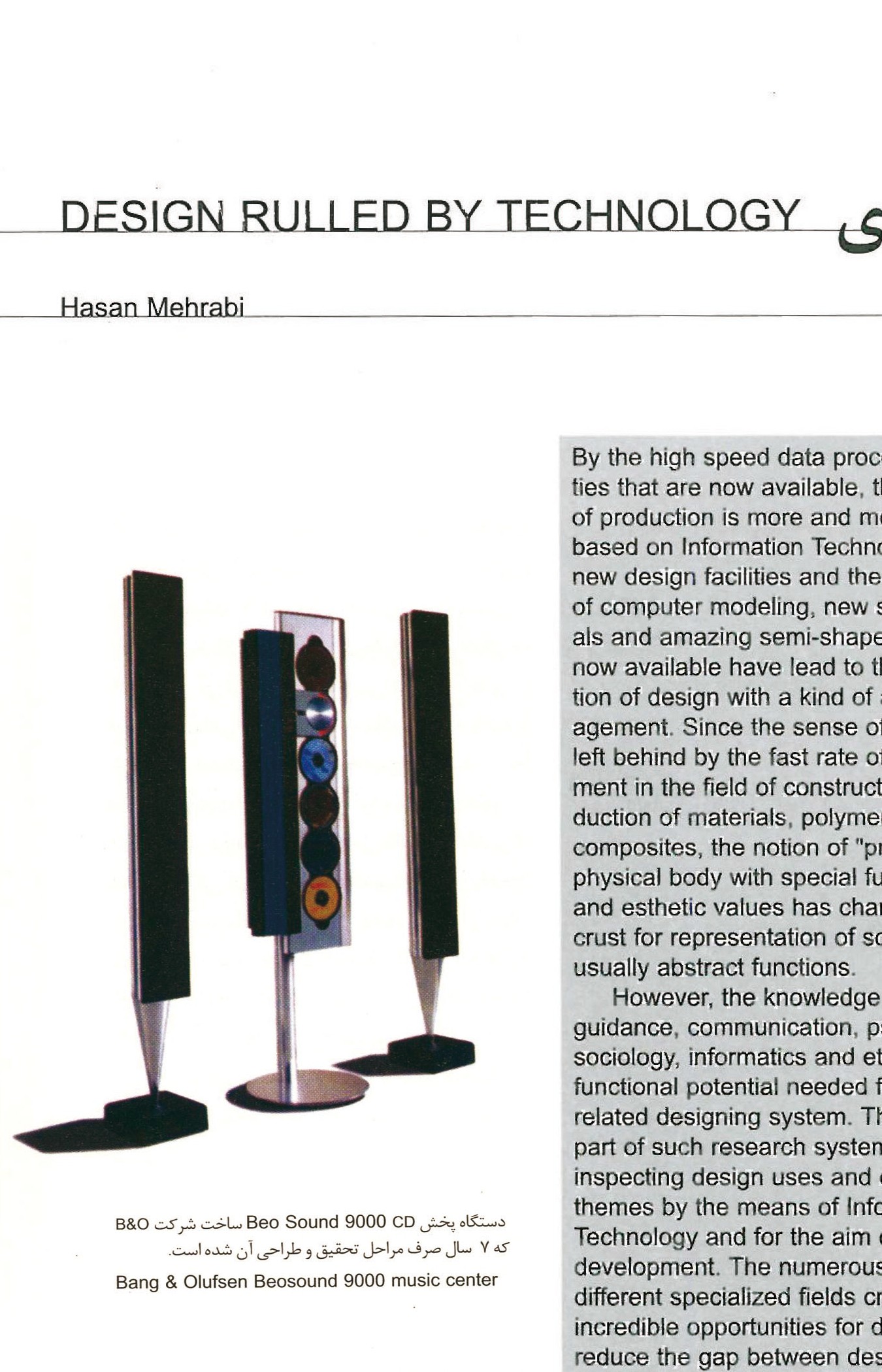
Today's products point to a uniformity of public taste and a uniformity of aesthetic values issuing from new technology. The proportions, surface finishes and symbolic expression now standard for an automobile are observed in the design of other products as well — mobile phones, digital cameras, the control panels of audio-visual equipment, and so on. At the same time the boundary between artistic design and technological design in these products is blurred by the new methods of forming and moulding their complex sub-parts. Technology is removing the technical limits of production methods at high speed; the market, as the addressee of the goods, is captivated by the technical inventions and innovations of the products before it can pause over their functional and aesthetic values. If today, when buying a product like a mobile phone, you wish to make personal taste your criterion, you will run into trouble. It seems you cannot find any trace of artistic design in the outer body of these products. Instead, an ever-rising number of technical functions and ancillary capabilities fills the empty space where their aesthetic dimensions ought to be.
High-speed data processing, the new facilities of computer-aided design and modelling, the creation of astonishing semi-materials and semi-forms, have led to a kind of "artistic management" being substituted for design. The display of the visual qualities of materials in complex forms, the transformation in the way colour, texture, material and the reflection of surfaces of volumes are presented in the virtual space of computer modelling, has set its own visual and aesthetic values in fashion. The lag of design vision behind the rapid development in materials, polymers and new composites has turned the product from a material body with specific functional and aesthetic values into a shell for the display of a sequence of largely immaterial functions. The reduction of design to fashion — usually attributed to Pop Art — in the present age has reduced art to management. The designer, as the user of design software and modelling systems, is increasingly hemmed into a hardware framework, and is pushed more and more towards processing at the software level — although in fact the processing of design data has more to do with information-technology technicians, programmers and software specialists. Software design has not only made the technical questions of programming and the analysis of design data easier, it has also made the giving-of-form to ideas and their modelling far easier. These facilities address the way ideas are presented at levels far beyond the perception and reception of the addressees.
McLuhan, the global village, and the human-machine
Marshall McLuhan, who proposed the idea of the global village, claims in his book The Medium is the Message that tools are the extensions of the physical organs of man. By placing logos and images, he tries to show — through advertising graphics — a logical relation between new tools and products and the organic organs of man: the book is the extension of the eyes, the clothing the extension of the skin, the wheel of the automobile the extension of the foot, and so on. According to McLuhan, the development of technology is a process complementary to the physical organs of man. Almost contemporaneously with McLuhan, in an interview Heidegger said it would be cybernetics that took the place of philosophy. The rapid expansion of tools complementary to man, in McLuhan's reading, could in Heidegger's cybernetic world give birth to a new social identity — the "human-machine", which had already declared its existence with the conversion of industrial labour into machine-operators of production. With the entry of the computer into the production process, the "human-machine" epidemic spread to the upper levels of the productive forces — those forces that had played a more strategic role. Production engineering, materials engineering, production planning and design joined the legions of users of specialised software. Expert systems began to encroach on the territory of every specialist in every field.
McLuhan held that tools, by changing the environment, change our sensory reactions; the extension of any sense transforms thought, action and our outlook on the world. When this proportion changes, the human being is also transformed. It is natural that the designer — both as the addressee of social development and as a participant in the production of its tools — must rethink many of the principles and concepts at stake and react afresh to the advanced levels of contemporary knowledge and technology. The role of design in producing harmony between the advance of technology and cultural development becomes possible by formulating ways of speeding up the design process — something that takes place at firms such as B&O, where, save in special cases, no technical and economic justification can be found in the laying-out of design without these new tools. The technical demands made on design information in this period are far greater than the control-lists of the flat-design era. Today, systems are designed that include micro-electronic components with extremely complex functions, and the systems are reshaped — not only because of the system's output and the harmonisation of its visual signs with electronic functions in its form and in what is meant to be evoked, but also because of the demands of contemporary technology in terms of speed, cost and capacity for communication. This deficit follows from the dead end reached by the traditional view of organising design activity.
The rapid growth of information technology forces designers to use new methods. For example, polymer technology — which makes possible the production of plastics with special properties for the various sub-sections and components of products as determined by functional analysis — has reversed the relation of raw material to production: the designer, instead of fitting the working mechanism of the product to the material being used, has now found it possible to fit the properties of the material being used to the mechanism and function of the product. Daniel Bell, the American sociologist, argued in his book The Coming of Post-Industrial Society in the late seventies that the productive system in a post-industrial information society is no longer summed up in the humanist domination over the properties of the materials common in the manufacture of goods. In its growth, it tends towards the dominance of techno-informational utilities. Polymer-production technology in the present age, by providing materials capable of being precisely fitted to the kind of function required, has broken through the impenetrable wall of material limitations in design and so paved the way for the dominance of techno-information over humanism.
On the other hand, the spread of the division of labour in the information society has stripped the unity of design of its credit. The notion that the design belongs to a single designer is no longer relevant. The activity of design has been broken into pieces. There are designers who design, designers who research and designers who organise and plan. Design is influenced by the images presented by the researcher-designer, and the route from idea to model is no longer driven by a single creator. Today the design belongs to the synergy of the design team — not to one designer.
Conclusion: a designer for the post-industrial information society
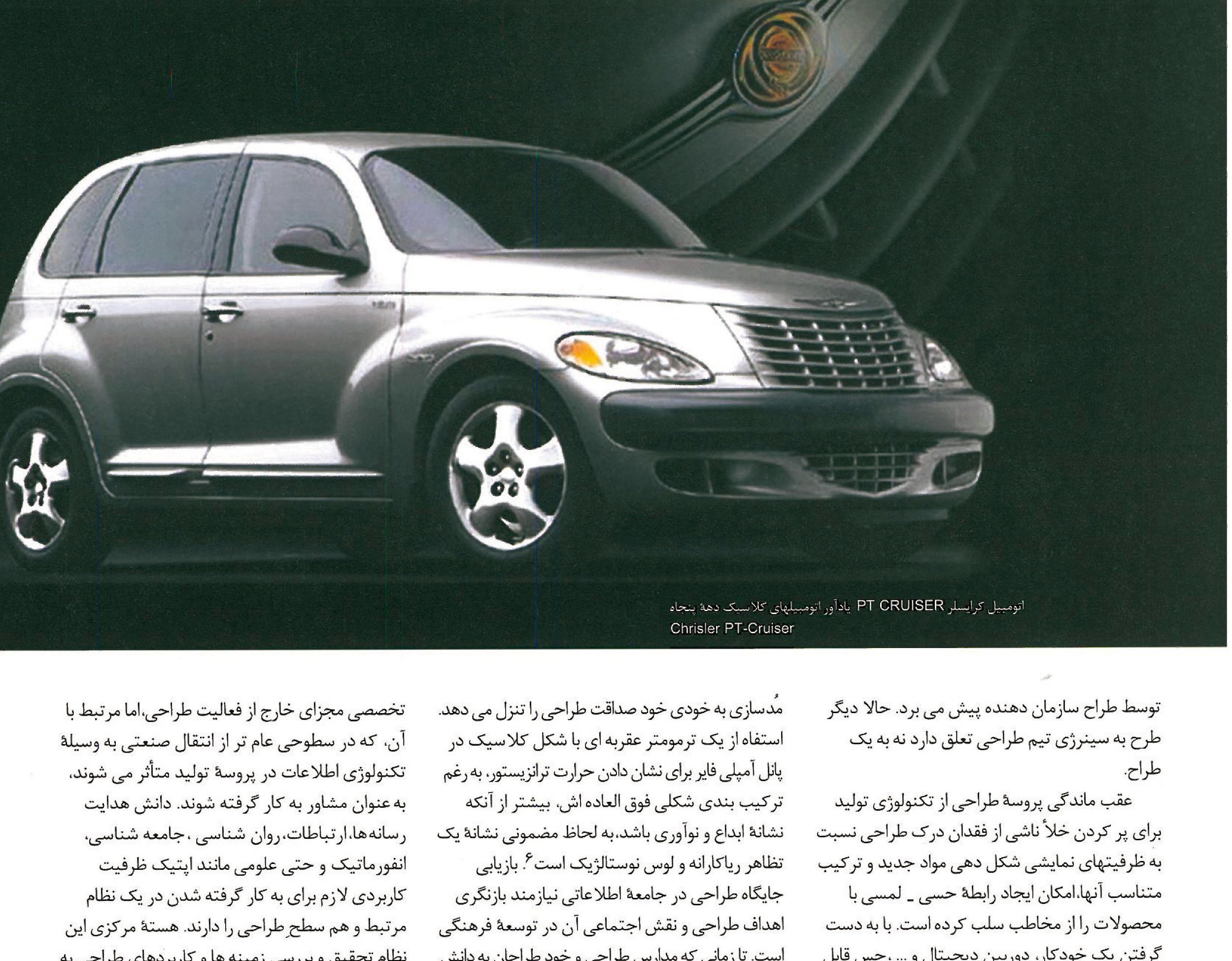
The lag of the design process behind the production technology — to fill the gap left by design's failure to grasp the display capacities of new materials and their commensurate combinations — has stripped the addressee of the chance for a sensory or tactile reaction to products. With this lack of design's grasp of materials, the inclination toward making fashion and following fashion has become a guiding line for finding ideas. In the late 1990s and the start of the third millennium a kind of regression to the past has emerged in the design of the outer shell of products. The Chrysler PT Cruiser is reminiscent of the classic cars of the 1950s; the Chevrolet SSR is a reminder of those classic American cars of the 1950s. Imitation in itself drags down the integrity of design. The use of an analogue thermometer with a classical face on the back-panel of an audio amplifier to display the temperature of a transistor — for all its extraordinary visual composition — is, in terms of meaning, less the sign of an invention than of a coy and nostalgic mannerism. Recovering the standing of design in an information society demands a re-examination of the goals of design and of its social role in cultural development. As long as design schools and designers themselves look at the knowledge of design as an idea-factory, design's subservience to technology, information and the embossed seal of fashion will be unavoidable.
Design is a process superior to the production of three-dimensional forms. In the relations and proportions now governing the global phenomenon of production it is necessary that distinct specialised fields outside the activity of design — but related to it — be drawn in as advisers; fields that, at more general levels, are themselves affected by the industrial transition mediated by information technology in the production process. The knowledge of media guidance, of communication, of psychology, of sociology, of informatics, and even of disciplines like ethics, possesses the practical capacity to be enlisted into a design-related and design-equal system. The central core of such a system is the research and study of the contexts and applications of design through information technology for the purpose of cultural development. Design appropriate to information technology — the prerequisite for design's connection with massive social aggregates and an advanced economy — creates extraordinary opportunities for designers to reduce, by harmonising materials and production methods with symbolic associations, by refining the sensational signs and adopting common visual signs for the new presentational capacities of new products, and by understanding the sensory-tactile structure of the addressees' reactions to them, the gap of design with the new situation of the production system.
Printed English summary panel (PDF 110)
By the high-speed data processing abilities that are now available, the process of production is more and more being based on Information Technology. The new design facilities and the possibility of computer modeling, new semi-materials and amazing semi-shapes which are now available have led to the substitution of design with a kind of artistic management. Since the sense of design is left behind by the fast rate of development in the field of construction and production of materials, polymers, and new composites, the notion of "product" as a physical body with special functional and esthetic values has changed into a crust for representation of some certain usually abstract functions.
However, the knowledge of media guidance, communication, psychology, sociology, informatics and etc. has the functional potential needed for an inter-related designing system. The basic part of such research systems is inspecting design uses and design themes by the means of Information Technology and for the aim of cultural development. The numerous merits of different specialized fields creates incredible opportunities for designers to reduce the gap between design and the situation of new production systems by harmonizing materials and production methods with the symbolic associations, refining the sensational aspects and also adopting common visual signs for the new presentational capacities of new products and understanding the sensational (palpation) structure of the addressees' reactions toward them.
Footnotes: 1. The Penguin Press, 1967. 2. Expert systems. 3. Bang & Olufsen. 4. Daniel Bell. 5. The Coming of Post-Industrial Society. Captioned products on the page: Bang & Olufsen Beosound 9000 music centre (B&O — seven years of research and design); Marantz PM-17 KI amp with analogue thermometer; Siemens SL-55 cellphone; same looks of some digital cams by different brands; Chrysler PT Cruiser; Chevrolet SSR.