Pardis Technology Park is being constructed by the Presidential Cooperative Office of Technology at Pardis, a new city located in the east of Tehran. This attempt is in response to the need of research companies, which are active in the field of new technologies and are expanding their technology of industrial products and need an environment with communal substructures, facilities and utilities, and also proper spaces used for research. The research buildings don't possess a predefined architecture. The variety found in the type of activities that take place in different companies (according to their final product), and in their position in the process of research, recommendatory production, sample production and engineering design has caused a lack of proper guidelines needed in designing these buildings. One can add the scale and amount of the activities done in different companies and also the separation of these complexes from the city texture to the above list.
Pardis Technology Park Association invited the interested contractors to take part in the competition by paying the five top selected projects the first design phase compensation and a 20-million-Rls award to the first winner, in order to encourage them to achieve a higher standard of architectural quality in their designs.
Although some companies prepared their frameworks and delivered them to the architectural committee, not all of them did participate in the tender. From the ten designs which took part in the competition before the declared deadline and which respected the competition regulations, five were chosen by the jury consisting of Farhad Ahmadi, Serajeddin Kazerooni, Farrokh Mohammadzadeh, Seyyed Hadi Mirmiran and Seyyed Reza Hashemi. These designs are introduced in this issue.
When Marcel Duchamp sent his "Fountain" under the pseudonym R. Mutt to the New York Independents exhibition in 1916, he was paying little attention to the value of the contest or to the choice of works for public display; what he aimed at was a critique of the prevailing artistic currents and of the way the jury chose the works. The competition has always been the best method of selecting works of art, and it is only in a competition — or in conditions resembling a competition — that one can witness the emergence of creativity.
1st place — Mehrdad Golmohammadi: Technology and Research Center of Iran Nasb Niroo Co.
- Client: Iran Nasb Niroo Co.
- Programme: Technology and Research Center of Iran Nasb Niroo Co.
- Designer: Mehrdad Golmohammadi.
- Design associate: Negin Beyhaghi, Kaveh Mazhar.
- Structure: Mohammad Taghizadeh.
- Electrical / electronics: Eng. Shokraei.
- Mechanical: Amanollah Faryadras and Mohsen Geraei.
From Mehrdad Golmohammadi's point of view, the architect must — through his work — both transcend the rote, lifeless construction of contemporary practice and at the same time mount a critique of the architecture of "special effects". Only in this way can the architect re-shape the existing situation in his work and submit it to scrutiny.
For the design of the Iran Nasb Niroo building, Golmohammadi proposed a single, clear box. The volume — a rectangular cube — is sited as a continuous mass with a perforated metal envelope; on each side, the openings have been arranged according to the orientation, the views and the principal functions of the interior. The building is oriented to a north-south axis, with the long sides facing east and west. The roof terrace, framed by the metal envelope, becomes a final outdoor room of the building.
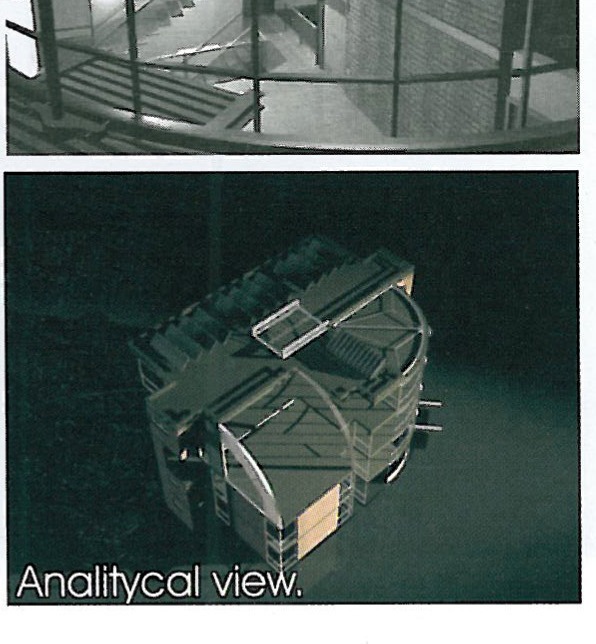
2nd place — Reza Daneshmir: Petunia Co. R&D Building
- Client: Petunia Co.
- Programme: Petunia R&D Building.
- Designer: Reza Daneshmir.
- Design associate and computer modelling: Pooya Khaze'eli Parsa.
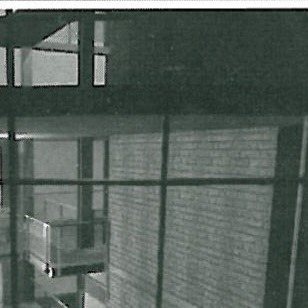
For Reza Daneshmir, architecture is a conceptual problem. In his words: "Architecture is the design of a spatial idea that, in addition to solving the project's specific problems, raises a question about space itself. Architecture, then, is the sum of an idea (space) and a building, in which space is a conceptual problem and the building is the existing physical reality." Daneshmir's idea for the educational and research building is the Hyper-Cube: "a cube plus a force, which gives it direction, scale and the will to combine."
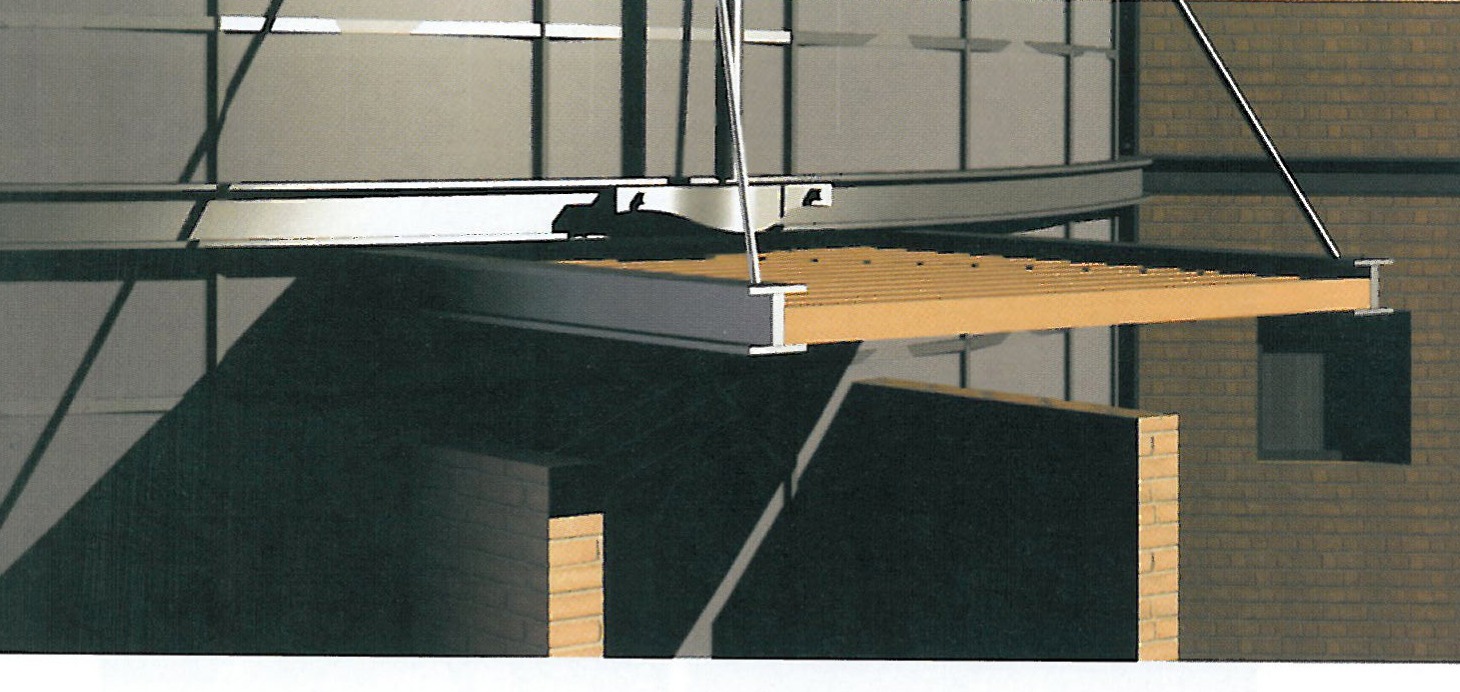
The hyper-cube combines simplicity and complexity at once; with this spatial idea, and with the project's specific programme — which has two distinct parts (administrative and educational/laboratory) — the project takes the form of a single integral volume with two distinct faces. The form of the project is at once the generator and the regulator of the inner and outer fields of energy that act on it. This is possible only if the form has the ability to receive information from the various energy fields and to display, over time, the changes they produce in its own structure.
3rd place — Hamid Anbarani: Aliazgaran Research Workshop
- Client: Aliazgaran Co.
- Programme: Research workshop for Aliazgaran.
- Site area: 2,220 sq m.
- Designer: Hamid Anbarani.
- Computer modelling: Nima Tohidi.
- Graphic designer: Ali Sadeghi.
The site is in the centre of one of the technology-park plots, with the long axis aligned roughly north-south. The principal idea is that of "fragmentation": the technology that drives the workshop is the design's own raw material. "Throughout the complex steel structure has been used; in the administrative and parts of the workshop section, in a hybrid arrangement. The roof of the main hall is a saw-toothed industrial profile with combined skylights, and the body and roof of the technology hall (1:2) is made of pre-fabricated industrial panels with an aluminium finish."
The technological character of the form and the space is defined by exposing the architectural elements: the metal frame is left visible, the saw-tooth roof is read as roof, the panels are read as panels. From this honesty about its means the building draws its identity.

4th place — Arash Mozaffari: Asr-e Danesh-Afzar Office & Research Building
- Client: Asr-e Danesh-Afzar Co.
- Programme: Office & Research Building.
- Designer: Arash Mozaffari.
The technology park's research building presents an architectural problem with a long history; the architect, in his approach to the brief, sought a clear architectural strategy. The Asr-e Danesh-Afzar Building, in plan, takes the form of two cylindrical research masses set against a horizontal administrative bar; the bar acts as a sieve, drawing the visiting researcher down a route that brings him into the workshops below. The whole forms a clear, legible diagram — a research building in which the experimental work and the discursive work are clearly differentiated.
In the elevations, the architect uses three principles: a continuous surface, a "mother-board" pattern of openings, and the legibility of the installations. The cylindrical masses are clad in a continuous metal screen; the horizontal bar reveals its structural rhythm; the installations are made part of the architectural identity rather than concealed.
5th place — Reza Aliabadi: Sandjesh Daghigh Tool Co. Research Workshop
- Client: Sandjesh Daghigh Tool Co.
- Programme: Research workshop.
- Designer: Reza Aliabadi.
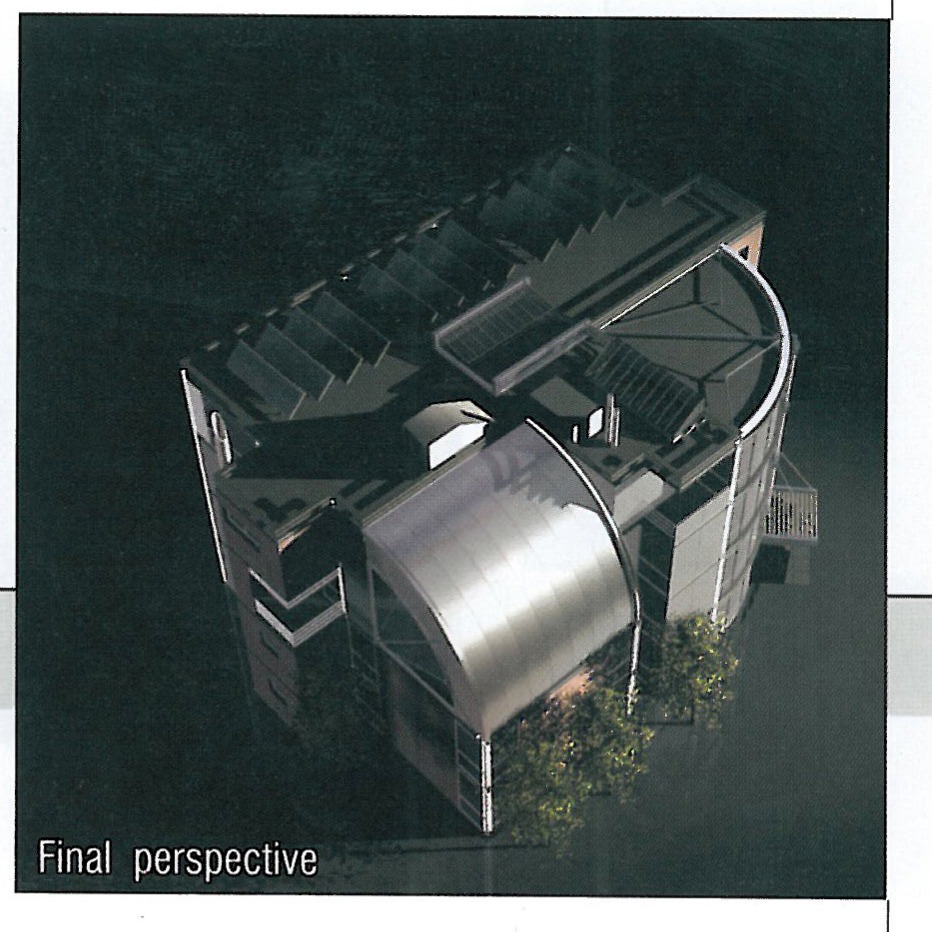
The Sandjesh Daghigh Tool Company's research workshop is conceived as a clear, contained box: a rectangular volume with a curved metal canopy at the entrance and a precisely-calibrated curtain-wall to the principal façades. The workshop hall, the office wing and the research wing read as three legibly separated programs gathered under a single roof; in elevation, the building states its workshop nature through its long horizontal organisation, through the curtain-wall openings of the office bar, and through the visible structure that supports the entrance canopy.
1 Marcel Duchamp, A Window Open to Something Else, translated by Lily Golestan (Tehran: Farzān-e Rouz Publications, 1372), p. 120.
2 Continuous Surface.
3 Mother Board.
4 Installation.
Jury references: works of Farshid Moussavi / Alejandro Zaera-Polo, Daniel Libeskind and the MVRDV group are cited in the introduction.