With the dawn of the second millennium and the emergence of various signs and indications — among them the stunning advance of communications technology that has turned the world into a small village — some scholars now regard the impact of these changes as equal, in our moment, to that of the Industrial Revolution of the eighteenth century. A period in the history of human civilisation has ended and a new age has begun, one accompanied by fresh discussions and theories in philosophy, the sciences, literature, art and other fields of thought. Architecture, of course, has not been exempt from the influence of these changes, and in the past few years, as the new millennium opened and these discussions spread, many symposia and sessions — with the participation of theorists from non-architectural fields — have been convened to address the theoretical dimensions of the architecture to come. Since these discussions are, on the whole, analytical in nature and have mostly been devoted to a critique of the modern architecture of the past century, one cannot yet speak of a coherent, complete theoretical basis articulating the traits and markers of the new age. Nevertheless, most theorists seem to agree that this century — after many ups and downs — has reached its closing stages, and that the theoretical foundations, content and form of this architecture have, over the past two decades, been so profoundly transformed that fresh definitions of them have become necessary; and they take that very necessity as a sign of the formation of a new age and period in the history of architecture.
In this series of articles the fundamental currents and transformations in twentieth-century architecture — including theoretical foundations and their attendant debates, schools and intellectual currents in different periods, the role of educational centres and scholarly institutions in nurturing these theories, and finally the manifestation of these theories in the field of professional architectural activity on the world stage — will be examined. Although this subject, especially in the past decade, has been treated in detailed and comprehensive books and from various perspectives in America and Europe, and readers may be familiar with some of them, the lack of adequate Persian sources in this area — and the overlooking of these very important discussions in journals, circles and even in Iran's schools of architecture — has made it necessary to compile a series in Persian. In what follows, along with a more detailed explanation, the necessity and aim of presenting these articles at this moment, their thematic arrangement and, finally, an overview of the contents of these articles in the form of seven periods will be presented.
Why take up this discussion? In recent years, two decades after the rupture of our relation with the world, the void left by theoretical debates about the world's contemporary architecture has been raised in journals and architectural circles repeatedly and under various headings. In these years, some architectural journals and certain design firms have attempted to fill this void somewhat by publishing articles and translations of selected controversial pieces. But unfortunately, due to the lack of a comprehensive view of the theoretical foundations of modern architecture from its beginnings until today — both among students and among architects graduated from the schools of this country — topics such as post-modernism or deconstruction that have been addressed in journals and certain books have not had the desired informing effect on the understanding of the matters discussed. The ideas that shaped modern architecture in the late nineteenth century — as presented in theories and manifestos — were universal and directed toward global social transformations, not only those of the European countries. Iran's contemporary architecture (at least over the past sixty years) has itself been a part of world modern architecture, and for an accurate grasp of the present situation it is necessary to have a comprehensive knowledge of modern developments — to refine our own foundational thinking and to arrive at a more precise picture of the current architectural process and of likely future processes in our own land.
Despite the sensitivity around "Westernism" and "cultural invasion" over the past two decades, both in architecture and in other fields, the realities of today's world — which, visibly and invisibly, keep diminishing the physical borders between countries — have meant that cultural, ethnic and linguistic attachments can no longer prevent the interaction of various cultures and the shaping of new ones. Undoubtedly, if we grasp these processes deeply, we can have our own share in the world's contemporary architecture. Already, in the designs of certain leading contemporary figures, we find features of Iran's traditional architecture. This does not mean that these designs have departed from the frameworks of modern architecture; the cultural complexes and even residential complexes built in these years — whose design is fundamentally posed within the framework of modern foundational thinking — show the use of certain traditional Iranian elements as a linkage that should not be read as an exit from the modern framework. In some important world projects we have also seen that an architecture born in a cold European country has been able, through appropriate solutions and by using elements of the traditional architecture of a hot-dry climate, to design a building that at first sight may seem strange and unfamiliar but, with time, may be regarded as the most desirable and most lasting example of that country's architecture.
Another important point concerning the necessity of discussing the theoretical foundations of modernism is that, contrary to the opinion of some critics (both in Iran and abroad), architectural education and the schools of architecture have played an important role in shaping new ideas and progressive views; and perhaps one of the fundamental weaknesses of Iran's contemporary architecture is the weakness of its schools of architecture in this respect. We have seen the prominent role of the schools — at the beginning of the century in Europe, in mid-century America, and in the seventies and eighties in both Europe and America — in the formation of new schools and new ideas. We have also seen how these institutions have played a major role in the theoretical formation and activity of many great teachers of twentieth-century architecture: the Weimar Academy and then the Bauhaus in Germany, the Moscow Higher Academy in Russia after the 1917 revolution (the centre of Russian Constructivism), the École des Beaux-Arts in Paris, the AA in London, the schools of Harvard, IIT Chicago, Cooper Union in New York and other respected schools of Europe and America — projects with fresh concepts and different programmes have always been proposed and tested, and these experiments have led to the shaping of new forms of design and building.
In this series the last hundred years of architecture are divided into seven periods, and the themes of each period — from both the professional-specialist angle and that of architectural education, and the ideas and debates raised in that period — are set out in a way that clarifies the relation between theory and practical-professional work. But for a deeper understanding of the conditions in which the early periods were shaped, beginning in the late nineteenth century, it is necessary to present a picture of the historical, social and economic conditions of the second half of the nineteenth century — its mental climate, the theories of its thinkers and the debates of that time — together with the material conditions and concrete factors that gave rise to that period; and to examine the effect of these two factors on the transformations that shaped the city of the new age.
Here we should recommend a book for those readers of these articles who are not deeply familiar with the history of nineteenth- and twentieth-century Europe. The book is All That Is Solid Melts into Air: The Experience of Modernity by the contemporary American author Marshall Berman, published in 1981, which intelligently pictures the important historical events of two centuries from a sociological-architectural angle, in close connection with the life-problems of the metropolis. Recently the book has been published in Persian in a fine, fluent translation by Morad Farhadpour. Reading it before reading these articles will be most useful.
After examining the conditions of the last decades of the nineteenth century, the birth of modern architecture is examined in a seven-part periodisation, from the last decade of the nineteenth century (1890) to today, with the features of each period being set out. The basis for dividing these hundred years into seven periods is, above all, the study of many books published in recent years on this very subject. Contemporary critics have proposed various periodisations for the past century, and in this series — with emphasis on the features of each period — seven successive periods (not strictly one after another, and overlapping a little) have been examined; and points or matters that have not necessarily been given enough weight in all the published books have been highlighted. At the same time, care has been taken to address matters that are less attended to in Persian-language writing.
This seven-part periodisation is, moreover, inspired by one of Shakespeare's well-known verses in As You Like It, which portrays human life from infancy to its end in seven acts. The pattern seems apt for explaining the formation, flourishing and decline of a phenomenon. The famous lines from As You Like It (Act II, scene vii) run thus:
"All the world's a stage, / And all the men and women merely players. / They have their exits and their entrances, / And one man in his time plays many parts, / His acts being seven ages." — the infant; the schoolboy "creeping like snail / Unwillingly to school"; the lover "sighing like furnace, with a woeful ballad / Made to his mistress' eyebrow"; the soldier "jealous in honour, sudden and quick in quarrel, / Seeking the bubble reputation / Even in the cannon's mouth"; the justice "in fair round belly with good capon lined, / With eyes severe and beard of formal cut, / Full of wise saws and modern instances"; the sixth age "shifts into the lean and slippered pantaloon, / With spectacles on nose and pouch on side, / His youthful hose, well saved, a world too wide / For his shrunk shank, and his big manly voice, / Turning again toward childish treble, pipes / And whistles in his sound"; and the last scene that ends this strange, eventful history "is second childishness and mere oblivion; / Sans teeth, sans eyes, sans taste, sans everything."
Before Act I, a prologue — historical-social and economic-political — will recount the start of the modern era in the early nineteenth century, and then, mentioning certain important elements and figures of the late nineteenth century, will recount the design and execution of modernism's great project in its proper setting, the metropolis.
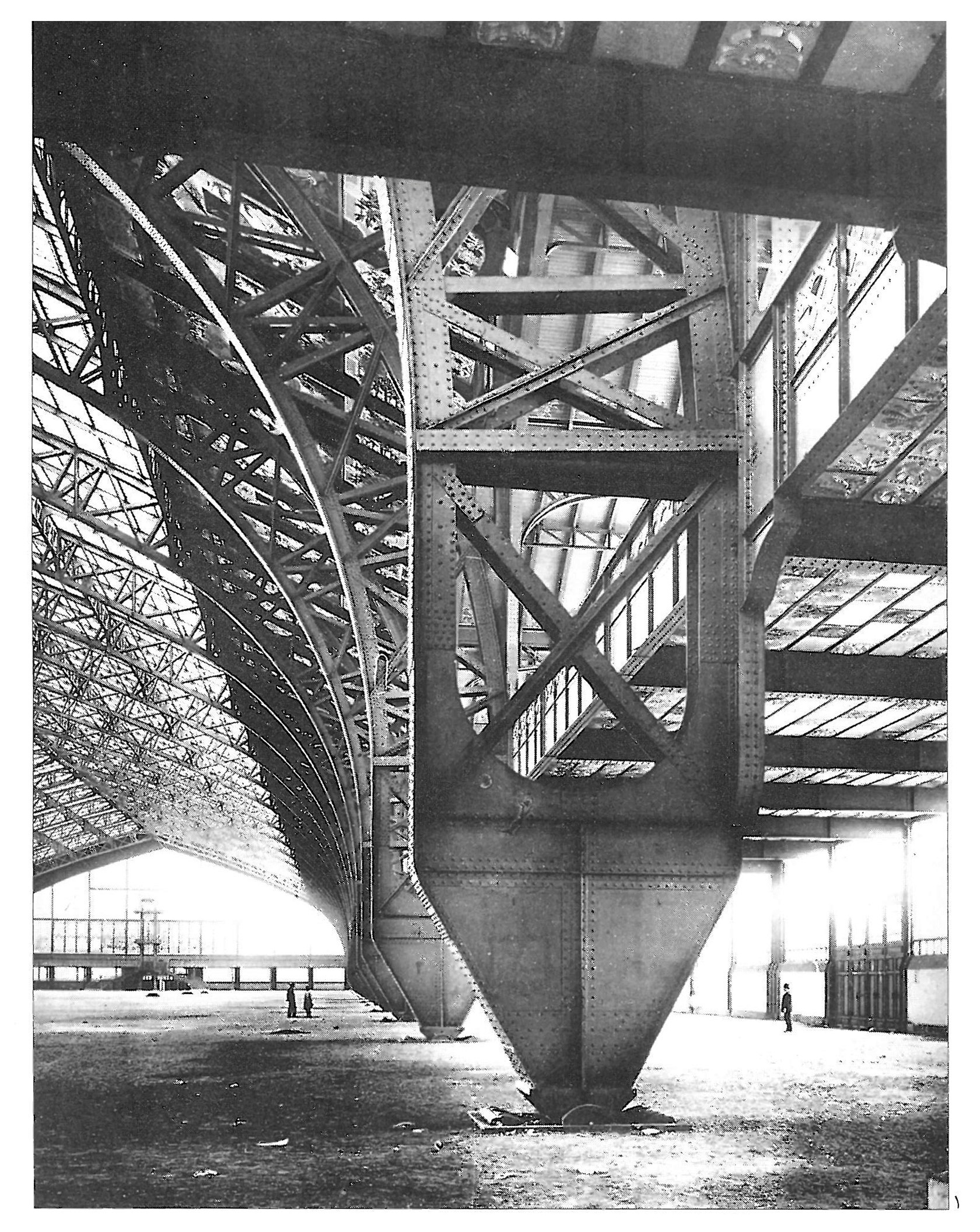
Act I (1890-1914): The Infant of Modern Architecture. In this act the infancy of the newborn — the very being and role of architecture and of the architect — is displayed in conditions in which, owing to the entry of metal structures onto the scene, they have been called into question and must, by objective necessity, undergo a fundamental change in every field; and in effect, with a new birth, must declare their new existence alongside professional craftsmen and engineers (a newly formed branch). In another scene of this act we shall see young, determined architects — both in Europe and across the Atlantic — forming new schools, inventing new building techniques, using new materials, and designing and making everyday objects and furniture, turning their backs on industry-driven thinking and making a great effort to introduce artistic dimensions into their work. At the same time, in this very period, after the new developments in Paris, the other cities of Europe and America also come to recognise their own fundamental role as the stage of new events in the everyday life of people; in effect the infant begins to walk.
Act II (1905-1925): "The schoolboy years of modern architecture." This period is in fact the period of shaping the theoretical foundations of modern architecture, bound up with the thinking of the early-twentieth-century socialist movement. In this period many intellectuals in academic forums and in the schools of art and architecture debate these foundations, and schools such as the Futurists in Italy, the Weimar Academy in Germany (the Bauhaus school in its earliest phase), the Constructivists in Russia, De Stijl in the Netherlands and the French modernists take shape. After the First World War these schools begin a new period of activity and place architecture next to other artistic activities; and in the early 1920s we shall see the many "pranks" of these schoolboys.
Act III (1925 - late 1930s): This act shows the period of the rapture and idealism of the young modern architect who is in love with every new phenomenon — the automobile, the ocean liner and the aeroplane — and with giving a new form to everything. In this period many new theoretical ideas take shape and are then put to the test in various artistic laboratories, gradually manifesting themselves as the primary elements of modern architecture in various buildings. Vast transformations take place in every branch of the arts. Poets alongside set-designers, sculptors alongside photographers, architects alongside painters and textile and fashion designers, alongside philosophers — by creating wholly new and original works — experience a new kind of modern life in all the affairs of twentieth-century social life. At the end of this period the first International Congress of Modern Architecture (CIAM) is held in 1928.
Act IV (1929-1939): This act shows the boldness of the sworn soldiers who, with steely will, enter the battlefield and turn the lives of millions upside down. The international style of architecture emerges toward the end of this period as one of the architectural styles, and the period of building great industrial and residential complexes in Europe and America begins. In this same period, a kind of heroic and striking neoclassical architecture also emerges in Germany and Russia as the preferred architecture of the totalitarian regimes of Hitler and Stalin; in both countries this weakens modern architecture and drives many modern thinkers, artists, teachers and architects to emigrate to other countries in Europe and America. At the same time, modern architecture appears in a new form and in the guise of Art Deco in Britain and America, especially in New York, where major changes occur in the fabric of that modernist Mecca, and where the Parks Commissioner Robert Moses takes on a major role.
Act V (1940-1972): The main figure of this act is the seasoned, experienced justice who, shortly after the end of the Second World War, rises to a senior governmental position and plays a role as one of the main figures in Europe's social-democratic governments in advancing their metropolitan and reformist programmes. Great projects — especially low-cost prefabricated residential complexes for large masses of people whose housing was destroyed in the six years of war — are one of his priorities in advancing reformist policies, and public buildings such as hospitals, schools, libraries, concert halls and so on are another priority — which emerge as symbols of modern-architectural programmes across Europe and elsewhere. In America too, this modern architecture — admittedly without its socialist social content — grows very quickly as a chic, up-to-date style. Many buildings of that era are marked by their functional features; and after a while this formulated, packaged architecture — whether through American architects or foreign architects trained in America — is exported to other countries (including Iran). In under two decades, many cities and capitals of the developing world take shape on the basis of this export architecture. Figures such as Walter Gropius and Mies van der Rohe — one at Harvard, the other at the IIT School of Architecture in Chicago — play a prominent role in the shaping of this architecture, whose bases are more or less drawn from the principles of the International Style. The seasoned, inventive justice of this period, by issuing his wise rulings, makes these transformations possible.
Act VI (1968-1989): The main figure of the sixth act is an aging architect. With the intensification of the student struggles in the late 1960s, the passing of modern architecture's golden age — especially in America — the creation of vast urban networks and the highways that quickly carved great gashes into the heart of great cities, and the appearance of tall towers that cast a shadow over the cities, a certain pessimism arises — regarding the correctness of some of the principles of modern architecture, especially its urbanism — among intellectuals and thinkers, and then in the mentality of large parts of a people tired and depressed by the turbulent modern life; and he contemplates the end of his life. At the same time a new generation of young architects, with fresh ideas, shape a new application called "High-Tech" that, in the last two decades of the century, is quickly supported by the owners of great industries, financial institutions, airports and so on. It is in the middle of this period that some American modernist architects begin to question many of the theoretical foundations of functionalist modern architecture, and, in search of a new identity for its misbegotten child — post-modernism — they turn to periods before the twentieth century. Aldo Rossi in Europe, from another angle as one of the theorists of a new rationalism, begins to set out similar theories that influence architecture students. Although many of the debates and articles in the early eighties are devoted to this subject and the topic takes hold in the professional activity of many eighties architects, after a few years its weak theoretical foundations — like its artificial façades — quickly fall apart, and only its expiry date remains.
Act VII (1979-2000): The period of a return to childhood and a new birth can be the title of the last act. The main figure of this act is once again a child, who can simultaneously be the symbol of the definite decline of one age and the birth of another. For in reaction to the post-modern fever of the late seventies, a group of middle-aged and young architects in Europe and America announced the birth of a new kind of architecture under the name of Neo-modernism or New Modernism; and figures such as Peter Eisenman and Bernard Tschumi, in professional practice, succeeded in building projects that raised fresh debates about modern architecture and were pursued in diverse ways in the work of Frank O. Gehry, Daniel Libeskind, Rem Koolhaas, Zaha Hadid and many other familiar and unfamiliar figures of contemporary architecture. In this period, too, schools such as the AA in London, Cooper Union in New York, Cornell in upstate New York and other leading teaching institutions, with figures like Alvin Boyarsky, John Hejduk and Colin Rowe, drawing on both experienced and young architects — as in the 1920s — took up fresh experiments with great enthusiasm. In this way we have witnessed the shaping of this new form of architecture on the world stage. At the end of this act a basic question will be put to us: are the transformations of the past two decades the raw foundations and principles of a new period in the history of architecture — a period passing through its infancy — or are they the period of the complete decline of modern architecture in all its aspects, sans teeth, sans eyes, sans taste, sans everything, sinking into the jaws of death?