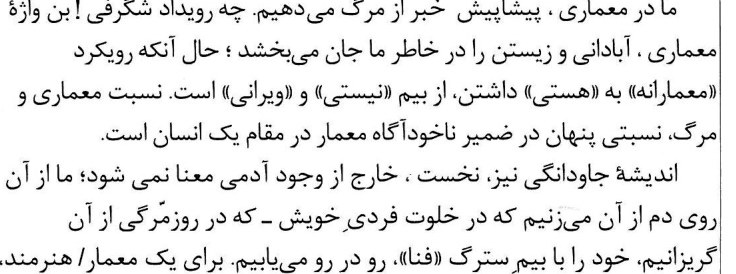
It is for 'to live' that man creates and 'makes flourish' — what then is the relation between man, his creations and... death?
If — to use Heidegger's words — the history of man is the history of the forgetting of 'Being', and 'everydayness' has distracted him from dwelling on its ultimate meaning, then it is in 'creating' and in 'bringing-into-being' that this forgetting and inattention turn into awareness: man creates in order to escape death. — But death is woven into the warp and weft of this awareness... He who builds in order to escape the dreadful fear of nothingness bears witness to the rightness of death: it is faith in death that makes building and creating meaningful. The relation we have been seeking, then, is a relation between life and death. Have we ever found these two meaningful in the absence of one another?
Architecture is a sign pointing to creation; it is for this very reason that it gives life its meaning. The architect 'architects'1, that he may show a way to escape mortality. — What is it in dust, clay, and stone that gives the meaning of 'duration'? Is it our being of the very stuff of man — earth, clay — that pricks us to seek perpetuity through earth? Why does man stretch his hand to the skirts of 'earth', to make life upon the earth seem eternal? — Architecture is the search for immortality in the mortal earth, and the architect, the abiding fever of the earth in its longing for immortality.
In architecture we announce death in advance — what an astonishing event! The very root-word of architecture quickens 'flourishing' and 'living' in our memory; yet the 'architectural' approach to having 'being' arises from the fear of 'non-being' and 'ruin'. The relation between architecture and death is a relation hidden in the unconscious of the architect as a human being.
The thought of immortality, too, finds its meaning first outside man's existence; we speak of it because, in our individual solitude — from which everydayness is our flight — we find ourselves face to face with the great fear of 'nothingness'. For the architect/artist, the encounter with this 'dread' opens the way to 'creating'. He thus tries to deny the earth — the earth, our first nature. But is this also our final destiny? Architecture has a marvellous answer: let us join 'earth' [of man] to 'earth' [of architecture] so that, from 'earth' [of man / architecture], we may make an eternity. This is, in truth, an astonishing answer.
Architecture is an answer to death: it creates in order to bear witness to the nothingness of death. If perishing is folded into the dust and clay of man and seats him in the earth, 'architecture' binds the perishable earth of man to immortality. What a joyful nature has the pain of immortality!
The joy of being ['memāridan'], the joy of 'architect-ing', owes itself to the sorrow that the architect bears in this 'creating'. Here pain has been remedied. He who is gripped by the pain of perishing / of being-perishing has a 'different' and 'non-everyday' destiny. But the architect, in this matter, is not so caught up — for him the cure is this very perishing. In his own stature he is its 'mortal'; on the bed of earth he is the phoenix of his own destiny. Upon the ash of his pain, the fire of longing — the thirst to 'create' — is forever blazing. He builds, and again throws it down to the earth. Upon the stature of the earth, joyously, he reads a garment of 'being'. He remains, with this perpetual creation and this unfinished yearning.
For one who seeks immortality in power, architecture too is the embodiment of power: he becomes immortal because he has rendered his authority and dominion eternal and abiding through 'architecture'. His power, in the magnitude of the architecture he 'has commanded', will become evident and enduring. — But what is the meaning of man's authority before death?
The man of authority, at the very moment when he thinks of making his dominion eternal through architecture, through earth, has accepted the authority of death: 'we', the result of the embodiment of the absolute dominion of 'life', are upon the earth. If we do not accept this dominion, speech of immortality will have no meaning. And — yes, we have accepted this dominion in our soul. For us, death is always the death of 'another'. What is for us is 'life'. Death is the other side; that 'time' (the 'time' that never arrives). How astonishing! We do not encounter death except in the back-room of our own mind. Does the architect dwell in the back-room of his own mind?
Architecture is a hidden longing to affirm life. Whether this longing blooms from the back-room of the architect's mind and from the fear of mortality and decline, or from the sorrow of bread, it is concerned with the 'soul' of man. The architect's bread — even fame, honour, and everydayness — is bound up with a concern from beyond the earth; architecture is an answer to that concern which pricks the human spirit — and how strange that it has no remedy other than this very earth. Blessed be this 'earth'!
Footnote
1. As is evident, this point is indebted to Heidegger's thought. With the same intention — and certainly without any pretension — 'me'māridan' ('to architect') is the state the architect has when he 'lives' as architect. This existential quality is not the mere verb 'to do architecture'. By way of example, compare it with the notion of 'welt-en / weltet' in Heidegger and his well-known phrase: Die Welt weltet ('the world worlds'). In old Persian texts, compare with — for instance — the verb 'bāshidan' ('to be / to become') and 'mībāshad' ('it is / it becomes').



