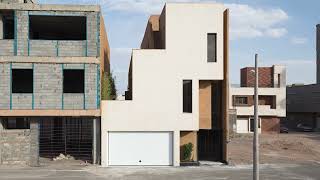
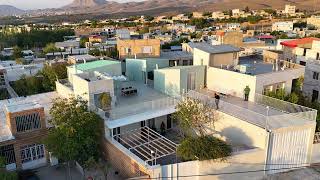
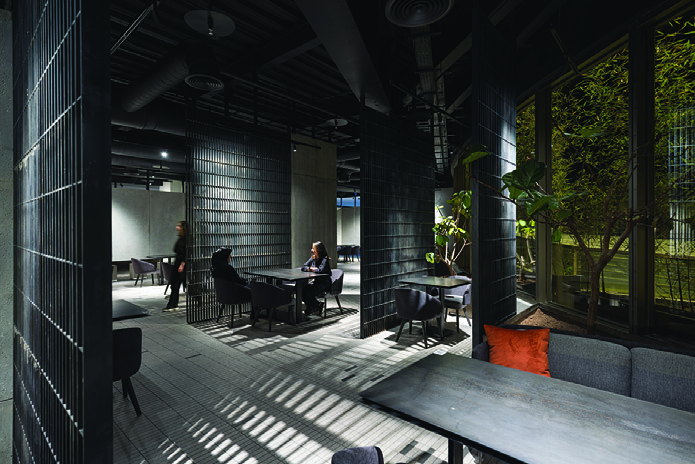
When achieving a noteworthy accomplishment in Iran's architecture today seems like a pipe dream, and what is actually present resembles a nightmare, one cannot properly speak of this "profession" or "art." The fundamental question is this: Is there a real basis for raising the issue of architecture at all? If the answer is affirmative, one must be able to prove, through precise evidence — that is, through built works — the existence of something worthy of the name architecture. And if the answer — as I too suspect — is negative, one must ask whether laying the groundwork for architecture in practical terms under current conditions, meaning the pursuit of realizing a dream, is even possible. In recent years, debate and discussion about architecture have flourished as never before. Yet no practical result has come from all this discourse. No one, of course, expects the obstacles that have — however unconsciously, yet precisely — identified and eliminated every worthwhile movement, to be swept away overnight. But the fundamental question remains: Is Iranian architecture, however slowly, moving in the direction of progress or not?
We have learned today that the world is moving toward pluralism, and in architecture too, as in other fields, no single truth exists. Aesthetics and tastes and one style or method hold no superiority over another. Baroque, Rococo, Modern, and Postmodern architecture are all valid and valuable. But such talk should not distract us from the reality that in architecture too, the issue of progress is at stake. In every era, certain problems arise, and architects of successive generations strive to develop solutions — both technical and aesthetic — to these problems. This process continues until a given approach reaches its zenith and comes to an end. It suffices to consider the historical typological evolution of the four-iwan mosque: a model whose roots can be traced to Parthian architecture and perhaps even earlier, which reaches its peak in the Safavid period and after which, as history has shown, no path remains for advancing this model further. The great masters of modern architecture — Le Corbusier, Gropius, and Mies van der Rohe — worked toward refining, completing, and strengthening the design approach and aesthetics initiated by Adolf Loos, Peter Behrens, and Tony Garnier, and other architects such as Henry Ciriani,1 Oswald Mathias Ungers,2 and Christian de Portzamparc3 carried it further still. The issue of progress is entirely evident even in the works of highly daring and individualistic architects such as Frank Gehry. The Cubist aesthetics that Le Corbusier translated into architecture's more conservative language is crystallized in Gehry's work with the same intensity and dramatism of Braque's paintings.
Let us compare today's Iranian architecture with our own architecture of the past half-century. In terms of technology, materials have changed, but no progress has been made. The durability of today's buildings is far less and their maintenance costs far greater. Energy consumption has also increased excessively. In terms of aesthetics too, attention to urban context, landscape, urban space, building proportions and variety within harmony, as well as the creation of interior spaces suited to the way of life, was taken far more seriously in the architecture of the past than in today's.
We Iranian architects seem to be caught in a spell, waiting for a leap that will break the enchantment. As in athletic disciplines, we await the appearance of a champion who will set an international record. We hold meetings, engage in debates, and write articles in the hope of perhaps getting just one work across the razor's edge. Of course, belief in transformation through a leap is valid — provided the groundwork for gradual transformation also exists. If the foundation for an acceptable architecture is not laid, not only will no leap occur, but even if one or two outstanding works are built, nothing will change.
In today's architectural discourse, two main axes stand out: "Iran's past architecture" and "today's Western architecture." In discussions of the past, the most vague and least usable aspects tend to be raised; in discussions of Western architecture too, the same tendency can be found in most approaches. It is surprising that, in the absence of any practical foundation in architectural practice, we have become so reductive in theoretical discourse as well. Even if we consider direct or indirect inspiration from existing sources entirely permissible, we must at least acknowledge that an extremely rich treasury is available to us, one that is bound by neither place nor time. The influence of Far Eastern art on Art Nouveau, traditional Japanese architecture in the works of Wright, primitive art in the works of Le Corbusier, Maghreb architecture in Barragan,4 and Romanesque architecture in Kahn all demonstrate that today's architect can draw from any tradition or historical period.
In my view, when we make the creation of identity the goal of drawing from the past, we have gone astray. The aim of postmodernism's struggle against modernist dogmatism in its methodology was not to establish new constraints. In the past quarter-century, various experiments have taken place worldwide, expanding in multiple directions: works that, although giving exaggerated attention to building technology, have simultaneously managed to establish innovative and adaptive new relationships between architecture, environmental conditions, and functional needs5; highly daring and provocative architectures that, by emphasizing the abstract figurative content of architectural form through scientific and philosophical paradigms or the experiential sensibilities of sculpture, have expanded the aesthetic dimensions of architecture and explored new territories of architectural form6; a new neo-classicism that has revisited and selectively employed historical elements in modes sometimes serious and sometimes ironic7; and flexible, contextual architecture that draws its essence from the immediate surroundings of the work.8
Architecture from the 1980s onward, due to this very multiplicity of tendencies — examples of which we cited above — has become far more heterogeneous than the architecture of the 1960s. One can examine the various tendencies, goals, principles, and methods of each with a pluralist perspective, without succumbing to naive relativism, and draw critically and selectively from the achievements of each. It appears that the era of style-making cliches of the 1970s and 1980s has come to an end, and although in our country the insistence on using terms like postmodern, deconstruction, and high-tech still persists, the complexity of issues and the pragmatic reassessments that have steered the world's leading architects toward a kind of maturity in recent years compel us to examine each designer's professional and creative trajectory individually.
At present, a major characteristic can be identified that has profoundly affected the prevailing spirit: an exaggerated emphasis on methodology that has caused, in works such as those of Koolhaas and Eisenman, the adopted method and theoretical mechanism of form production to take precedence over the tangible result. Though one must acknowledge that there are pragmatists favoring high-tech who have continued to bypass philosophical and figurative temptations through more direct means, achieving satisfactory and sometimes outstanding results.
The tendency most prevalent among the progressives of Iranian architecture is connected to only one extreme — though serious — branch among the many available worldwide: the provocative and confrontational architecture that, because of its effort to replace human parameters with elements borrowed from new mathematics, cosmology, and natural sciences, resembles a Ruskinian moralism. An architecture that, instead of consciously critiquing the dehumanizing effects of the post-industrial world (which is of course different from a nostalgic negation of the inevitable transformations wrought by progress), celebrates the rootlessness and chaos of multimillion-person megacities. An architecture that, although like Archigram it seeks legitimacy through publications and media, unlike Archigram actually clothes its utopias in built form. Eisenman, Tschumi,9 Gehry,10 and Libeskind11 — the leading figures of this type of architecture — belong to an advanced society that has passed beyond the stage of the "society of need" and approaches the "society of desire," and for this reason, unfinished works that represent a stage of methodological and aesthetic experimentation and the realization of a core content in the purest and most effective expression possible, through the usurpation of all other conceivable purposes of a building, find the possibility of being built. A kind of virtual reality that achieves material existence.
The revelatory and unfinished quality that was a hallmark of the figurative arts in the twentieth century — and which caused new aesthetic territories to crystallize separately in their own right — has also spread to architecture. An architecture stripped of all its traditional characteristics draws closer to graphic design and painting. Even the material expression of materials and the selection of colors take on a virtual quality in imitation of computer imagery. An architecture that has relegated "the work as production" to secondary importance and contents itself with displaying the architectural idea and the process of its formation.
Although the theoretical discussions, methodologies, and new aesthetic territories of this avant-garde architecture — and especially the written and built works of Koolhaas, with their objective and anti-utopian take on contemporary life — are on the whole very interesting and useful, since the realities and complexities of Iranian society are vastly distant from those of advanced societies, and since this tendency has not yet won widespread trust even in the West, its achievements must be used with the utmost caution and one must not leap blindly. The subject is serious at the theoretical level and can certainly be highly useful in advancing architectural discourse in Iran. However, an eclectic appropriation of the realized (not merely general) achievements of new aesthetics and methodology, given the lack of technical tools and the absence of suitable economic and cultural conditions, is futile and perhaps to some degree harmful. Although the recent experience of several competitions has shown that a group of architects and especially students have finally emerged who have grasped the "spirit of the time" at least from its "iconographic" dimension, and have created photogenic works that attest to their abundant talent and relative immunity to the ill effects of academic miseducation. The space for genuine and profound actions remains empty. As usual, our approach is more "mannerist" (stylistic) than deductive and critical. In the theoretical discourse of this methodological architecture — where theoretical discourse should be the main discourse — we are weak, and what exists is derivative and belated.
Our progressive architecture has apparently remained oblivious to an important and new front that has emerged especially since the beginning of the 1990s. The reason is that on this front, there are no "special effects." A new architecture that has grown weary of the dizzying consumption of imagery, excess in the decorative or symbolic aspects of eclectic postmodern architecture, and also the "elitist" and pseudo-intellectual and pseudo-scientific behavior of abstractionists — in reality suffering from weakness of formal content — such as the former deconstructivists. This architecture is a kind of rebirth (not revival) of minimalism12 and rationalism in a new body; an architecture grounded in seriousness, simplicity, and objective factors that creates refined and proportionate spaces through the use of limited but serious and considered formal elements, signs, and materials; an architecture that in a sense follows the teachings of Richard Neutra,13 Luis Barragan, and Alvaro Siza Vieira.14
— Josep Maria Montaner15
Among the architects working in this new field, one can name Souto de Moura,16 Venezia,17 Shinohara,18 Tadao Ando,19 Carlos Jimenez,20 and Antoine Predock.21 Their works take shape on the basis of limited elements and simple tools that express the essential core of architecture. The existential logic of each building and the objective environment of the project are formed and are not transferable to another location. This architecture, which may at first seem tedious, possesses the quality of generalizability. Although, because of their engagement with limited and fundamental subjects, they are not as spectacular and photogenic as the works of Gehry and Hadid,22 they have the capacity to not be merely for elites and not produce astonishing works, yet perhaps provide a suitable ground for some remarkable and astonishing works to emerge.
The elitist works of Eisenman, Gehry, and their like, on the contrary, are more important from the standpoint of posing fresh questions in architectural culture than in providing answers to practical problems. For this reason, in the new museums built by Gehry and Libeskind, numerous problems arising from architectural form have emerged in the museum itself. In any case, if we return to our own country's reality, we discover that among today's prominent tendencies, there are also paths that allow for the growth of an architecture connected to global currents while simultaneously adapted to our cultural, economic, and climatic conditions. In Iran, especially in recent years, the desire to have a presence on the global stage has grown intensely, and this signals two important realities: first, that the needs and sensibilities of our people are very close to those of other nations of the world; second, that we have realized that any genuine progress in scientific, technological, artistic, or athletic fields requires competition on a global stage. Although the precondition for architectural progress in Iran is solving the specific problems of our society, it cannot in any case be independent of other architectural currents in the world. One cannot reinvent the bicycle and expect progress to ensue. Progress that is not grounded in fundamental creativity and innovation is merely reformist and does not go beyond issues of welfare, technological improvement, and the like. But how is one to confront the necessity of advancing architectural culture?
History has shown that progress is achieved by elites through a limited body of works. But architecture is not confined to this group. Nor should it be. In Iran, given the limited economic, educational, and informational resources, the possibility of devoting attention to special works aimed at advancing architecture naturally becomes much more restricted. Architecture that demands exceptional creativity and knowledge from the designer and economic means from the client produces disasters under ordinary conditions. Given the realities of society, a division of labor is necessary: the majority should devote themselves to meeting the basic needs of society, improving building quality, and eliminating current visual disorders. Under such conditions, a language as simple and precise as possible, free of extreme stylistic mannerisms, confined to a few "themes" and formal elements, is more appropriate. Even in the field of aesthetics, very simple problems — such as the main facade and the architectural relationship of corner buildings, urban space, and so on — remain unresolved, and addressing them could help improve the current situation. In most cases, "the excellent" is the enemy of "the good." Attempting to advance architecture through mere leaps alone may distance today's architecture from its primary social duty.
Those who wish to place Iranian architecture at the global forefront must also engage in serious reflection. One must consider what role Iran can play on the international stage. Is our advantage in getting ahead of Westerners in tendencies whose theoretical foundations and production tools have been shaped in Western societies for years? Can we, for example, surpass Eisenman in his pseudo-scientific method or Foster in his technological approach?
I believe that to achieve real progress in Iranian architecture, we must examine our conditions and limitations carefully and free from prejudice. Minimalism and refined non-luxurious creativity, critical attention to the historical substance of architecture and to Iranian general culture as a whole, the values of environmental awareness and alternative technology given Iran's legacy of creating magnificent works using simple and inexpensive materials — these are among the resources that hold considerable potential and that allow Iranian architecture too to play a role in world architecture. To be global, one need not melt in the crucible of global culture. Even in modern architecture, which claimed a universal aesthetics, local undertones were perceptible. Behrens, Gropius, and Mies van der Rohe relied on the industrial culture of Germany and the classical tradition of that country. Le Corbusier, by contrast, was tied to the French figurative avant-garde, and Frank Lloyd Wright to traditional American architecture. In the later period, in the works of figures such as Alvar Aalto and Kenzo Tange, local influences became more apparent. We too, in order to play a role in the global culture of architecture, must discern our position on the world stage with precision.
Abandoning national capabilities merely to protest vulgar traditionalist tendencies in architecture is misguided. One cannot surrender the entire rich historical heritage and civilizational capabilities — drawn from cultural diversity and vastly different building types — to those who hold only a superficial understanding of it. The remarkably diverse climatic, cultural, and numerous and extensive needs of our country for architecture and urban design, unparalleled compared to most advanced countries of the world, have made Iran an excellent field for conscious and serious movements, and the results of these experiences can certainly leave positive and tangible effects on the overall course of architecture in the world.
Footnotes
1. Henry Ciriani
2. O. Mathias Ungers
3. Christian de Portzamparc
4. Luis B. Guadalajara Barragan
5. For example, the works of Renzo Piano, Norman Foster.
6. For example, the works of Frank Gehry, Peter Eisenman.
7. For example, the works of Michael Graves, Aldo Rossi.
8. For example, the works of Alvaro Siza Vieira, Rafael Moneo.
9. Bernard Tschumi
10. Frank O. Gehry
11. Daniel Libeskind
12. Minimalism
13. Richard Neutra
14. Alvaro Siza Vieira
15. Josep Maria Montaner, Dopo il movimento del moderno, L'architettura della seconda meta del Novecento, Editori Laterza, Roma–Bari, 1996, p. 279.
16. Eduardo Souto de Moura
17. Francesco Venezia
18. Kazuo Shinohara
19. Tadao Ando
20. Carlos Jimenez
21. Antoine Predock
22. Zaha Hadid