Contemporary Architecture

Art of Studdwork: Examples from Kashan

Maryam Kian·Memar 15

A portion of blacksmiths' production consists of the door hardware and metal fittings for doors and windows — collectively known as zamud. In other words, zamudgari (studdwork) is a craft in which all manner of metal attachments used for traditional and antique doors and windows are made. Zamudgars possessed great skill in design and drawing, for zamud literally means to inscribe patterns and decorate, as well as the appended and decorative elements of a building.1 The most common material for studdwork is iron.

At the dawn of iron's discovery, it was used for making jewelry. But once humankind realized that iron is a hard, durable substance of great strength, in addition to its use in manufacturing tools, iron implements related to agriculture, weaponry, and cooking utensils, it was also employed as a covering to increase the strength of vulnerable materials. Besides armoring the body for battle, this included sheathing wooden gates.

Among the artifacts recovered from excavations at the Lik Shiran cemetery in Ardabil, dating to the first millennium BCE, wooden pieces had been covered with metal sheets and studs.

◆ ◆ ◆

Decorative Metalwork and Coverings on Doors

They had covered the doors with metal sheets. Sheathing or ironwork — that is, affixing beautiful animal figures on gold leaf over palace doors — was customary from the Median period onward. In subsequent periods as well, gates were covered in this manner. Timbers for columns and ceilings were clad in thick sheets of precious metals so that when light struck them, they would produce beautiful reflections and brilliance, adding to the spirituality of the space and the sacred power of the king.2 It appears that in later periods, the decorative traditions of the Achaemenid era continued to some extent. The destruction of the Tisfun (Ctesiphon) palaces such as Aspid Dez and the breaking of their gold-clad, jewel-encrusted doors has been recorded and documented in historical writings.

The oldest door surviving from the early Islamic period (approximately the 2nd century AH) is found at the Mehriz Gate (Mehrijerd). This door and three others were made by a skilled blacksmith from Isfahan at the command of Abu Ja'far Kakuyeh for four gates of Yazd (Mehrijerd, Kushkeno, Taft, and Qatriyan). On the iron-clad surface of these doors were depictions of horsemen, animals, and abstract motifs.3

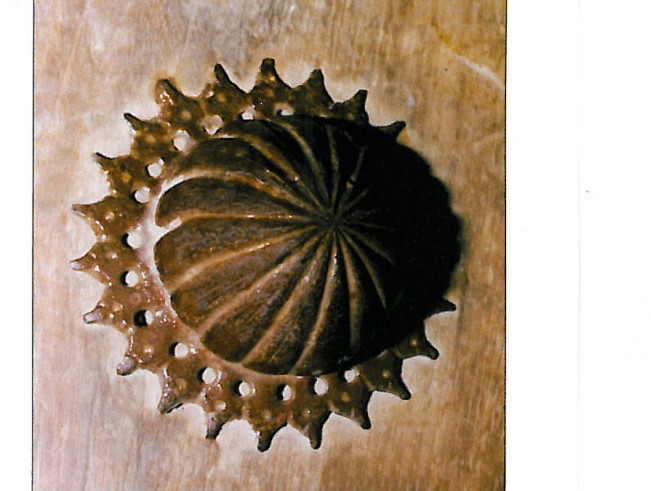
The decoration of wooden doors evolved beyond the stage of mere metal sheathing, and the execution of patterns in the form of three-dimensional attachments — namely studs — became widespread on door surfaces. Studs, made in the shape of multi-petaled flowers or rosettes, were applied in regular rows on gates for both beauty and reinforcement.

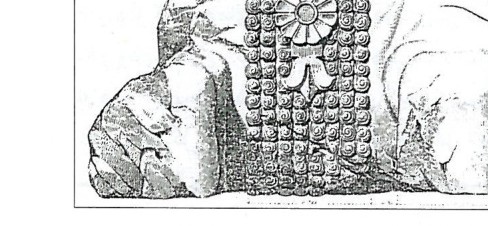
Rosette flowers — symbols of the sun — have been used as decorative motifs on human garments, horse bridles and harnesses, and as metal attachments on gates. Since the sun has always been a symbol of life-giving power, from ancient times — even in the stone carvings of Persepolis — the rosette has been used extensively.

Ornate wooden door with metal studs, knockers, and hardware at Abbasian House, Kashan
Studded door at Abbasian House, Kashan, showing gol-mikh (studs), knockers, and metal fittings

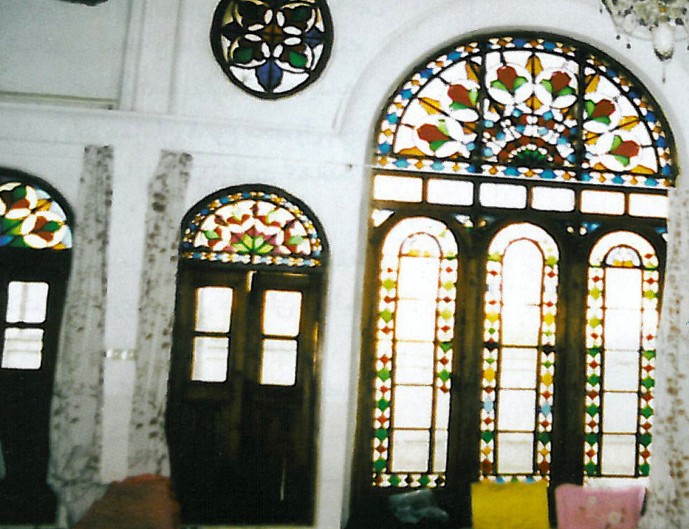
What we refer to as zamudgari in this article are the metal components that were used in old doors and windows. Old doors and windows bear no resemblance to what we see around us today. Doors are made of iron sheets or plates, roughly the height of a person, in square or rectangular form, and are installed by means of hinges or pivot pins within a frame at the entrance or exit to a room, corridor, and so forth. Doors are usually made in pairs of two leaves, though single-leaf and three- or four-leaf doors also exist, two of which are usually fixed. The connection of these leaves is achieved through metal attachments. As mentioned, another application of metal fittings is in windows. Windows in the past came in the forms of orosi (sash window), palkane,4 and rowzan.5

The orosi is a lattice screen that opens by sliding upward on hinges and pivot pins, settling into a housing above the upper window. The literal meaning of orosi derives from the Pahlavi word orus, meaning light. The prefix ar in Persian means upward movement. Generally, windows that are raised vertically when opened and lowered to close are called orosi or owrosi.

◆ ◆ ◆

Metal Fittings on Wooden Doors and Windows

01

Stud (Gol-mikh)

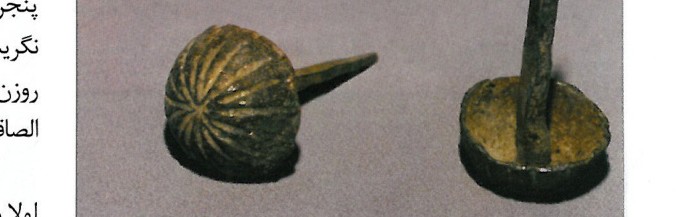
The stud (gol-mikh) is a type of iron nail with a large, hemispherical head featuring concentric grooves. In addition to joining wooden pieces, it serves to beautify and create a harmonious composition. Studs are generally made of two parts: the cap (kolahak) and the shank (taneh) — or prong (shakhak) — in various dimensions. Small studs are typically used for doors and windows in residential spaces.

Types and uses of studs: (1) Studs that attach the damagheh (nose piece) to a door leaf. (2) Studs that attach the kolun (bolt), tazeh, shab-band (night latch), and parallel and vertical planks to one or two horizontal half-beams on the door. (3) Studs that attach the pivot pin at the corners to the door. (4) Studs that attach the guide rails of orosi windows to the frame. (5) Studs that attach the handle to the door or window. (6) Studs that attach the hinge to the door and frame. (7) Studs that attach the cockspur latch (khorusak) to the window. (8) Studs upon which the knocker strikes.

Knocker (Koobeh)
Knocker (Koobeh)
02

Knocker (Koobeh)

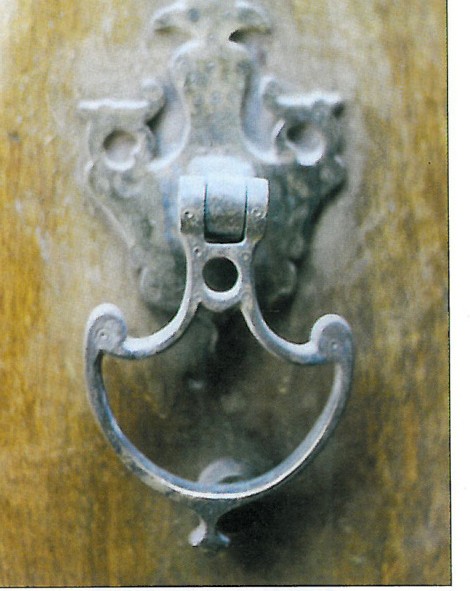
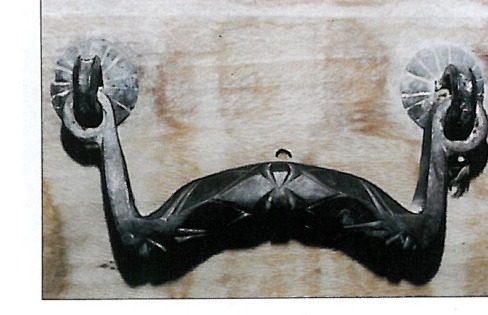
The knocker is a metal device mounted on the front door of a house upon a metal plate called a pulak (backing plate). By striking it against the stud, one can alert the homeowner to one's presence at the door. A knocker is a device that is struck against another object, and depending on the shape and size of the knocker and its backing plate, the tone of the strikes varies.

Knockers were initially made of iron and later of brass. Surviving examples of old iron knockers date to approximately 50 years ago and were used on the entrance leaves of houses and gates. Their shank is in the form of a nail or wire, with one prong that, after passing through the door, is bent to one side on the other side.

Naseri considers stud-making an independent craft from blacksmithing and, regarding the method of making studs, says: "Using a nail-maker's tool, one works with a round bar and separates it with a sharp chisel. The wider and thicker end is heated until red-hot. Then the narrow end is placed in the hole of a mushroom-shaped anvil, and with heavy hammer blows on the spherical surface, it is shaped."

The knocker is particular to Iran, owing to certain geographical, social, religious, and at times political factors, as well as the form of traditional inward-looking architecture in some parts of the country. We know that a large portion of Iran's territory has a hot, arid climate with low rainfall, accompanied by sandstorms and scorching sun. Iranian architects, with their knowledge of the climatic characteristics of each region, had to create safe and pleasant environments for the household. Given the hot, arid surroundings and the dense urban fabric lacking green spaces, the interior courtyard was a suitable setting for creating a small garden with a pool and water channels. This complex required a distance between the entrance of the house and the family's living quarters — a factor that played a significant role in the initial formation of inward-looking houses. Beyond having a green environment within the home, cultural factors and the matter of keeping the sacred privacy of the family from the gaze of outsiders gained greater importance in the Islamic era in certain parts of Iran. The origin of inward-looking houses predates Islam, but in the Islamic period, architects were encouraged to observe certain principles. The design of this private realm took various forms in one or more courtyards (andaruni and biruni). The women who lived in such houses, in addition to being alerted to someone's presence at the door, also needed to know the visitor's gender. The knocker was an essential device in every household. As the sound of knocking echoed through the windowless entrance vestibule, one of the household members would go to the door to answer.

In all the hot and arid regions of Iran, the use of knockers was customary, but the manner of their fabrication and decoration varied from city to city. Some knockers were so artfully made that they can be considered unique works of art, and sometimes a knocker served as the distinguishing feature of a house or neighborhood.

In making knockers, a piece of iron was first heated and shaped by hammering into the desired form, then decorated by filing, chasing (qalamzani), or engraving. Given the decorations on knockers and other metal door fittings, it appears that either the chelangars (locksmiths/metalworkers) had also developed skill in chasing, or they would commission a master chaser to adorn their products with simple motifs. This very characteristic accounts for the variety found in these works. Even among the simplest knockers, which appear to have been mass-produced, no two are exactly alike. Knockers differ in ornamentation, weight, and the timbre of their sound. Generally, knockers on madrasas and sacred places had more elaborate decoration than those on residences.

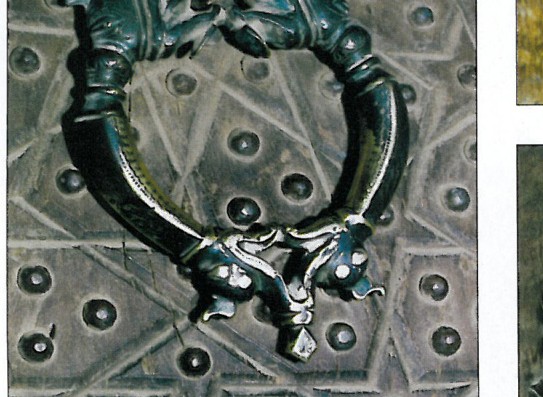
Knockers were usually made in two main types: a ring-shaped type with a high-pitched sound designated for ladies, and a hammer-shaped type with a deep sound designated for gentlemen. It is evident that knockers were usually installed in pairs on the two leaves of a door. The knocker for gentlemen was typically placed on the left leaf and the one for ladies on the right leaf. From the sound, the household could determine the visitor's gender before opening the door.

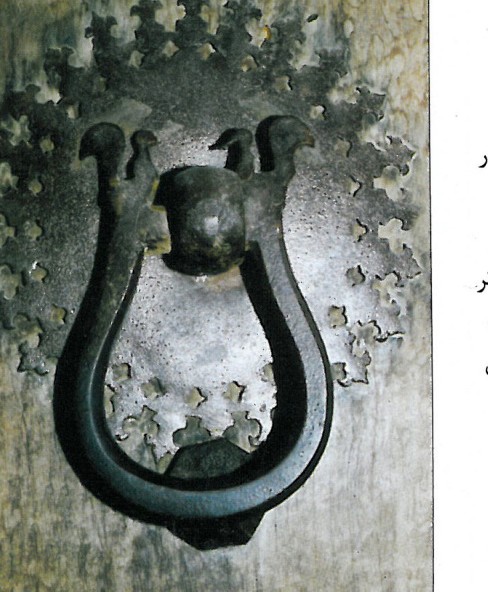
The placement of knockers varied. Knockers have greatly varied decorations. Ring-shaped knockers come in forms such as a heart, a toranj (medallion) tip, a horseshoe, or an apple, connected to the door by a ring called a sholeh. Great taste went into the design and decoration of ladies' knockers. Sometimes at the point where the sholeh passes through, two symmetrical arabesque dragon-mouth (eslimi-ye dahan-ezhdari) motifs or two symmetrical birds were fashioned, adding to the knockers' beauty.

Knockers designated for gentlemen were much simpler in form. Their overall shape was generally that of a solid rectangular block. For decoration, cross-hatched lines (in radial or parallel patterns) were engraved on them, along with holes created on their surface.

Brass knockers can be seen on the entrance door of the Ebrahim Khan Madrasa in Kerman and the Aqa Bozorg Mosque in Kashan. Brass knockers intended for residences date to approximately 50 years ago, and the finest examples can be seen at Tabatabaei House.

◆ ◆ ◆
03

Pivot Pin and Hinge

A — Pivot Pin (Pashneh)

Door leaves open and close in three ways. Sometimes the rotating mechanism is part of the door's overall structure, and sometimes it is a separate attachment affixed to the door. In the first type, a portion of the lower part of the door is carved into a protrusion, and the wooden pivot pin sits on a kavadeh. The kavadeh is a wooden piece that is embedded in the threshold of the door, and the pivot pin sockets are cut into it. Sometimes the pivot pin sockets are positioned separately at the two lower corners of the door and rotate on the ground surface (whether soil, stone, or cement), and the door leaves open and close on these sockets.

In the second type, metal pivot pins are attached to the lower and upper side corners of the door leaves. Metal pivot pins come in two types: two-way and three-way. In two-way metal pivot pins, in addition to the partition or short wall placed on both sides of the door corner (front and back) and secured by studs, a wedge-shaped piece is set beneath the pivot to facilitate the door's opening and closing.

Three-way pivot pins function similarly, with the difference that a third partition is placed at the side edge of the door adjacent to the frame and is secured on the door leaf. Three-way pivots were better than the two-way type and positioned the door leaves more securely.

B — Hinge (Lula)

The word lula derives from lulab (meaning male and female) and also means "iron band on the back of a door." A hinge consists of two parts: the ring and the hook. The ring — also called a razeh — is installed on the fixed part (the frame), and the hook on the moving part (the door leaf), on both the leaf and the frame or the lintel of the door. Hinges come in two or three types; the installation method by which one part of the hinge is placed on the side edge is called shuleh-i (ring-type). The concealed hinge (lulaye towhmi) and the wire hinge (lulaye darnya) are types in which the two parts — fixed and movable — are separated.

Today, more advanced methods are used for making hinges. In addition to flat hinges, fan hinges — which provide greater and faster rotation than other hinges — have appeared on the market. Metal pivot pins and iron hinges used in the past had extensive decoration, to the extent that they constitute one of the important artistic and decorative elements on doors, with great variety.

04

Latches and Clasps (Choft va Bast)

A latch — also called choft va bast, choft va band, zolf, or zanjir (chain) — is a chain and ring by means of which one locks or secures rooms, houses, chests, and the like.

Choft also means "chain of a house," and bast means the device that locks the door. The lock is passed through its ring. Each latch has a delicate chain that is attached to the door by a stud with a sholeh (ring). At the other end of the chain, there is a flat piece called a zabaneh (tongue) with a slot in its middle so it can be placed over the sholeh. Sholeh is a common term among the people of Kashan for the ring on the door's face. Sholeh means "something that holds another thing up in the form of a loop." The word bast in Kashan also takes the terms razeh-seft (tight ring), halqeh (loop), and sholeh. Usually, the clasps have no decoration, but the tongues of the latches are diverse in both form and motif. Most tongue shapes take the form of a bazubandi (armband design) or a sar-toranj (medallion tip), and their motifs are typically arabesque designs.

Another type of latch is the push-bar latch (choft-haye posht-dari), which — unlike the first type that is installed at the top of the door and fastened vertically — is installed at the middle rail of the door and holds the two leaves together horizontally. These latches usually have no particular decoration.

05

Handle (Dastgireh)

The handle is a device for opening and closing doors and windows, and its type is directly related to how the door or window opens and closes. Doors and windows that rotate on pivot pins or hinges usually have fixed handles, while orosi windows that open vertically or as sliding sashes have movable handles. Fixed handles usually have no decoration and the surviving examples show little variety. These handles are typically installed on interior doors within the house and are not used on doors opening to the street or alley.

The handles used for the sliding sash windows of orosis are attached to the door by means of rings, which enable the handles to be movable. Orosi handles are more varied in design and motif than fixed handles. Sometimes they are also very simple. Occasionally, a simple type is used for latching the door to the pasal6 (a supporting rail), which is also called pachoft or lower latch.

06

Cockspur Latch (Khorusak)

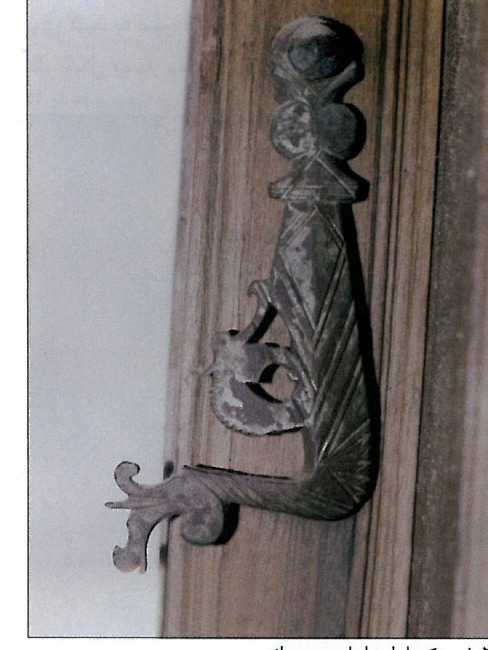
This name may have been given to this device because its shape resembles the tip of a rooster's beak. It has a pivot point and functions as a swivel latch. The cockspur latch is made in the form of an arabesque with a dragon-mouth tip, or in the shape of a bird's head.

In any case, the cockspur latch is an iron piece that is installed at two points on the fixed part of the orosi frame by means of stud-mounted sholeh rings, allowing it to move freely. After the sliding sash of the orosi window is raised, the cockspur is dropped into a sholeh ring on the other side of the window, and the window remains in place resting on the cockspur that connects the two sides of the frame. To close the window, one lifts the cockspur from the sholeh and lowers the window. Usually, cockspur latches are mounted on a stud with a sholeh ring on the orosi window frame to allow greater mobility. In overall shape, the cockspur resembles a hinge.

Cockspur latches are also very diverse in form. Sometimes the tips of the cockspur are shaped as arabesque dragon-mouth (eslimi-ye dahan-ezhdari) motifs using a sharp chisel.

07

Backing Plate (Pulak)

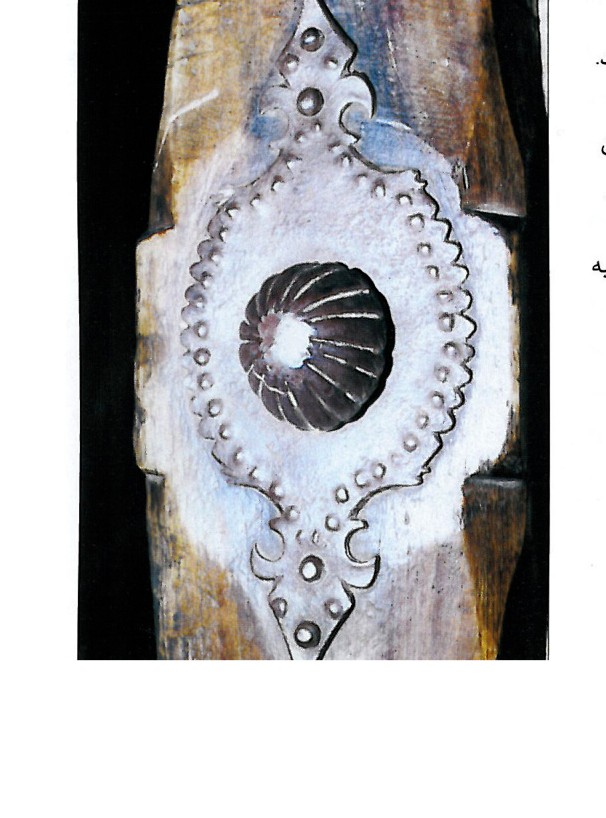
A backing plate is a flat metal piece, usually made of iron, with a hole in the center, that serves as an underlay for mounting the components of zamud (metalwork). Since zamud elements vary in shape, size, and function, three main types can be identified: (1) Backing plates under knockers. (2) Backing plates under the nose-piece stud and studs on the door leaf. (3) Backing plates under the face-rail latch and clasp.

The backing plates under knockers are usually the most elaborately worked. These plates are generally made of iron or copper in the form of circular discs, though sometimes they are shaped as a shamsah (sun medallion) or toranj (medallion). The decorations executed on them are typically in the form of tulip-abbasi flowers and trefoil (shamrock) motifs, created in interlocking patterns using a sharp chisel around the perimeter of the plates.

Sometimes the surface of the plates is incised with very simple and delicate motifs using a half-round chisel in a hammered technique. These chasings have shallow depth and low relief, and their motifs include four-petaled flowers that resemble carpet borders, animal motifs such as rabbits and deer, and calligraphic lines (nasta'liq script).

The backing plates under the nose-piece stud and the studs on the nose piece are cut in the form of a complete toranj (medallion) and are coordinated with the door. In the backing plates under the face-rail latch and clasp, circular forms are used, but the toranjes are executed symmetrically, and for this reason they have an elongated shape.

08

Key Escutcheon (Rukilidi)

The key escutcheon is an iron piece installed on the exterior side of the door to make the location of the keyhole more visible. The madang or day-key is a wooden device used to open the lock. The kilidan (keyhole) is the opening through which one opens the door or its bolt using a wooden or metal key.

Key escutcheons might be considered a type of backing plate, but they usually feature mihrab (prayer niche) or sar-toranj (medallion tip) designs on the key's surface in half-form. Although key escutcheons are very varied in shape, no particular motifs are executed on them. Sometimes the surface of the plates is decorated with very simple and delicate motifs using a half-round chisel in a hammered technique. These chasings are shallow, and their motifs include four-petaled flowers. Key escutcheons are diverse in shape, and the size and form of the key opening also plays an important role in the escutcheon's beauty.

09

Door Bar (Posht-band)

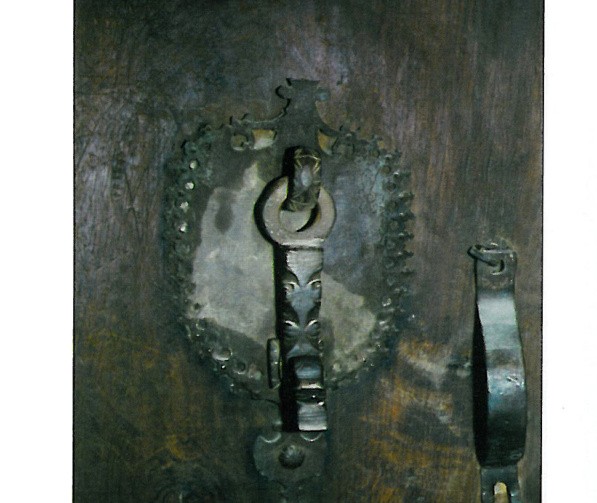
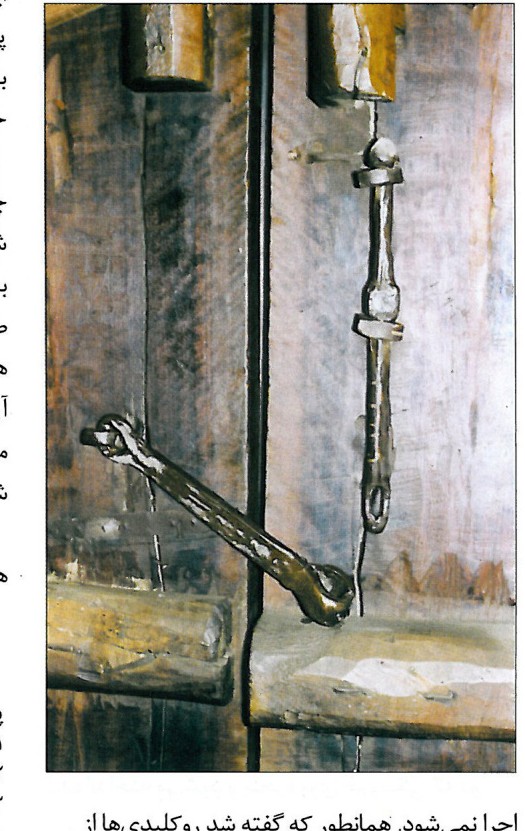
A door bar is one of the types of latches used for locking the door from the inside, mounted on the door leaf. If the bolt or the kolun (wooden toothed bar) is used for locking the entrance door, it is installed behind both leaves. The door bar is a metal brace used along the length of the frame, and it functions as a restraint, since opening and closing it is easier.

The main components of a door bar include a rod, a sholeh (ring), and a latch. One end is hemispherical, the middle is spherical, and the other end of the rod is formed into a loop. Before installation, the rod is passed through the rings of two sholehs, and then it is mounted on the right side of the door. Thus, it can swing back and forth, but because of the spherical form in the middle, it cannot exit the sholehs. The latch of this door bar has two loops.

The sholeh on the left side is passed through the opening of the latch before installation, so that the latch can swing and open and close on both sides (180 degrees). To close the door, the latch is brought close to the right side of the door, and when the door is locked, no one from behind the door can open it. To open, one can push the latch toward the left side of the door so it opens.

Door bars are made entirely by hammering and no chasing work is performed on them. As noted, key escutcheons are varied in shape, and the size and shape of the key opening also play an important role in their beauty.

◆ ◆ ◆

1 Sa'id Fallahfar, Glossary of Traditional Iranian Architectural Terms, Summer 1379 (2000).

2 National Development Organization, Craft and Industry History, 1365 (1986).

3 Mohammad Karim Pirnia, Introduction to Islamic Architecture, University of Science and Industry, 1373 (1994).

4 Palkane: A small latticed window or door in a wall through which one secretly looks outside.

5 Rowzan: A window above the door.

6 Pasal: A wooden or metal rail that is installed on the frame and to which the door leaves are attached.

Memar Magazine
Iranian Bimonthly on Architecture and Urban Design · Issue 15 · Winter 1380 / January 2002
Art of Studdwork: Examples from Kashan