Part Two
Our thesis in the first part of this article was that Deconstruction in philosophy did not arise merely as the antithesis of, or opposition to, structuralism — which had first taken root in linguistics. The factors and manifestations of our age, which had already shown themselves in philosophical schools before Deconstruction, played a substantial role in its emergence. The influence of structuralism may be more historically evident, and in a textbook of the history of philosophy Deconstruction may be counted the immediate successor of structuralism; but one must not overlook the influence of other philosophical schools and tendencies — especially the excess of positivism in analytic philosophy and mathematical logic, and the mark of existentialism, namely the sense of life's futility and emptiness.
In the first part our explanations necessarily stayed on the ground of philosophy. In this part the effort is directed more to the field of architecture — to see what the effect of Deconstruction upon architecture has been, or, more precisely, in what points the link between what has been called “deconstructive architecture” and the philosophy of Deconstruction lies. To understand the relation between Deconstruction in philosophy and Deconstruction in architecture it is first necessary to attend to the similarities that exist between them.
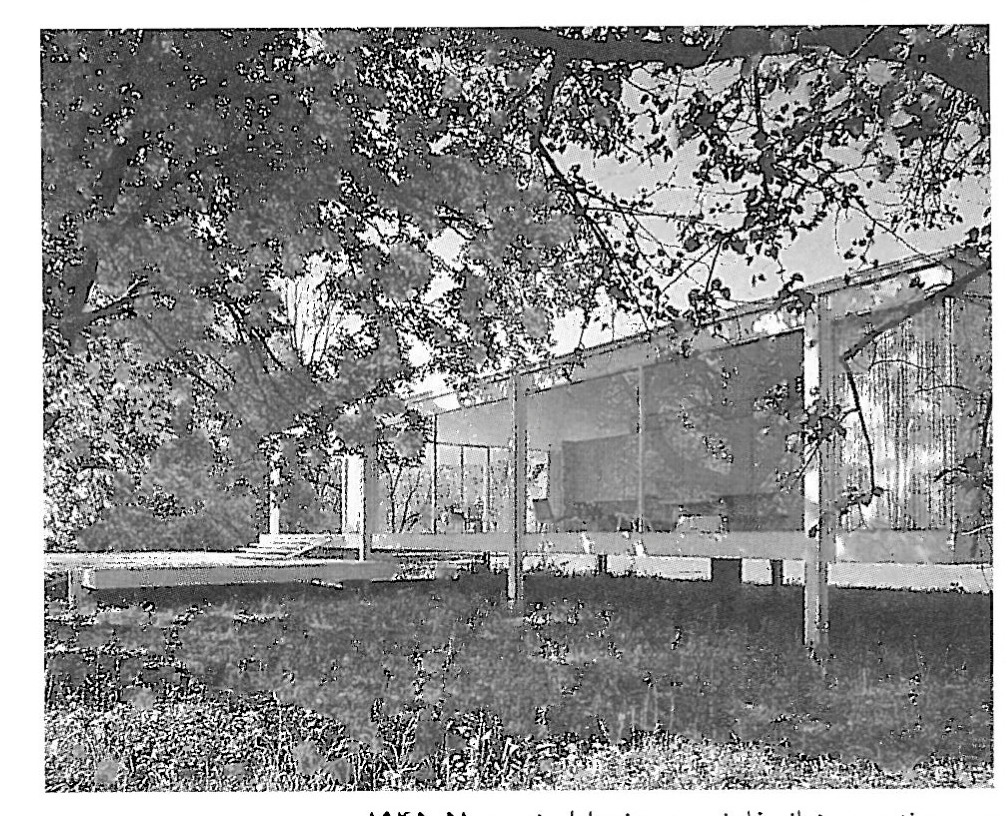
The new generation that has grown up in our age in both fields — philosophy and architecture — neither wished nor could merely follow the generation that preceded it. Although the teachers and the architects of the new generation wholly belonged to the past generation, and even, in most cases, had themselves given the new generation its wings, the new generation wished to speak for itself. It is as if the “fathers and sons” quarrel of Ivan Turgenev was, in a sense, at work here too. At times, lesser architects of the older generation fell in with the new. Philip Johnson, perhaps, may be given as an example: having studied his whole life with Mies van der Rohe (the Glass House is his work), he suddenly turned, and joined younger contemporaries in rejecting modernism!
The rejection of the thoughts and opinions of past thinkers took place in both fields. With Derrida, nearly every philosopher of the past — from Plato and Aristotle to Nietzsche and Heidegger (his direct teacher), and certainly the structuralists (the principal target of his attack) — was subjected to vigorous attack and criticism. He wanted to clear the way for the expression of his own views.
In architecture, in some respects, the case is different. We know that Venturi, in his sharp critique of modern architecture, likewise left no one out and, with unprecedented boldness, criticised Wright, Mies and Le Corbusier in the name of “Complexity and Contradiction in Architecture” — though he could not himself offer any example from his own “works” possessing such qualities, and his historical examples too were minor, worthless and mixed with his own fancies and private conjecture.
With Eisenman — whom one may count perhaps the most deconstructive of the deconstructors in the field of the philosophy of architecture — the matter is a little different. We know that Eisenman, in 1969, together with four other young architects of his own generation in New York, put on an exhibition — which these five architects named a “Conference” — of their works, with the aim, as they put it, of removing from the path of an architecture that was then showing a kind of stagnation the fork between “facts” and “values”, by taking the road of “values”.
Although the New York Five were gentler in their rejection of their own past generation — they had neither Derrida's sophisticated language (though Eisenman would later perfect it in Derrida's school), nor Venturi's brazenness — the whole effort, if not affronting, was a display of the new generation, making use of the opportunity that the changes of the time, and the age and energy of the older generation, had opened up. All the pioneers of the first modernism were at that time — the end of the 1960s — either already dead or living out their last years; and, with a little imagination, one can picture those who remained recalling their own youthful days with a smile on their lips, since they themselves had once fought with the customary and accepted values of their own times.
What Eisenman raised in this “Conference” — and to which one may suppose the others assented — was that “function” does not matter much in architecture in comparison with “form”, and that the first modern architects had set this point aside. What should not be forgotten here is that, although in word the first modern architects spoke of function as a settled principle of architecture and propagated it, dozens of examples can be given where they — under the name of functionalist — did not adhere to their own words about practicality, or the dry construction that can be drawn from it (which now serves especially as a pretext for critics such as Jencks). Mies van der Rohe's Crown Hall, built for the IIT School of Architecture, was in many respects fundamentally unsuited to a school and merely expressed Mies's formalist idea of a façade in which structure is emphasised — beautifully and eloquently, to be sure. Among Le Corbusier's later works one may mention the small and large windows of Ronchamp, which have no functional justification.
But the younger generation of architects, in order to make their argument convincing, understood and altered the words of the first moderns as they wished. Eisenman went so far, in rejecting functional considerations, as to place a hole in the bedroom floor of a house designed for a mathematician and a staircase leading nowhere, apparently in order to meet his formalist aim! In some cases Jacques Derrida does the same: he gives a distorted definition of a thought or an idea and then subjects it to severe criticism, and then himself offers an indefinable, obscure idea.
The conversation of Charles Jencks and Peter Eisenman, in a telephone interview, is very revealing on this point; we quote part of it below:
— Charles Jencks: But in [your words and works] there was hostility to everything. In those formalist houses you were highly anti-functional, and in a sense your work has shown itself in prefixes in English such as Anti-, Dis-, De-, each of which is a milder form of hostility. Your language has, as it were, changed — but what I am trying to say is that throughout your work there is continuity and consistency.
— Peter Eisenman: Let me say that in this case “Anti-” is the wrong word. I was trying, in architecture, for function not to be the main subject — not to be anti-function.
— C. J.: No, no! Come now. Remember “House I” — the staircase, the kitchen. These were clearly and polemically anti-functional, and …
— P. E.: No, they were opposed to using functional elements symbolically.
— C. J.: No, dear boy, because of their strange shape the functional elements of these houses cannot be used.
— P. E.: People live in these houses.
— C. J.: But you made a hole in the bedroom floor, and you added a railing and a staircase that goes nowhere. These are all polemically anti-functional. I think it is useless to argue that these are not anti-functional. You yourself proudly said that the mathematician for whom you built this house — House I — does not live in it. So why do you suddenly deny it?
— P. E.: There is no denial. I am trying to make clear that I have never been anti-functional. There is, in my view, a difference between being anti-functional and being opposed to the idea that function should be the main subject.
(Deconstruction in Architecture, pp. 49-50)
We see that Eisenman is hardly less cunning than Derrida. Perhaps this is in part why Derrida titled one of his articles “Pourquoi Peter Eisenman écrit-il si bons livres?” (Why does Peter Eisenman write such good books?).
It is hard to say that Eisenman's architecture came into being and took root from the start under the influence of Derrida's philosophy. Eisenman is, of course, an educated and knowledgeable architect; he even holds a doctorate from an English university and may well be aware of the currents of philosophy in France. But as far as I know and can say, these two currents — one in Paris, the other in New York — grew up relatively independently of each other, and, of course, under different names drawn from the nature of philosophy and architecture. The invitation to take part in the Parc de la Villette scheme came years later. Bernard Tschumi, the winner of that competition, writes about Derrida's participation in the project:
“Right after we won the Parc de la Villette competition, I telephoned him [Derrida] one day. He was full of hesitation and doubt. I wanted to set up a stage in which others too could have a share in designing the park. I wanted Jean-François Lyotard [philosopher] to work with Daniel Buren [architect] and Jacques Derrida with Eisenman … Derrida asked why I was interested in deconstruction. In architecture, the subject is structure, form and hierarchy. I tried to evade the answer. At that time Eisenman was speaking of deconstruction of composition. But I pressed him to speak with Derrida …”
(Deconstruction, Persian translation, p. 156)
A better choice could not have been made. Both wanted to break the limits and definitions of the past to drive their own views home.
It is now necessary to examine one of the buildings that Eisenman designed, and which was surely built under his supervision, to see and understand how he has brought his deconstructive views and tendencies to crystallisation in architecture. This building is the “Biology Centre” in Frankfurt am Main (we Persian speakers know this city only as Frankfurt).
In presenting the building, Eisenman says that he applied three criteria in its design. First, that it should enable the maximum mutual relation between the functional parts (apparently meaning the laboratories of the centre) and those who use them. Second, that the building should accommodate changes that arise from the expansion of the centre and which could not be foreseen at the time of design. And third, that the maintenance and care of the site — now a good natural green space — should be realised quickly and from the very start of the work.
Eisenman then adds that because traditional architecture — by which he means modern architecture — with its unchangeable spatial hierarchy cannot answer these criteria, especially that of flexibility, it must be set aside; with it, the arbitrary autonomy of architecture, a quality of classical architecture, must also go, and even a design must be produced that stands between biology and architecture.
In our view these criteria of Eisenman's are, for any specialist, nothing new and have been repeated — in different terms, of course — in every one of the five university years that I have been either a student or a teacher. The novelty lies in his wanting to produce a design that stands between biology and architecture. This can be taken simply to mean that in this design both biological and architectural considerations have been observed. But Eisenman's intention behind this simple reading — itself a matter for discussion — goes further. To make his meaning clearer he writes:
“Whereas the role of architecture has hitherto been conceived as the embodiment and manifestation of function in the building, in this project, instead of the process of research methods in biology being embodied in architecture, the natural processes of biology themselves have been clearly expounded.”
(Deconstruction in Architecture, p. 73)
Eisenman then gives a fairly detailed account of the concepts present in the functional process of DNA, and says that his architecture reflects this process! Here Eisenman's explanations take on a Derridian colour. These explanations, to the extent that they concern the natural process of DNA in the human body or any other living being, seem convincing, scientific and logical — science and logic that Derrida, Eisenman and the other deconstructors regard as rejected and condemned, and which, very probably, Eisenman must have heard from the scientists of the Biology Centre itself. But whether he has been able to give them embodiment in his architecture is open to question. It is striking that, in resting on science, he apparently finds — in his unconscious — Euclidean geometry unsuitable for his architectural expression and, in his own words, turns to “fractal geometry”. Yet what we see of fractal geometry in this work is that the masses on the right of the building cross the middle axis at a non-right angle; otherwise, the row of buildings on the left wholly recalls Euclidean geometry. Euclidean geometry is visible not only in the solid masses themselves but also in the voids between them; and, as far as one can see in the model and plan of this building, nothing of the “clear exposition” Eisenman claims can be traced in them.
But Louis Kahn, about thirty years before Eisenman, when he took on a similar programme (the Richards Medical Research Laboratory building at the University of Pennsylvania), knew very well how to explain these volumes and spaces so that they are at once varied and dynamic while each retains its own identity. Moreover, Kahn's skilful spatial translation of these volumes is far more powerful than what Eisenman has been able to produce in his own work. Even so, one must not regard Eisenman's work as wholly unsuccessful or rejected. But why so much rhetoric about it?
It must be said that rhetoric — which we translate here as “ensha-nevisi” (composition) — appears now to have become the fashion of our time in the presentation of works of architecture: a kind of rhetoric that can be found abundantly in Derrida's philosophical works, but is not suited to architecture. Of course the presentation of Kahn's works too — more than anyone else's by Kahn himself — was accompanied by this rhetoric; but it was a sweet, poetic rhetoric, full of the contradictions of our age.



