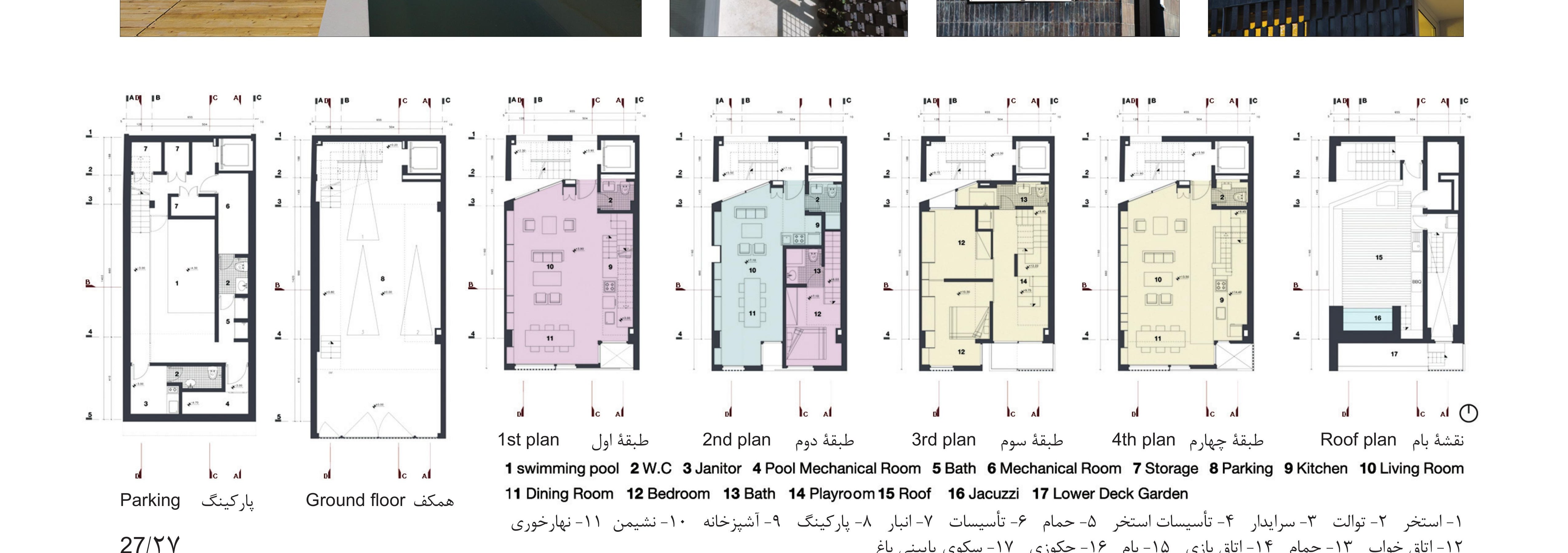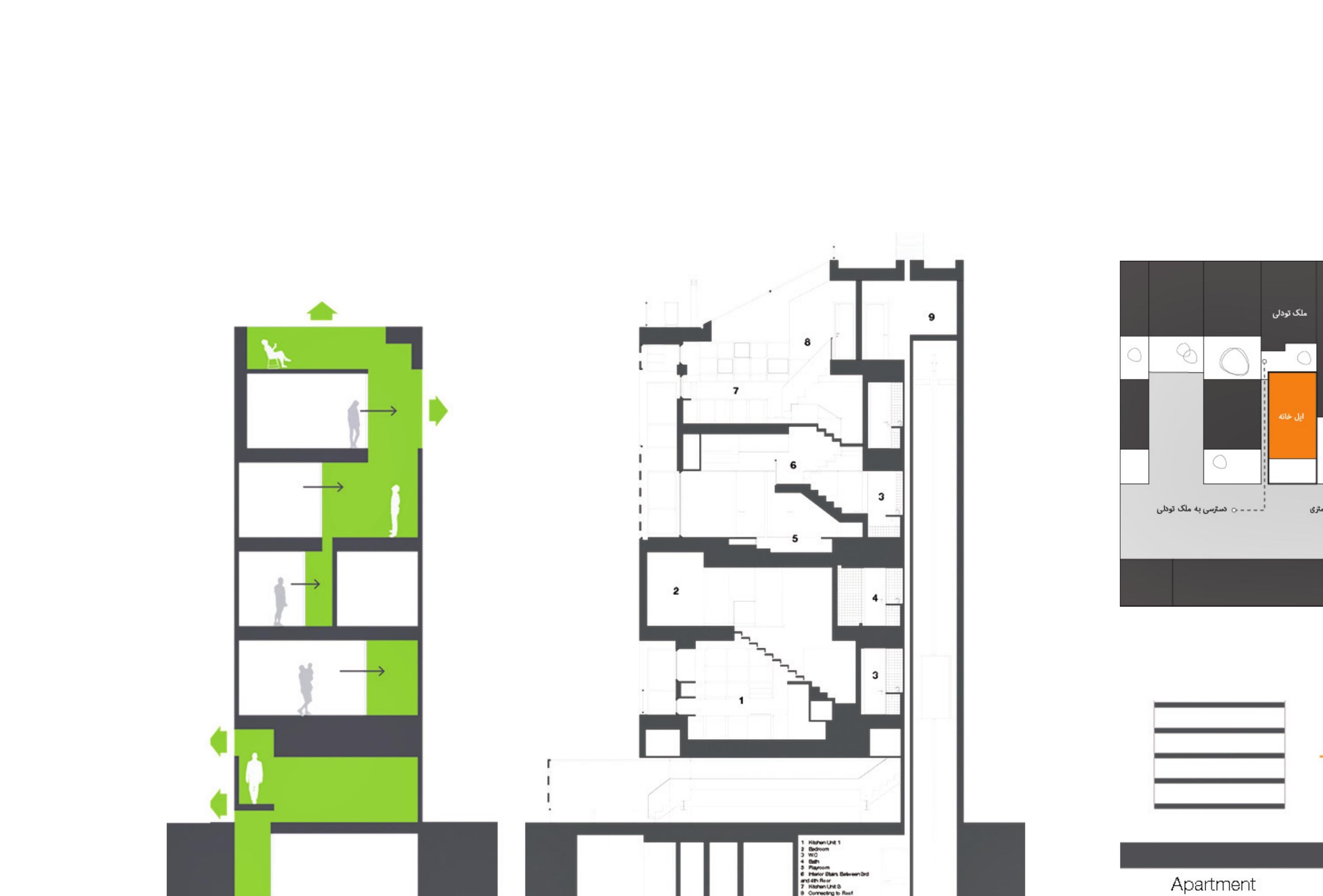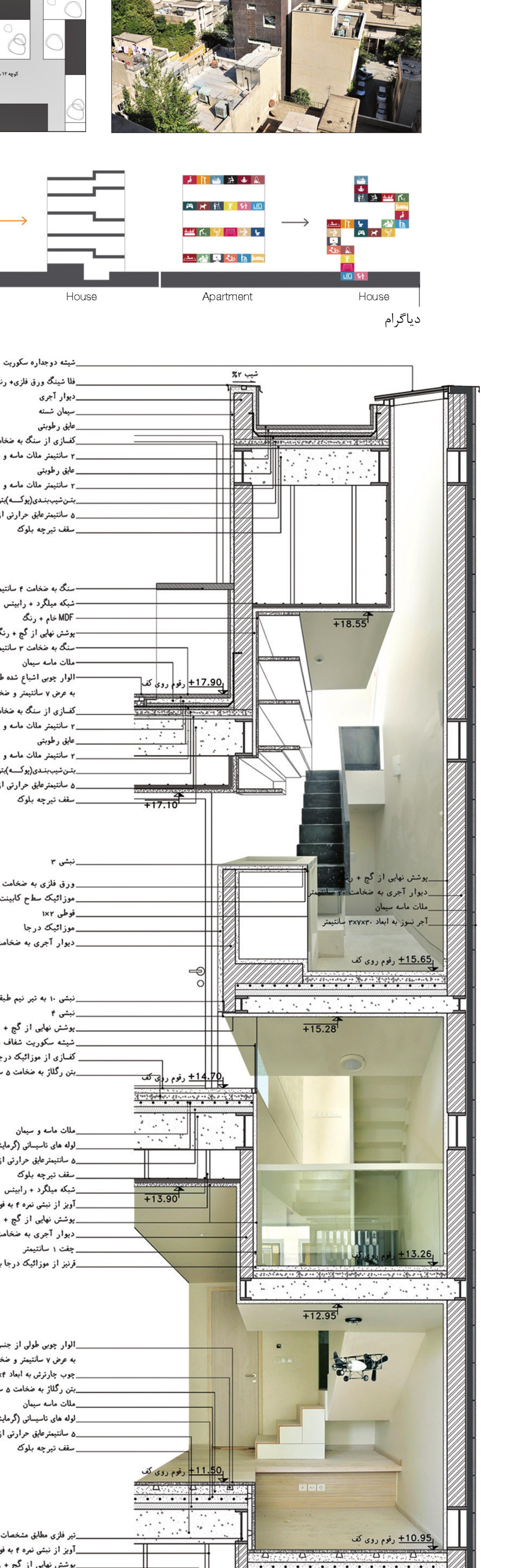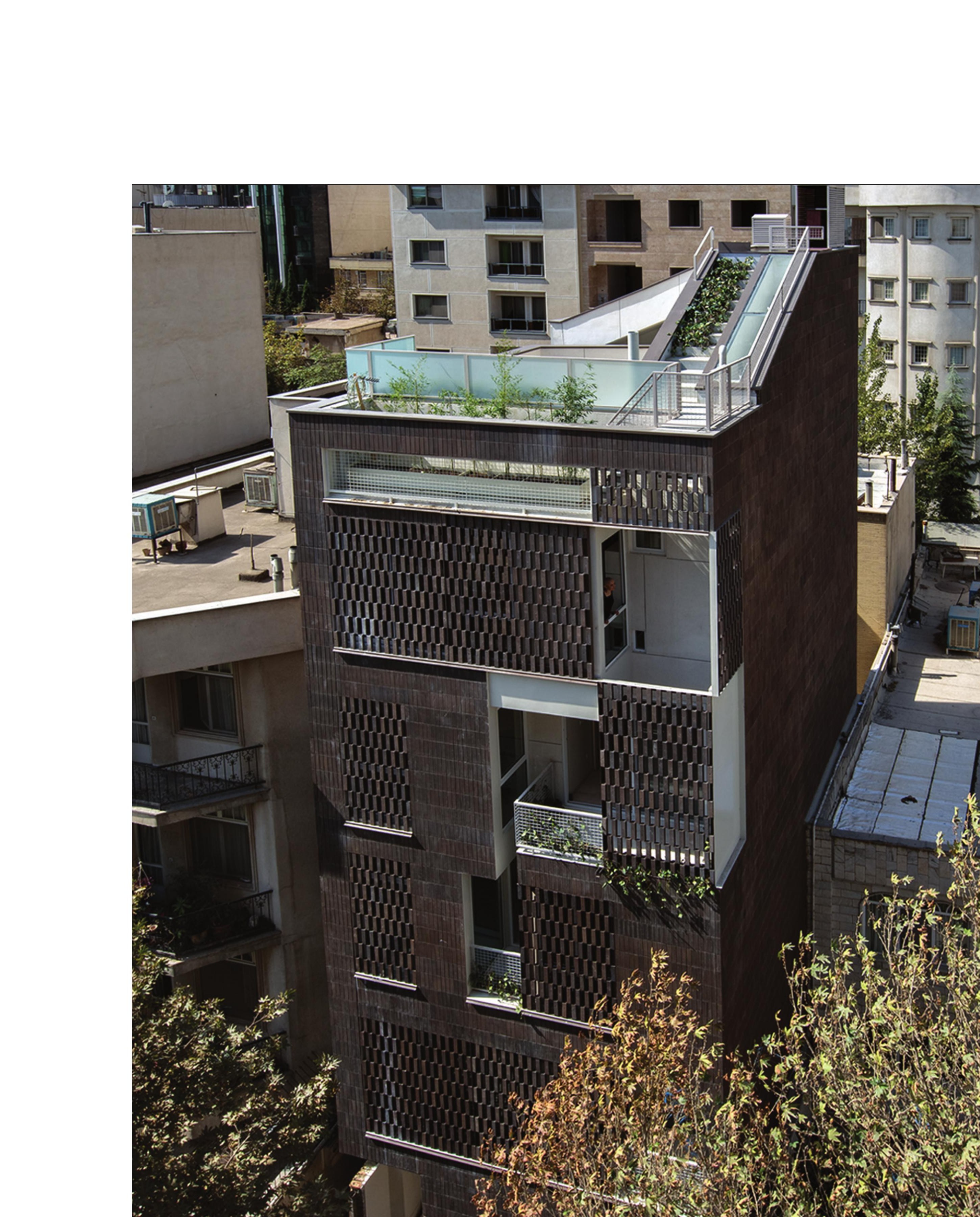
Eilkhaneh is a four-storey apartment containing three residential units for three families of an extended kin. The site sits to the north next to the "Toodelli" plot, accessed from the street through a narrow alley to the west. To the east lies a plot whose depth equals the combined depth of the Eilkhaneh lot and its northern neighbour; the eastern building's projection therefore stops short of Eilkhaneh's buildable boundary. Physically, then, Eilkhaneh is a building with four facades. Yet under municipal regulations it has the right to take light and open windows only on the south.
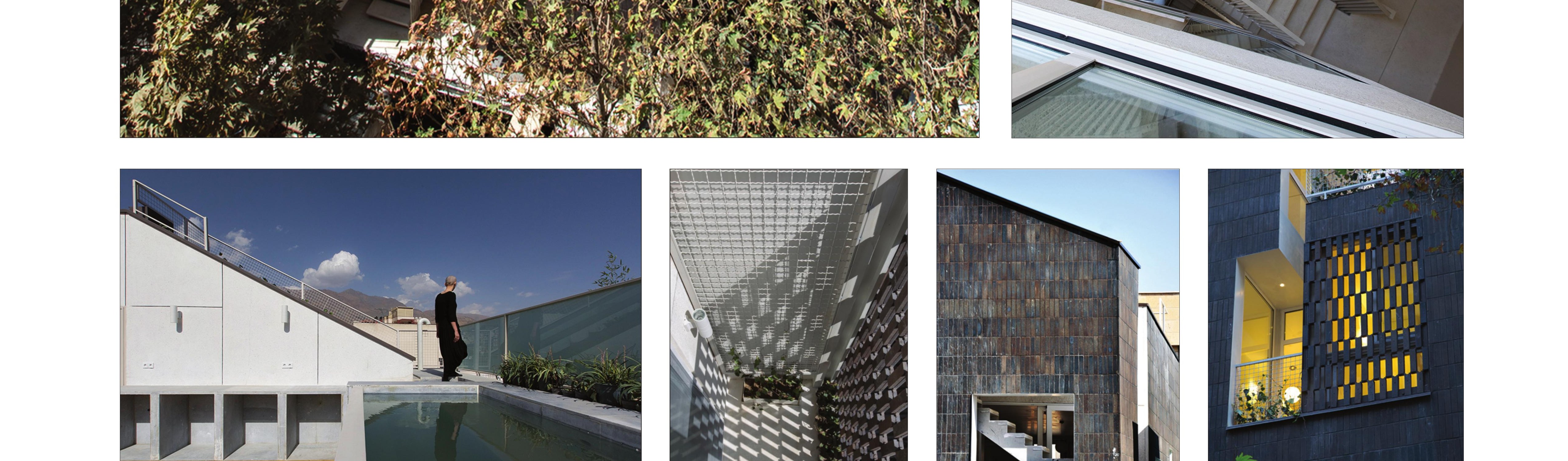
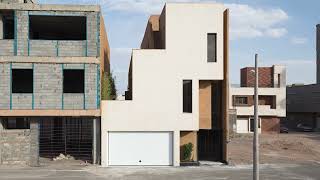
Typologically, Eilkhaneh is an infill apartment with four elevations. The recesses of the south facade create a series of semi-open rooms onto which most interior spaces look, instead of looking onto the alley. In parts of the facade, a translucent, perforated skin — a steel frame with brick infill, partly movable across the facade — allows the southern envelope to be reconfigured locally for view and daylight.
On the northern wall, green pockets open small views and admit indirect light to Eilkhaneh. Along the western wall, in line with the access alley of the "Toodelli" property, a continuous slit gives the building general indirect daylight, while the deep interiors also receive lateral light from small openings in the western wall. The south-east corner is sculpted with set-backs that allow oblique access to the eastern view, within the municipal rule that forbids direct eastward views.
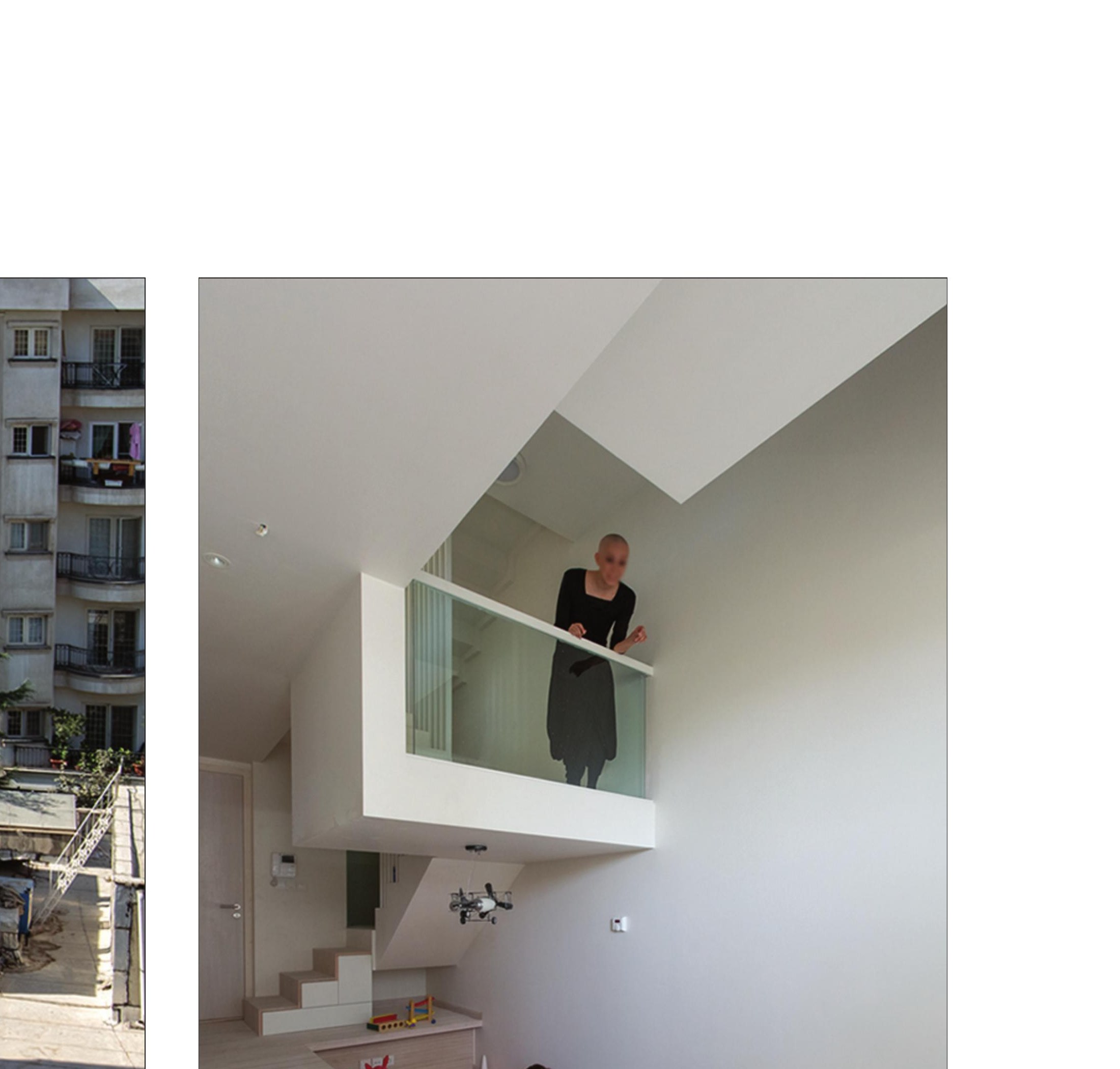
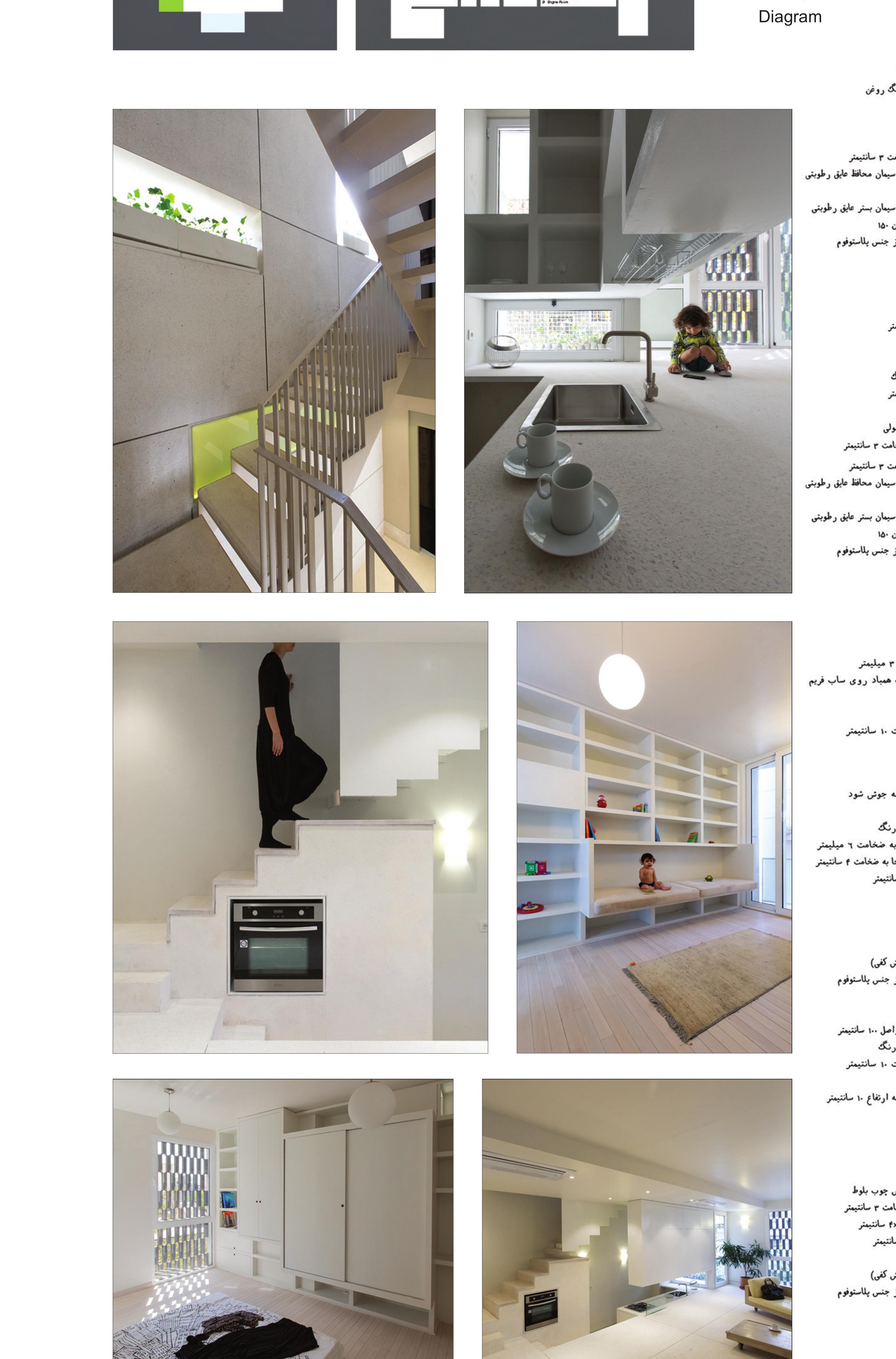
The section is designed as a set of continuous folded planes and discontinuous floating planes. The breaks in section make parts of the vertical surfaces inhabitable. In addition, the entire western wall, seen from the interior, is composed as a wall of niches sized to everyday objects, so that this vertical surface too becomes inhabitable.
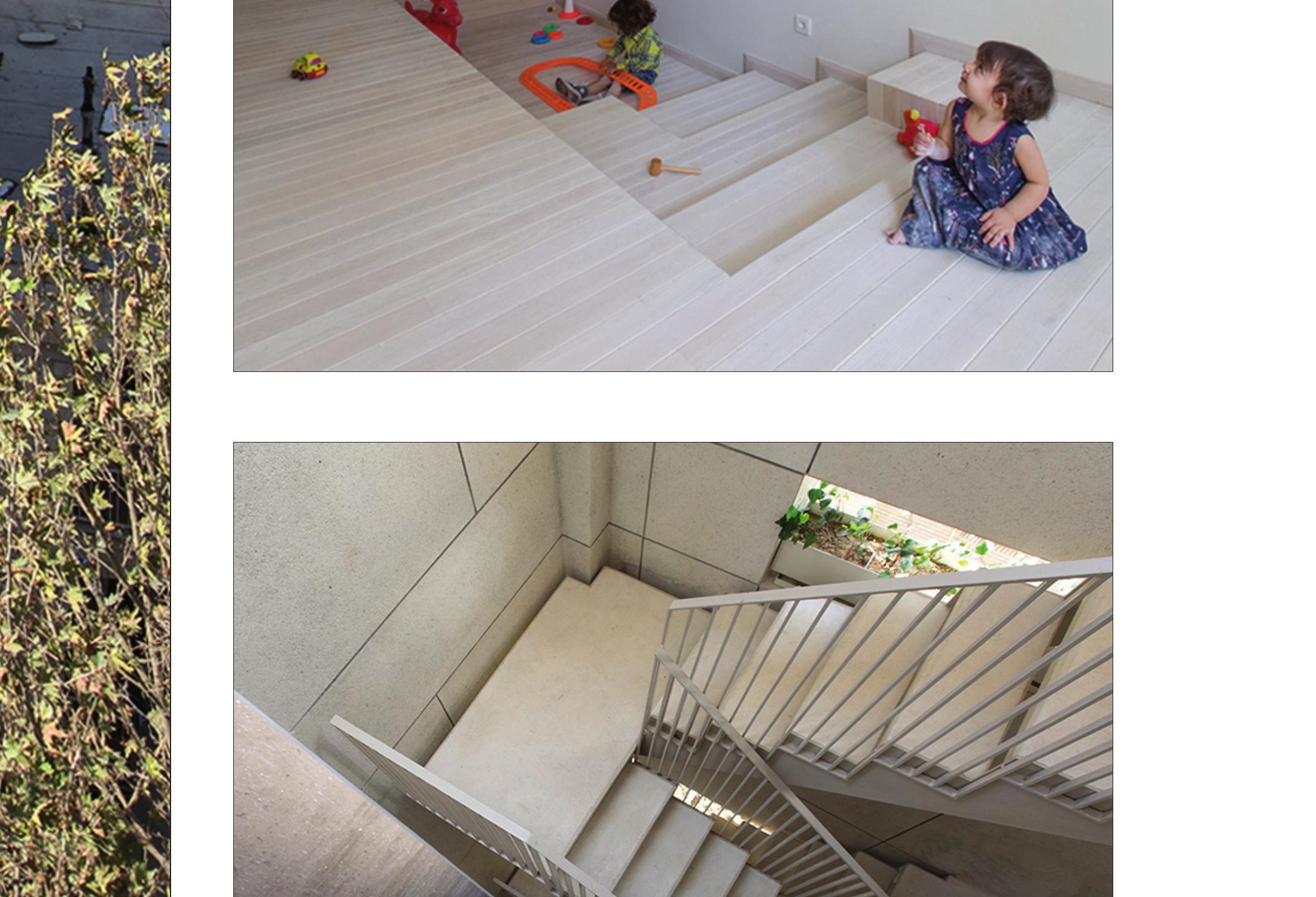
The communal stair — through a series of indirect light sources from the north and west and the green pockets of the northern wall — is turned into a generous space that supports social interaction among the resident families. By borrowing from the spatial logic of central-courtyard houses, the interior spaces of the apartments on the north side look onto this terraced, half-open, sunlit stair.