



Inventing Kindergarten
Norman Brosterman
New York: Harry N. Abrams, 1997
Reviewed in: Marie-Jeanne Dumont, "Friedrich Froebel, L'enfance de l'architecture," L'Architecture d'aujourd'hui, No. 313, October 1997
It seems as though modern art has had a father who has remained unknown until today. In truth, he is the grandfather of this art — or its godfather, guardian, and master, in the strongest sense of the word: Friedrich Froebel, a German educator from the nineteenth century.
This startling discovery comes from a book published in the summer of 1997 in America, supplemented by research recently conducted in Europe. The avant-garde artists of the 1910s and 1920s — and thereafter — who bear the title of every geometric abstract movement, including "total art" at the Bauhaus, can be seen as inspired by a single source, the deity of temptation and inspiration: the philosophy of someone named Froebel, who by examining the relationships between the arts of different nations, made the transition of art across cultures possible. While education specialists still disagree about the best method of teaching the visual arts, and even debate whether one can truly create an artist through training, the case of Froebel is worthy of our reflection. Froebel did not work in an art school; from early childhood, he shaped taste and artistic sensibility. The academy of Master Froebel was the kindergarten.
Much has been said about the various sources of modern art. A recent study has brought one of these sources — equally abundant yet unknown — out of obscurity. I am referring to the teaching of pure geometry that Friedrich Froebel fundamentally completed and transformed on the one hand through kindergartens, and gardens of children on the other. A number of the leaders of avant-garde art in the last years of the nineteenth century received such education. Froebel's method can be considered the origin of all forms and patterns of modern art; his heritage is undeniable. Indeed, Froebel has been the Esperanto of modern art.
Froebel, the son of a Protestant pastor, was born in 1782 in Thuringia and died in 1852 in Switzerland. He belongs to the lineage of innovators and reformists who, by scrutinizing their own time and its realities, transformed them. After much going back and forth between study and teaching, he finally resolved to establish schools — in Berlin, Switzerland, and in his native region of Thuringia. This was his last great endeavor. If his fame even today is owed to his invention and creativity, historians do not forget that this teacher and private tutor was, above all, a theorist of education who, in his writings, produced several scholarly works expressing a most lofty idea of human education and cultivation — an idea that, beyond Christian piety and German philosophical thought, led Froebel to construct and elaborate a theory in which play is regarded as a means of deepening the mother-child relationship, the most noble and fruitful spiritual activity that a human being can engage in at this stage of inner growth, giving form to their thoughts. Away from the family environment, and against his own wishes, he was compelled to create an institution for implementing this educational and pedagogical play. Thus, the kindergartens — devoted to the education and development of children at pre-school age — came into being.
The Geometry of the "Gifts"
Children in these kindergartens, following a comprehensive educational program that claimed completeness, became acquainted with a set of activities — singing, gardening, storytelling, and so on. But most importantly, their time was devoted to playing with a revolutionary educational instrument that Froebel had called "Gifts." The Gifts, which initially numbered five and in the developed form of his method grew to twenty, were not toys intended for children's idle fantasy. They were educational instruments that had to be used under the supervision of trained instructors with discipline and regulations. Each Gift constituted a complete educational program that was to be put into practice over several years and, whenever possible, continued during primary school education.
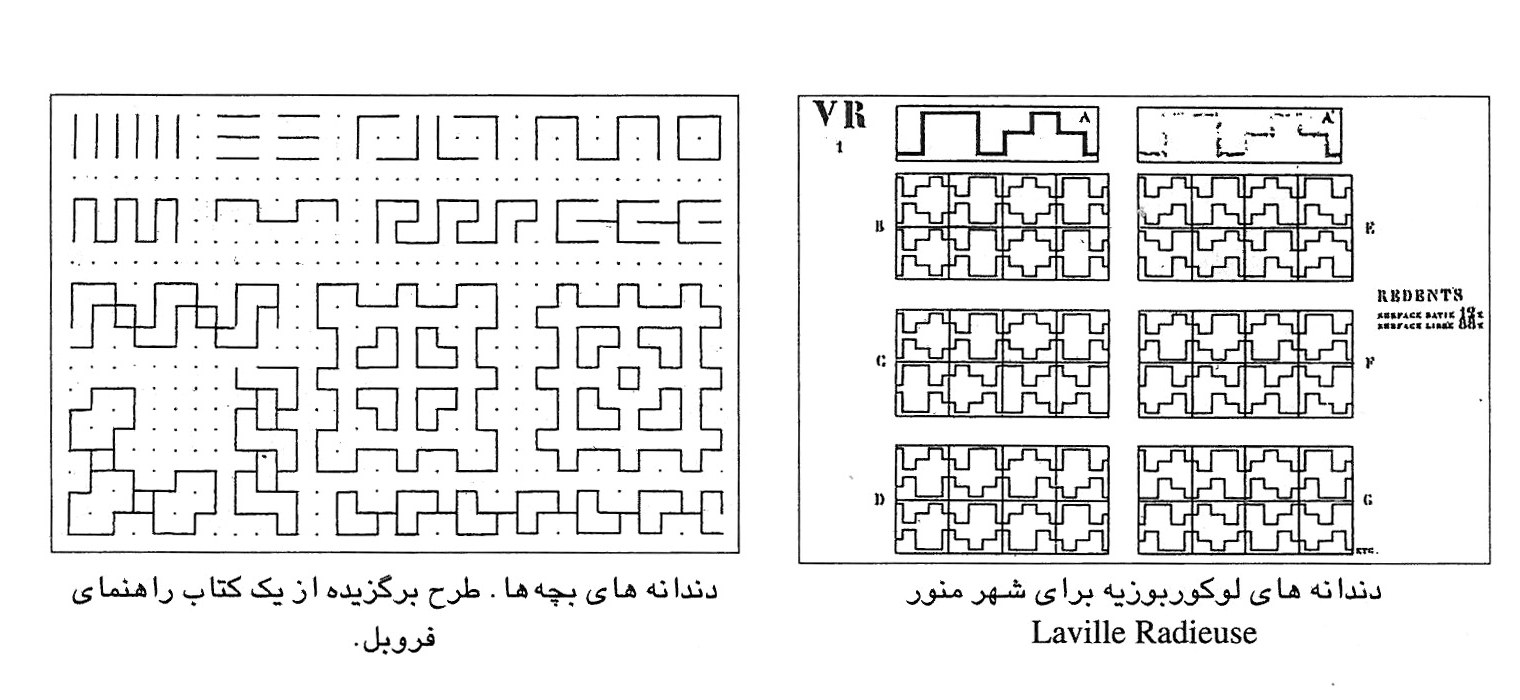
This method began with the manipulation of soft, delicate balls that could be held in one's fist and then thrown and caught again. Precise movements had to regulate this back-and-forth. After that came solid forms — cylinders that one must grasp and roll to set them in motion, so that the transformation of their shapes through changing views could be observed. A cube would become a cylinder, and a cylinder would become a cone. After this stage, by stacking, placing side by side, and combining cubes, the turn came to discover all the possibilities of their surfaces. When the child had become thoroughly familiar with geometry in three dimensions, the turn came for plane geometry — the stage of designing and shaping with the help of three-layered cut boards or cut colored papers. Finally, the line was introduced. At this stage, one had to draw on paper or on a small blackboard divided into tiny squares.
Froebel's method proceeded from three dimensions to two, and then to one, arriving at last — in reverse — at a volume made of constituent lines. Froebel delighted in the mutability of forms, their direct and symmetrical relationships, and the kinship of shapes — in which an object was embodied in a different form. For three years: stacking, mounting, separating; cutting, weaving, sculpting, and drawing — these preliminary forms made the geometry of this system second nature to children, so that it became their second mother tongue.
This method, which became more complete, precise, and practical in the last years of Froebel's life, was propagated by his students and also after his death, meeting with brilliant success. In the 1850s, kindergartens spread in Switzerland and Germany, and then in the Netherlands and England. German immigrants, shortly afterward, introduced the system in the United States. By 1890, Froebel's method had been adopted more or less everywhere — from Austria through Japan to Australia — as a teaching method. In some countries, such as France, they preferred to create their own version (which became known as "maternal schools").
From Pedagogy to Art
Le Corbusier attended kindergarten. Let us imagine for a moment: this is an important fact. Few things are known about the childhoods of famous artists, but we know with certainty that, for example, Le Corbusier and Johannes Itten attended Froebel schools. This can almost certainly be said of Kandinsky as well (though for a brief period), and probably Paul Klee. We know that Wright, without attending a school run with such rigorous method, played extensively with Froebel's "Gifts" and was profoundly influenced by their dynamic geometry.
— Frank Lloyd Wright
How could one better summarize the philosophy of Friedrich Froebel? And what finer tribute could be paid to this educator than this — from architecture (Wright) — which had discovered him on its own.
The Esperanto of Modern Art
Those whom Froebel influenced were not all artists as solitary as Taliesin's exile. Particularly in the case of Itten, his approach traveled from childish upbringing to art education. Itten, who was the pure product of Froebel and had even inherited his spiritual side, based on his "preparatory lessons" — the famous first-year course — laid the foundation that became the origin of all design courses in every school of architecture today. If we also take into account the presence of Paul Klee and several other advocates among the Bauhaus faculty, and if we add that in the same period (1925) Gropius was designing a memorial facade for the great teacher (Froebel) that was to be the culmination of his geometric ideas, we can consider the Bauhaus the direct and legitimate heir of Froebel's method.
Le Corbusier is the most prominent example, for we know the most about this Prussian-born man. We know precisely which day he entered kindergarten, the name of his teacher, and how long he stayed. Little Charles-Edouard was able, for amusement, to arrange thin, elongated wooden sticks in rows, stack cubes, caress pure forms in natural wood, add them together, combine them, separate them, build — and with this inviolable geometric order, create. Le Corbusier had forgotten the influence of this period, or rather, during his Art Nouveau phase and its local ornamentalism, had repressed this influence into his unconscious. But afterward, during his period of reflection and exploration of grand theories alongside Ozenfant, he would acknowledge this influence. Around the magazine L'Esprit Nouveau, in a certain way, he returned to this unconscious forgetting and became susceptible to it once more.
There is no room for doubt about the source of the famous plate "Toward an Architecture," in which pure volumes are presented exactly like the actual volumes of Froebel's Second Gift. Le Corbusier is the most striking example of Froebel's influence — the fundamental geometric influence was so powerful in him that it withstood even several years of the more academic and rigorous training at a local art school, emerging complete and headstrong.
Norman Brosterman, author of the recent research on Froebel, wished to rightly extend the resemblance further between Froebel and the Bauhaus, and to demonstrate that this mystical tendency toward geometry, this formalist idealism, this modern visual language, had somehow become the visual culture of the avant-gardes or the Esperanto of modern art. Van Doesburg, Mondrian, Klee, Lissitzky, Malevich, Kandinsky, Wright, or Le Corbusier — and all the artists upon whom Brosterman has built his argument. In truth, each in their own way was in harmony with Froebel's Platonic philosophy. But proving this important point cannot be contained in a book about kindergartens.
Brosterman also lacks the ability to explain how, in a country like France — which completely resisted the Froebel school — Cubism was able to emerge and flourish, to the extent that neither Braque nor Picasso attended kindergarten. But if this research is somewhat deficient in reasoning, its collection of images and illustrations is so compelling and apt that it conceals all other shortcomings. Brosterman, like a sort of Brooklyn antiquarian, has gathered the educational materials and supplies from American Froebel schools: guidebooks, the "Gifts" themselves, old photographs, and selected works of students from the end of the last century — a treasure trove from which the book draws extensively and upon which all its originality depends. Moreover, this collection, comprising hundreds of pieces, was recently acquired by the Canadian Centre for Architecture.
Placing side by side Mondrian's paintings, Josef Albers's works, Bart van der Leck's designs, or the plans of Wright and Le Corbusier, alongside children's work selected from old collections or guidebooks for instructors, surpasses all discourse and writing. If, as educational psychologists constantly repeat, before the age of six — or four, or even two — everything about intelligence takes shape, who is to say this is not also true of children's artistic learning? Parents, do not hesitate!
Notes
1. Norman Brosterman, Inventing Kindergarten (New York: Harry N. Abrams, 1997).
2. Several points that may aid further understanding of Froebel's work: Froebel lost his mother in childhood and spent many hours alone in a garden. When he entered school, the change of environment — given the dry atmosphere of the classroom — pained him. He suffered from this austere environment, the lack of images in school textbooks, and the fact that children did no handwork. In his later writings, he refers to these issues repeatedly. For this very reason, the German word Kindergarten, which he coined, is an apt term, and the word Gabe (Gift) is also, in truth, a kind of defiance against homework and children's rote exercises.