At dawn on the 19th of Dey this year, Bruno Zevi — the esteemed Italian architect and theorist — died in Rome, the city in which he had been born eighty-one years earlier and where he had spent most of his life. The report carried by the major news agencies was to much the same effect: “Rome: the architect and architectural historian Bruno Zevi, a fiery enemy of fascism in politics and in architecture, died at 3.47 this morning (9 January) at his own home. He was professor of architecture at the universities of Rome and Venice. It was through his writings that the American architect Frank Lloyd Wright became widely known, and the concept of organic architecture — which Wright originated, and which consists in the fusion of nature and architecture — was expounded by Zevi.”
Agency reports are of course short by their very nature, and although they convey part of the truth, they do not do the subject full justice.
In my view, Zevi was a theoretician of architecture before he was a historian of it. He knew the history of architecture well, and for that very reason he was able to analyse architectural phenomena well. Although Zevi had a large share in making Frank Lloyd Wright’s architecture known to the European public (and indeed to the wider world), his role in theorising about modern architecture should be counted ahead of his analyses of Wright’s work. So far as I know and can say, no theorist or historian has analysed modern architecture with as much directness and daring as he did, and there are no explicit signs or allusions to “post-modern” architecture in his writings. His work is truly not history-writing in the usual manner, for in his writings he used the historical events of architecture as evidence for his theories about modern architecture — and some of those theories, as we have said, carry very clear hints of the “post-modern” architectural tendencies that we all know today.
In his book The Modern Language of Architecture,1 he enumerates seven traits or characteristics — which he calls “invariables” (Invariables) — for modern architecture. And with clarity and directness, and in a fiery language that seems to arise from his own temperament, he analyses and explains them, and brings historical evidence, both old and new, in support of his views.
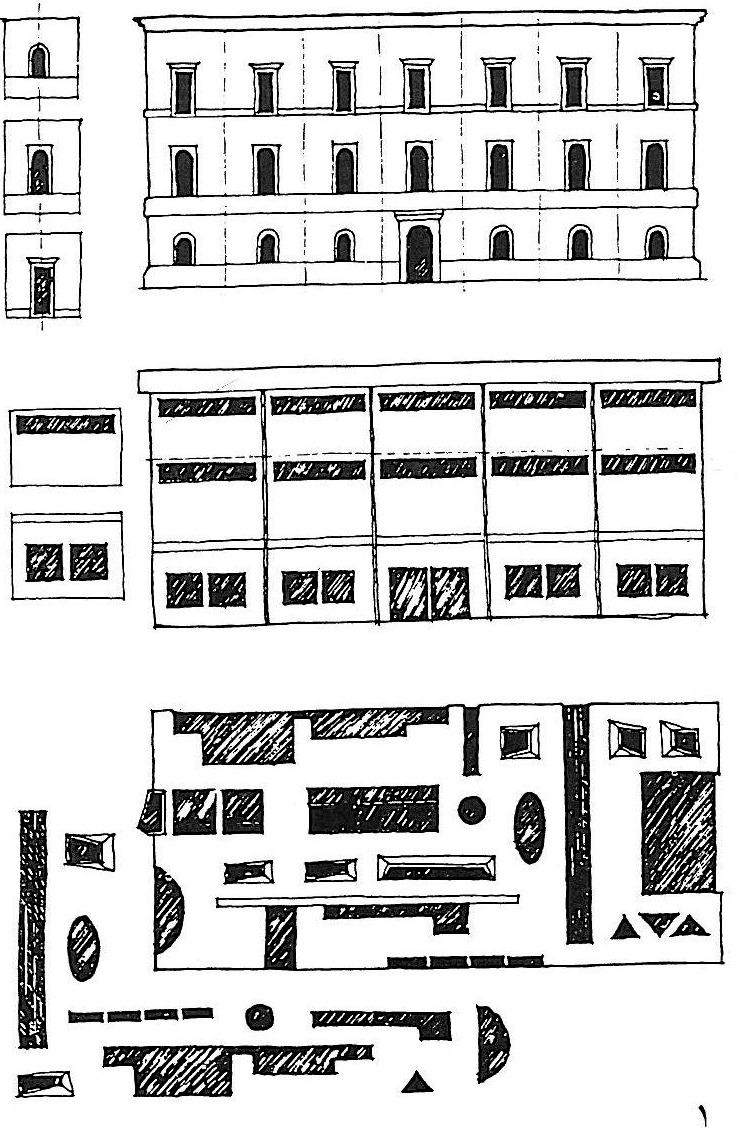
The first “invariable” he calls “the list, as a method of architectural design,” and he writes that this list, which comprises all the functions of a work of architecture, is the founding principle of the modern language of architecture and that all the other principles follow from it. What Zevi means by this “list of functions” is not, as might be supposed, that architecture should be given a tight garment woven out of functions; on the contrary, his meaning is that each of the building’s elements should be the expression of the particular function that element performs in the building. The example he offers in this connection is the window in a building (figure 1).
As we see, this drawing shows the elevations of three buildings. The elevation of the upper building marks a classical facade; the middle one marks a superficial or counterfeit modern facade; and the lower one is the facade that Zevi himself proposes. In the first two elevations the windows in no way express the function that goes on behind them — whether a reception room, a bedroom or a kitchen. Whereas in the lower elevation, although each window plays its own tune, it is the spatial function of which each window is the outward expression.
More interesting than these drawings is Zevi’s own statement introducing his first principle and introducing genuine modern architecture. In describing this principle he writes that it wipes clean the tablet of the written and accepted rules and principles of architecture, rebuilds it, frees it from those constraints, and in their place inscribes a new command and a new text (pp. 7 and 8, reference 1).
We said that in describing the principles of modern architecture as he interprets them, Zevi shows signs of the recent tendencies. Is this writing of Zevi’s not the very thing that later — borrowing a term from the Greek philosophers — Derrida and his follower Peter Eisenman call palimpsest (Palimpsest), and which forms one of the principles of today’s deconstructionist tendency? Geoffrey Broadbent,2 referring to this last point in the sense of the word of which Derrida is so fond, writes, quoting the Oxford English Dictionary, that “a palimpsest is a parchment or stone tablet from which earlier writing has been erased so as to make a blank surface for new writing.” (Deconstruction: p. 9, Persian translation); and Zevi speaks of wiping clean the tablet of the past and beginning from point zero. Zevi himself, in the preface to the second edition of this same book of his (1994), writes: “Four years after the publication of the Italian edition of this book (The Modern Language of Architecture) I read a highly amusing and entertaining article entitled The Post-Modern Language of Architecture by Charles Jencks. That article shows that post-modern architecture, which has set itself against modern architecture, is in truth a pre-modern architecture — the architecture of academic classicism. In that case my book ought to be called The Post-Post-Modern Language of Architecture.”
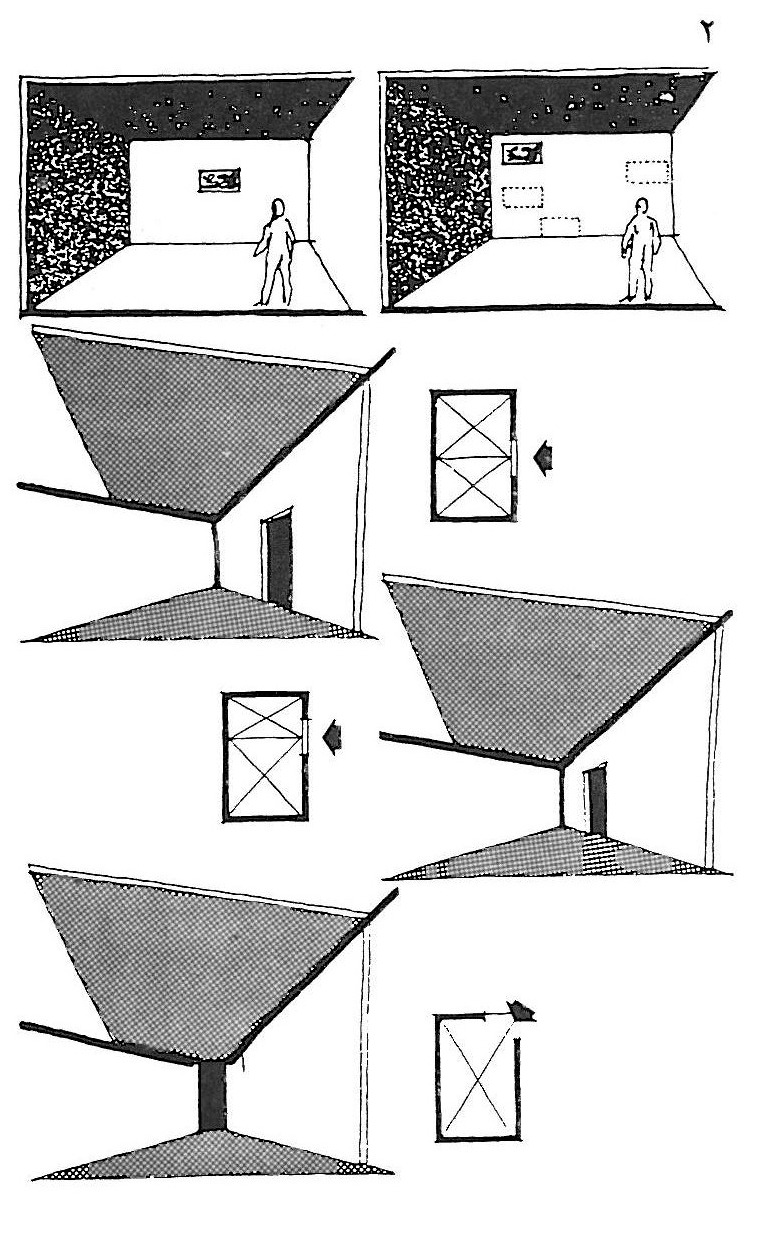
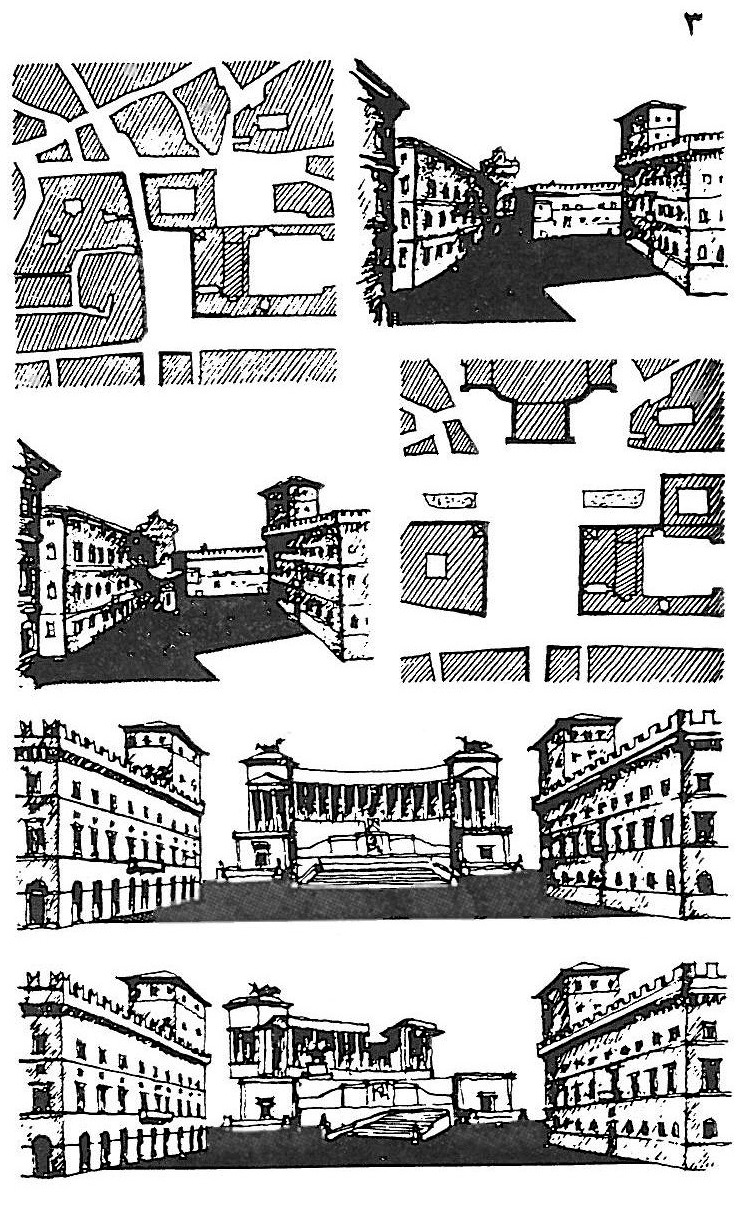
Zevi calls his second “invariable,” or principle, “asymmetry and dissonance.” He describes symmetry as equal to a squandering of capital (economic waste) plus an arrogance and an intellectual contempt towards human beings, and he rightly holds it to be one of the principles of classicist architecture. He writes: “Once you have rid yourself of the vulgar fashion of ‘symmetry,’ you have taken a very large step towards a democratic architecture!” The example he gives in this connection is the hanging of a picture on the wall of a room. He writes that, on this principle, hang the picture anywhere on the wall except in the middle of it; and in order to give an example of the ugliness of symmetry he cites the Piazza Venezia. This square was formerly entirely asymmetrical, but they opened it up and set the monument to that king in the middle of it so that everything about it should be symmetrical (figures 2 and 3).
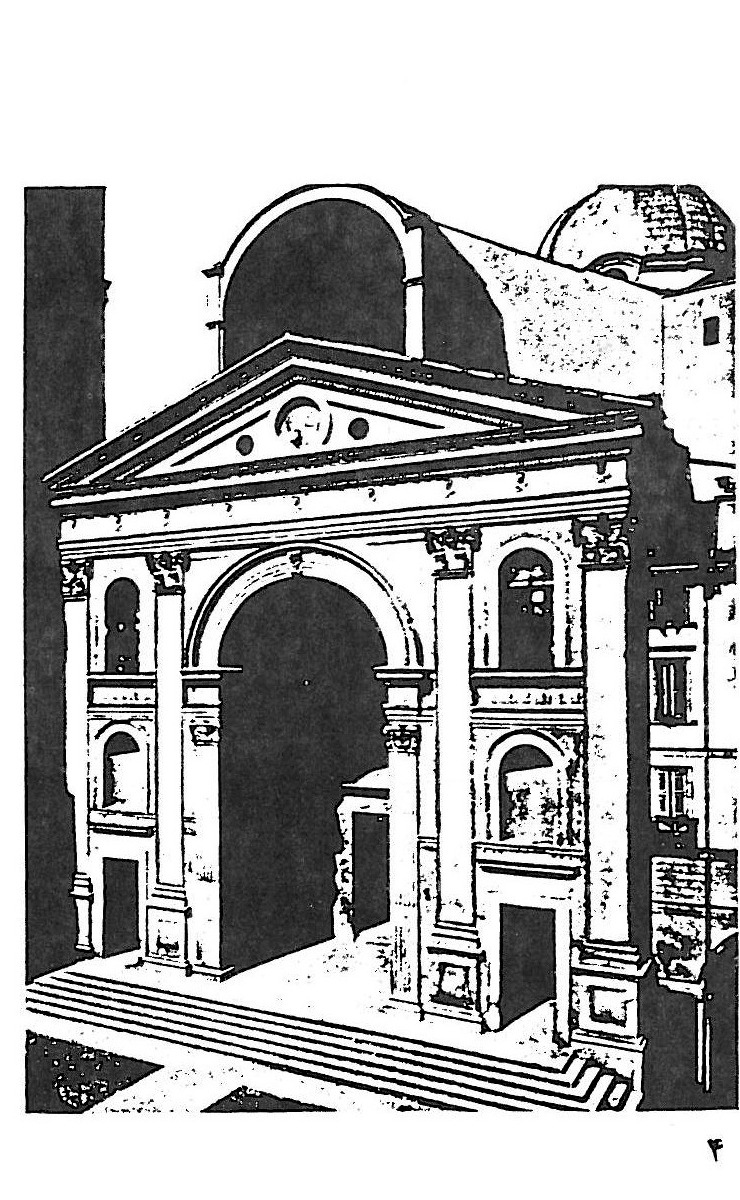
Zevi calls his third “invariable” “anti-perspective.” We know that perspective was discovered by the Italian masters in the Renaissance and that its rules were codified then, and that Leon Battista Alberti3 first applied it in the church of Sant’Andrea in Mantua4 (figure 4). In its own day this new invention brought a fresh conception of space into architecture; but for all its novelty at the time, it was not sufficient to convey the space–time conception of the modern age. For the perspectival view looks at an object or a building or a space from a fixed point. The cubist conception or idea that found expression in our own age in the work of painters such as Picasso is the best expression of the three-dimensional “anti-perspectival” conception that Zevi puts forward. It is striking that in post-modernist writings this conception is invoked again and again without any mention of Zevi, and striking too that Zevi counts it among the characteristics or “invariables” of modernism, while later the post-modernists took the same conception as a characteristic of their own work, or used it to justify and explain that work.
The example Zevi offers here is the Palazzo Farnese square (Palazzo Farnese). He writes that if the buildings around this square had been built at an angle to one another, its three-dimensional richness would have been increased (figure 5), whereas as things stand the building facing across the square appears only as a facade to be seen frontally.
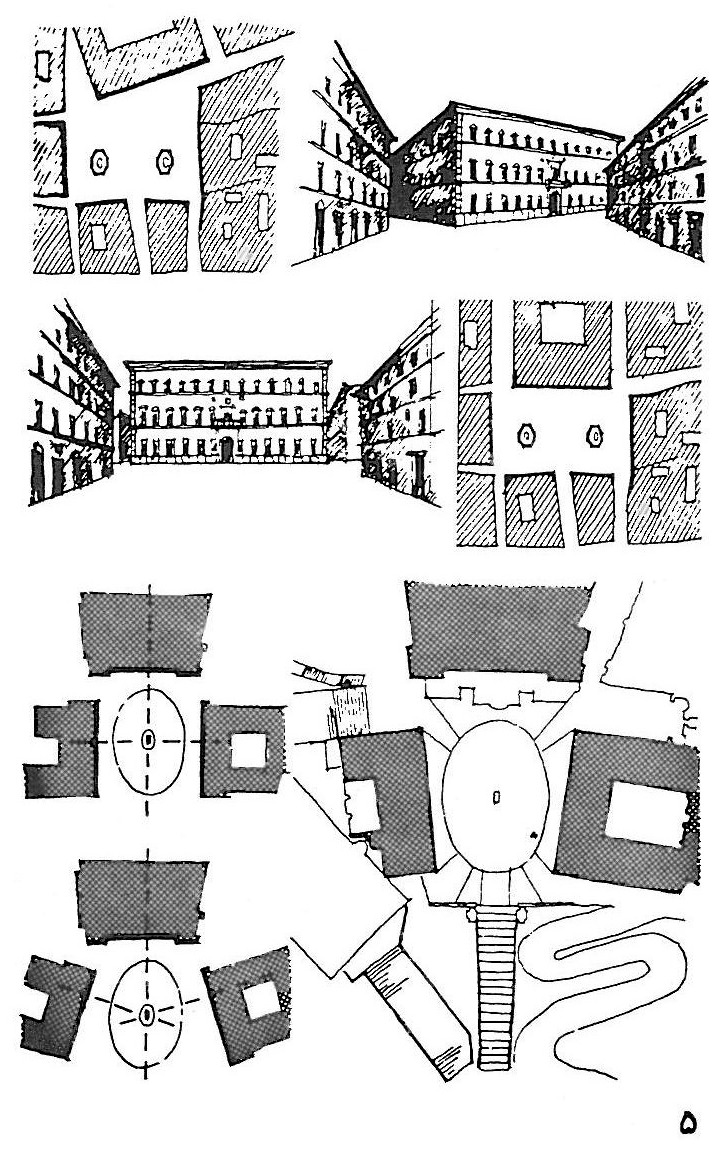
A sentence of his, in our view, explains his fourth “invariable” or principle: “Break the box!” What he means by this sentence — which, like many of his terms and views, is vehement and severe — is that any architectural space enclosed within a merely cubic or rectangular box should be opened up. In figure 6
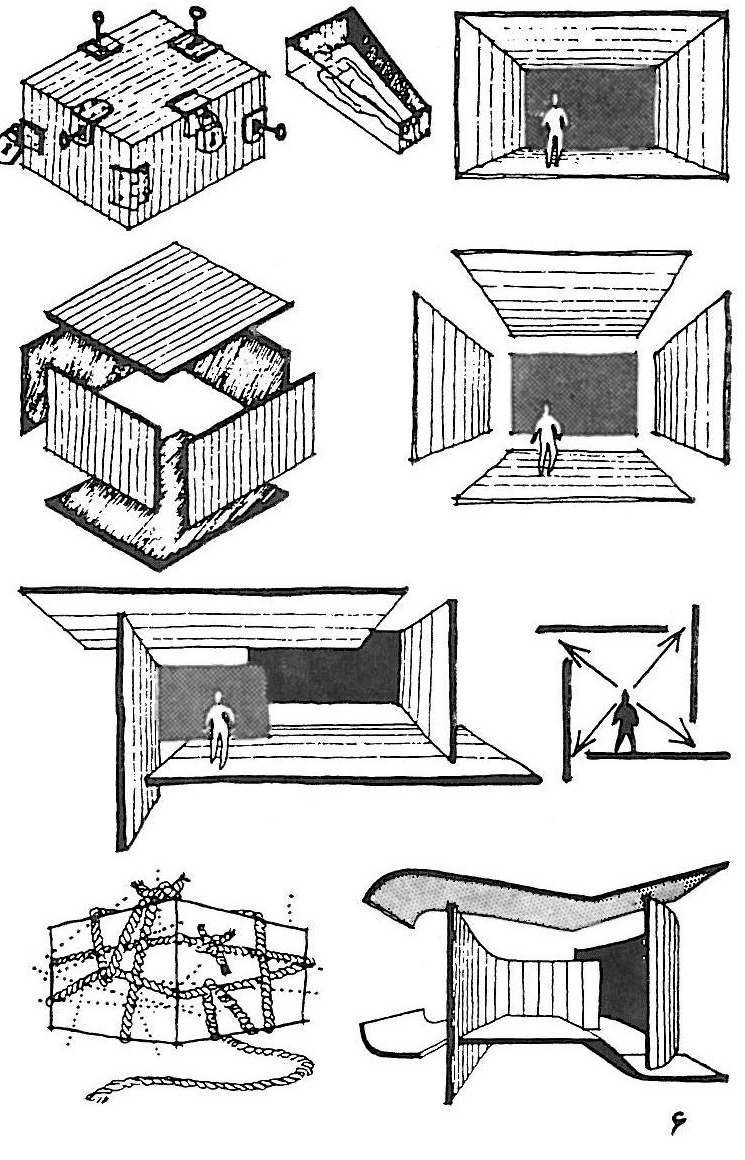
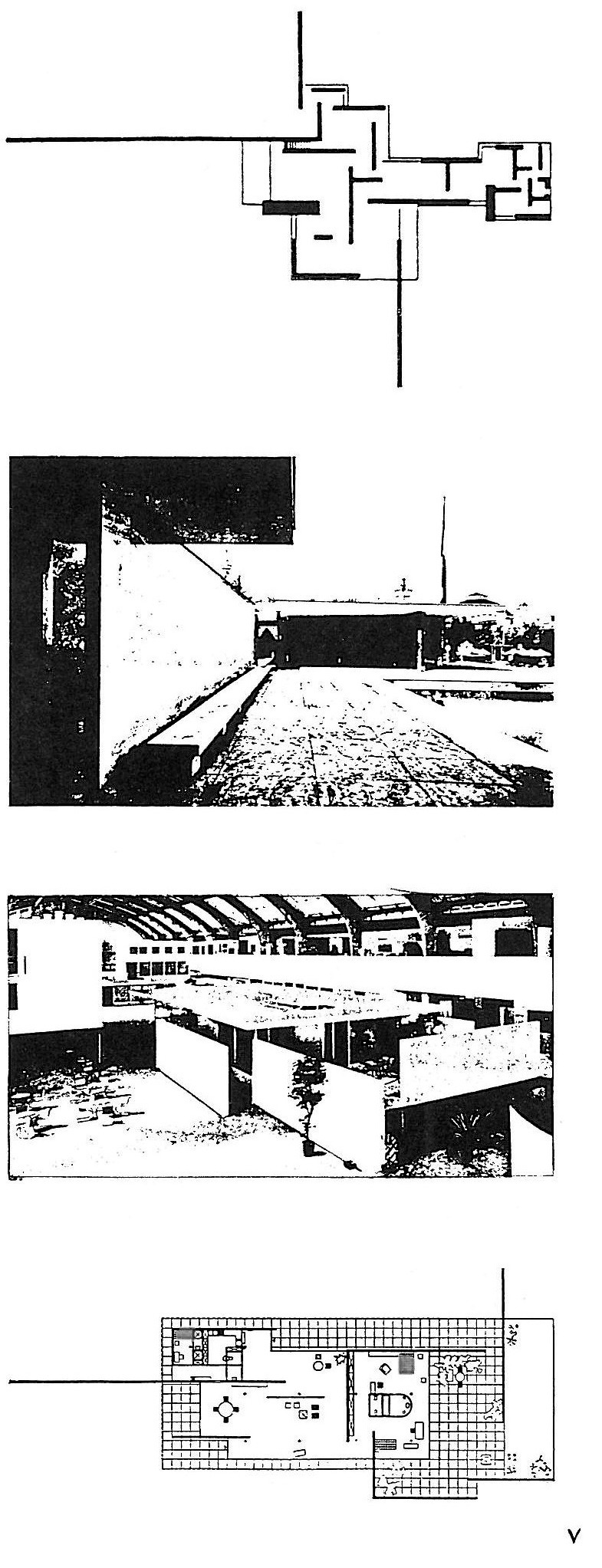
he offers numerous examples of this opening up, or as he himself puts it of “breaking the box.” For in his view a closed space “confines, and restricts the person like a corpse in a shroud. But if we open the six surfaces of this box (this cube) away from one another, we have taken a revolutionary step which is among the principles of modern architecture.” Let us not conceal that the “Barcelona Pavilion,” the work of Mies van der Rohe (1929), and his country house (1923), which was shown at the 1931 German architecture exhibition, are the embodied, built examples of this principle (figure 7). It seems that Zevi took the term “box,” or box-architecture, from Frank Lloyd Wright. This point becomes clearer still when he sets out his fifth principle or “invariable.”
Zevi opens his fifth “invariable” with a quotation from Wright. This remark of Wright’s belongs to the year 1955, and it is there that Wright uses the term “box” building. Part of the quotation runs thus; Wright, referring to his Fallingwater house, says: “... I understood enough of structural engineering to know that the outermost corner of a box is not the place that is most economical for carrying the load of the box.”5 What Wright means, of course, are the daring cantilevers he used in the Fallingwater house in order to bring that house and its architecture out of its box-like form (figure 8).
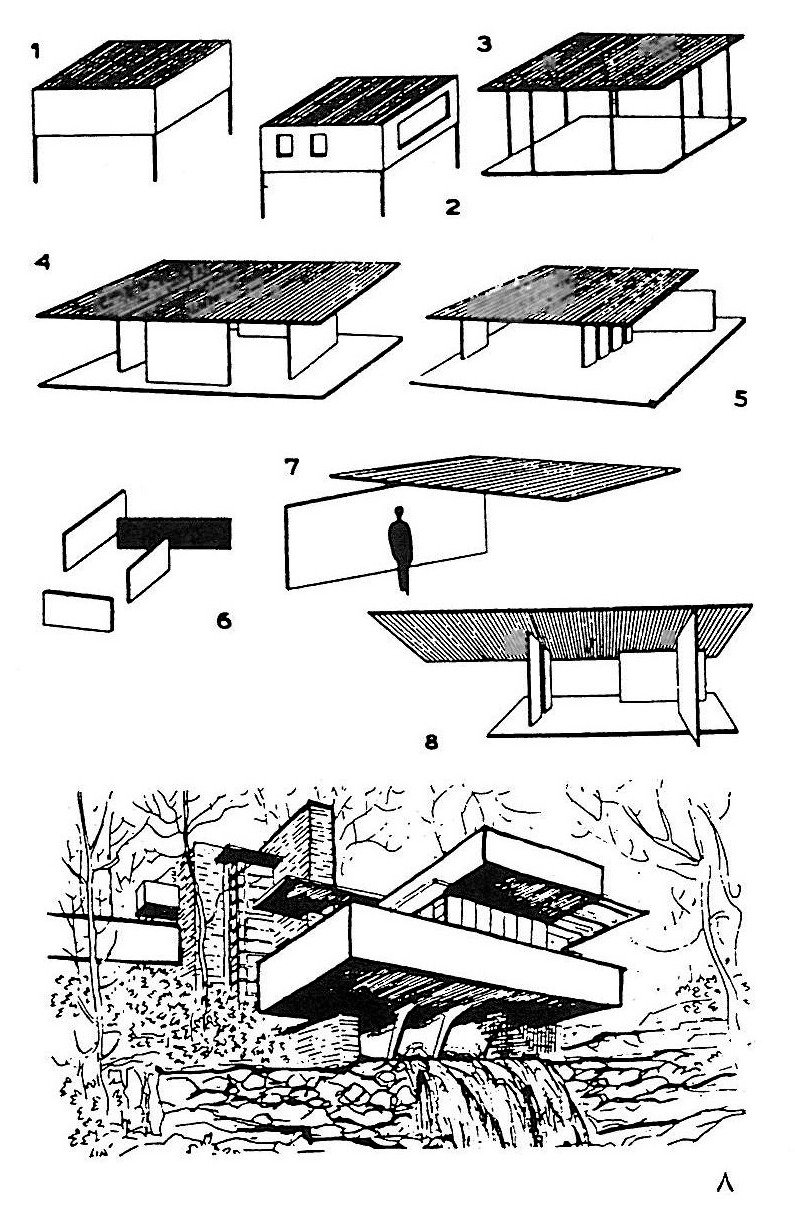
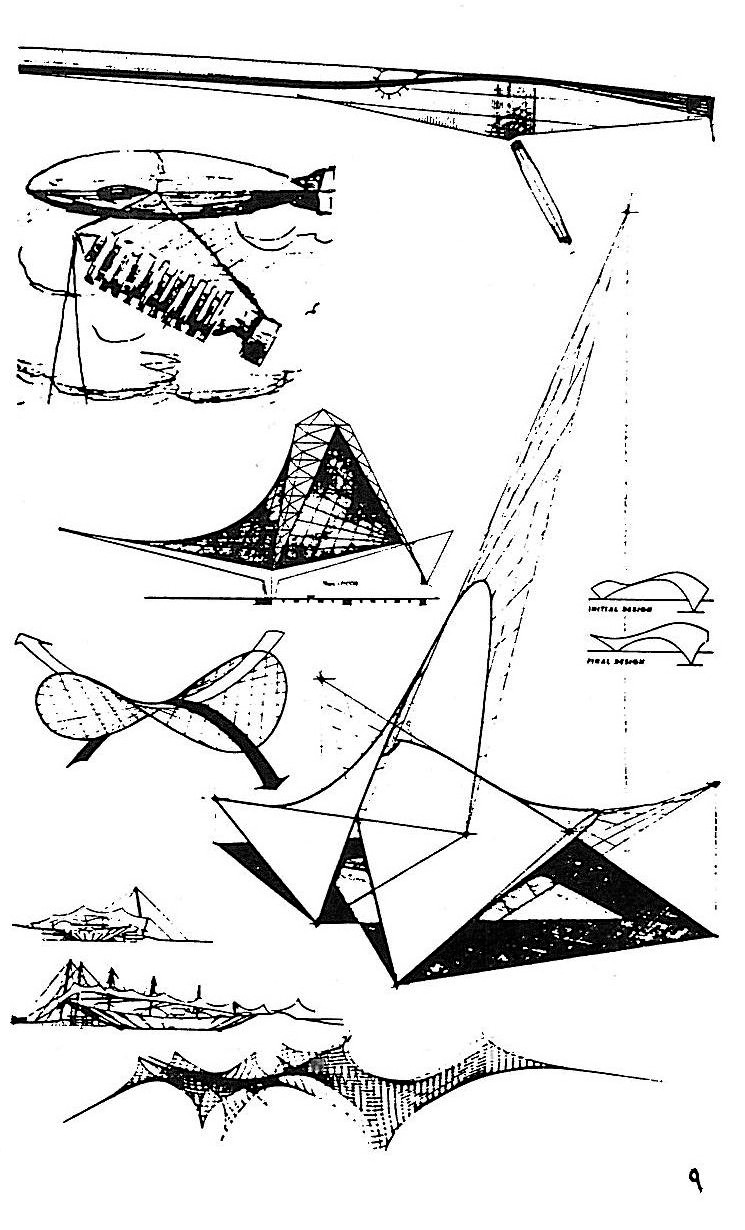
After this quotation from Wright, Zevi writes that “the modern language of architecture means that engineers and architects alike — by speaking this language — should free the building from the chains of classicism and put an end to the long-standing antagonism between engineer and architect.” For the same reason he gave his fifth “invariable” the name of cantilever, shell and membrane structures,6 and the illustrations he provides in this same section of the book in defining and explaining the fifth “invariable” all serve to convey that invariable of his (figure 9).
Zevi’s sixth “invariable” has been named “space in time.” If in the naming of the five “invariables” we have so far mentioned it was the architectural works of the great names of this profession that gave rise to those names, then without doubt the sixth “invariable” is indebted to Sigfried Giedion’s famous book Space, Time and Architecture. For it was he who brought the concept of space and time into the field of architecture — under the influence, of course, of the works of the masters of architecture and of the scientific discoveries of the twentieth century.
In defining this “invariable” Zevi opens his discussion thus: “The history of architecture bears the mark of lost opportunities: long strides forward, and long retreats. Michelangelo took a very long stride forward; everyone praised him, but no one set foot on the path he had opened. Borromini made a leap forward, but in his own lifetime he was set aside, and after his death too no one spoke of him (until in our own age he was rediscovered). Constructivism marks a major advance before the October Revolution. But Stalin — who must be called a classicist of renown — froze that movement ...” (p. 47).
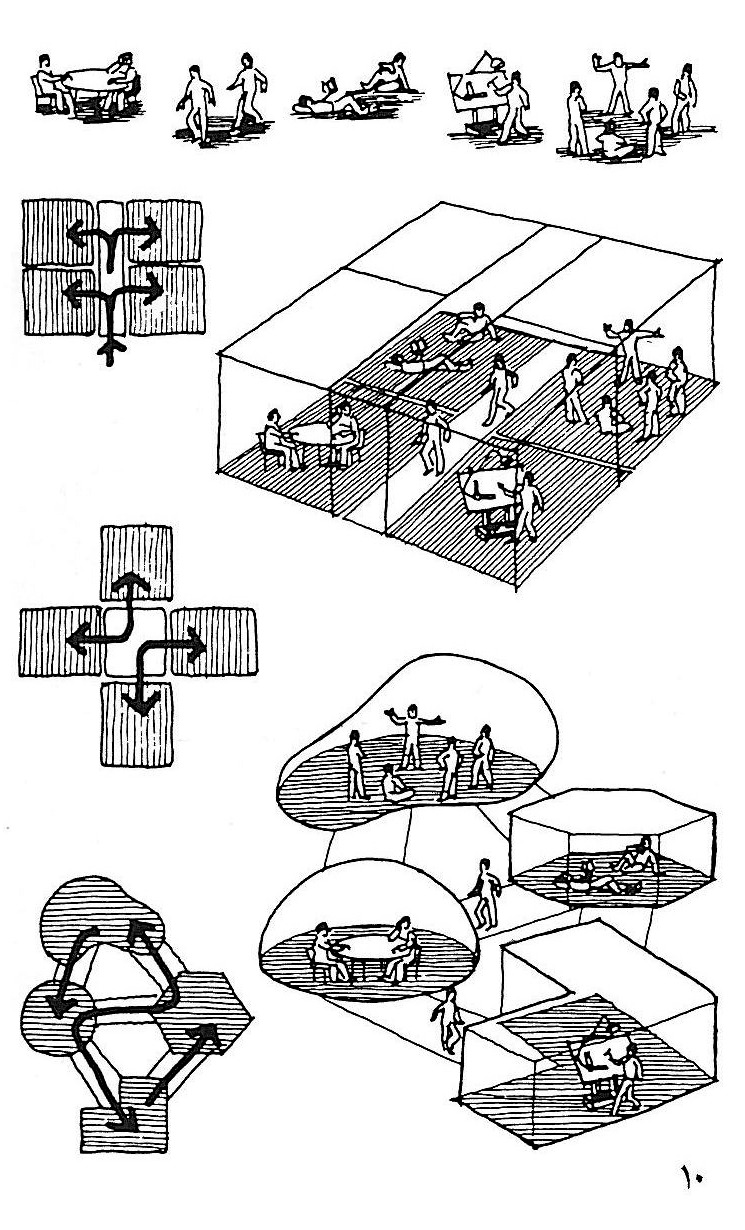
The illustration he gives in explaining this “invariable” of his shows his meaning in the best possible way (figure 10). In the upper part of the illustration he shows the activities of a human being taking place freely, without the constrained space of classicism, until at last an architectural space places them in a cage with no regard for time. Conversely, in the lower part of the illustration each of the activities, according to the time of the activity, is placed in a space suited to it. Truly, if under Zevi’s fourth “invariable,” anti-perspective, the external volume of the building — or as he puts it the box — must be broken, then in observance of the sixth “invariable” the box must take its shape from the internal activities of the house.
And finally the seventh “invariable,” which has been named “the link between building, city and landscape.” To grasp this “invariable” one must first recall a sketch that Zevi drew from the work of John Johansen (John Johansen), the American architect, explaining this architect’s work on the design of the Mummers Theater (Mummers) in the city of Oklahoma in America (figure 11).
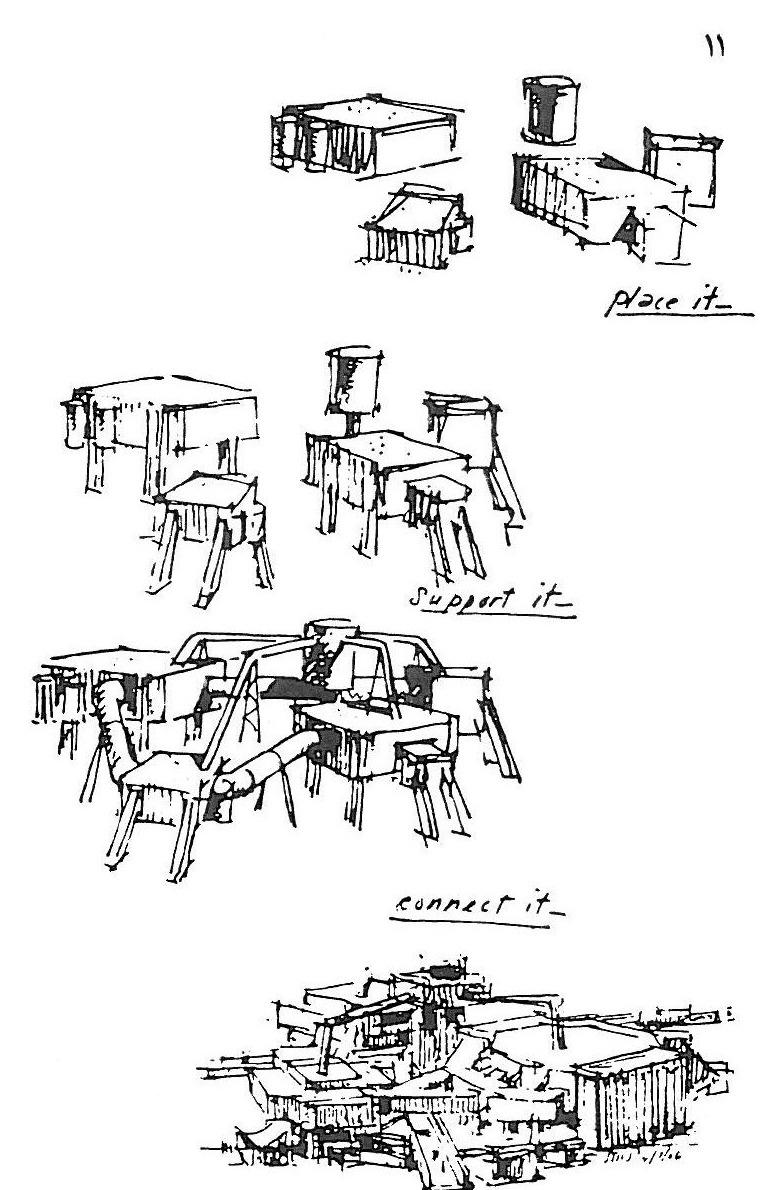
In this drawing the architect shows the process of architectural design in three stages:
1) Shape the volumes and place them side by side,
2) Set them upon a structure, and
3) Link them to one another.
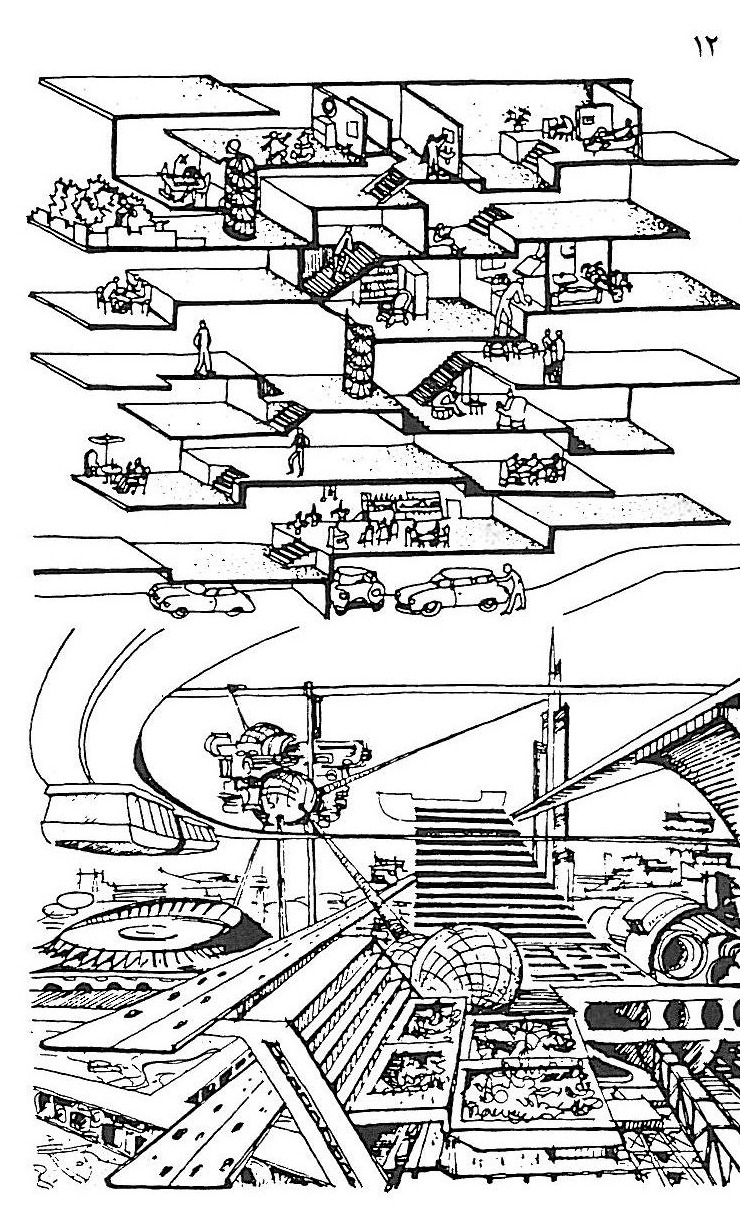
Another sketch (apparently by Zevi himself) shows this “invariable” of his in a wider sense: in this sketch not only the linking of the elements of a single building to one another is realised, but also the linking of different buildings of differing uses with such elements as the street, the park and even the whole urban transport system (figure 12).
At the beginning of this discussion we said that agency reports are — by their very nature — usually transmitted briefly. Magazines too — by their very nature — have little room for extended discussions. For that reason what I have written about Zevi, though short, does in my belief make clear Zevi’s most fundamental ideas about an important aspect of architecture, which he calls the modern language of architecture. Otherwise, books could be written about Zevi’s ideas and views, and without doubt they will be.
I saw Zevi only once, and that was when he had come to Iran to take part in the second World Congress of Architecture, held in Shiraz in 1353. My colleagues at the Faculty of Fine Arts seized the opportunity and invited him to lecture at the Faculty. He accepted and spoke in the Faculty’s hall. He began by asking the audience in English whether they wished him to speak in English or in Italian, and since Italian was agreed upon he spoke in that language, with the then dean of the Faculty translating into Persian. He analysed the works of the great architects of that time on the basis of these very “invariables” — without naming them directly. His warm tone and his “fiery” personality, to which the agency reports referred with the English word Fervent, and of course the things he said as well, greatly captivated me. At that time I had only recently returned to Iran from the New World and from Europe, and the translation of Space, Time had been published a little earlier. I was therefore not at all unfamiliar with the contemporary architecture of the West. For all that, I regretted that I had not been a student of Zevi’s. Both his warm personality — which I could sense from the movement of his hands and head and neck and from his manner of delivery, without knowing Italian — and his meticulous analyses of the works of the great architects of that time, which I understood from the Persian translation of his lecture, drew my attention to him. Later, when I became better acquainted with his views through his books, although I did not find some of his opinions in agreement with my own, and although questions about them came to my mind, I still admire his directness in speech and his analytical method, which is always that of a teacher. May his soul rest in peace.
References
1) The Modern Language of Architecture (English), the 1975 and 1994 editions. The page numbers cited in the text refer to this source unless another source is named.
2) Deconstruction, “Deconstruction,” Persian translation 1375
3) Space, Time and Architecture (English) 1968
Footnotes
1. The Modern Language of Architecture
2. Geoffrey Beoadbent
3. Leon Battista Alberti
4. S. Andrea Mantua
5. Quoted from the book An American Architecture, in Zevi’s book, p. 40
6. Cantilever, shell, and Membrane structure
* At the request of Dr Manouchehr Mozayyani, the Persian spelling of foreign names has been set in the manner he prefers.



