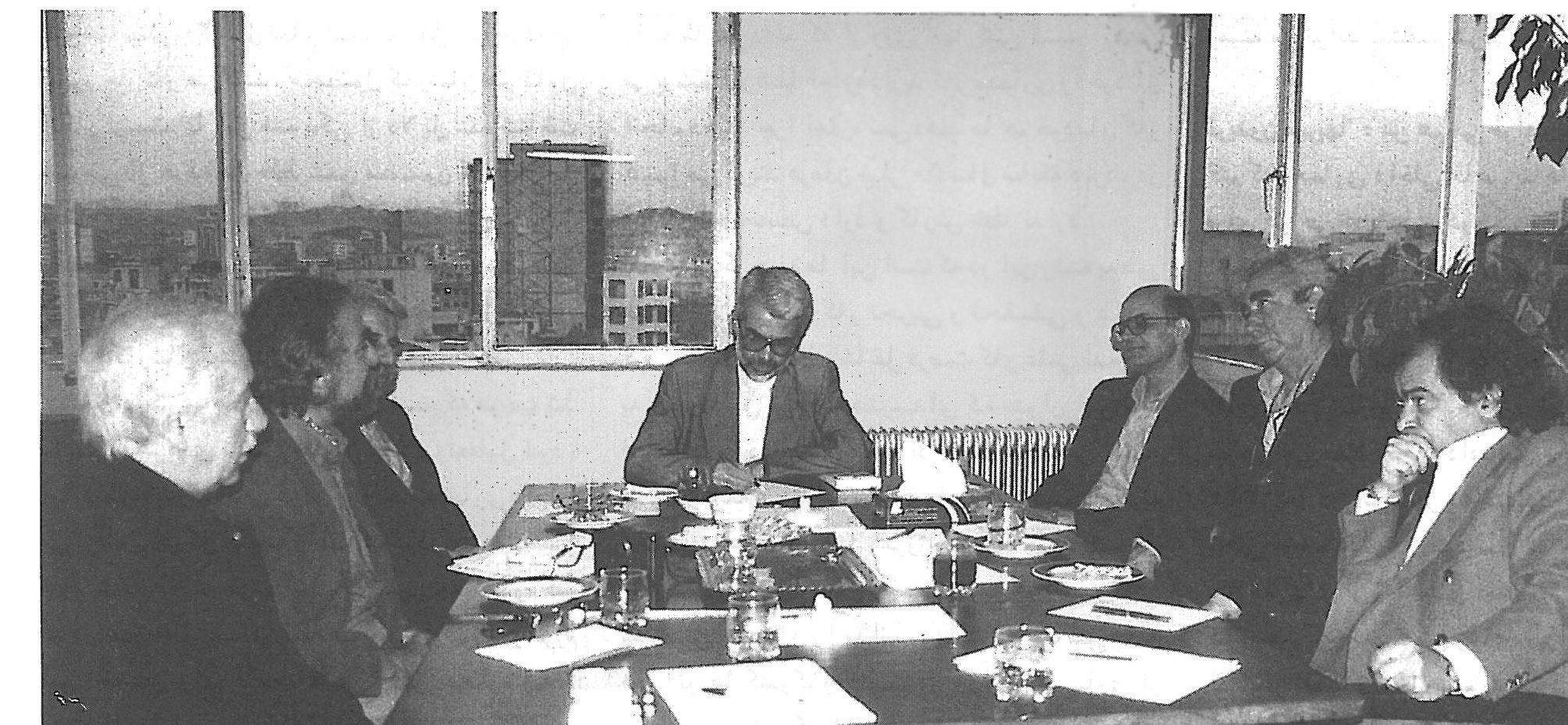
Participants
Memar
Interior design — as a profession, an industry, and an art form — is well recognized worldwide; architectural space is not usable without interior design. But in our country, this profession has not gained the recognition it deserves. Perhaps only the affluent classes have paid some attention to this subject and benefited from this expertise, although the necessity of interior design for several government buildings has somewhat drawn attention to the matter. Architecture magazines, given the close relationship between architecture and interior design, typically devote a portion of their pages to this topic. We too wish, in this first issue, to raise the general concerns of the interior design profession in Iran through the voices of its practitioners, and in subsequent issues to introduce good examples of completed work and establish connections between enthusiasts, consumers, and producers. What are your thoughts?
Naser Araghi
The reality is that the subject of interior design has been tainted in our society. The Faculty of Decorative Arts — in those very first years after the Revolution — was shut down under the argument that decorative arts cater exclusively to the wealthy. Yet the subject of interior design is by no means limited to the wealthy and their grand homes. If we take frugality as a fundamental principle of today's society and intend to provide the possibility of comfortable living in 60-square-meter or 40-square-meter apartments, interior design becomes an inescapable necessity. Interior design can tell us how and with what furnishings we should live in these small spaces, and who should build these furnishings.
Interior design is not confined to grand ceremonial buildings. For equipping hospitals, schools, even bus stations, one can benefit from this expertise. Interior design affects the lives of every member of society and directly intervenes in daily life. In other words, interior design shapes human behaviors in living spaces — both public and private — and making life more comfortable is the goal of interior design.
Ali Mohammad Shoja Jazayeri
The scope of our profession is vast, ranging from urban design to furniture design. The boundary between our profession and architecture is clear. At the same time, I must emphasize that it should not be confused with decoration. This field is fully recognized in the West. In a world that is moving ever more toward specialization, with various specialties accepting the boundaries of other fields' activities, our architects generally do not recognize the specialty of interior design. For twenty full years, practitioners of this profession have been working in our country. The product of their work is undeniable. Nevertheless, one of the reasons for the general public's lack of recognition of our work is the conflation of our profession's substance with architecture. Whereas, in my belief, our work is complementary to architecture. Even many speculative builders have come to realize that using interior design makes their work sell better.
Another problem is the same misunderstanding that caused the Faculty of Decorative Arts to be shut down after the Revolution. But as Mr. Araghi said, interior design can be very useful for society as a whole and for lower-income classes as well. It is worth noting here that after the Revolution, for the first time, the necessity of this specialty for public buildings in the country became apparent, and consulting engineers specializing in interior architecture were able to receive official rankings from the Plan and Budget Organization.
Heydar Jahandari
In general, the discussion of art arises when we consider the question of public welfare. As mentioned, the knowledge of interior design can serve the general public in many spaces. Public places where thousands of people pass through every day — terminals, parks, hospitals, and so on.
Of course, in our work, defining the boundaries of disciplines — knowing where the architect's work ends and the interior architect's begins — and distinguishing the work of the decorator, the interior architect, and the industrial designer matters. But establishing precise, definitive boundaries is not easy. In any case, all these specialties must work together, just as in the design and construction of a building, engineers from different disciplines collaborate.
The last point I can mention is that with the closure of the Faculty of Interior Architecture after the Revolution, no new professional practitioners have been trained in this field for nineteen years. With the retirement of our generation, the field will be left empty.
Kambiz Safari
Following on from this discussion, I should add that with the closure of the school of interior architecture, its foreign-trained graduates will replace the domestic specialists, and consequently they will propagate a foreign culture in our land, and gradually we will lose our own cultural symbols. Also, in the absence of any serious training — as with other artistic disciplines — there is the danger of foreign cultural infiltration through new software. Many of our works have been archived because investors — perhaps due to client taste, perhaps for economic reasons — prefer to use copied designs.
For five years now, the best-selling product of a company I know is a copied work. Or for designing office systems, they use samples featured in journals. Even architects, when it comes to interior design, give us catalogs from Herman Miller and the like to copy from. When we ask, "If you have the authority to do the architectural work yourself, why don't you allow us to do our own work?" they say Herman Miller has fifty years of experience, has expertise in this area, and its work is error-free.
Another issue in our profession is that one cannot do experimental, research-based, and scientific work spontaneously. Working interior architects have no opportunity for scholarly work. For this reason, the need for an institution where such activities can be organized is keenly felt. Before the Revolution, the government commissioned research of this kind. But today we have no commissioning body. Yet it is necessary that we learn the history of interior design in our own land — we must explore paintings and miniatures. In designing many films, we see that specific furniture and objects are used for set design. Research in this field helps everything.
In my belief, to improve the conditions of our profession, cultural and educational advocacy work must be done. Specialized magazines must address this subject. Radio and television as well. These activities will help the public become more familiar with the substance of this profession. Although perhaps the true audience is not the general public, because — in both the private and public sectors — specific individuals and institutions can be clients of this profession.
Finally, let me mention this important point as well: the lack of a training center for this profession and of new graduates — in large projects, we face a shortage of active designers. The magazine can take the lead in this area.
Fereydoun Mirbaha
I too want to emphasize this point: that interior design is not exclusive to grand buildings. The design of small spaces and the furnishings they require needs our profession even more. Currently, the typical residential unit in Tehran is 75 square meters and in provincial cities 100 square meters. Yet as Mr. Mottaghi mentioned, we have carried out useful design work even in 25-square-meter apartments. I remember that in 1347 [1968], in this city we built a 12-story building for one of our colleagues where most apartments were 23 square meters. But now, at a time when the size and population of Iranian cities are rapidly increasing and the urgent need for adequate housing is clearly evident, most of our work involves retrofitting new buildings — which inflicts enormous losses on the nation's capital and labor force — and we face a serious shortage of proper design for urban spaces, alongside the profound transformation that has occurred in people's communication and lifestyles.
In any case, it is fortunate that due to the crystallization of the need for this specialized field in large buildings, the Hafeziyeh Project has benefited from the abilities of our esteemed colleagues, Mr. Mottaghi and Mr. Jazayeri, and I hope that at least in other national projects — airports, cultural centers, the metro, and the like — this expertise will also be utilized.
Hassan Mottaghi
I do not entirely agree with the notion that interior design pertains only to the privileged. We have done a great deal of design work that has been useful for the general public. I myself have done interior design for a 35-square-meter apartment. Even the inexpensive furniture sold at some exhibitions is the product of our own colleagues' designs. That is to say, we have been able to design a comfortable and simple chair at an affordable price. Of course, we have also done interior design for large buildings such as cinemas and hospitals, whose users are ordinary people. In fact, I believe interior design is fundamentally for the general public.
Our relationship with architects has in many cases been based on mutual understanding, and we have worked collaboratively. Of course, there have been architects who carry out all stages of work themselves — even the structural calculations — and naturally have no need for us. But many prominent architects have worked with us and accept the specialized nature of our profession. In my belief, compared to a decade ago, a transformation has occurred that has made the need for this field palpable. Ten years ago we did not have this many tall buildings. These buildings need interior architecture consultants. Likewise, the new cultural centers, libraries, parks... For this reason, the ground is ready. But we must introduce this field. Your magazine can take the lead in this area.
Memar
We thank you for participating in this conversation. As mentioned at the beginning of the session, the purpose of this discussion was to open the door to a dialogue about interior design. We hope in future issues to properly introduce examples of interior design in our country and its designers, and to show that in our country there is a market — however small — for interior design. We can devote pages to introducing examples of unified space design or custom-commissioned examples for a building, or manufactured furnishings produced for a project, and we hope you will assist the magazine in this endeavor.