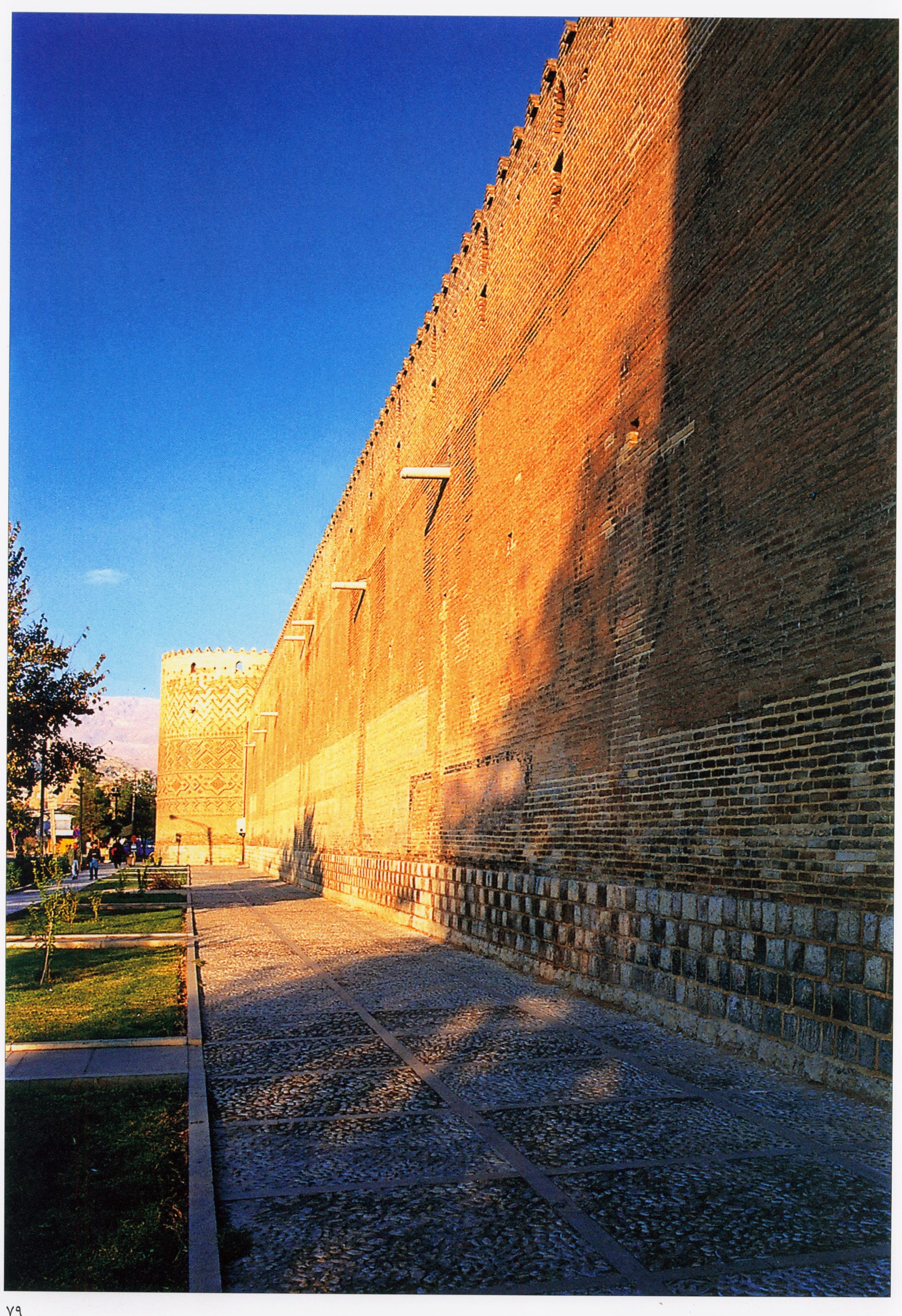
Karim Khani Citadel, Shiraz
Karim Khan Citadel, a precious legacy of the Zandiyeh period (mid-18th century), is one of the greatest surviving examples of Iranian fortress architecture. It was constructed more than 300 years ago and despite suffering damages in the Qajar and Pahlavi eras, has remained alive and in use. It is planned to be converted into the ethnography museum of the region.
The citadel, with 4,000 square meters of usable area, is situated on a 12,800-square-meter site with high brick walls, four towers in its corners, and richly detailed interiors. The large courtyard, surrounded by residential wings with balconies and gardens, evokes the spirit of the Iranian garden and its geometry.
Historical Background
Karim Khan Zand, who rose to power in 1163 AH (mid-18th century), gained control over Iran and made Shiraz his capital. In 1179 AH, he formally assumed governance of the entire country and chose Shiraz as his seat of power. As a ruler of diverse and benevolent character, Karim Khan devoted himself to serving the deprived layers of society and constructing public buildings for their benefit.
He ordered the construction of the citadel, known as Arg-e Karimkhani, in the north of what was then called Toupkhaneh Square. The complex included a bazaar and a caravanserai to the east, a bathhouse to the south, gardens to the southwest and west, and residential quarters arranged to combine the functional, civic, and ceremonial needs of the capital.
Architecture and Spatial Organization
Karim Khani Citadel is among the most important and largest buildings of the Zandiyeh period. With a floor area of approximately 4,000 square meters on a site of 12,800 square meters, it takes the form of a grand quadrilateral on the west side of the old Toupkhaneh Square. The height of the brick walls reaches 12 meters, and at each corner stands a tower rising to 14 meters. Atop the ramparts and the four corner towers, embrasures were carved for surveillance, control of the surrounding area, and defense by musketeers.
Inside the four peripheral watchtowers, there are small chambers used by guardsmen. At the center of the citadel's main entrance stands a stone-paved corridor. The large internal courtyard is organized into garden quadrants adorned with orange trees, water channels, and stone pathways — echoing the classic Persian garden layout.
Decorative Elements
The citadel features exquisite decorative elements including intricate brickwork patterns on the towers, colorful tile mosaics depicting scenes from Persian mythology, stained glass windows, and elaborate geometric patterns. The interplay of these decorative arts represents the pinnacle of Zandiyeh-era craftsmanship.
The four corner towers display particularly fine brickwork with geometric and floral motifs. The stained glass windows cast prismatic light into the interior chambers, while the tile panels depict scenes of hunting, royal ceremonies, and mythological narratives drawn from the Shahnameh tradition.



