Carlo Scarpa
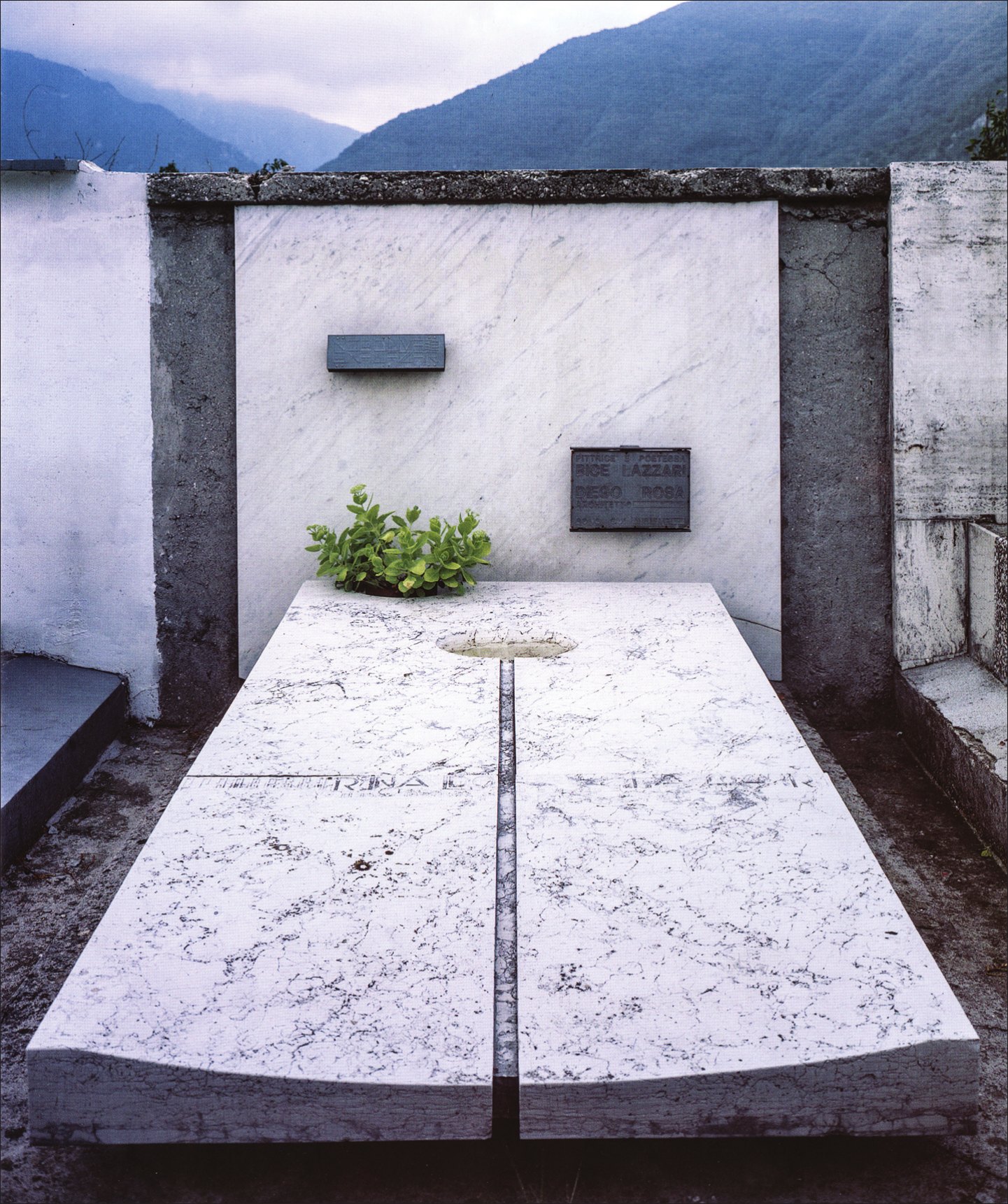
After experimenting with the memorial stone slab (Capovilla1) and the memorial chapel (Veritti2), for the tomb of Francesca Rinaldo3 (1869-1958), sister of Vincenzo4, an architect Scarpa had worked with in the early 1920s, Scarpa designed a horizontal stone in keeping with the simplicity of the small mountain cemetery. It consists of two strips of Botticino marble5, 13 centimetres thick, joined crosswise by an overlapping joint. The first strip, about a third of the length of the whole stone, has a compact semicircular hollow that narrows towards the open edge. A central longitudinal slit starts from here, runs the whole length of the stones and opens into a hollow space with arcs on two centres. By setting back the support, Scarpa made the stone appear to hang above the grave. It is also detached from the line of the wall and leans imperceptibly towards the path opposite.
From the intersection of the long slit and the line joining the strips of stone, the shape of a cross is created in a particular way; while the hollow with two circles, which here alludes to the earthly/heavenly world, or the idea of infinity, plays a key role in Scarpa's work, and takes on different meanings according to the context and the methods used.6
The name and other details of the deceased are carved in chronological order along the upper edge of the first strip of stone in a kind of printed lettering, using upper- and lower-case letters of different sizes, so that some letters overlap.
Something similar is repeated on the plaques attached to the marble stone above the grave, in memory of their daughters Luigina7 and Bice8 Lazzari (and their husbands) - their younger sister, Onorina9, was Scarpa's wife - both of whom died after the Venetian architect.
Footnotes:
1- Capovilla
2- Veritti
3- Francesca Rinaldo
4- Vincenzo
5- Botticino marble
6- Kurt W. Forster, Mappe d'invenzione: edifici e allestimenti di Carlo Scarpa, in Carlo Scarpa. Mostre e musei 1944-1976/Case e paesaggi 1972-1978, catalogue of the exhibition, Verona, Museo di Castelvecchio, Vicenza, Palazzo Barbaran da Porto, 10 September – 10 December 2000, ed. by Guido Beltramini, Kurt W.Forster, Paola Marini, Milan 2000, pp. 3-26, in particular pp. 16 – 8.
7- Luigina
8- Bice
9- Onorina
Carlo Scarpa: Architecture and Design