



Client: Organization for the Construction of Government and Public Buildings and Installations, Ministry of Housing and Urban Development
Planning, Design, and Construction Supervision: Pirraz Consulting Engineers
General Contractor: Armeh Dasht Company
Background
On the seventh of Mordad 1374 (July 29, 1995), the jury of the Ministry of Housing and Urban Development's competition for the design of the National Library of the Islamic Republic of Iran selected the proposal by Pirraz Consulting Engineers. Earlier, in 1356 (1977), the National Library of Iran had organized an international competition with the help of the International Union of Architects, in which a consulting firm from Germany won first place. However, with the victory of the Islamic Revolution and the outbreak of the eight-year war, the execution of the project was delayed, subjected to fundamental revisions and changes in the program, which ultimately led to a new competition and the selection of the current design.
Design
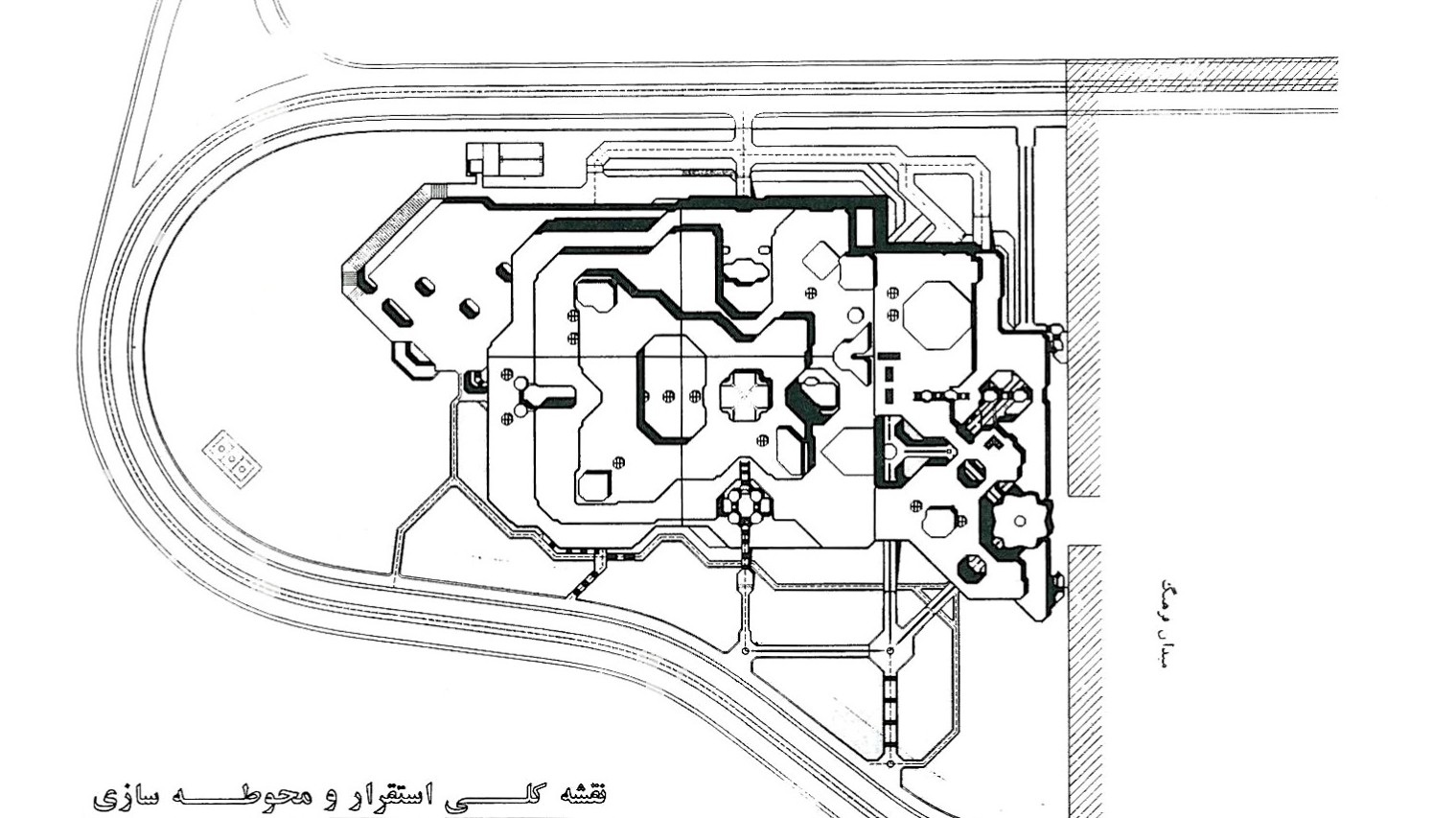
In response to the functional requirements expected of it, the National Library is a large, unified, compact yet expansive, flexible, and adaptable building with special mechanical requirements. Maximum natural light must reach all levels. The total built-up area is 97,000 square meters, and its usable area is approximately 72,000 square meters.
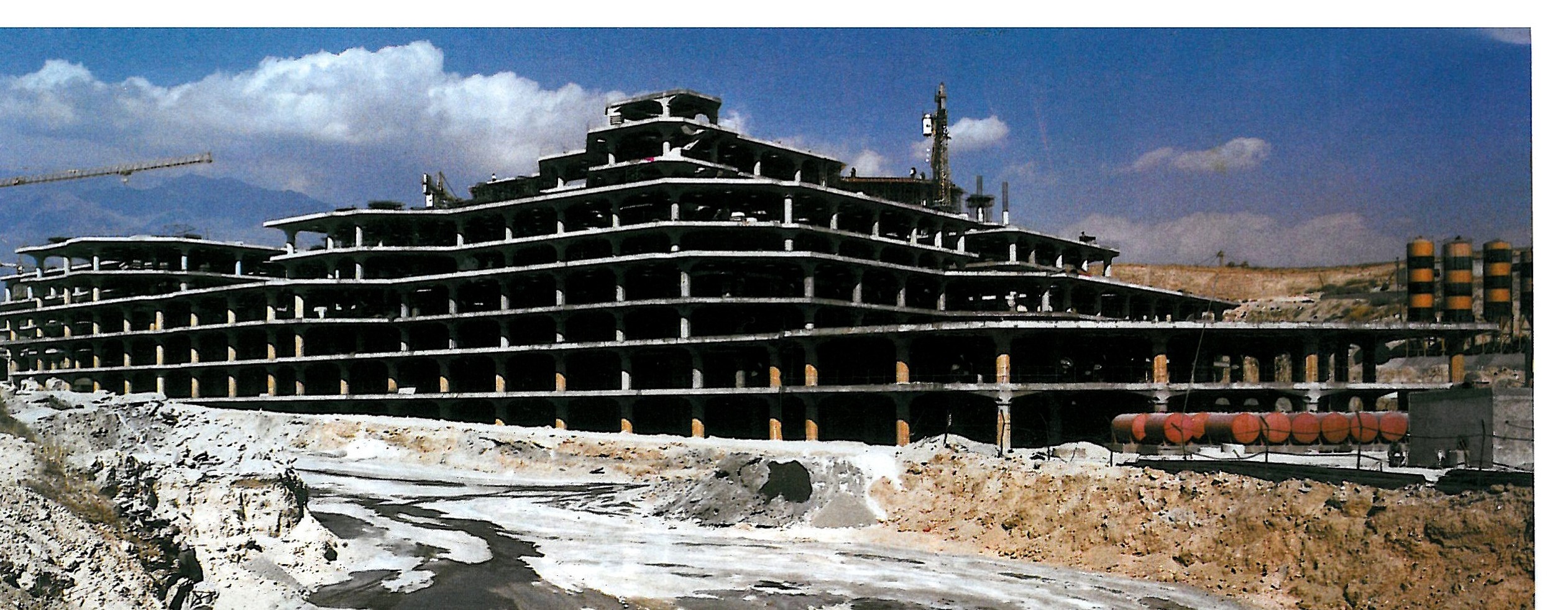
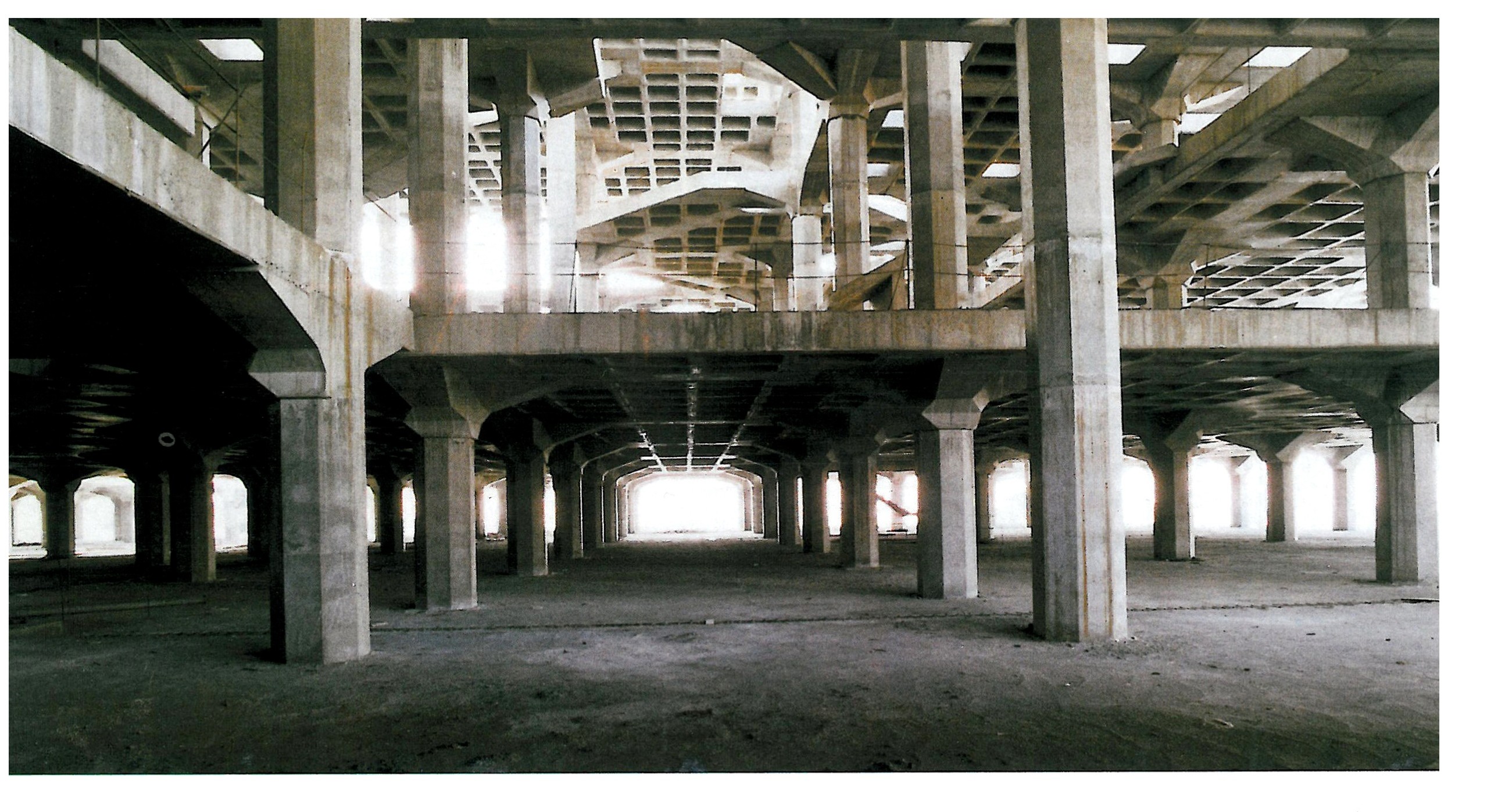
The stacked floors have given the building's exterior the appearance of a somewhat irregular ziggurat. In designing the lower floors, maximum use has been made of the natural topography of the land to reduce earthwork and to allow foundations to rest directly upon the ground. The structure of the National Library resembles that of industrial buildings, with live loads ranging between 600 and 1,500 kilograms per square meter. The seismicity of the region and the proximity of the site to a fault line increase the structural sensitivity. The 8/10-meter spans have been an appropriate response to the special functional, architectural, mechanical, and structural requirements. The use of a fixed span on a column-centered axis, in addition to its structural role, has been given a decisive architectural role — one that, even in the bare concrete skeleton as it stands now, already makes itself felt.
The National Library, in addition to housing a repository for three to seven million books and a research library, also contains an Islamic and Iranian Studies research center.
The Blossoming of Management
The National Library project is a remarkably successful example of executive management in government and public buildings and installations of the Ministry of Housing and Urban Development. In the first half of the 1370s decade (1990s), by boldly setting aside the worn-out, cumbersome, and counterproductive methods of the past, and by persuading the decision-makers of the national development planning system to accept the grave responsibility of executing several large and sensitive national projects through a new method — and by expressing confidence in the country's engineering capacity — the Armeh Dasht Company was selected for the execution of the National Library project. The company was thereby able to harness the specialized capabilities of consultants and contractors in the way these institutions were created to function. Every visitor to the National Library construction site can witness firsthand the proper functioning of the client-consultant-contractor triangle.
The short seven-month interval between the jury's selection of the design in Mordad 1374 and the signing of the structural execution contract with Armeh Dasht Company in Esfand of that same year, by itself, demonstrates the existence of meticulous planning throughout the various stages between design and the commencement of construction operations.


Bidding: Lump-Sum Price and Duration
The conventional approach — pricing based on unit-price lists with adjustments and unpredictable payment schedules — effectively eliminates the "time factor" from the project management equation and turns contracting work into a disjointed operation whose decision-making horizon extends no more than a few months. Neither the contractor claims against the consultant, nor the consultant against the client, nor the client against the Plan and Budget Organization.
In the National Library project, the establishment of a lump-sum price, the elimination of adjustments, a binding schedule with mandatory commitment, timely payments, and the provision of delay penalties, acceleration bonuses, and late-payment fines created all the conditions necessary for the management element to come alive, and the effects became rapidly apparent. With the closing of the contractual time limit, the contractor's interest lies in accelerating work as much as possible. Working at night stems from this very logic — maximum utilization of time through the initiative of management. Unit-price lists and adjustments work against this logic. Conversely, under conditions of unit-price and adjustment-based contracts, the contractor avoids investment as much as possible and strives to complete the work as cheaply as it can — a system that transforms the contractor from an active player in economic activity into a kind of unmotivated, passive salaried worker.
Despite the use of a lump-sum price — authorization for which was obtained from the Supreme Technical Council of the Plan and Budget Organization — the result of the tender was also favorable for the government, as the winning company's bid was only 3 percent above the base unit-price list and applicable adjustments.
Drawing Production Concurrent with Execution
In the seven months between the announcement of the competition results and the execution of the tender and commencement of operations, Pirraz Consulting Engineers had to prepare, in addition to architectural phase-one drawings, the quantities of major construction work items such as concrete, steel, and formwork, as well as detailed drawings for excavation and the execution of foundations and footings. With these documents and drawings, the contractor was able to procure the necessary materials and begin work. In order for the necessary drawings to be produced in pace with the progress of construction, the consulting firm, over the approximately six months following the tender, prepared guideline drawings for the production of complete construction drawings with full coordination among the structural, electrical, and mechanical engineering groups, and with the requisite precision. In this manner, without the early structural works being delayed waiting for the very detailed and time-consuming construction drawings, the drawings were prepared concurrently with the progress of construction operations, thanks to the good organization and management of the consulting firm.
Supervision and Testing
By taking control of well-equipped laboratory facilities, the consulting firm — while establishing full supervisory coverage — ensured that supervision and testing of all materials and operations was not limited by any schedule or working hours. At any time of day or night, in conditions of heat and cold, no restriction arose; rather, the supervisory apparatus fully complied with the demands of the work. With variable, unconventional loads, the multifaceted structure that creates the interior spaces would be severely vulnerable without serious, meticulous, comprehensive, and unexcepting supervision across all concrete pours — something only possible with the help of well-equipped laboratories stationed at the site and an experienced, reputable supervisory team from Pirraz-Sano companies.
In this project, all reinforcing steel — whether supplied by the government or purchased on the open market by the contractor — was tested, and if found to be substandard, was not permitted to be used. The cement had to meet the project's required standards, and ultimately, first Tehran Cement and then Soufian Cement were selected from among the available options. Despite this, the cement delivered to the site was continually tested through sampling to ensure no substandard cement entered the works. In the selection of sand and gravel, thorough and precise investigations were conducted, such that the quality of the selected aggregate resulted in a reduction of approximately 50 kilograms of cement per cubic meter. The reinforcing steel used was Type 3 (AIII) with a high yield strength of 4,000 kilograms per square centimeter. All shipments were tested in accordance with the instructions of the Iranian Concrete Code to ensure no substandard reinforcement entered the site.
Contract Details
The contract with Armeh Dasht Company was signed in Esfand 1374 (March 1996). The contract duration was 30 months. The scope included excavation, execution of foundations and accessible mechanical service tunnels, execution of floors, waterproofing behind retaining walls and in storage areas and sensitive spaces, execution of columns, ceilings, and the entire concrete structure. The project consumes approximately 99,500 tons of reinforcing steel and about 270,000 cubic meters of concrete. By Shahrivar 1377 (September 1998), the contractor had managed to complete 90 percent of the work.
Major Works
Drainage. To prevent the infiltration of substantial underground water into the soil beneath the foundations, three rings of drainage were installed beneath three levels of various sections of the building, using concrete culverts, with inspection manholes at every 5-meter interval, totaling 1,200 meters of drainage including the outlet drain.
Foundation Preparation. To prevent water from penetrating the soil beneath the foundations, instead of lean concrete, 12 centimeters of asphalt binder was used.
Foundations. 24,500 square meters of raft foundations, 70 centimeters thick, with foundation columns of 270 by 270 centimeters and a height of 50 centimeters.
Columns. 1,943 octagonal columns of 80-centimeter diameter and 275-centimeter height, cast using metal formwork.
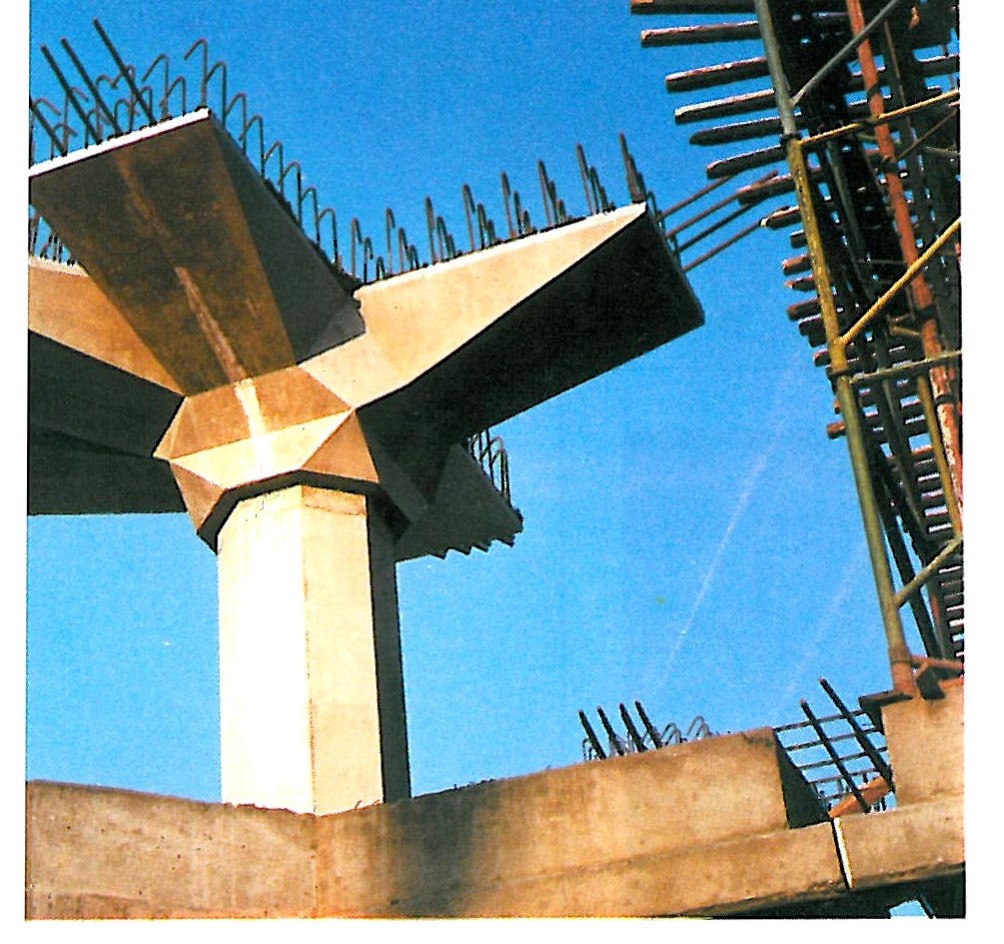
Column Capitals. The mushroom or umbrella-shaped column capitals, in addition to increasing shear, punching, and negative moment resistance and reducing beam deflection at mid-span — and thereby reducing floor height — contribute to the arrangement of the numerous columned spaces, creating symmetrical, hypostyle-hall-like perspectives. However, because the ceilings are cut at 5-degree angles, 64 types of non-standard and asymmetrical capitals were produced, for which only six modular metal formwork units were used, with metal plates installed at various positions to create the different configurations.
Waffle Slab Ceiling. To reduce the dead load of the ceiling and consequently reduce floor height, and to exploit the structural form of the ceiling in the arrangement of modular interior spaces, waffle slabs were used — complete squares of 100 by 100 centimeters and half-modules, 55 centimeters thick — with fiberglass molds for the square and rectangular types, and metal molds for the irregular types. The weight of the fiberglass mold is very light (full module 30 kilograms, half-module 25 kilograms), and removing it is very easy and fast. The modular metal scaffolding of 135 by 135 centimeters, with a height of one meter or less, is supported by adjustable jacks, with metal beams mounted on the jacks. The base of the main beams and the angles between the column capital wings are formed with 7-ply plywood, and rapid formwork removal beneath them is achieved by placing jacks underneath.
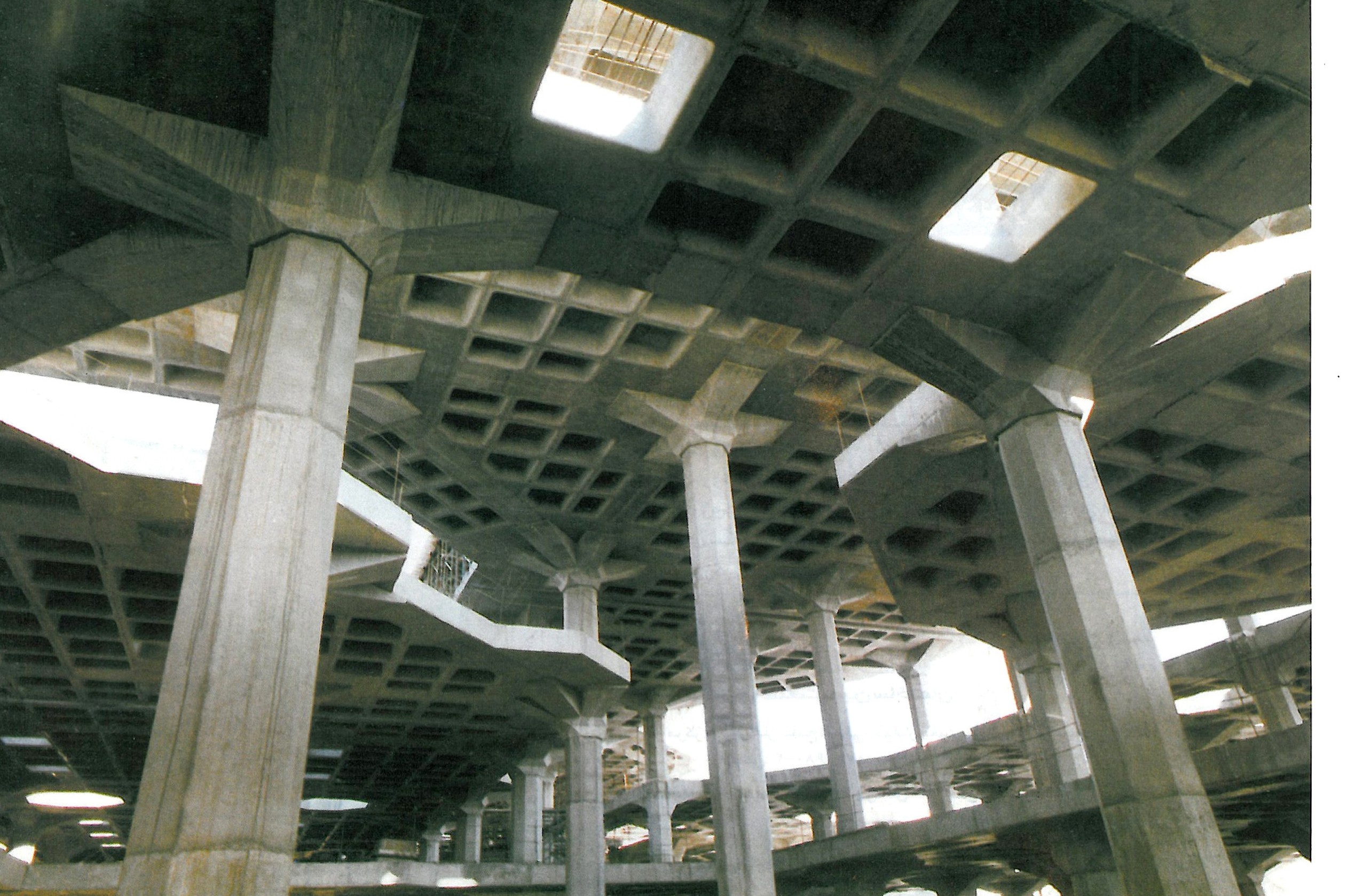
Special Ceilings. The ceilings of special spaces such as staircases, corridors, the entrance, and the amphitheater hall are constructed using beam-and-slab systems with 7-ply plywood formwork and modular scaffolding.
Concrete Pouring. The specified concrete strength was 250 kilograms per square centimeter in cylindrical specimens and 300 kilograms per square centimeter in cubic specimens. Considering the safety factors and the need for acceleration in operations and for rapid formwork removal, the cement content was set at 400 kilograms per cubic meter. In hot weather exceeding 38 degrees Celsius, ice was added to the water tanks for concrete production, and several layers of burlap were placed over the mixer drums, and the aggregates were wetted — all in compliance with code requirements that limit concrete temperature to a maximum of 30 degrees. In temperatures below freezing, the water was heated in the concrete production tanks, and concrete was prepared at temperatures above 5 degrees Celsius. The poured concrete was then protected by covering it with insulated burlap blankets lined with fiberglass wool.