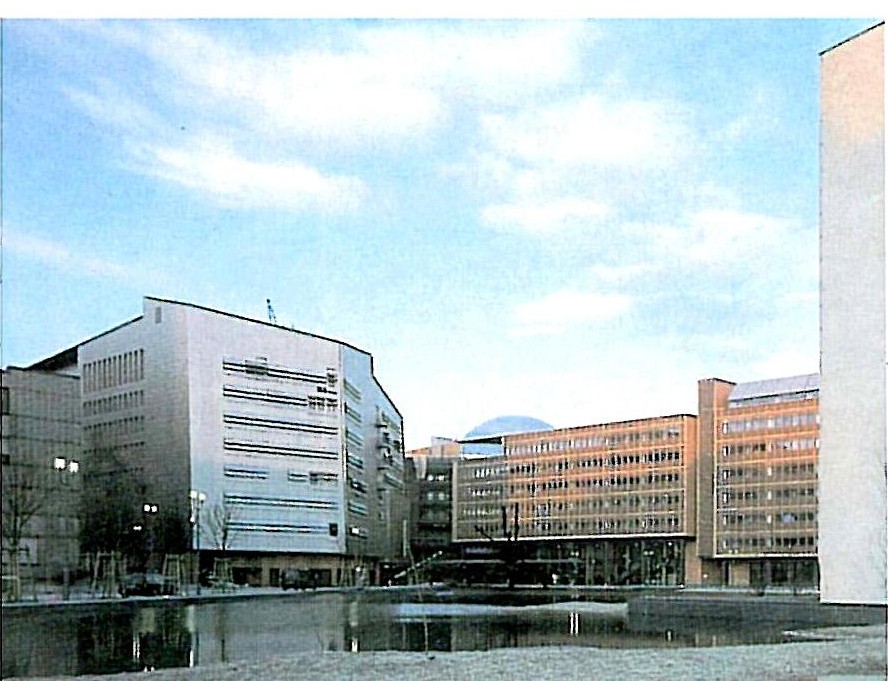
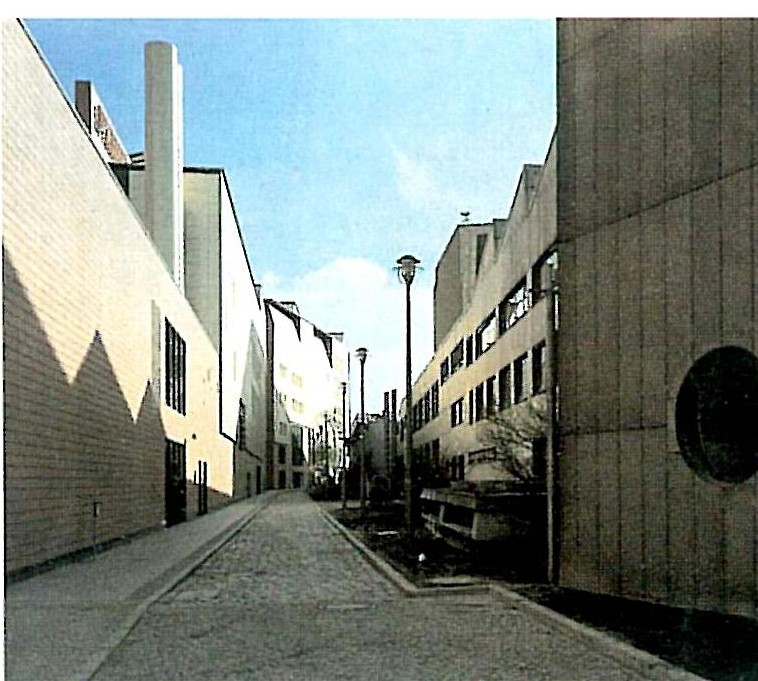
Potsdamer Platz Reconstruction, Berlin — Renzo Piano and Christoph Kohlbecker
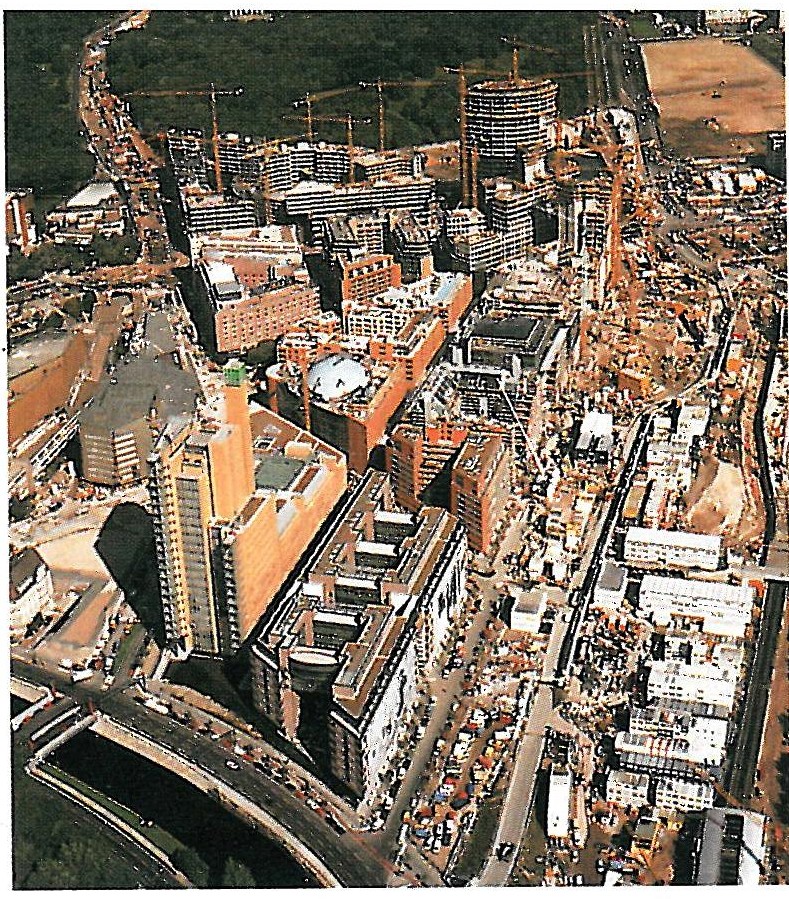
Text: Gerwin Zohlen · Photographs: Stefan Muller · Commentary and translation: D. Samarqandi.
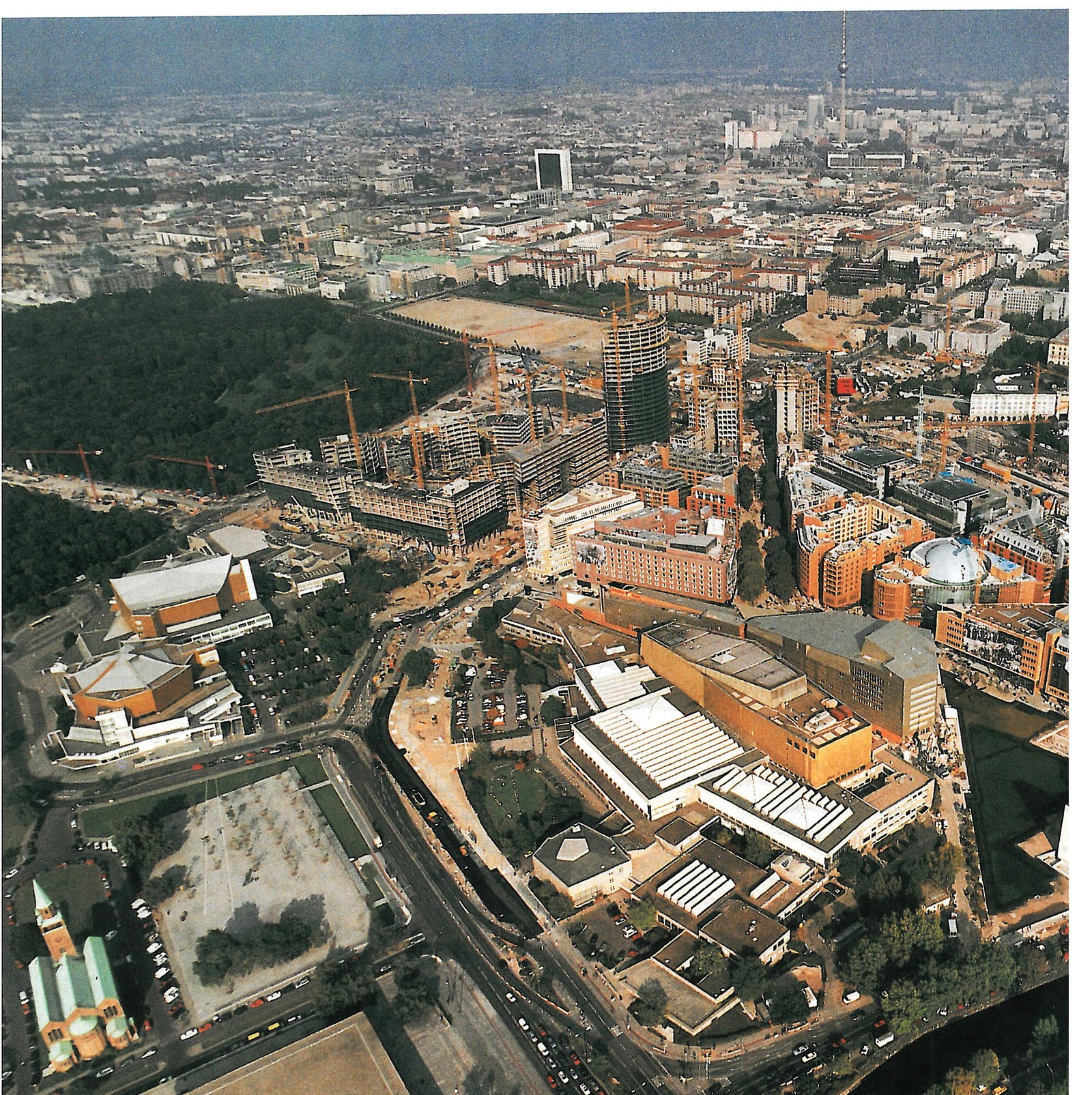
Potsdamer Platz in Berlin is a blank white slate — yet it carries the weight of the historical reputation of having once been Berlin's heart and the busiest square in Europe. At the time of the competition it was the piece of ground over which the most passionate debates raged: Berlin's long isolation, a 100% commercial undertaking, or a free play of forces pointing to the future. The result is a little of everything: the work of some of the most prominent architects stands side by side to create the largest single entertainment complex in any contemporary European city — a monument which the surrounding public has set at its centre.
The opening
The opening of Potsdamer Platz in October 1998 turned into an extraordinary spectacle. For days the clamour of banner headlines was that all of Berlin was pouring into the new district. To underline the event's importance, the conservative and liberal, serious and not-so-serious newspapers alike issued special editions with plans, photographs and information about the scheme, the buildings and the turbulent history of Potsdamer Platz, and about the progress of the zone called Daimler City, whose construction had begun in 1991. Press and television broadcast the opening ceremony across Germany. Two figures at the top of German politics and business — Roman Herzog, the President of the Republic, and Jürgen Schrempp, head of the company that had just emerged at the very moment of the Potsdamer Platz opening out of a trans-national merger, the Daimler-Chrysler company — lent the ceremony their weight and standing. Extravagant similes and metaphors went about: “open-heart surgery,” “heart transplant,” “new battery.” All of this to describe an urban and architectural event at a point that was never — repeat, never — at the centre of the city in its own history. Potsdamer Platz has always stood outside the gates of the old city; it was the beginning of Leipziger Strasse, or — depending on which direction you counted from — its end. Yet the work of planning limped ahead under the ever-swelling 250-year expectations of what Potsdamer Platz was supposed to be. Its centrality as a crossing of Germany, and its location at what were then the most important long-distance rail terminals (the Anhalter and Potsdamer stations), had given it a legendary aura. In the post-war period, before and after the Berlin Wall, the loss of Berlin's world greatness under the Kaisers and above all in the 1920s was mourned repeatedly; this greatness was what now had to be renewed as far as possible — and of course with foreign resonance and with success.
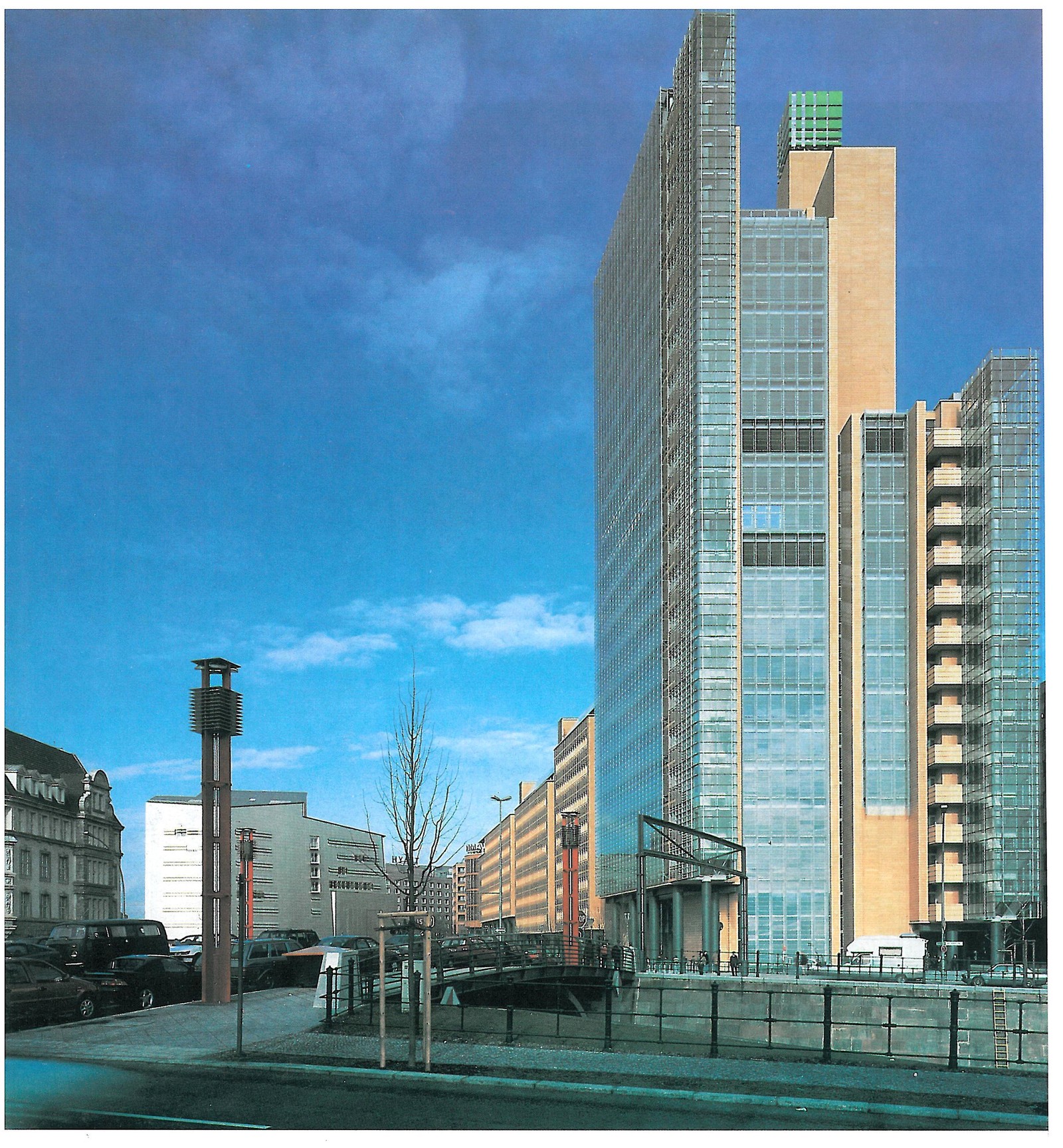
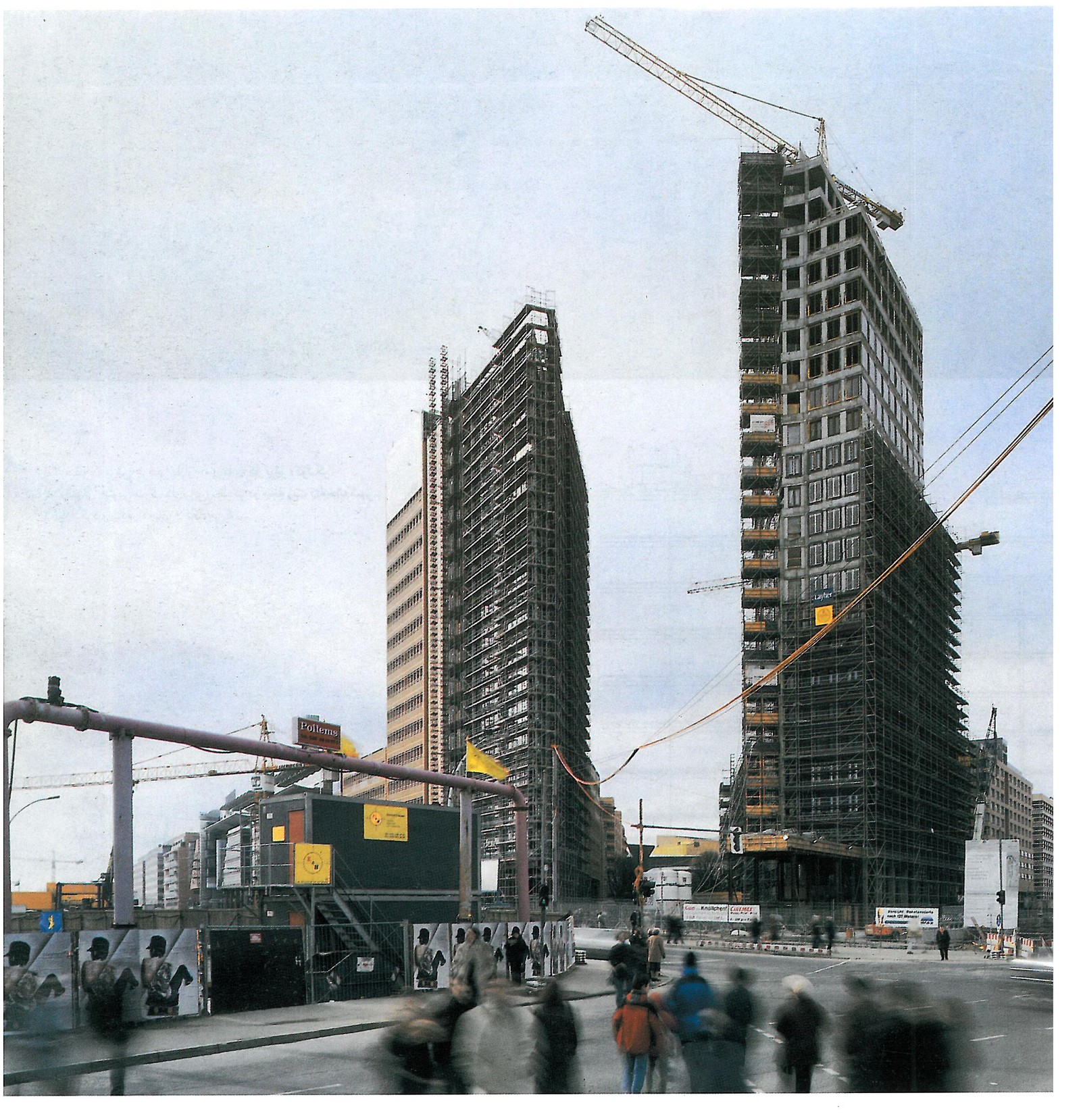
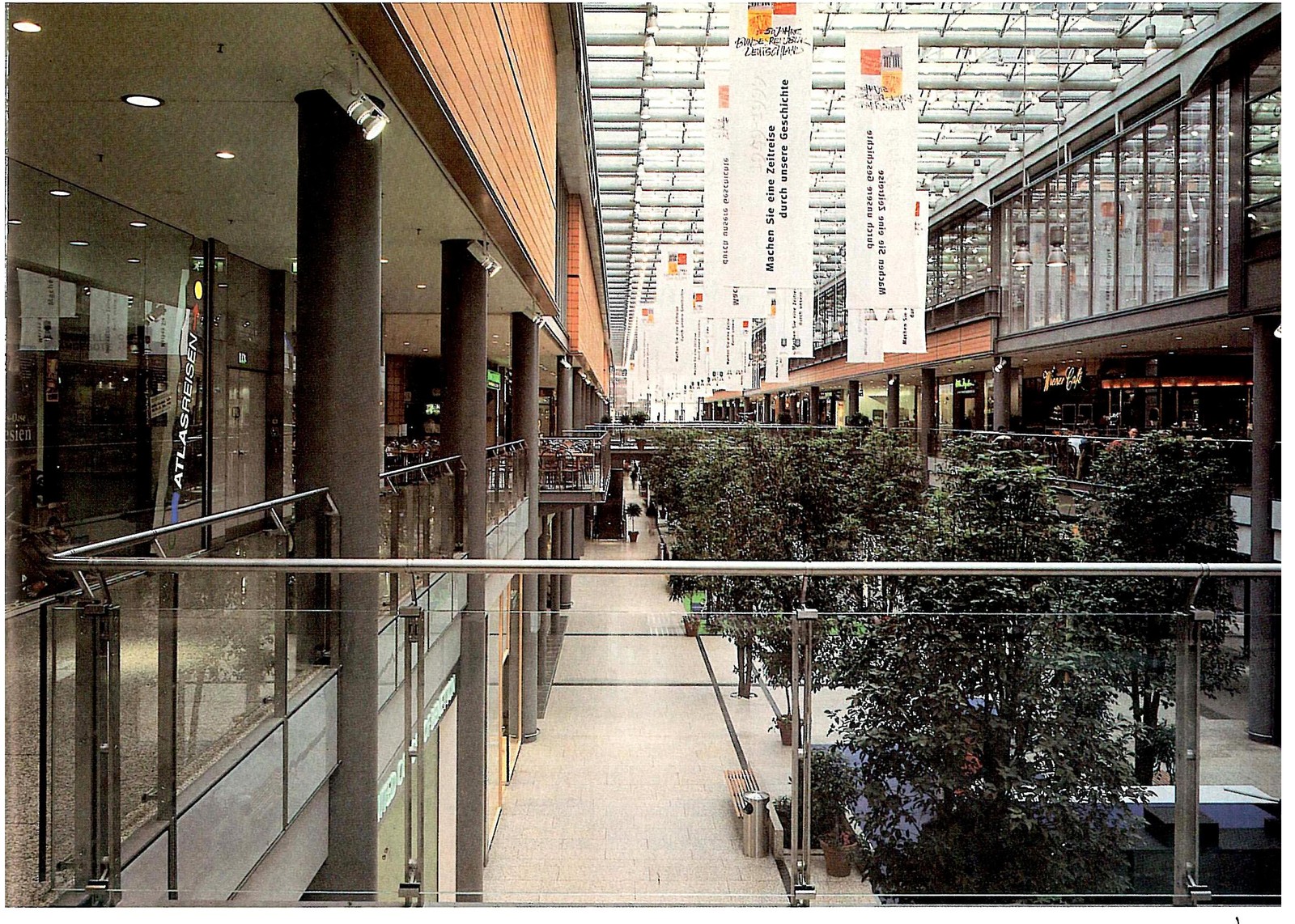
Crowds, cheerful and full of curiosity, poured out of the streets whose construction had only just been finished, and converged on Marlene Dietrich Platz in front of the musical theatre and the casino for the opening ceremony. Even though the still-unfinished towers standing on Potsdamer Platz itself — by Renzo Piano, Hans Kollhoff and Helmut Jahn — remained a slightly jarring sight, this did nothing to dampen their enthusiasm. Most took the route to their real destination: the shopping arcade, the Arkaden, at Potsdamer Platz.
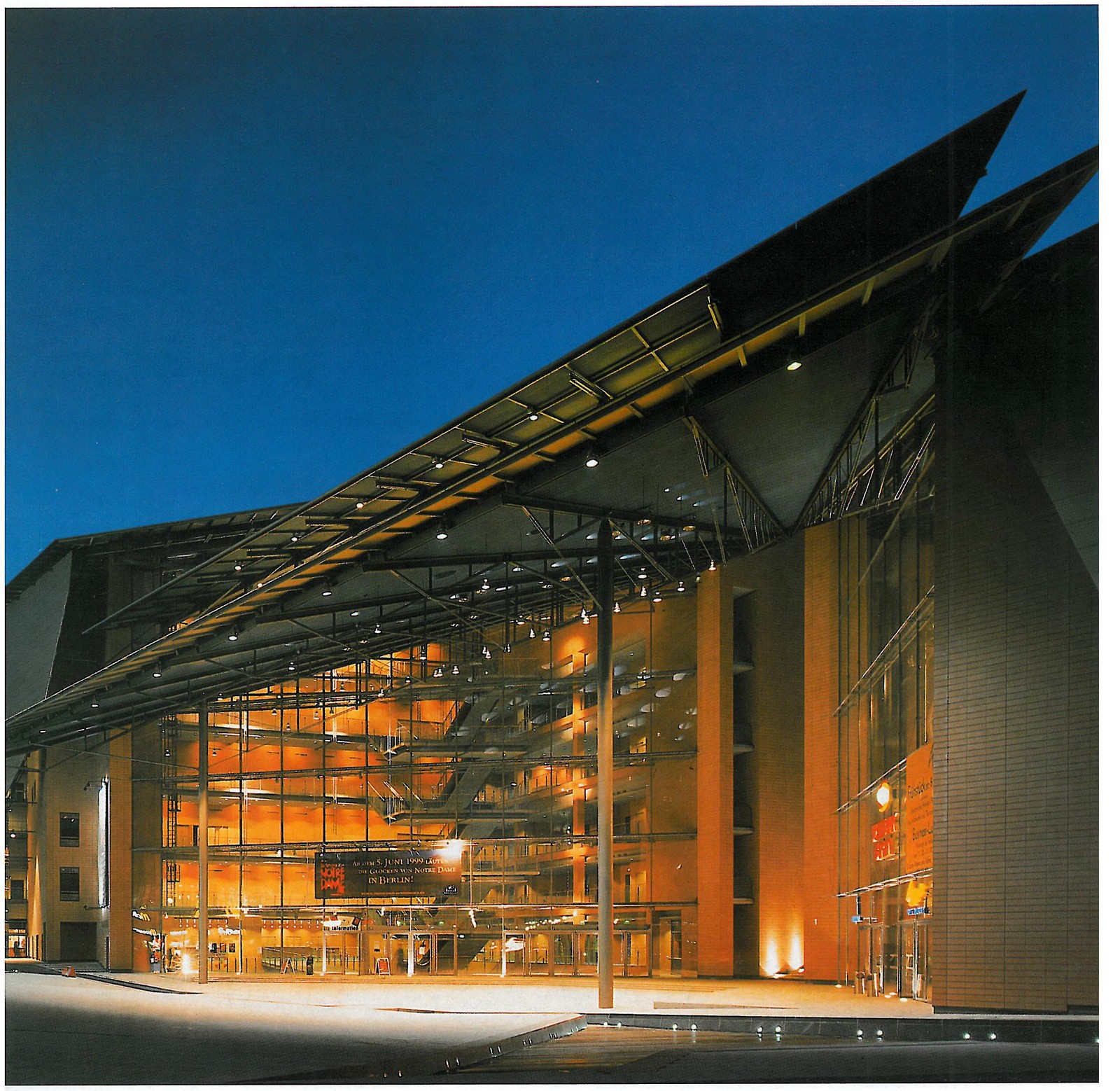
On the opening day and the weeks that followed, the shops were stripped as if Berlin had been without a possibility of shopping for decades. 200,000 people came on the first day; at least a third of them dragged heavy plastic bags to public transport or private cars on the way home — not because anything special had been put on sale for the opening, but as the sign of a long-standing desire, of a strong attachment to a city made whole once again. Everything suggested that Daimler-Benz's planning and calculations had been right, not least in drawing the public to the commodity “Potsdamer Platz.” The lavish and wasteful fireworks that Daimler-Benz put on in the snowless Berlin sky were a royal thanksgiving to celebrate the birth of the new city.
Second thoughts
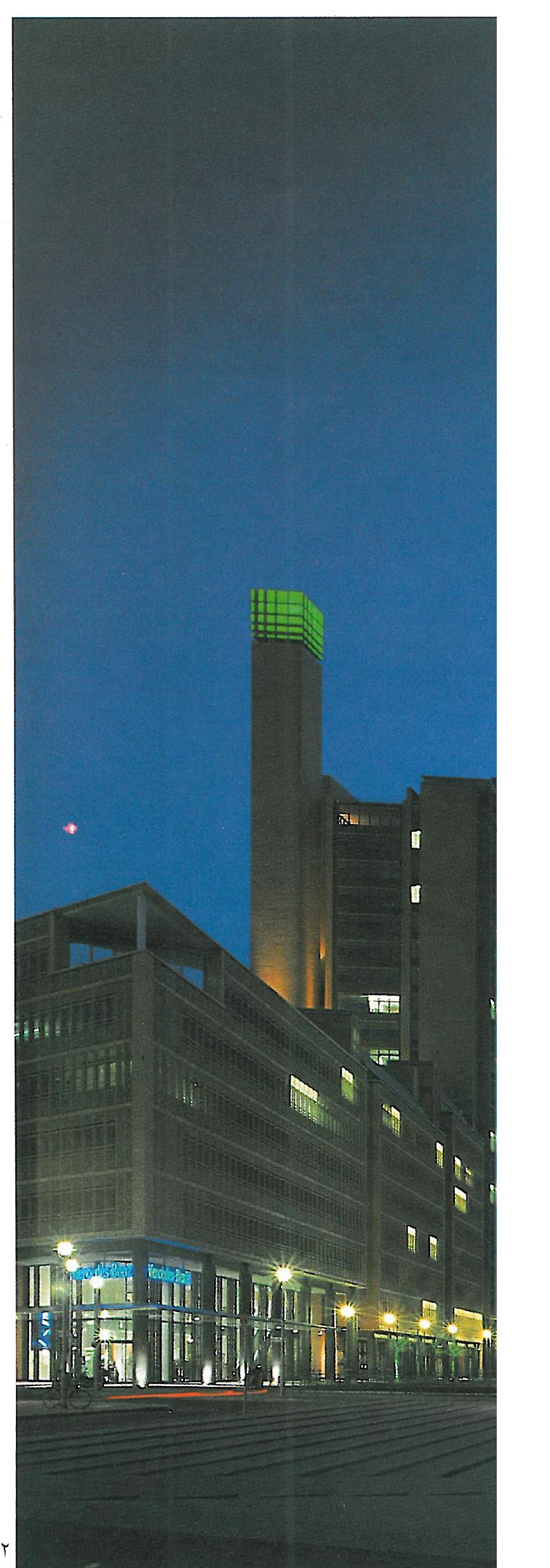
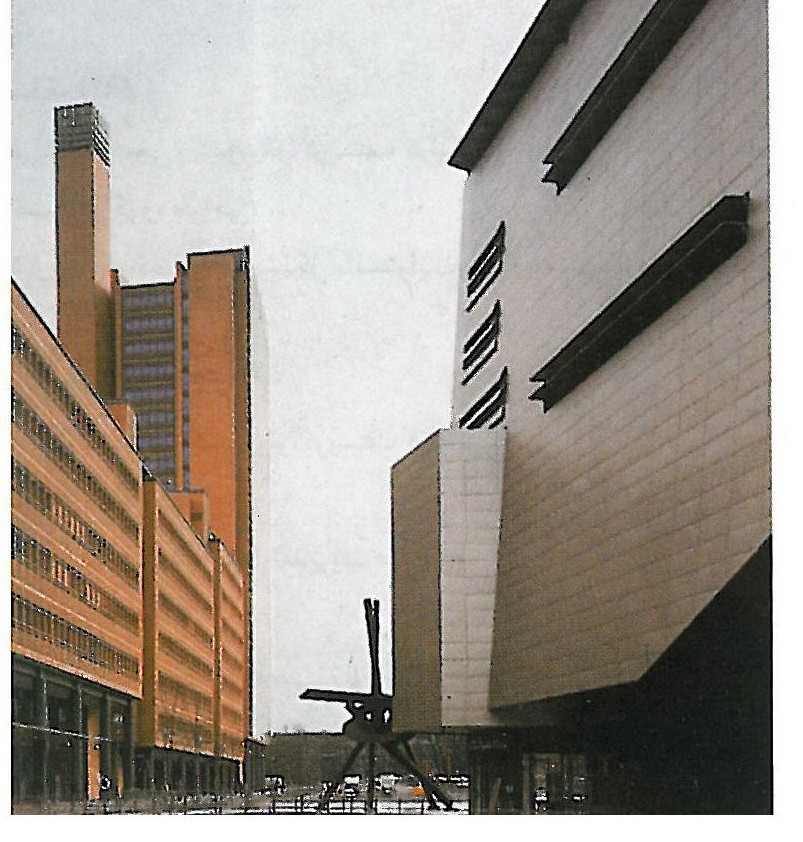
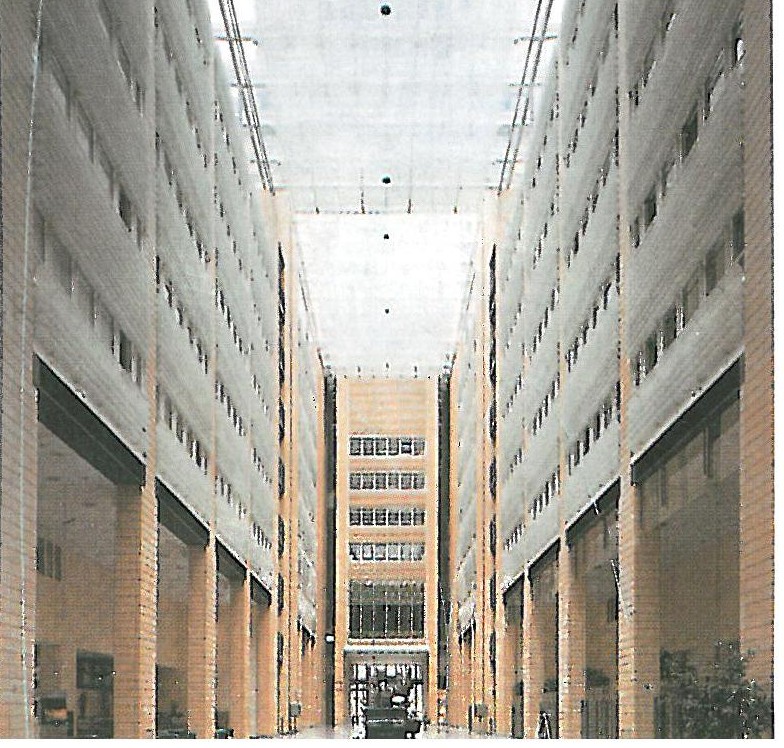
It was at the beginning of 1999 that the first doubts began to emerge about whether the crowds at Potsdamer Platz had really come to spend money, and whether all those who streamed into the Arkaden had intended to loosen their purses for any serious shopping. Often they had not; they had come to see what was going on. Many came to drink iced coffee in the American coffee bars, and did their other shopping, as always, at their local stores: those familiar shelves are closer to home and stocked with the same products as the Arkaden — Wolford tights and underwear, cheap H&M clothes from Scandinavia, the global branches of Aldi selling below price. Critics have noted in astonishment that the choice of shops and goods at Potsdamer Platz is not top-tier but middling: no luxury goods, no attempt to nudge customers into extraordinary or discretionary purchases — the usual daily needs and nothing more. Arkaden changes its goods with the seasons. Under its glass shell, everything is shifting — a shopping street whose appearance, in the cold daylight, and dozens of others like it, can be found (regardless of differences in materials and design) in any German city and in any district of Berlin. The ordinary state of the Arkaden is thus well below the high expectations generated over the years; but these expectations have, in the end, been answered by the architectural magnetism of Potsdamer Platz as a whole. The plan has been laid well, not least because the extended insurance-protection system for major German retail managers advertises to its customers that they should forget Berlin's Brandenburg hinterland — with cities like Potsdam, Nauen and Brieselang — in favour of Potsdamer Platz. Thus Potsdamer Platz has become what American specialists call a destination — with many cinemas, musical theatres and gambling halls — turning a shopping trip into a pleasurable experience. Is this the start of a new chapter in European urbanism, in which pre-fabricated urban pieces are inserted, like American specialist towns? It is too early to judge: Daimler City itself is still unfinished.
Context and brief (D. Samarqandi)
Berlin is the emblem of German national unity. That unity was realised in 1871 and Berlin became the capital of unified Germany in the same year. In the thirteenth century AD it was a small village; by the late fifteenth century the seat of the Brandenburg Electors; from 1701 the capital of Prussia; and in the eighteenth century one of the important industrial and commercial centres. Russian and Austrian troops in 1760, the French in 1805, and the Allies at the end of the Second World War in 1945 occupied it; in that last war it was heavily bombed from the air. Potsdam is a city to the west of Berlin; it was the historical centre of Brandenburg and then of Prussia. After the defeat in the Second World War, Germany was occupied by the United States, Britain, France and the Soviet Union; the occupying powers were stationed in Berlin and divided the whole of Germany — and Berlin itself — into their spheres of influence. Berlin, apart from being split into east and west, lay entirely within East German territory and was cut off from West Germany, the de facto keeper of Germany's history and culture. The state of Brandenburg, in which Berlin lies, together with its historical centre Potsdam, fell within the East. Thus after the reunification of Germany, the fall of the Wall and the reunification of Berlin, the renewal of the bond between Potsdam and Berlin is deeply meaningful. The urbanism of Potsdamer Platz is part of the same movement.
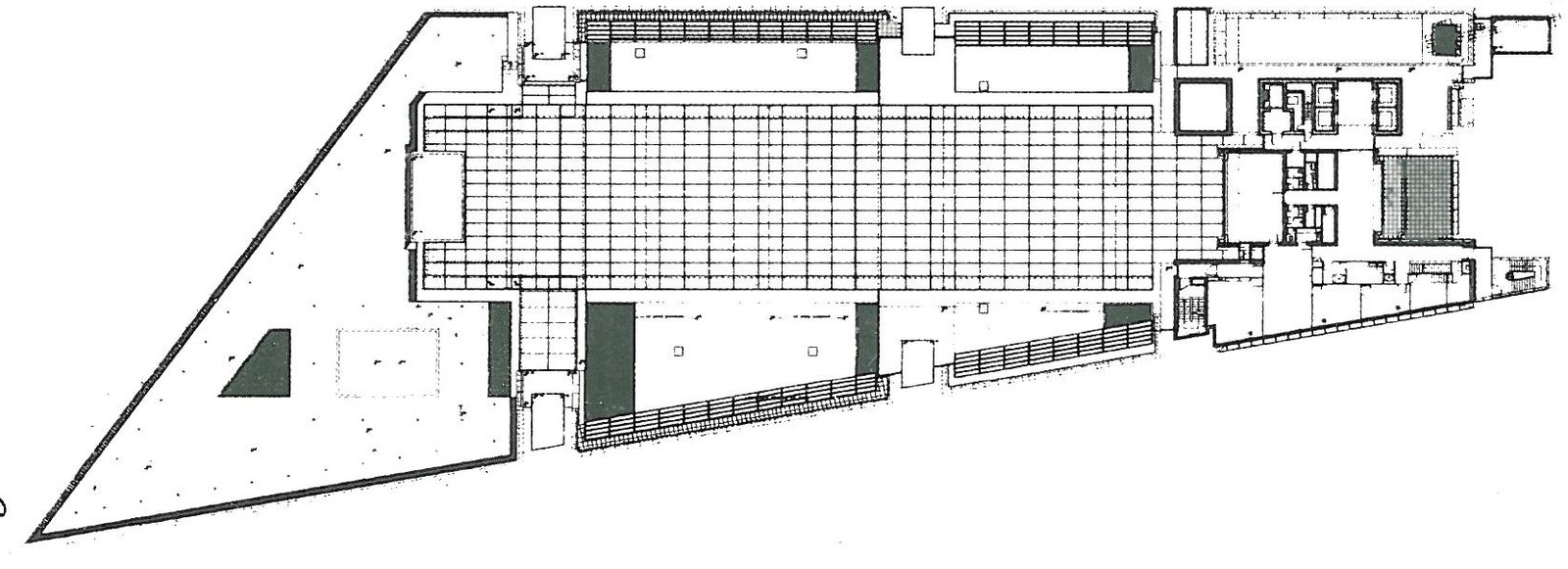
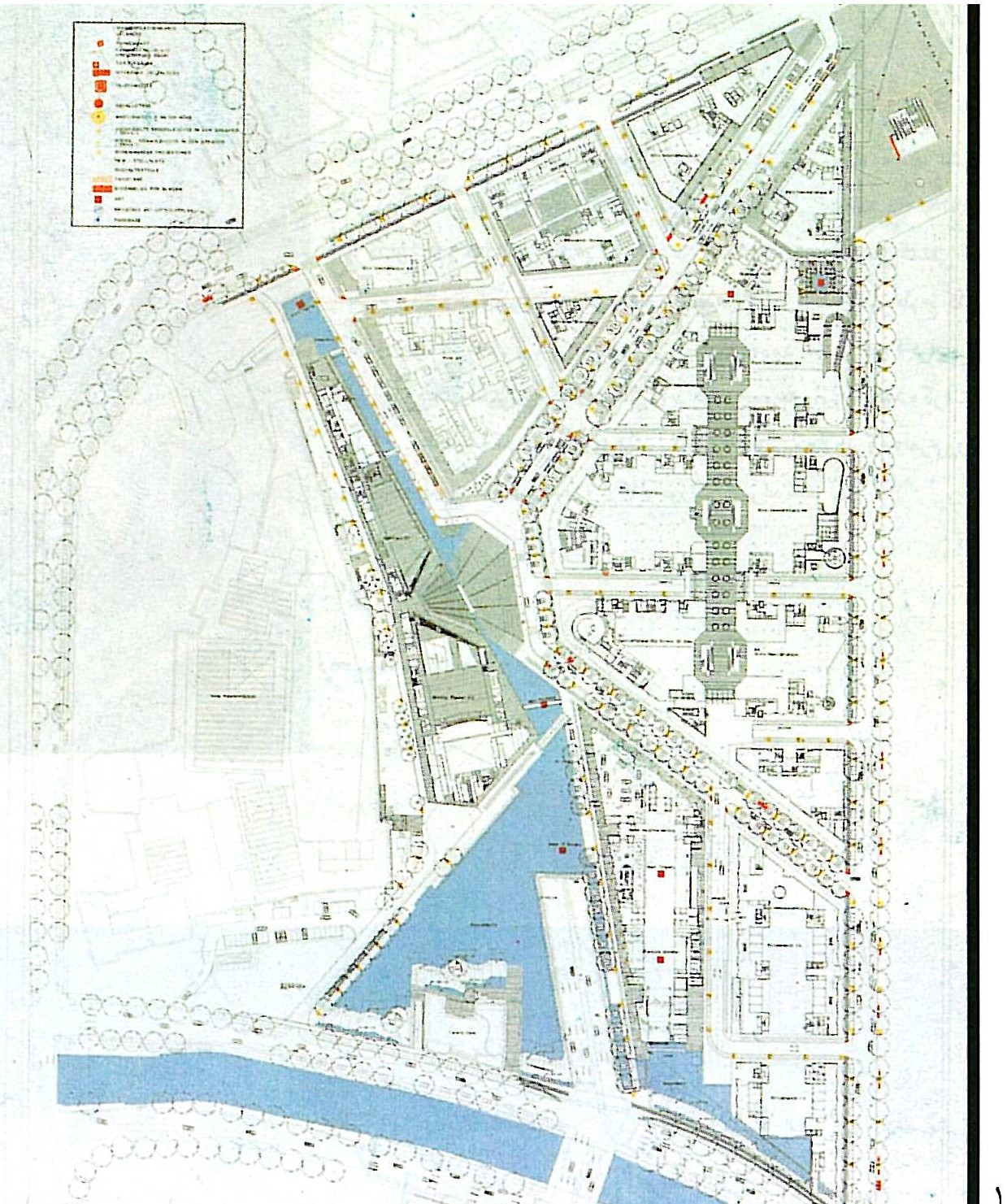
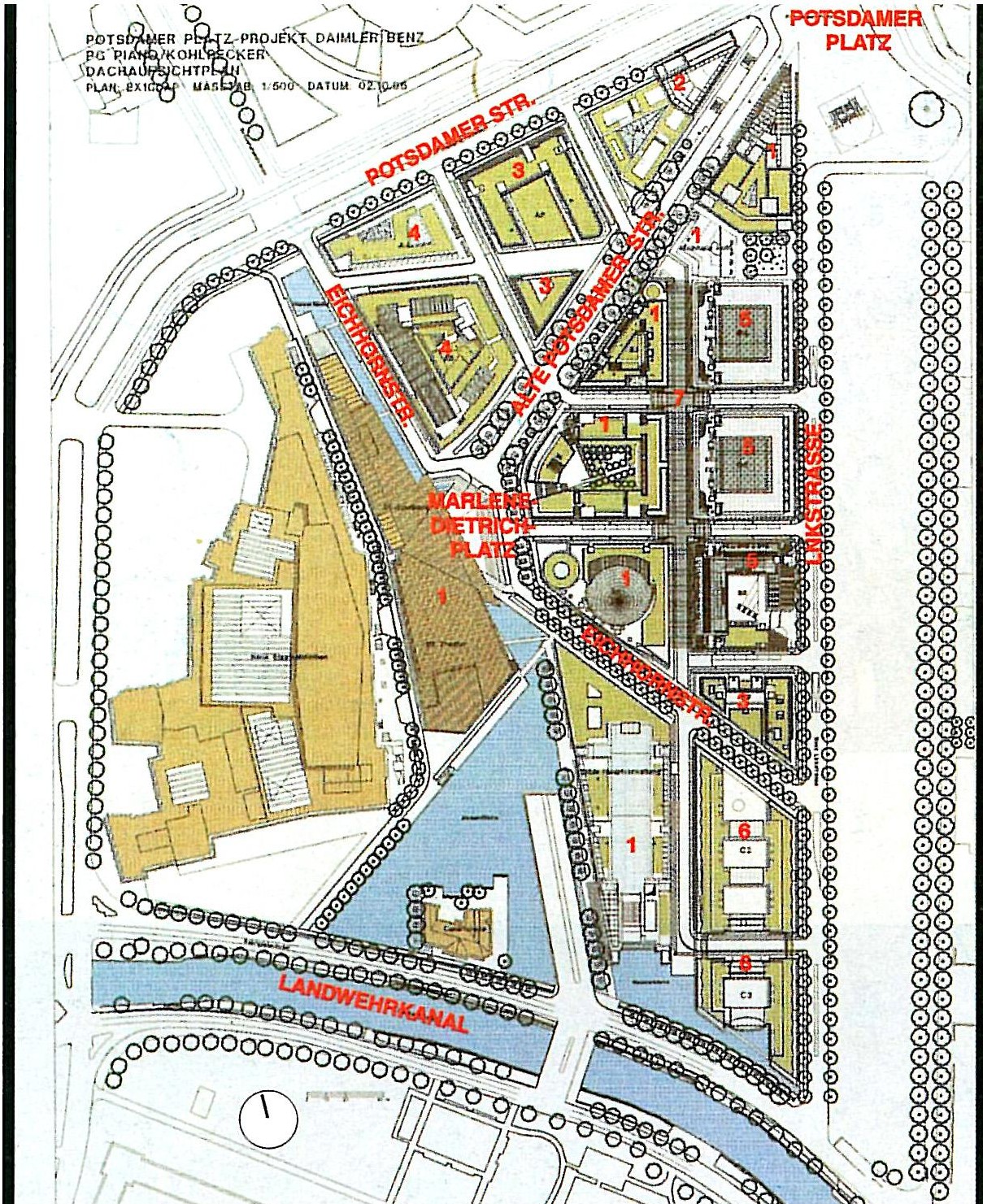
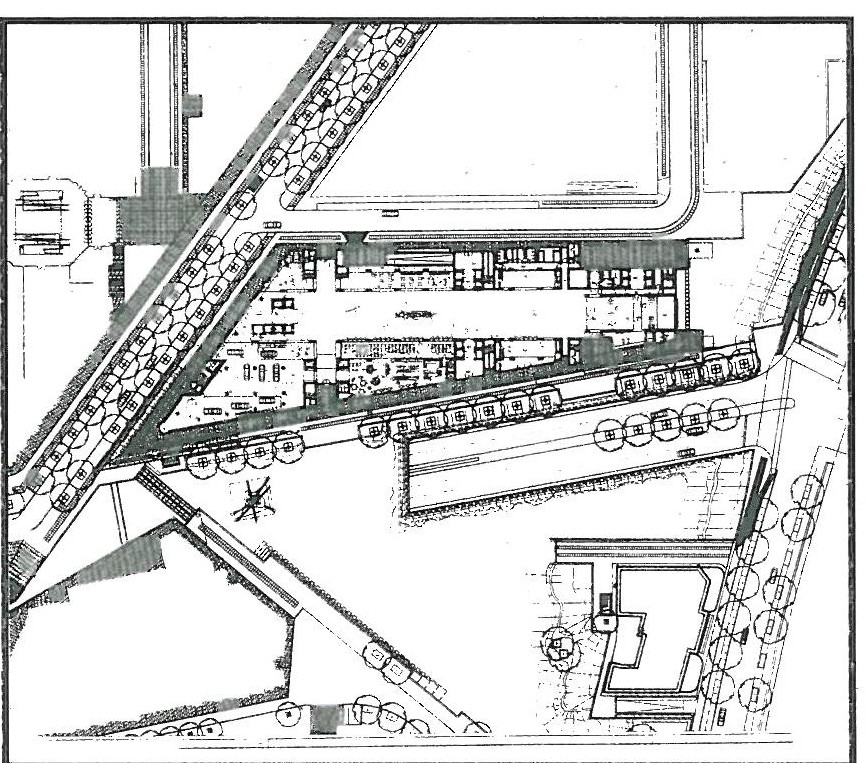
The entire area of the Potsdam reconstruction plan is a rectangle of about 500 by 500 metres. The portion which Daimler-Benz has selected for its urban project lies entirely west of Linkstrasse; Potsdamer Strasse runs along its north and west, and the great Landwehrkanal along its south. The Spree, perpendicular to the Landwehrkanal — which forms a large triangular pool at their junction — divides the area into an eastern section (wholly allocated to the Daimler-Benz scheme) and a western section (in which the city library by Hans Scharoun already stood). Renzo Piano and Christoph Kohlbecker have produced the master plan for Daimler-Benz's new commercial-cultural-entertainment centre over an area of about 100,000 m².
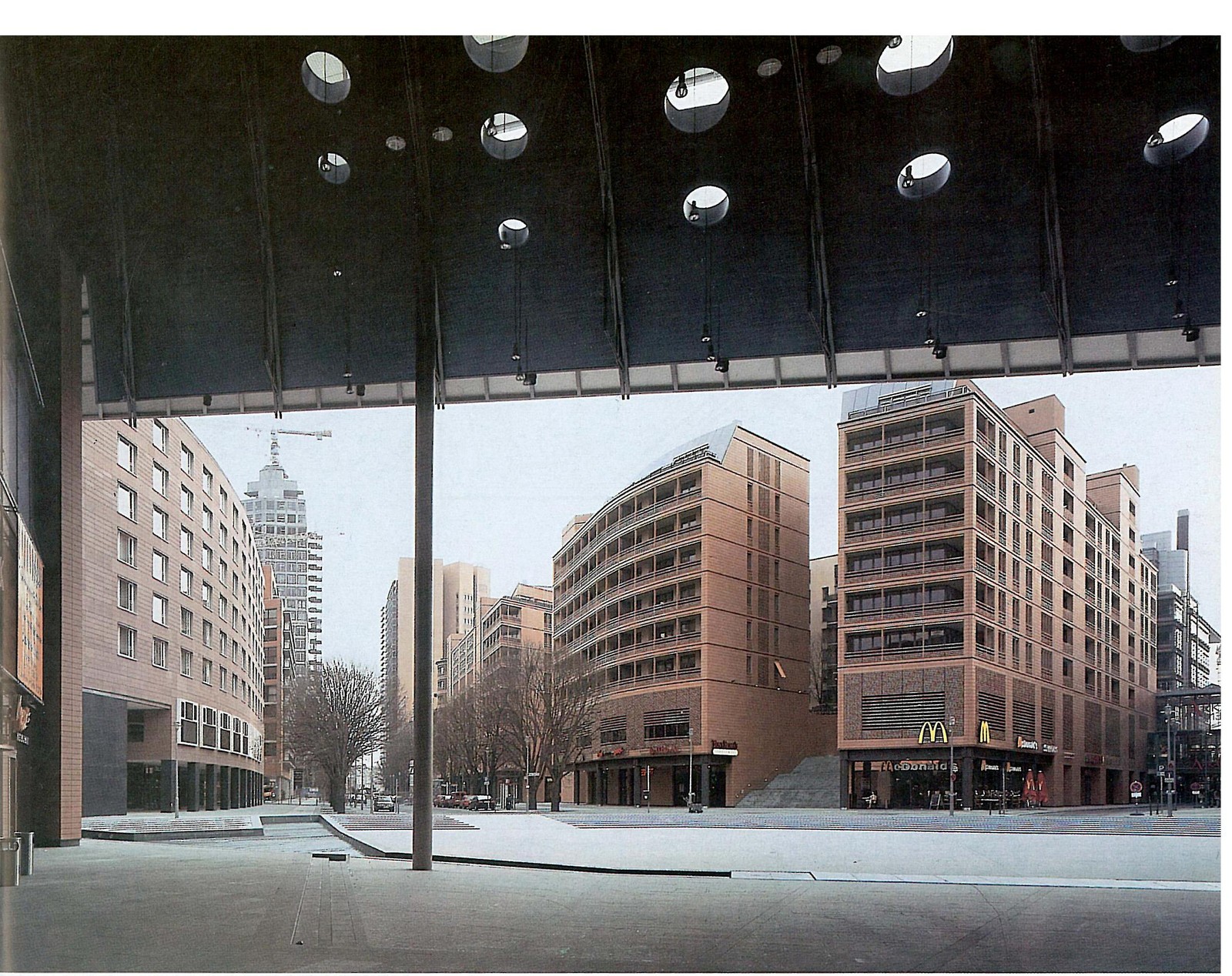
The Piano-Kohlbecker master plan
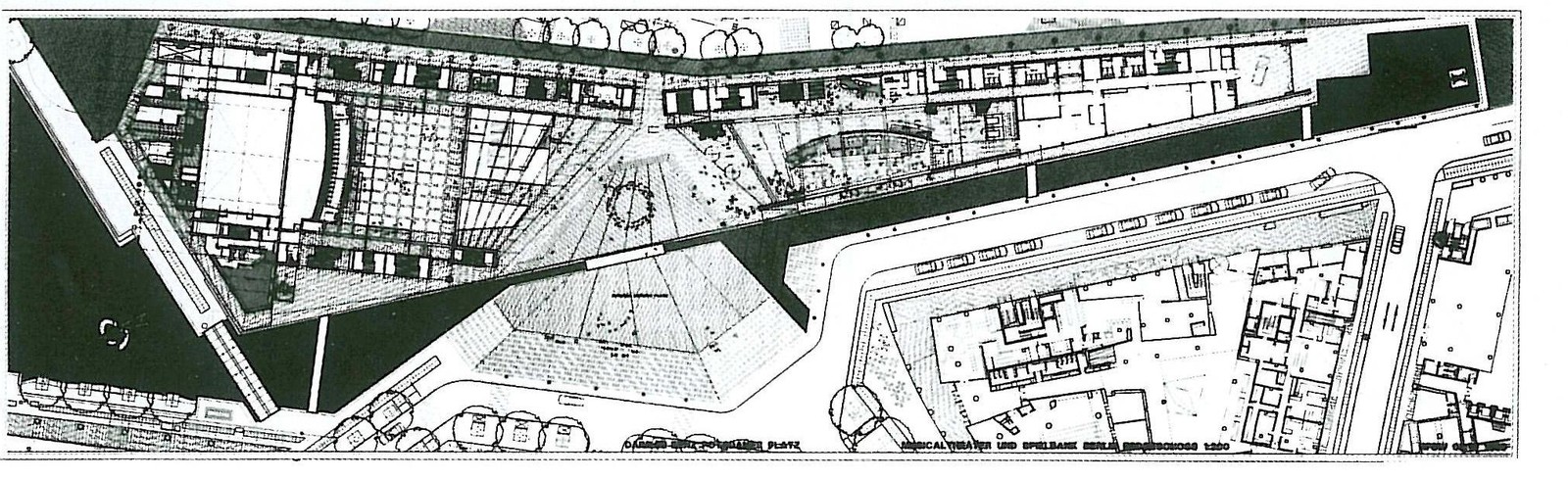
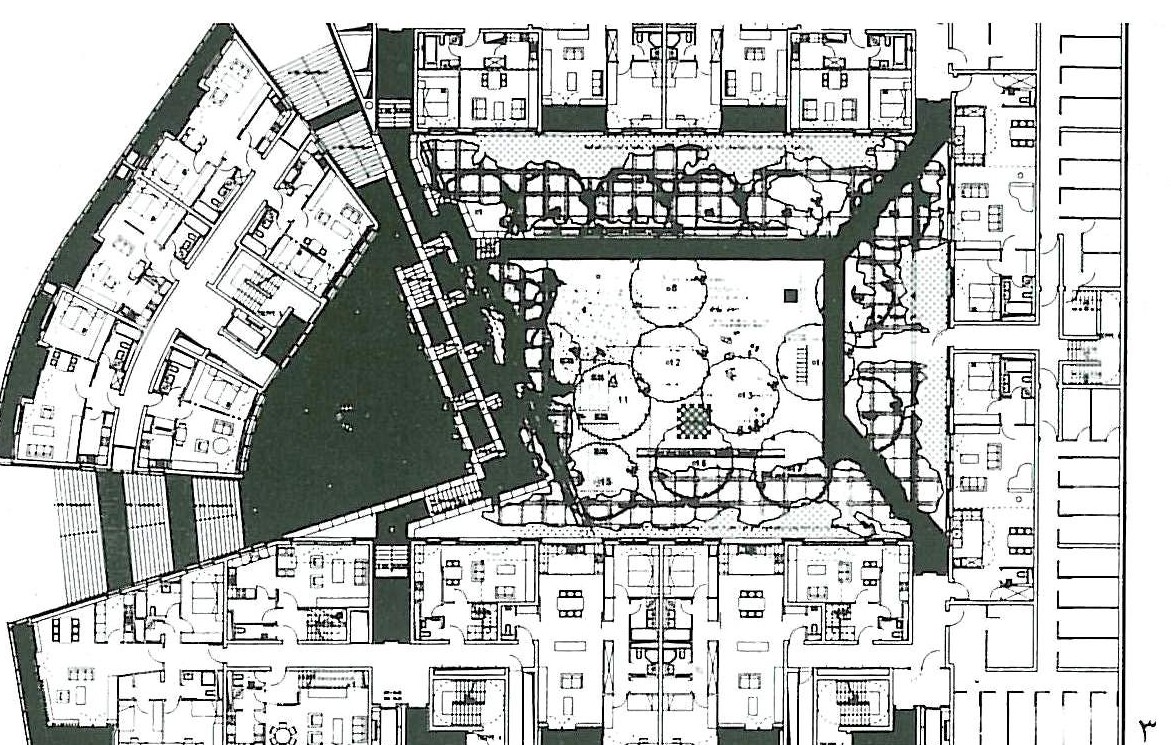
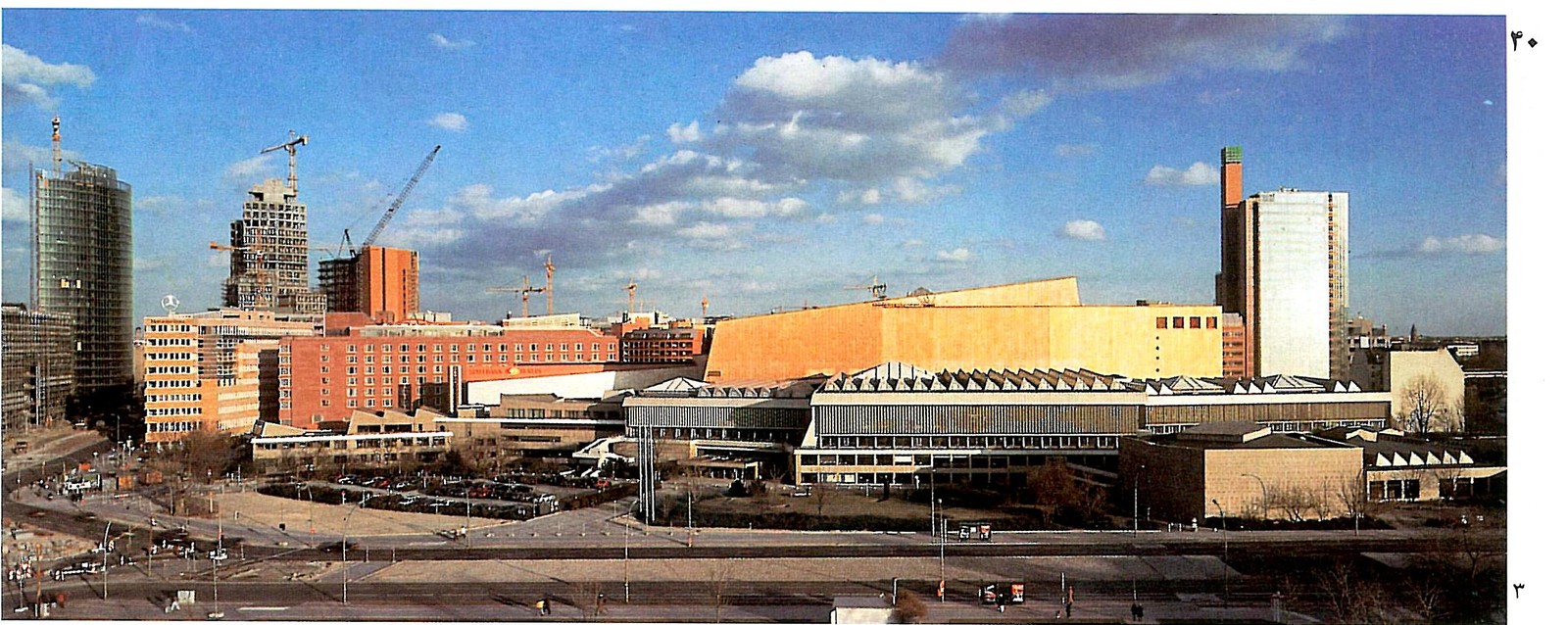
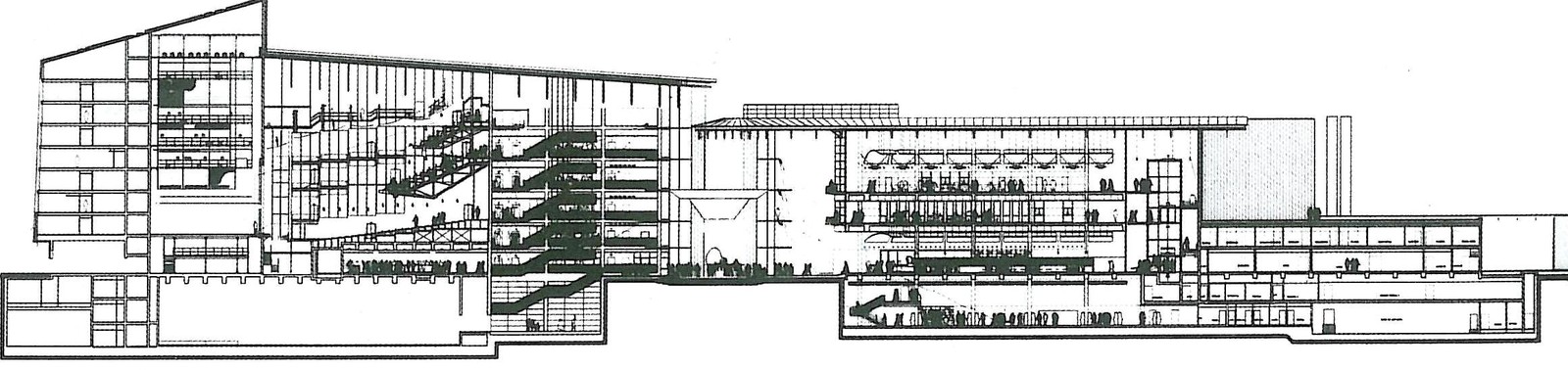
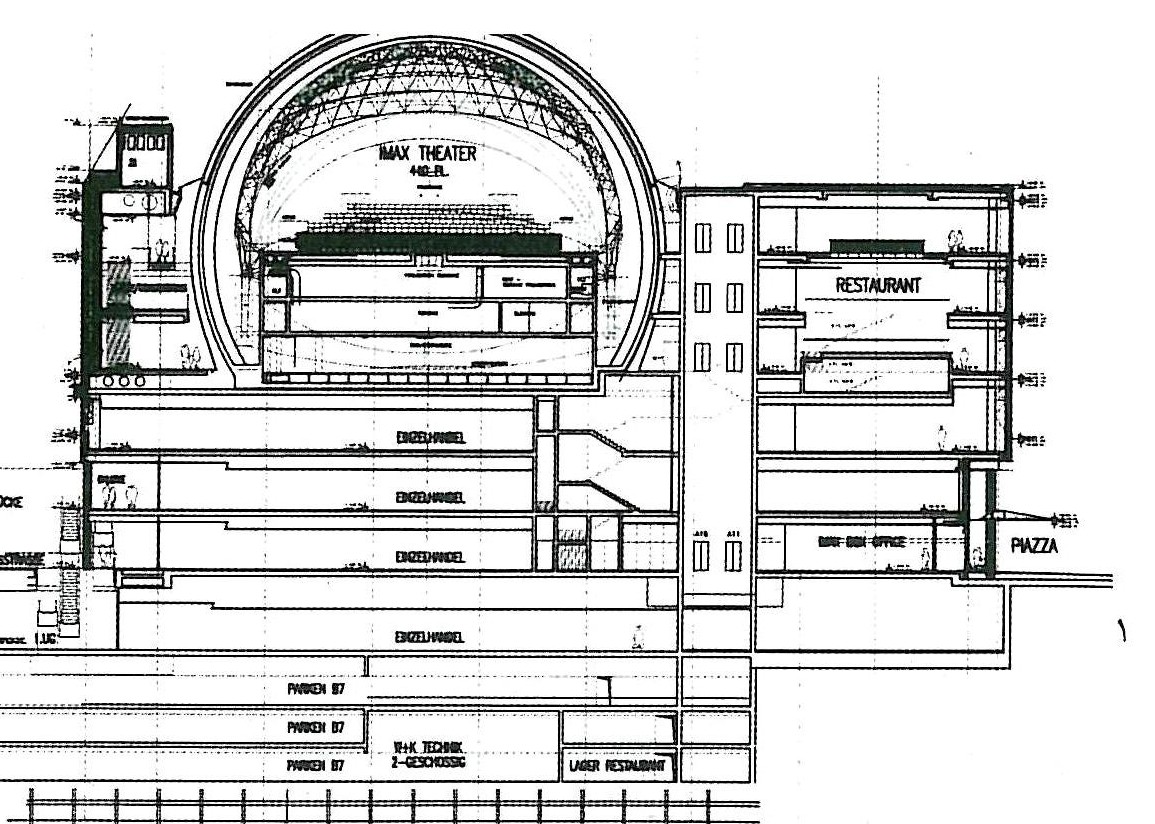
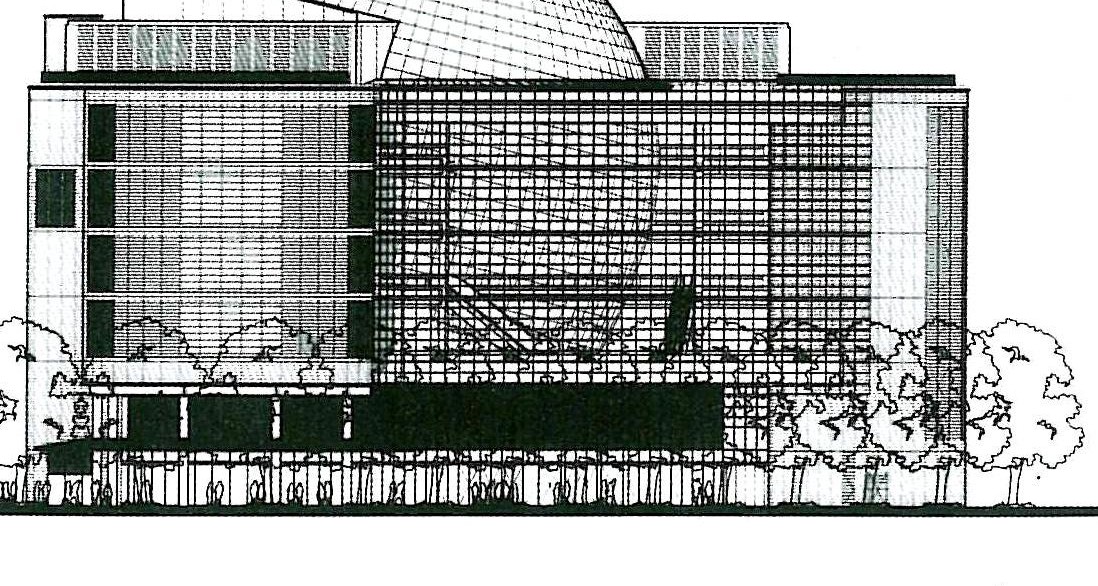
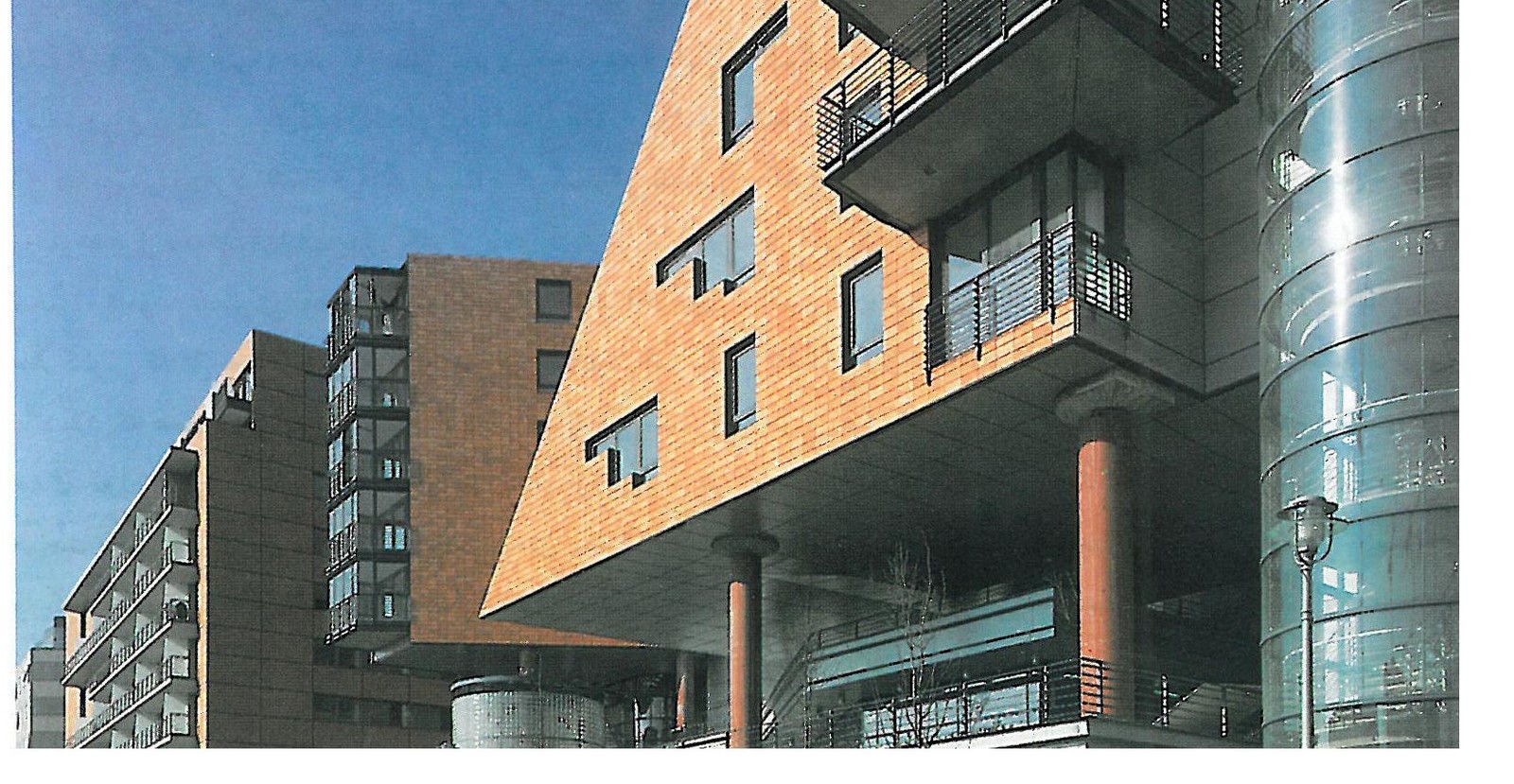
Piano-Kohlbecker have, in general, arranged the functions and uses in a cultural-entertainment-commercial-residential sequence. Hans Scharoun's library — the intellectual organ of the ensemble — occupies the most extensive and most important position of all. Piano-Kohlbecker have made this library (as a centre of cultural diffusion) the formal centre from which the ensemble expands. The choice of such a focus for the ensemble's formal growth is not arbitrary: they have in mind one place of gathering and, at the same time, of entertainment — Marlene Dietrich Platz. Potsdam has long been the centre of the German film industry, and the entrances to several theatres open onto this plaza — all of them designed by Piano-Kohlbecker themselves. They have built the city's entertainment complex, which (apart from the three-dimensional IMAX theatre) houses the other auditoriums inside. Along the western edge of the ensemble, parallel to the city library and stretched out in a manner coherent with Scharoun's architecture, they have integrated the central plaza (Marlene Dietrich) into their main entrance space and linked it through a gap behind the building to Scharoun's library. Two radial axes spring from Marlene Dietrich Platz — one to Potsdamer Platz in the north-east corner, the other symmetrically to the south-east — and divide the ensemble into three principal parts (north, east, south).
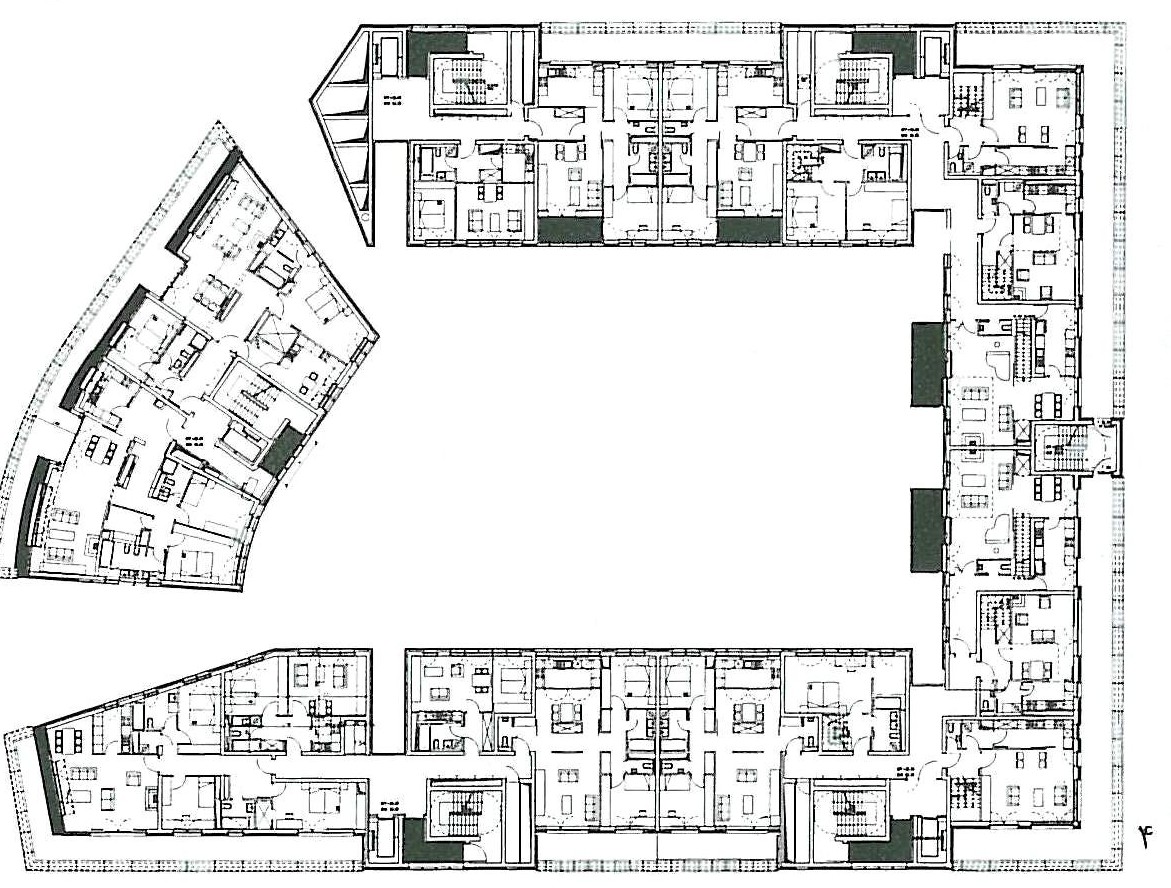
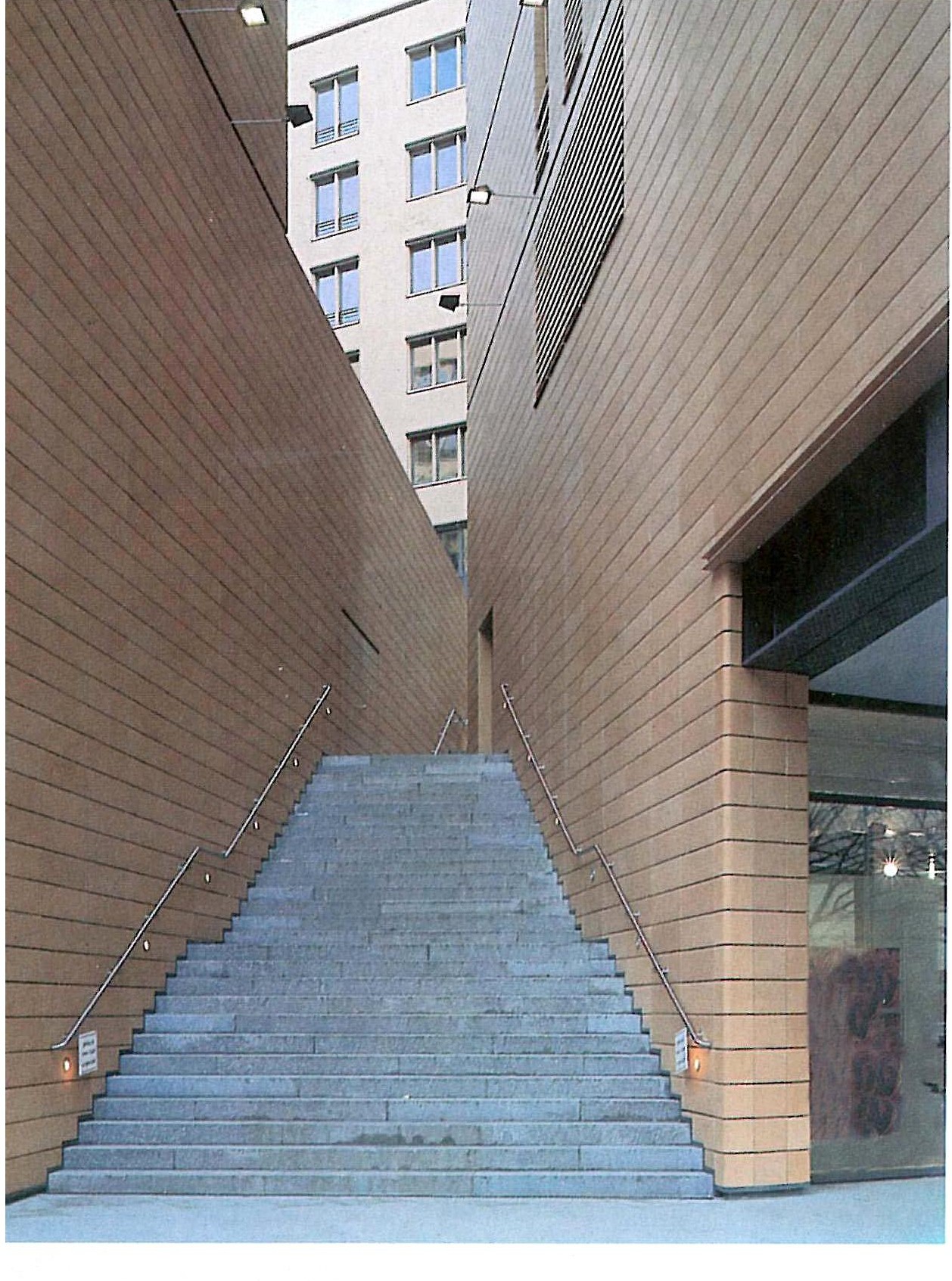
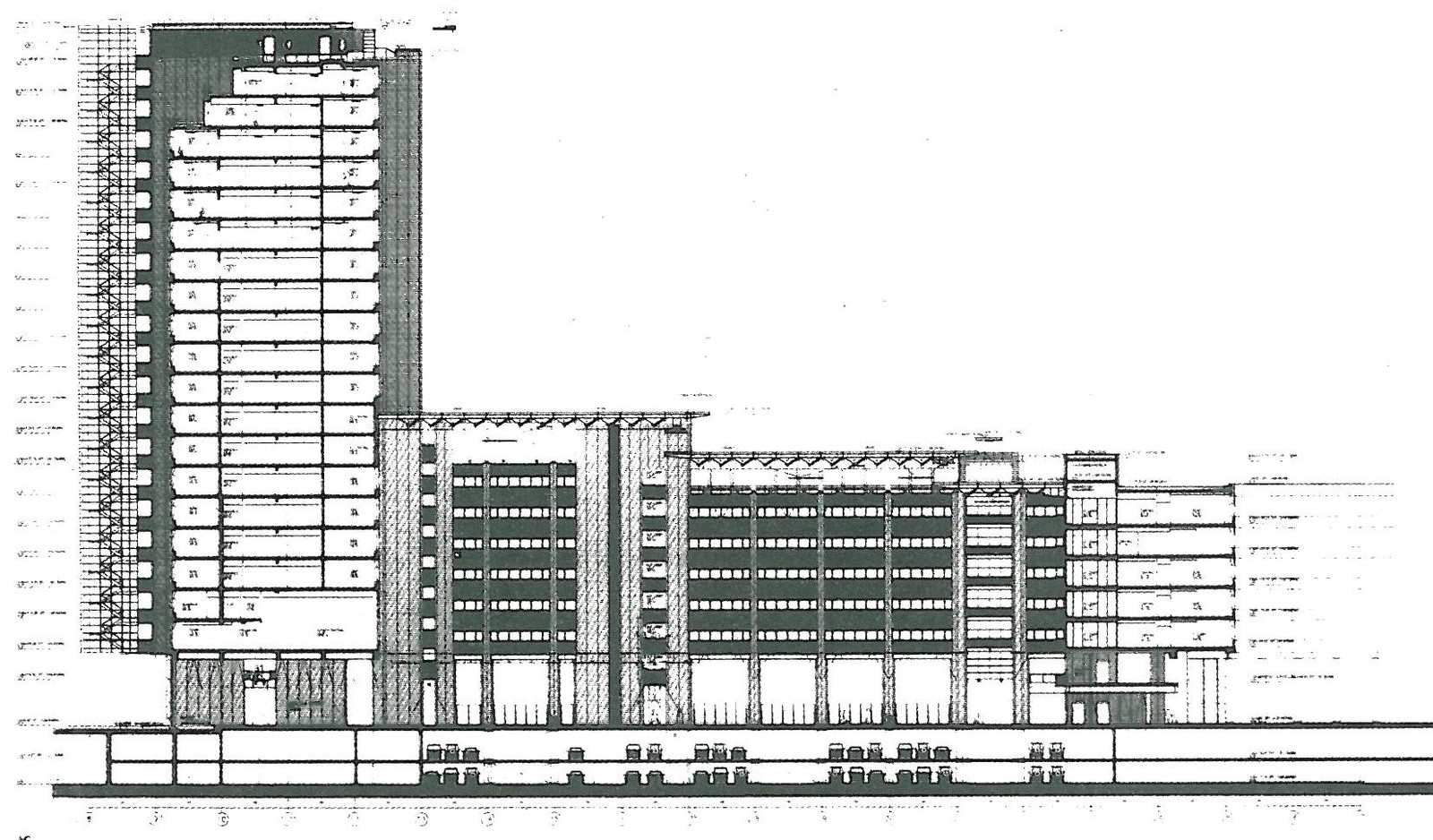
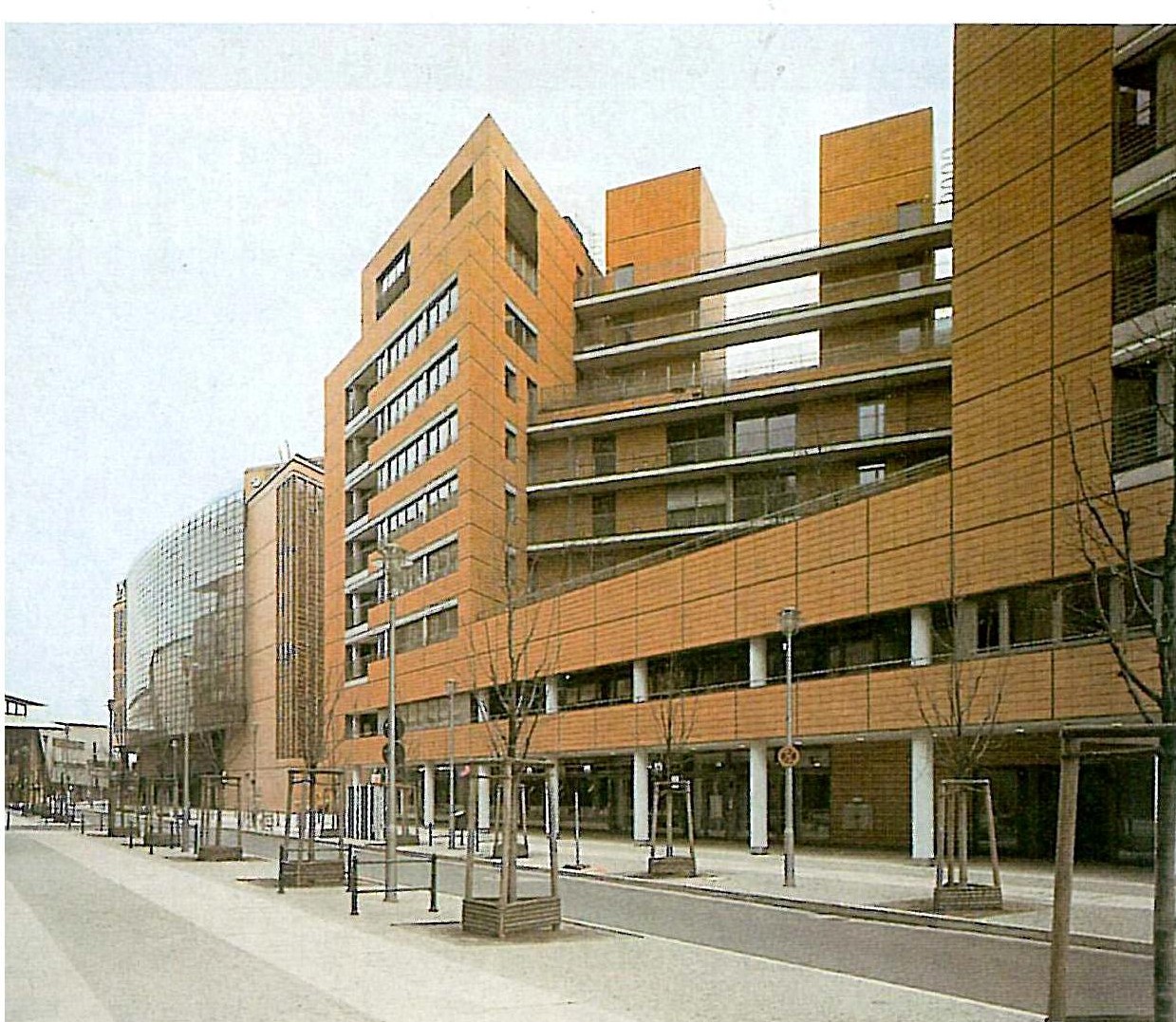
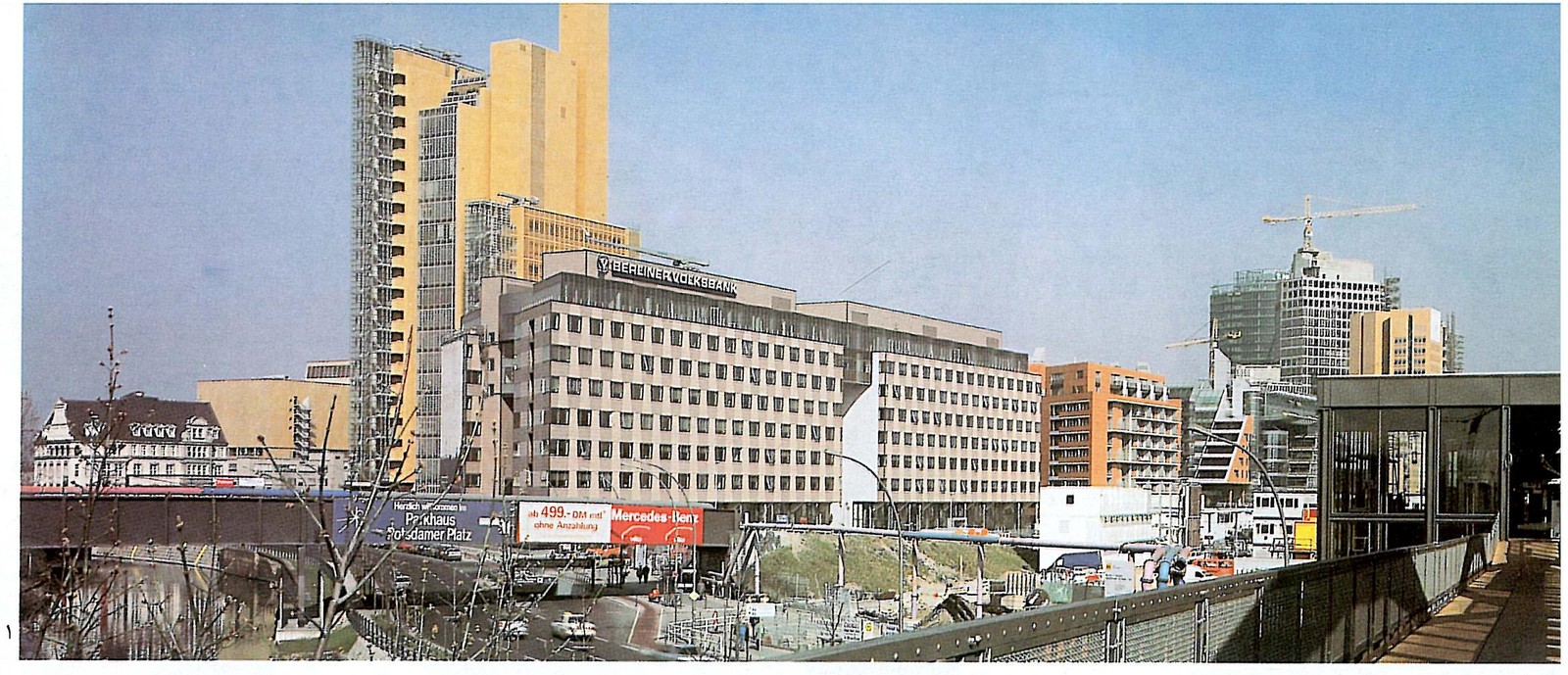
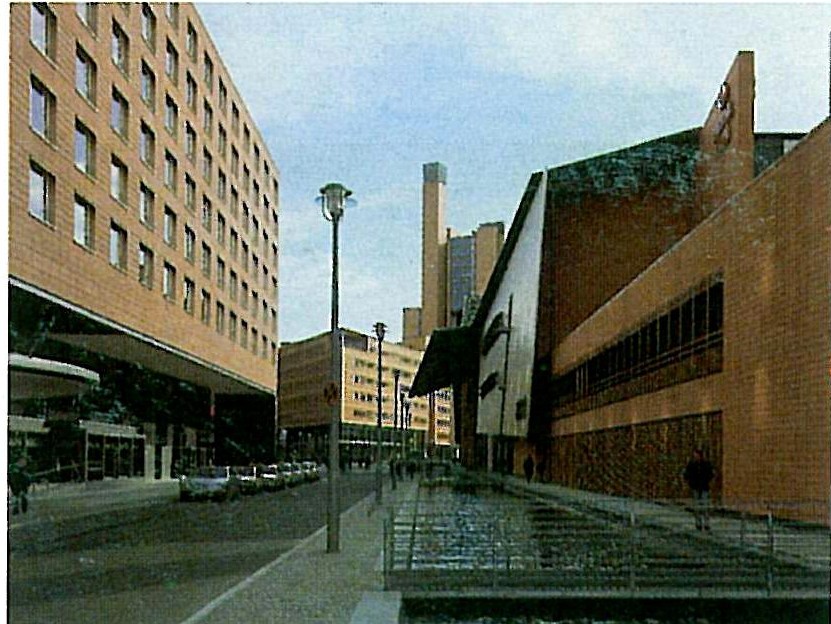
This division is simply obtained by halving the depth of the site along the main surrounding streets. Of the three parts, the north and south are offices, while the east is office-residential, with the main arcade, the Arkaden, running north-south through the middle. The distribution of density at Potsdamer Platz is calibrated to the surrounding urban context: the east half is a continuation of the city's dense fabric with somewhat greater height and density; the west half, woven into open space, river, park and religious and cultural buildings, has low density, low coverage and extensive landscaping. The building heights across the ensemble are more or less uniform, about ten storeys.
The architects
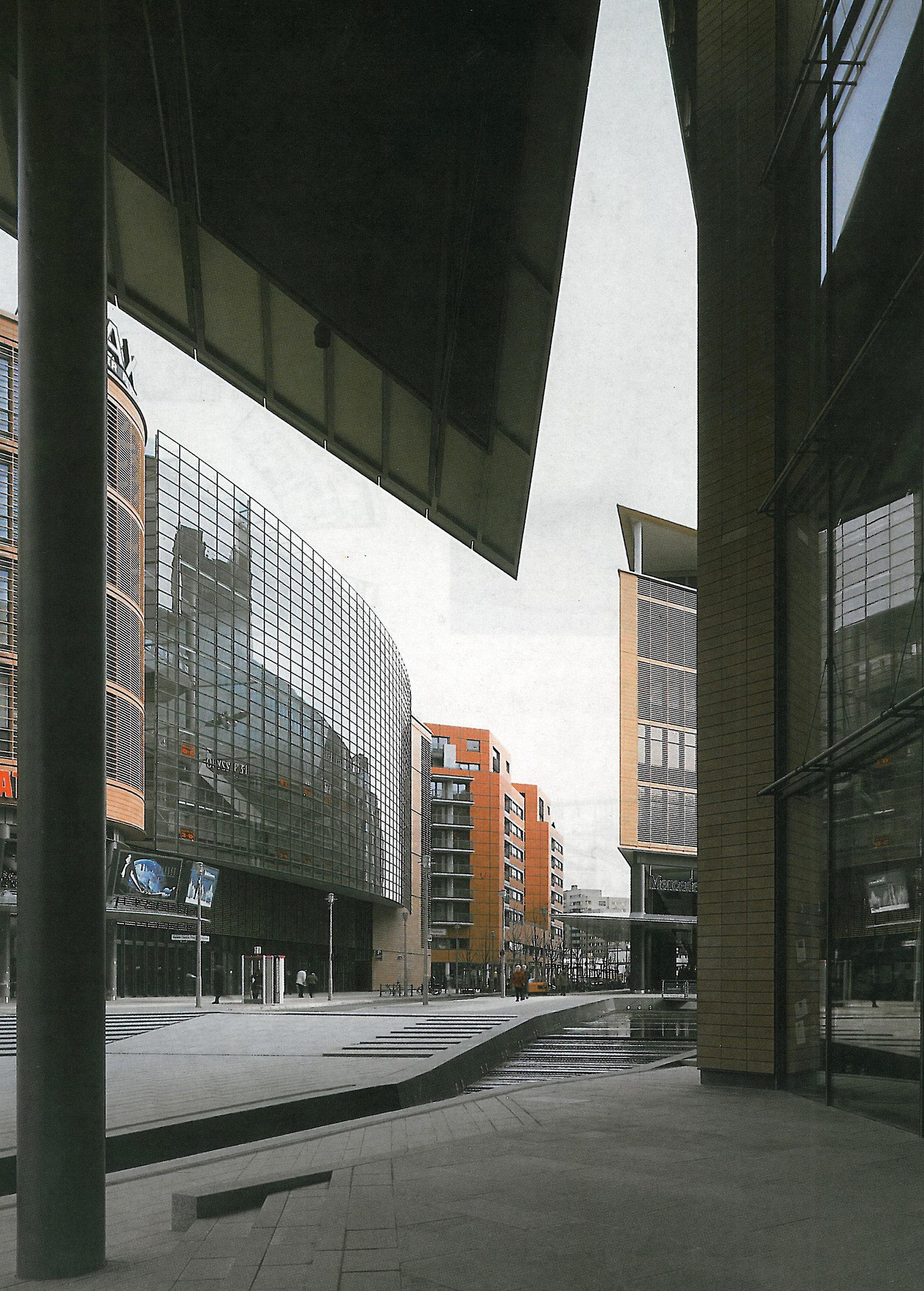
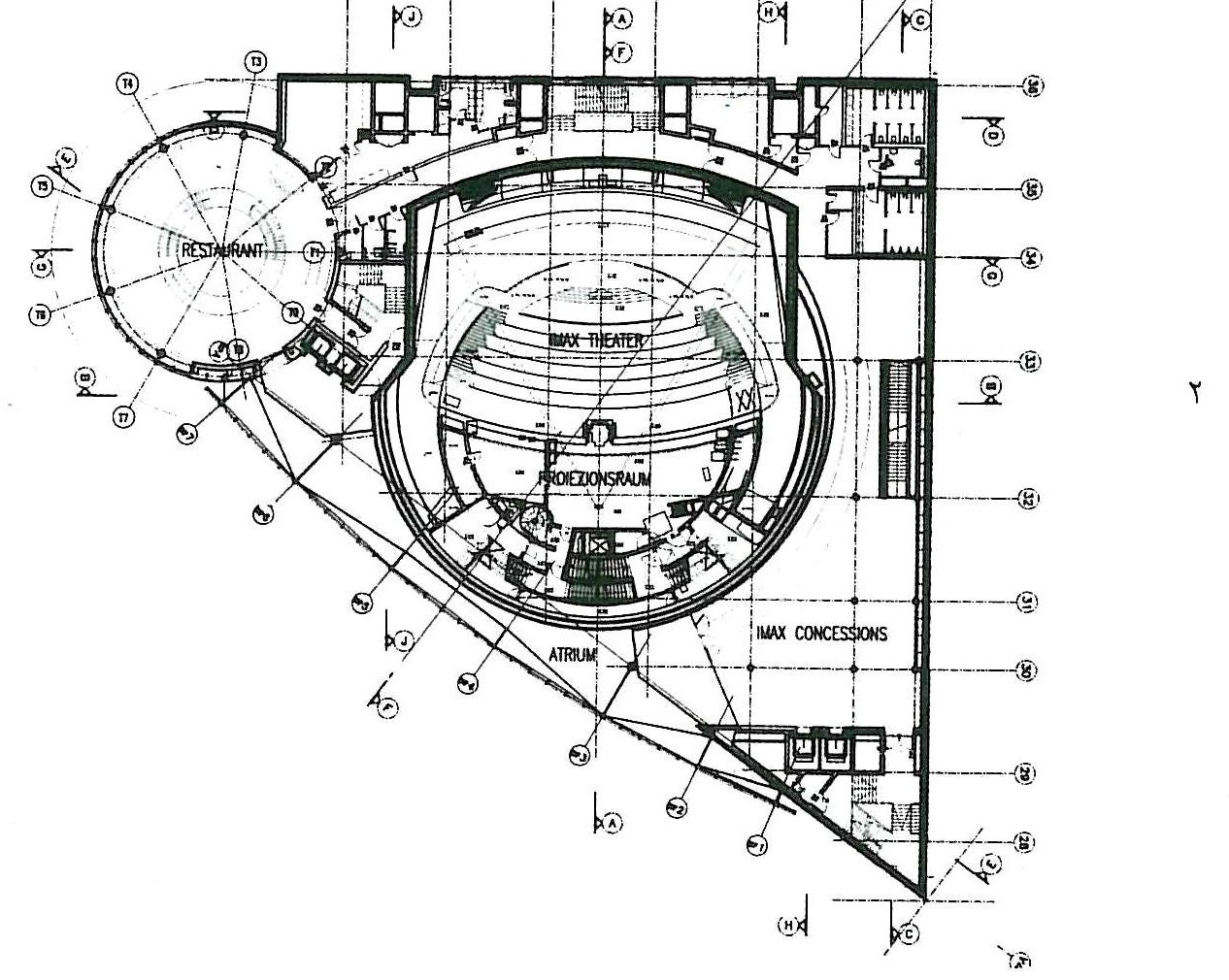
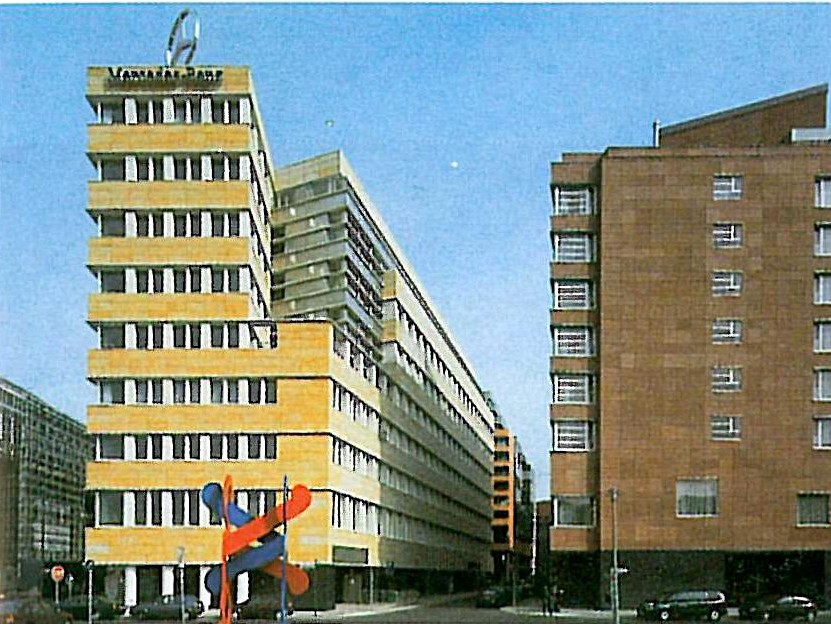
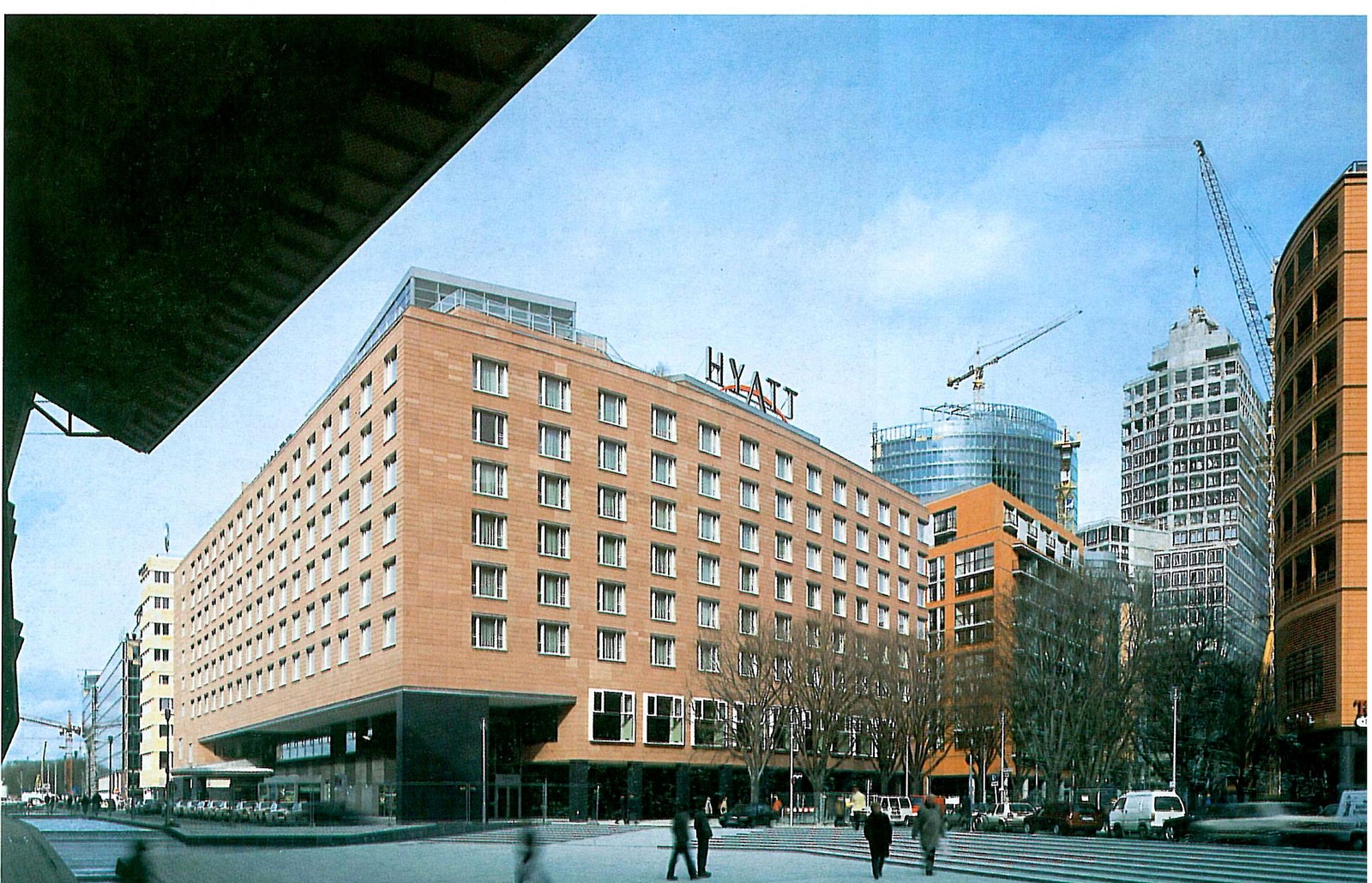
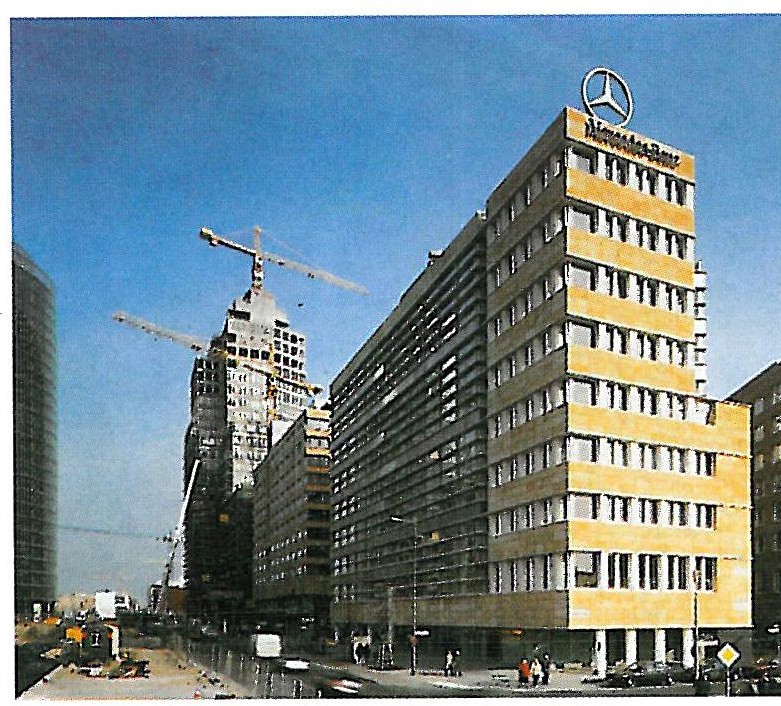
The blocks are divided among different architects: Piano / Kohlbecker (with several offices, residential buildings and the Arkaden); Hans Kollhoff; Ulrike Lauber and Wolfram Wohr; Richard Rogers (two blocks, one office and one residential); Arata Isozaki (an office building and a gateway-colonnade); Rafael Moneo (two blocks, one for Mercedes-Benz's offices and the other the Hyatt Hotel). Just north of the area stands Helmut Jahn's integrated glass Sony Centre.
Project data
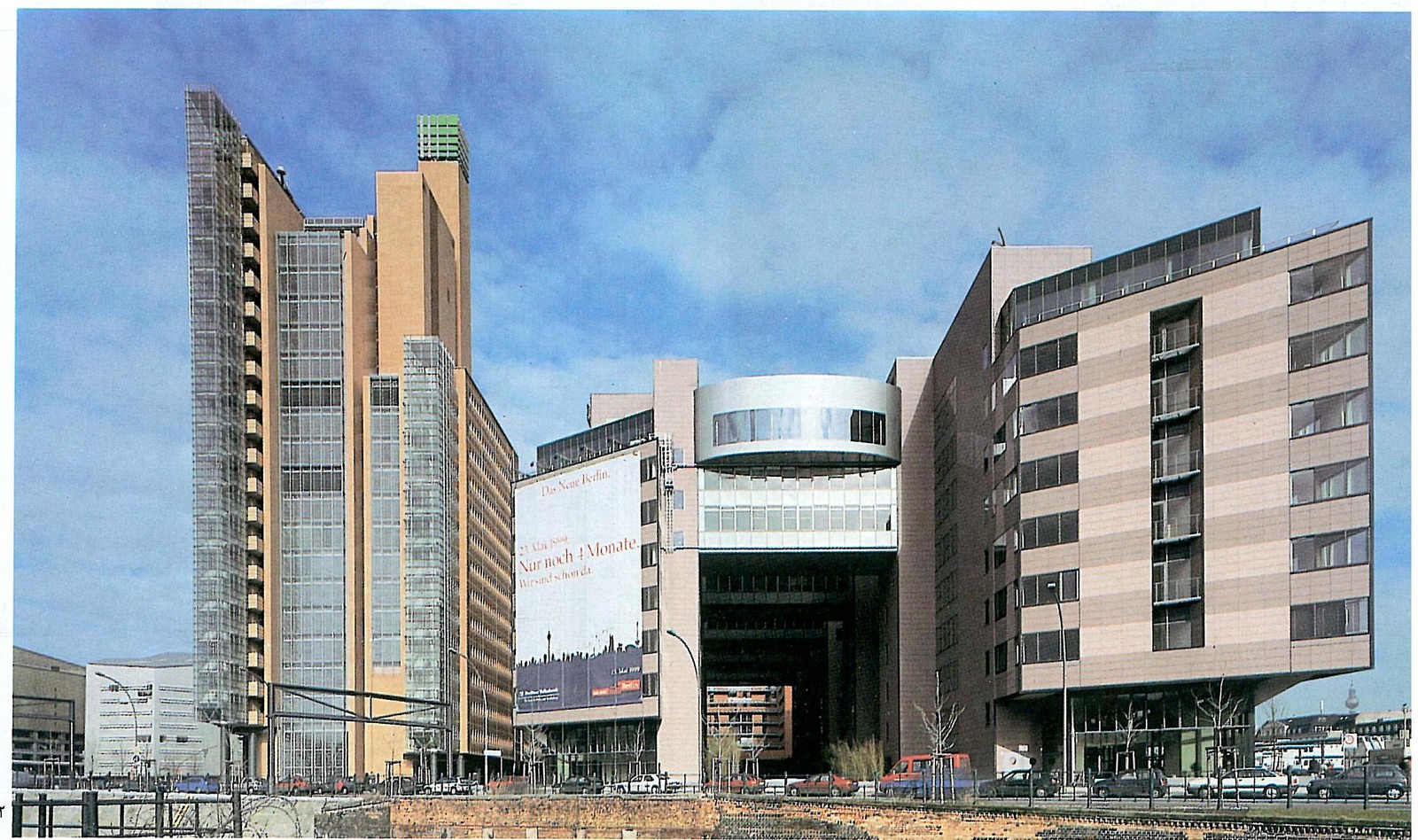
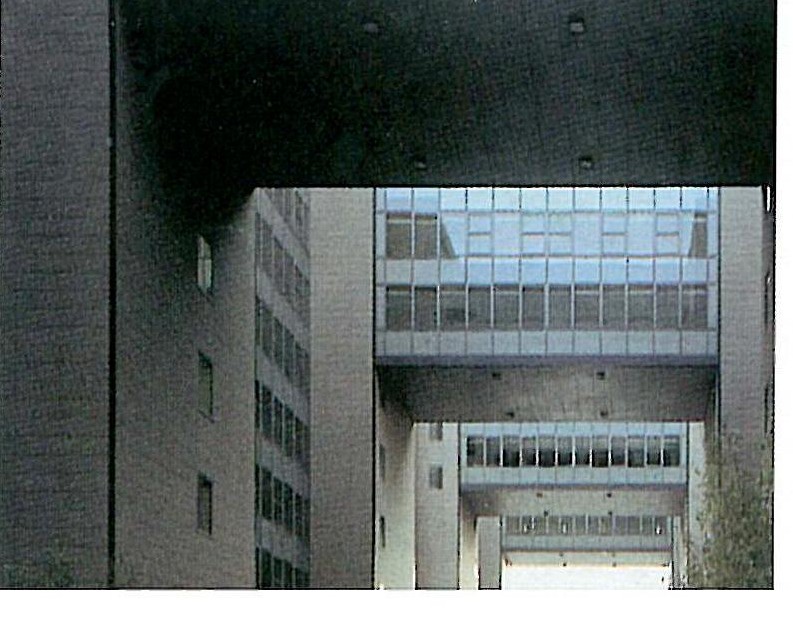
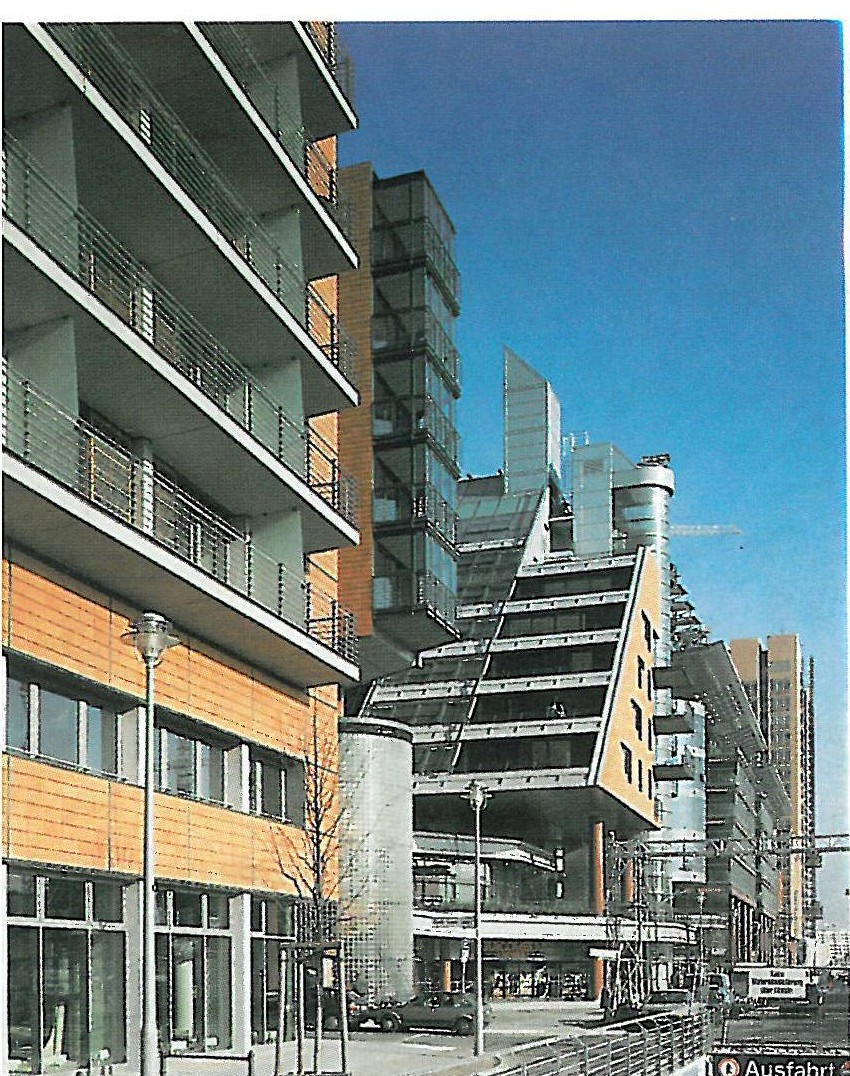
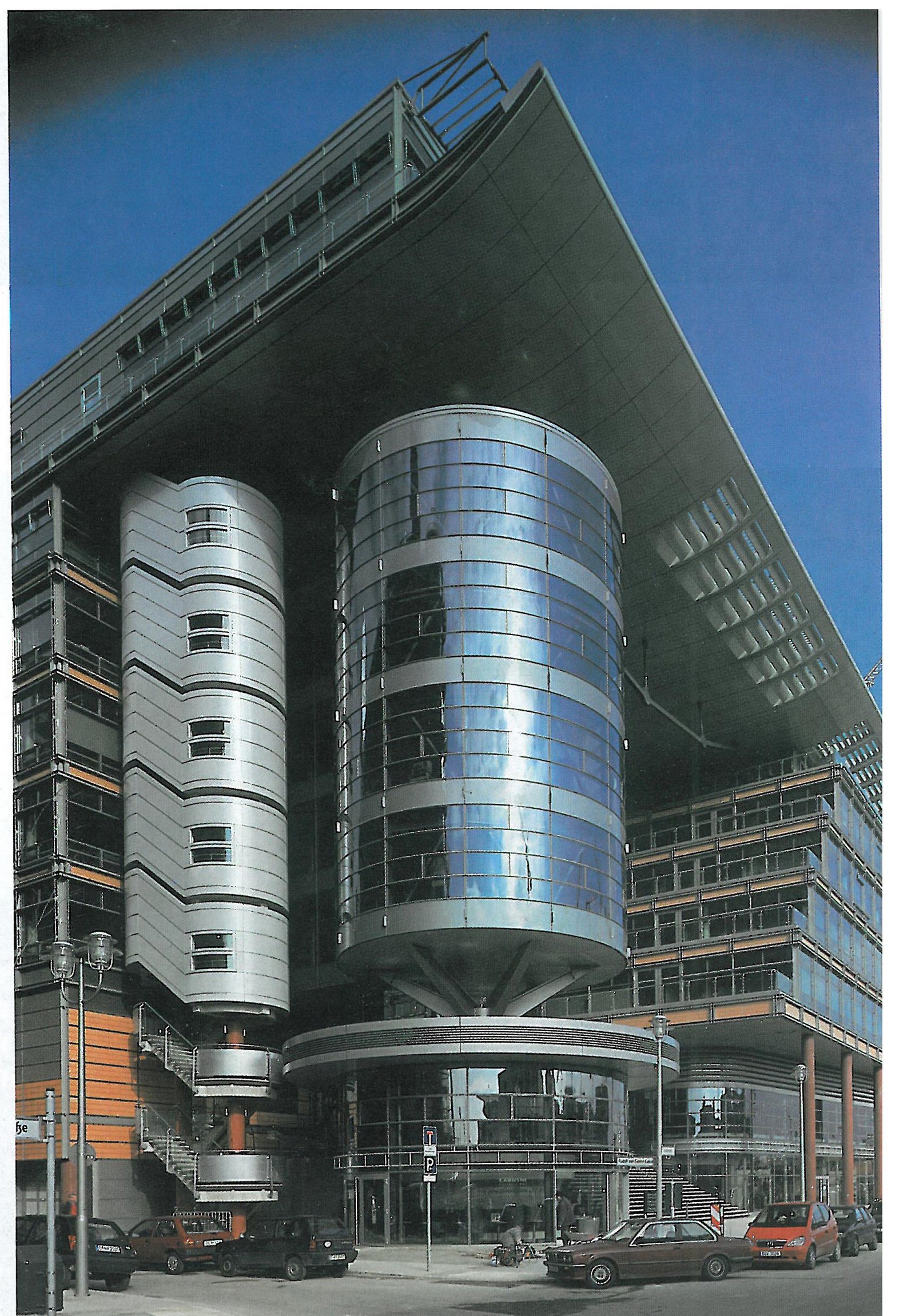
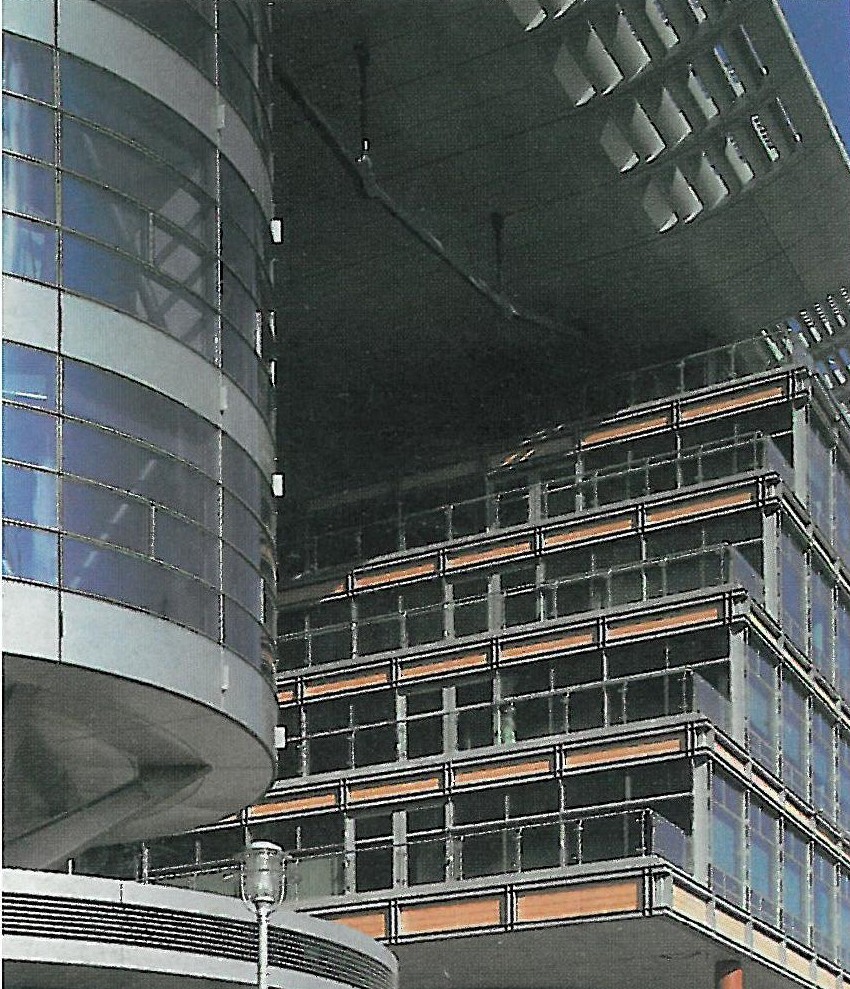
Design: Renzo Piano Building Workshop (associate in charge: Christoph Kohlbecker), with the B. Plattner design team. · Master plan (1992) and detailed design (1993-94); construction (1993-1996). · Consultants: Drees & Sommer (project management), IBB Weiske & Associates (structure), IG Hoch / Arup (technical advisor), Schmidt-Reuter & Associates (mechanical services), Müller-BBM Effect (traffic), IPB Bührer Ludwigsburg & Associates (electrical engineering), Schlegel GmbH-Spiekermann (supplies), Moehler & Krüger (landscape), Honk & Associates (excavation), IBA Schmidt & Associates; workshop in Eisaita.
Evaluation of the urban space
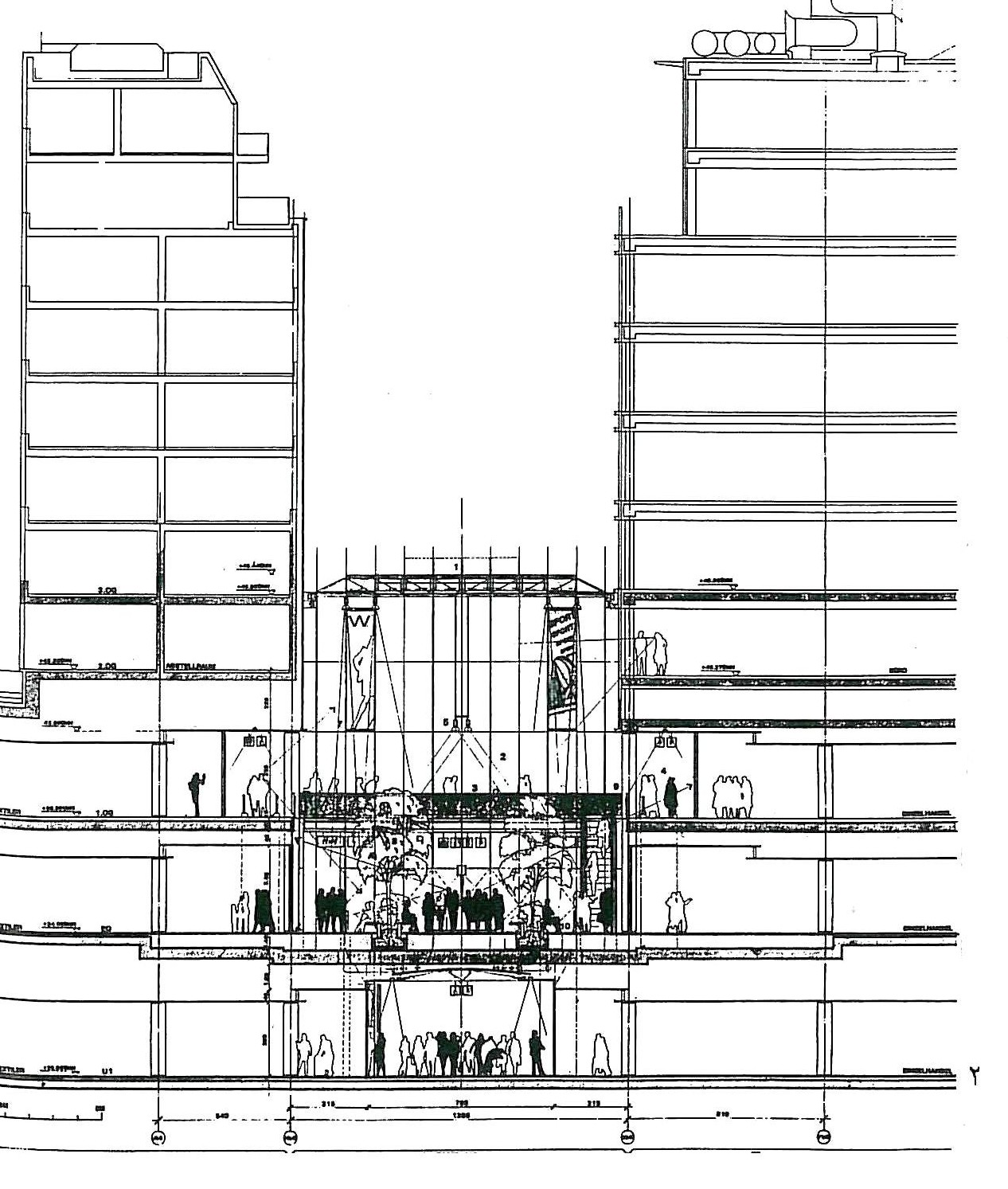
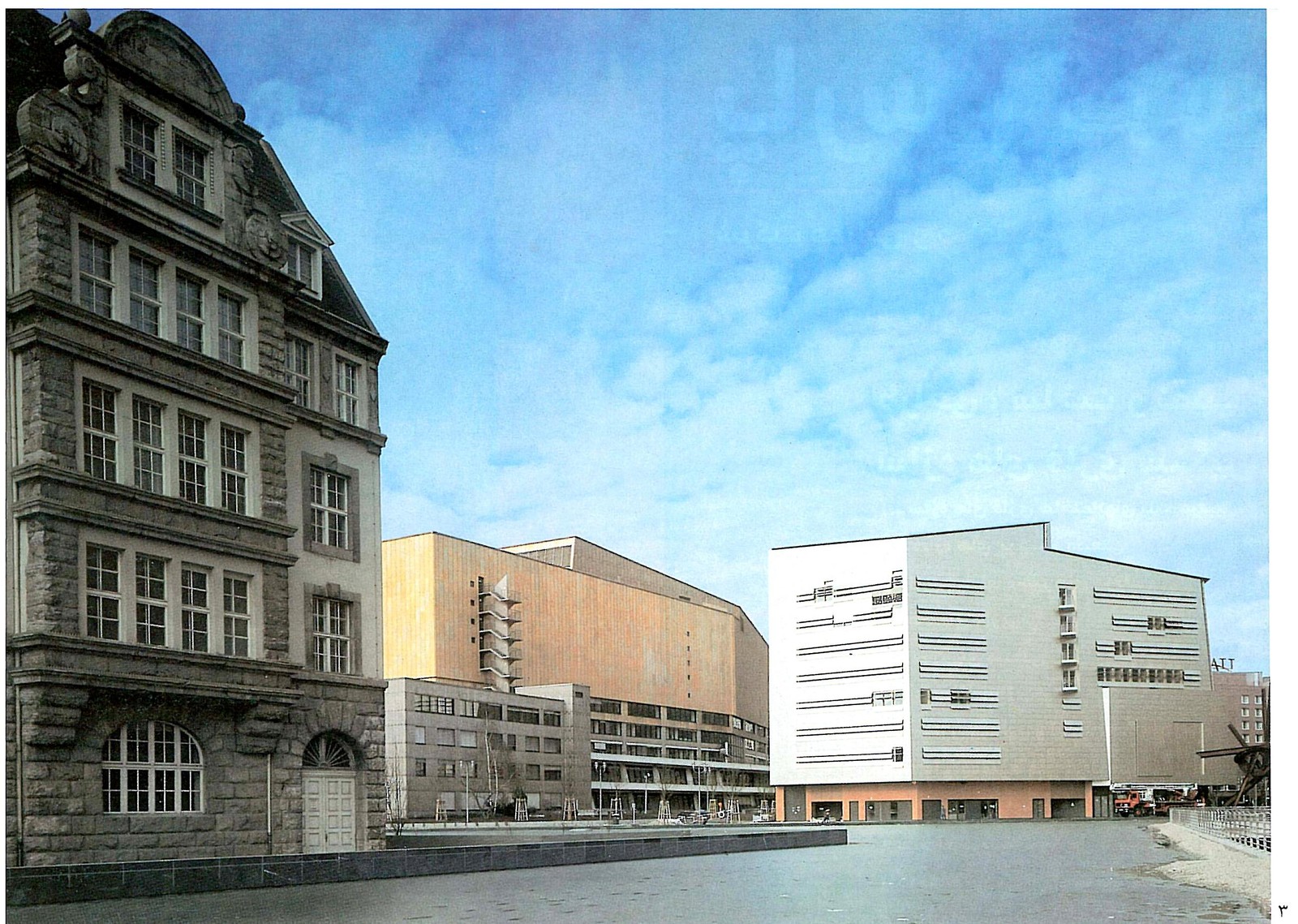
Perhaps the most successful aspect of Potsdamer Platz as urban design is its ground-plane, the paving, furnishing and landscaping that threads through all the building blocks and, while giving access to special buildings along the way, makes a cheerful, captivating public walk. The treatment of ground surfaces, plazas and grounds is not merely a fitness exercise for pedestrians or a showcase of clean execution; it is the invention of a poetic architecture in a heavily commercial and technique-laden environment — a space for nature and the delicate human relation to it to appear, against the bulk of money and plastic. Earth, water and breeze not only offer their usual visual values and imaginative resonances; these human resonances — drawn out of human imagination and feeling — are made physical in slopes and steps, in the waves the ground-plane takes under Isozaki's gateways, in the grooved incline of the running water over the paving, in the ground, in the water, and in the shapes of the public routes.