
Jury Discussion
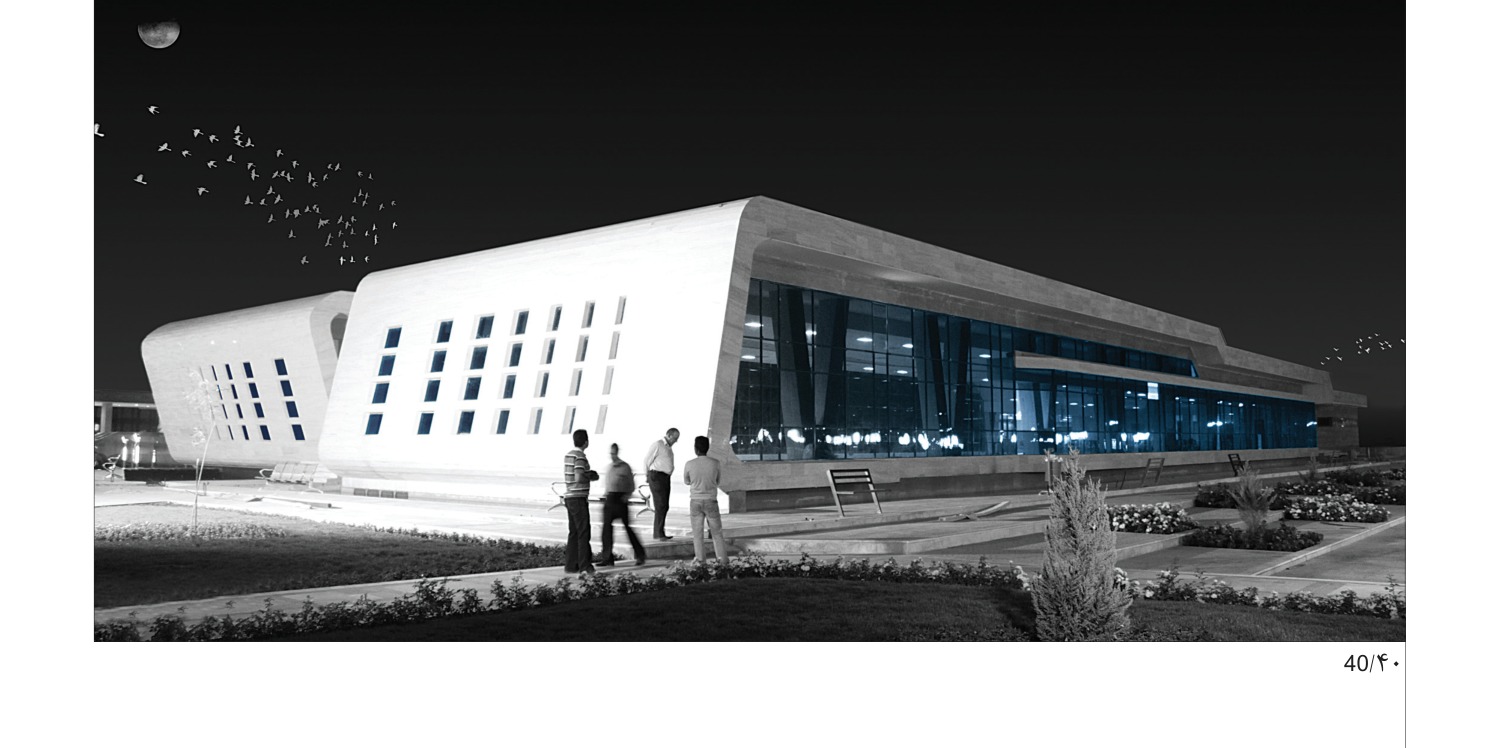
Gisue Hariri: As a project whose designers wanted it to be different and placed like a sculpture in the environment, it is good. Although the designers have not explained why they chose this particular language. Overall, it looks beautiful and clean to me. The fact that it sits on water and uses water for ventilation, and that two parallel and similar volumes are placed for women and men, is very interesting — and of course that it has been built at the University of Sistan & Balouchestan.
Hadi Tehrani: I agree. For a university restaurant and for showing modern work to students, it is a good project. Usually, such forms are made from lightweight materials like aluminum, but here, despite the use of heavy materials, the building's elegance has been preserved.
Mojgan Hariri: I think the simplicity of its materials — glass and stone — is also good.
Nader Tehrani: I agree with most of what has been said, especially the two parallel volumes which are the strongest part of the project, but I have two issues: First, if water is supposed to play a cooling role in this project, the air needs to be able to pass over the water and through the dining space, but it does not seem that the glass facade can open. It appears that for the water-based ventilation to be practical, the form would need to change to some extent. In my view, water has not been integrated into the project; it has more of a symbolic role. Second, the project also has an issue with architectural language — floor, wall, and ceiling are defined in one language. If this was for minimizing and simplifying the architectural language, given the excesses we have seen so far, it is a suitable strategy. But if the specific use of this particular language — meaning Folding — was intended, it is regrettable that good materials and details have not been used.
Nasrin Seraji: I agree with some of these statements, for example the building volume and how it is placed in the environment, but the relationship between volume and environment has not been defined. The building form and columns are well defined, but when the designer accepts the engagement with such a form, they cannot reduce it to just a structure. For me, the problem is that the form (structure) is by no means new, but the building claims to be modern.
Nasrin Seraji: Water is an interesting idea for cooling the building, but not only must one pay attention to how air passes through the building, but this system must also be comprehensible and experienceable for the user. Of course, I agree with Hadi Tehrani that for students, seeing a new and modern volume is very good, and the equality between men's and women's spaces is commendable.
Nader Tehrani: If we want to talk about "imitation" through this very project, it is a very good example. The question of how much Iranian designers and architects follow global architectural discourse and, more importantly, how much they influence it and elevate it to a higher level, is very important. If this design is a reflection of the discourse among Foreign Office, Neil Denari, and OMA, the question is to what extent it has advanced their discussion and might influence it.
Nasrin Seraji: I also think it is important that such projects are built in Iran, but they must go beyond this. Because in our culture, architecture holds a special place. I do not mean that the project should have been built with brick, but perhaps it should have been more distinctive. Nevertheless, it is a good project.
Gisue Hariri: I am not sure I agree with you about the problem with its language. The issue of physical program in this project is very important, and the fact that the project as a single project has been divided into two completely equal parts is much more important than the question of its language. For me, the importance of the project is not in its form, but in its success in responding to the physical program needs in a specific way.
Nader Tehrani: But we should not assume that Iranian designers are not at a level where we can expect them to elevate themselves to the level of international designers and have their work evaluated and critiqued at that level.
Mojgan Hariri: My only criticism of the project is that one would have expected the entire volume to open up, but this possibility has not been provided for in the design.
