If we do not consider architecture a "special subject" that is the preoccupation of "special people," and its mission solely "innovation" (at any cost and in any manner), and if — in addition to the grand, important, and unique buildings that are built from time to time — we also consider all the small and large, important and unimportant buildings that are constructed and that form the reality of our cities and neighborhoods, alleys and streets, and the main stage of our lives, to fall within the domain of architectural concern, then we can say that the chaos that today afflicts the face of our cities and living environment is an important architectural problem.
This chaos results from a combination of multiple factors: the speed of transformation, our superficial and hasty approach to the achievements of the advanced West, and the effective and influential presence of social strata who, in the course of this rapid change and transformation, have suddenly come into wealth and have imposed a caricature of aristocracy, luxury, and superficial ostentation upon the architecture of cities through an unhealthy competition.
Yet despite the dominance and influence of this destructive assault, we believe a healthy current still exists in the field of architecture — one that has stood firm against this onslaught. Memar Magazine intends, in solidarity with this healthy current and in support of this architecture — which is the product of cultivated taste, serious thought, and skill born of sustained practice — to introduce to the public, against the backdrop of vapid, irresponsible, and trend-following architecture, the works of architects who through years of labor and effort have achieved technical and artistic maturity and built buildings that are serious, sound, and beautiful.
In this issue, we shall introduce the works of Farokh Ghahremanpour. Born in 1320 SH (1941) in Tehran, he graduated in architecture from the Faculty of Fine Arts at the University of Tehran in 1346 SH (1967). Over his thirty-year professional career in architecture, Ghahremanpour has designed and built numerous houses and residential apartments as well as several public buildings, either as an independent architect or as a member and associate of Parsaz Consulting Engineers.
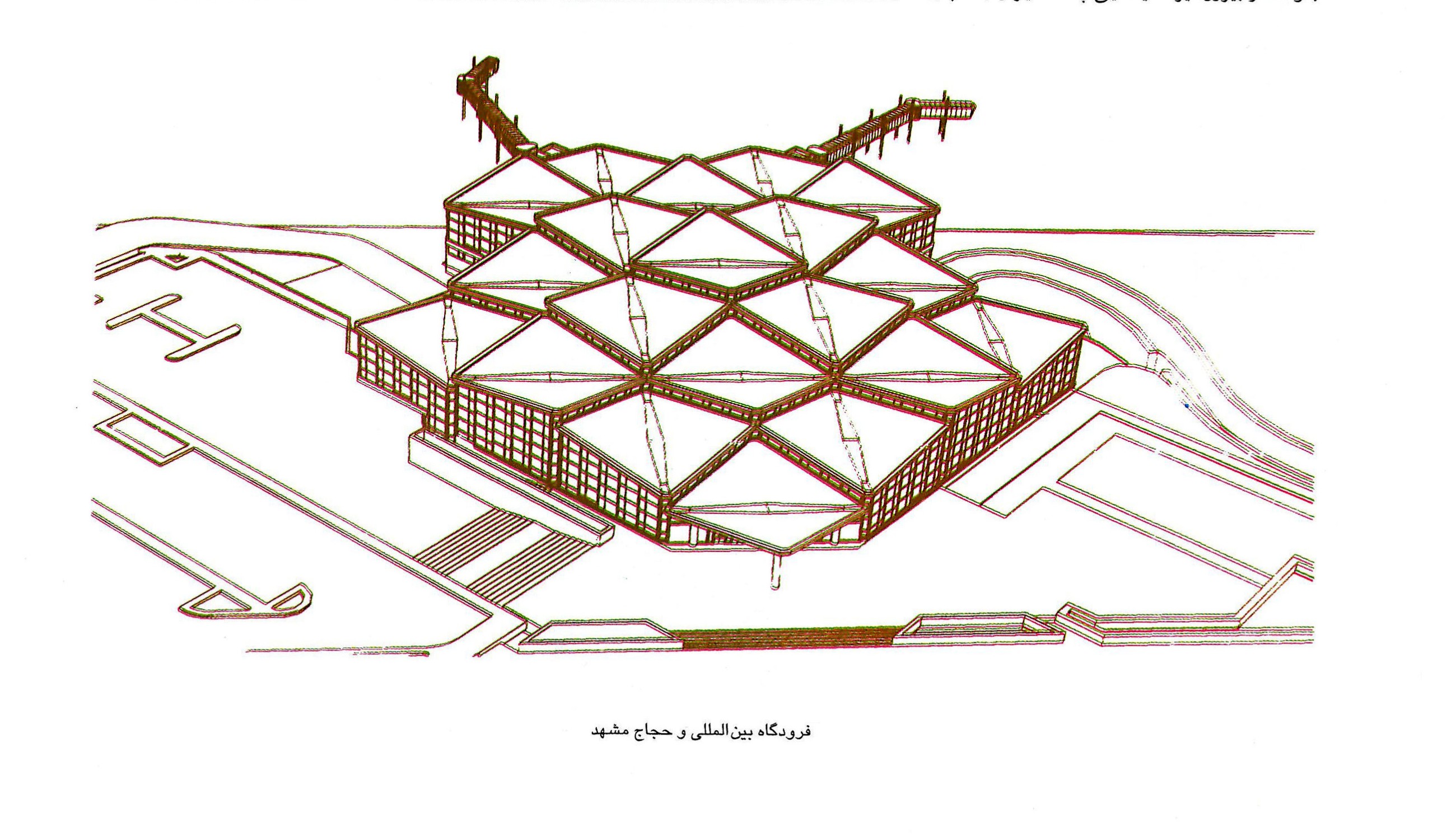
Here we present one example of Ghahremanpour's completed works — a private-sector office building — and two public buildings under construction within the framework of Parsaz Consulting Engineers.
Creating a pleasant and delightful environment through a measured and harmonious composition of volumes, while maintaining simplicity and avoiding clutter, disorder, and the use of incongruous elements; providing natural light for all spaces of the building; maintaining a geometric order upon which the building's structure rests while allowing freedom and variety in volumes; economy in the use and precision in the selection of materials with serious attention to construction details; and responsiveness to functional needs — these constitute the fundamental pillars of Ghahremanpour's architecture.
He believes that since an architectural work is enduring (even in cases where a building's lifespan is short, it lasts at least 20 to 30 years), it must remain appealing and acceptable throughout its life, and for this reason he considers blind and hasty imitation of passing fashions to be wrong. He strongly criticizes the practice that has become common in recent years, whereby some prepare "plans" for a building while others "paste" a "facade" onto it, and says that architecture is not facade-making. Interior space and exterior facade must be the product of a thoughtfully composed and coherent combination of volumes that are integrated to respond to the building's needs.
A glance at Ghahremanpour's recent works reveals his increasing tendency to use soft and curved surfaces and volumes, as opposed to the orthogonal surfaces and volumes that in his earlier works were combined at 45-degree angles — a tendency that perhaps speaks of a flexibility and suppleness born of the passage of time.
Magazine figure: Perspective drawing of the Iranian Association of Consulting Engineers Headquarters — second-place competition entry.